


SHADOW OF THE FUTURE?
This article presents a design concept that could revolutionize the configurations used for competition in many free-flight events, both indoors and out. The basic idea is not new, but it has been developed with two modifications that make it a reliable and improved alternative to previous folding-wing designs. In a category of modeling where the search has often focused on the perfect airfoil or the right combination of moments, this article suggests a complete change in the underlying approach used to design free-flight models for many events.
Contained here are the concept's main points and details of its first successful application to a competition free-flight design. By giving an overview of the concept and its potential benefits, the author hopes others will investigate the many duration applications of this idea and produce varied solutions to the individual problems, thereby accelerating evolution of these designs.
The Design Concept
In most outdoor free-flight events — those powered by internal-combustion engines or twisted rubber motors — and in indoor and outdoor hand-launch glider events, the optimum climb and glide configurations are completely different. With the power available from today's engines, rubber motors, and human launch power, the best climb configuration is one that holds the model back the least, allowing it to climb nearly vertically. In other words: low drag and operation near the zero-lift trim point. In glide, however, the ideal configuration achieves a low sink rate, which calls for low wing loading and operation at high angles of attack. Highly cambered airfoils that perform well at high angles of attack do poorly during climb because of their high drag at low angles of attack.
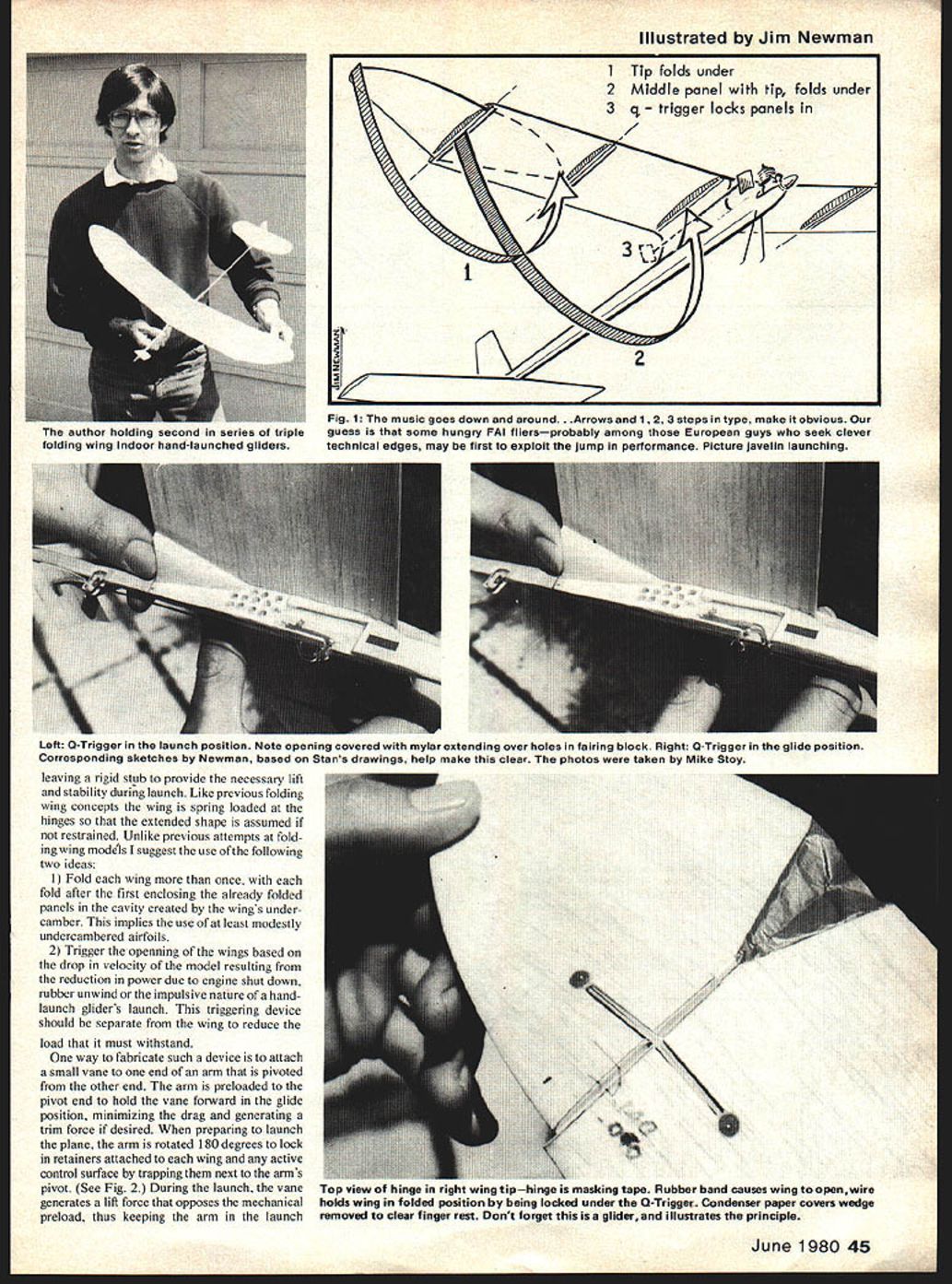
The proposed solution is to reduce compromise between flight phases by using variable geometry: fold the wings along chordwise hinge lines so that, starting at the tip panel, each successive panel folds under and in. This permits the bottom surfaces of adjoining panels to mate, resulting in a low-drag launch configuration. The innermost panel of each wing does not fold, leaving a rigid stub to provide necessary lift and stability during launch.
Like previous folding-wing concepts, spring-loaded hinges are used so the wing assumes its extended shape when released. Unlike previous attempts, the author suggests two specific ideas:
- Fold the wing so that, once folded, the already-folded panels enclose a cavity; the wings' undercamber implies the use of at least modestly undercambered airfoils.
- Trigger the opening of the wings based on the model's drop velocity resulting from power reduction (engine shut-down or rubber unwind). The impulsive nature of hand launches requires that the triggering device separate from the wing and reduce the loads it must withstand.
The q-trigger
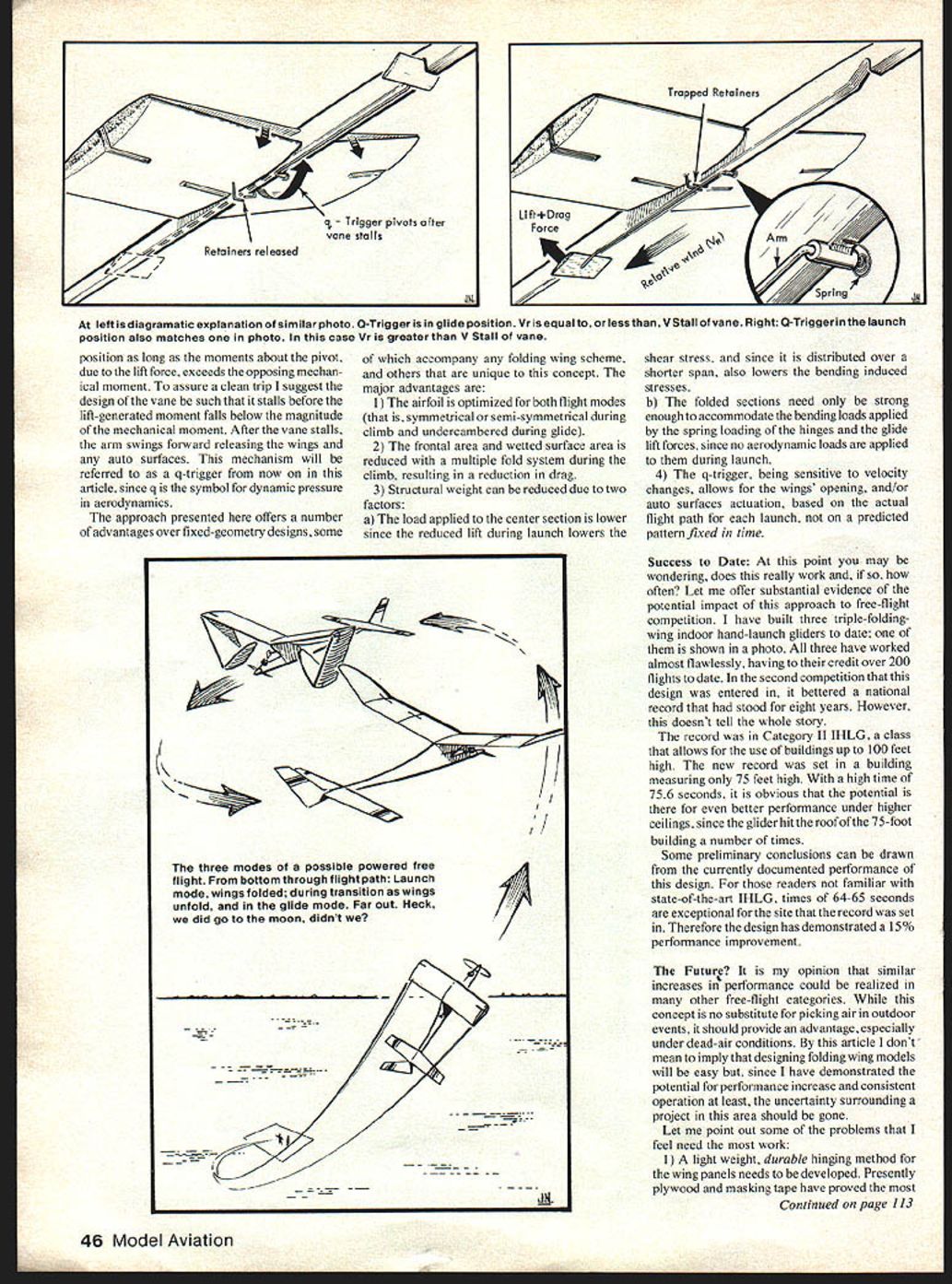
One practical trigger device is a small vane mounted at the end of an arm pivoted at the other end. The arm is preloaded at the pivot to hold the vane in the forward, glide position, minimizing drag while generating the desired trim force. Preparing for launch, the vane arm is rotated 180 degrees and locked with retainers attached to the wing, trapping the arm's pivot. During launch, the vane generates a lift force that opposes the mechanical preload, keeping the arm in the launch position as long as the aerodynamic moment exceeds the opposing mechanical moment.
To assure a clean release, the vane should be designed to stall before the lift-generated moment falls below the mechanical moment. After the vane stalls and lift drops, the arm swings and releases the wings and any automatic surfaces. This mechanism is referred to here as a q-trigger (q = dynamic pressure).
Advantages
The approach offers a number of advantages over fixed-geometry designs — some common to folding-wing schemes and others unique to this concept:
- The airfoil can be optimized for both flight modes: symmetrical or semi-symmetrical during climb and undercambered during glide.
- Frontal area and wetted surface area are reduced during climb by the multiple-fold system, lowering drag.
- Structural weight can be reduced due to two factors:
- a) The load applied to the center section is lower because reduced lift during launch lowers shear stress; the shorter effective span also lowers bending-induced stresses.
- b) The folded sections need only be strong enough to carry hinge spring loads and glide lift forces, since they see no aerodynamic load during launch.
- The q-trigger, being sensitive to velocity changes, allows the wings to open (and autosurfaces to actuate) based on the actual flight path of each launch rather than on a fixed-time pattern.
Success to Date
To date the author has built three triple-folding-wing indoor hand-launch gliders (IHLG). All three have worked almost flawlessly, completing over 200 flights. In the second competition in which this design was entered, it bettered a national record that had stood for eight years.
The record was in Category II IHLG (buildings up to 100 feet high). The new record was set in a building measuring only 75 feet high, with a high time of 75.6 seconds. The glider struck the roof of the 75-foot building several times, so better performance is likely possible under higher ceilings. For context, times of 64–65 seconds are exceptional at the same site; thus this design has demonstrated about a 15% performance improvement.
The Future?
The author believes similar performance increases could be realized in many other free-flight categories. While this concept doesn't replace skill in picking lift for outdoor events, it should provide an advantage, especially in dead-air conditions. Designing folding-wing models will not be easy, but demonstration of consistent operation and performance improvement reduces much of the uncertainty for those wishing to experiment.
Problems that need the most work include:
- Developing a lightweight, durable hinging method for the wing panels. Currently plywood and masking tape have proved most successful on the author's models.
- Finding a more streamlined means of applying the opening torque to the hinges. Rubber bands are used at present.
- Designing a more streamlined q-trigger.
For this approach to become popular it is essential that people begin to win with these designs, since many competitive free fliers follow the trends of winning models rather than experiment. If experienced designers become convinced this approach is worthy of effort, free flight could become an exciting, changing category in the next few years.
If you want to become involved in building folding wing planes, the author would be most interested in discussing ideas and problems.
An editor's note: thinkers have suggested additional mechanisms — for example, a “ceiling timer” and force-multiplying levers to latch the wings — that may be necessary to turn this concept into a practical reality. Stan's work has taken the idea well beyond paper; clever free fliers can turn it into a physical reality. Why not begin with some simple half-A sheet balsa experiments? There may be a pot of gold at the end of this rainbow.
Transcribed from original scans by AI. Minor OCR errors may remain.

