

The SHARK Attacks a Record
THERE ARE six FAI world records for radio-controlled models which emphasize fuel economy. In the spring of 1977 five of these records resided in the USA. Giertz of Texas held landplane duration (14:29:51), having taken the record from Japan. I held landplane straight-line distance (266 mi.) taken from Italy, and closed-course distance (424 mi.) taken from the USSR. Bowles of California held seaplane straight-line distance (135 mi.), previously also held by the USA. Petersen of West Virginia held seaplane closed-course distance (153 mi.), taken from Germany. The remaining economy record was seaplane duration (6:18:17), held by Kaiser of Germany.
In September 1976 my two attempts to extend the landplane duration record had failed. The first ended after seven hours when the fuel-pressure regulator gave out with two thirds of the fuel still remaining in the tanks. A second attempt seriously damaged the underpowered model when it stalled on the first slow turn after takeoff. It is hard to say which day was more distressing. I decided to work on other records until reliability was improved.
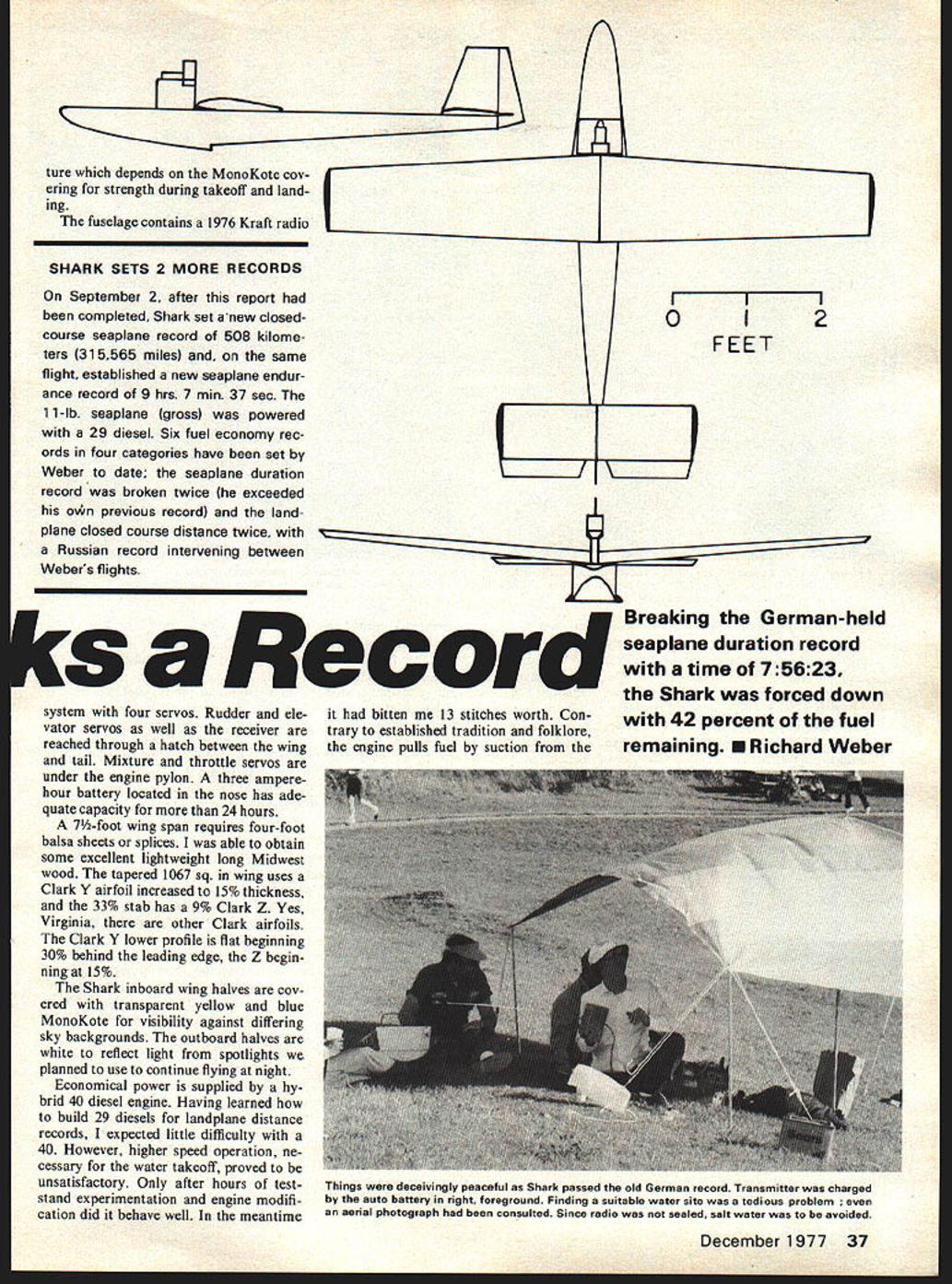
The Shark was designed for the FAI seaplane economy records. Since I had never seen a seaplane fly, the hull design was derived from previous record-holding models by Brice Petersen and Dale Reed. The bottom has no V, but is flat except for the step. This shape may produce a rougher ride than a V hull, but it needs remarkably little power for takeoff. Plywood sheeting is used on the bottom front of the hull, with balsa sheeting behind the step. An unusual feature is that the fuselage (hull) sides and top are made with an open built-up structure.
SHARK SETS 2 MORE RECORDS
September 2, after this report was completed, Shark set a new closed-course seaplane record, 508 kilometers (315.565 miles). The same flight established a new seaplane endurance record, 9 hrs 7 min 37 sec, in an 11-lb seaplane gross powered by a .29 diesel.
The record Shark was forced down at time 7:56:23. The model uses four servos. Rudder and elevator servos and the receiver are reached through a hatch between the wing and tail. Mixture and throttle servos are under the engine pylon. A three ampere-hour battery located in the nose has adequate capacity for long flights.
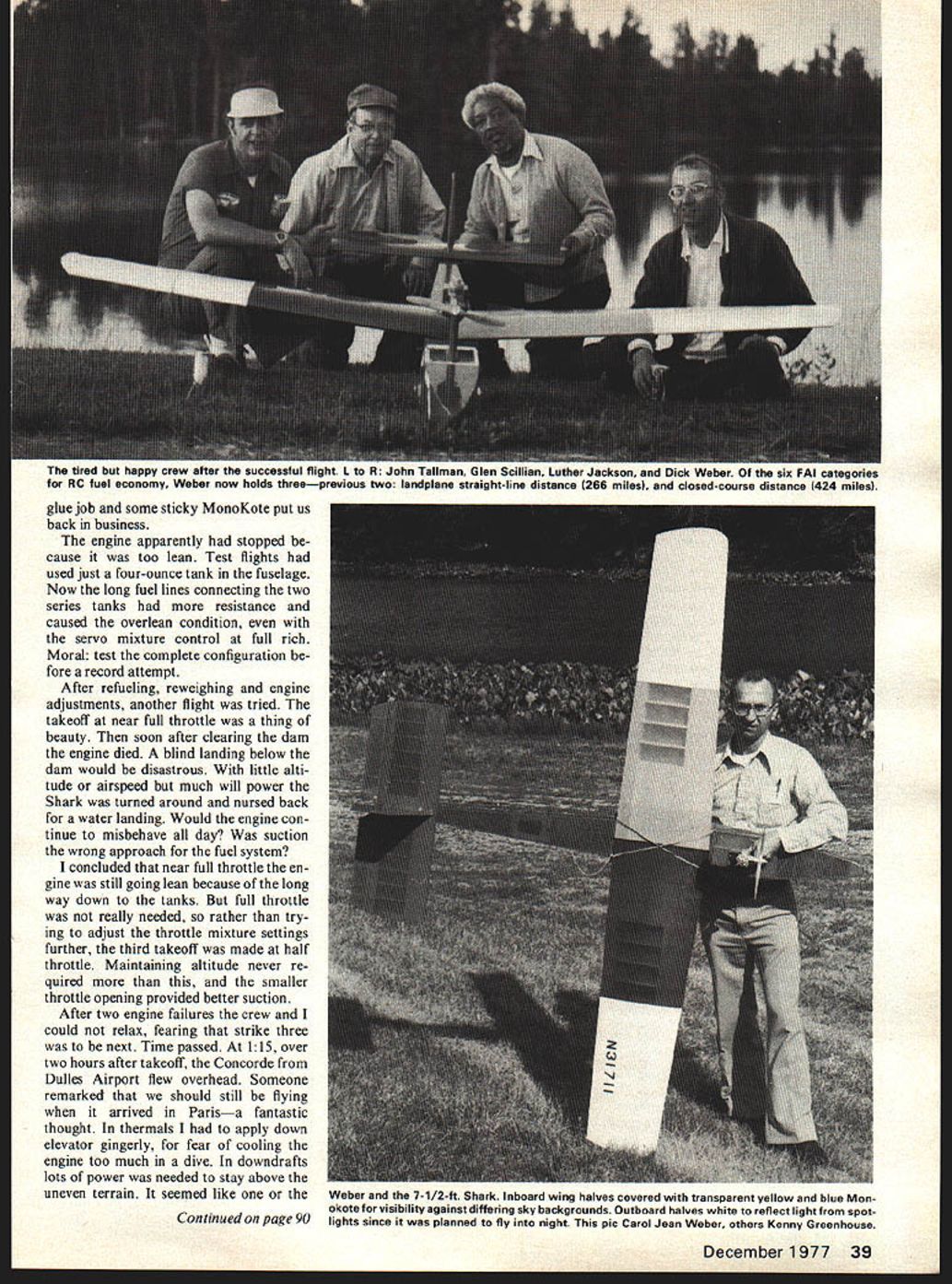
The 7-foot wing span requires four-foot balsa sheets; splices were used to obtain some excellent lightweight long Midwest stock. The tapered 1067 sq. in. wing uses a Clark Y airfoil, increased 15% in thickness. The stabilizer uses a 9% Clark Z airfoil. Shark inboard wing halves are covered with transparent yellow-blue MonoKote for visibility against differing sky backgrounds; the outboard halves are white to reflect light. Spotlights are planned for continued night flying.
Economical power is supplied by a hybrid .40 diesel engine. Having learned to build .29 diesels for landplane distance records, the .40 presented some challenges for water operation. Higher speed operation necessary for water takeoff proved unsatisfactory at first; only after hours of test-stand experimentation and engine modification did it behave well.
Richard Weber
SHARK SETS 2 MORE RECORDS
On September 2, after this report had been completed, Shark set a new closed-course seaplane record of 508 kilometers (315.565 miles) and, on the same flight, established a new seaplane endurance record of 9 hrs. 7 min. 37 sec. The 11-lb. seaplane (gross) was powered with a .29 diesel. Six fuel economy records in four categories have been set by Weber to date: the seaplane duration record was broken twice (he exceeded his own previous record) and the landplane closed course distance twice, with a Russian record intervening between Weber's flights. tanks located under the Shark wing.
After the Shark was completed early this year it was necessary to choose which seaplane record to attempt first. Two facts were decisive. Surpassing the German duration record would produce an economy record monopoly for the USA. Also, further duration experience should help in a later try for the landplane duration record. It was even conceivable that the Shark could exceed the landplane record.
Finding a flying site proved to be an unexpected problem. Because the radio was not in a sealed compartment I wanted to avoid salt water. Large freshwater lakes are hard to find in Maryland. Inquiries at several RC fields and hobby shops did not uncover any place that seaplane models were flown regularly. A beautiful four-acre farm pond was found on an aerial photograph, but the farmer said no. A county policeman visiting our flying field suggested a lake in Bowie, Md., but the city fathers, who probably had never seen a radio-controlled model, decided to refuse permission. Nearby rivers had inaccessible banks, low-flying aircraft, or too many people. Finally, I heard of a new lake in Columbia, Md. which was ideal for a duration attempt.
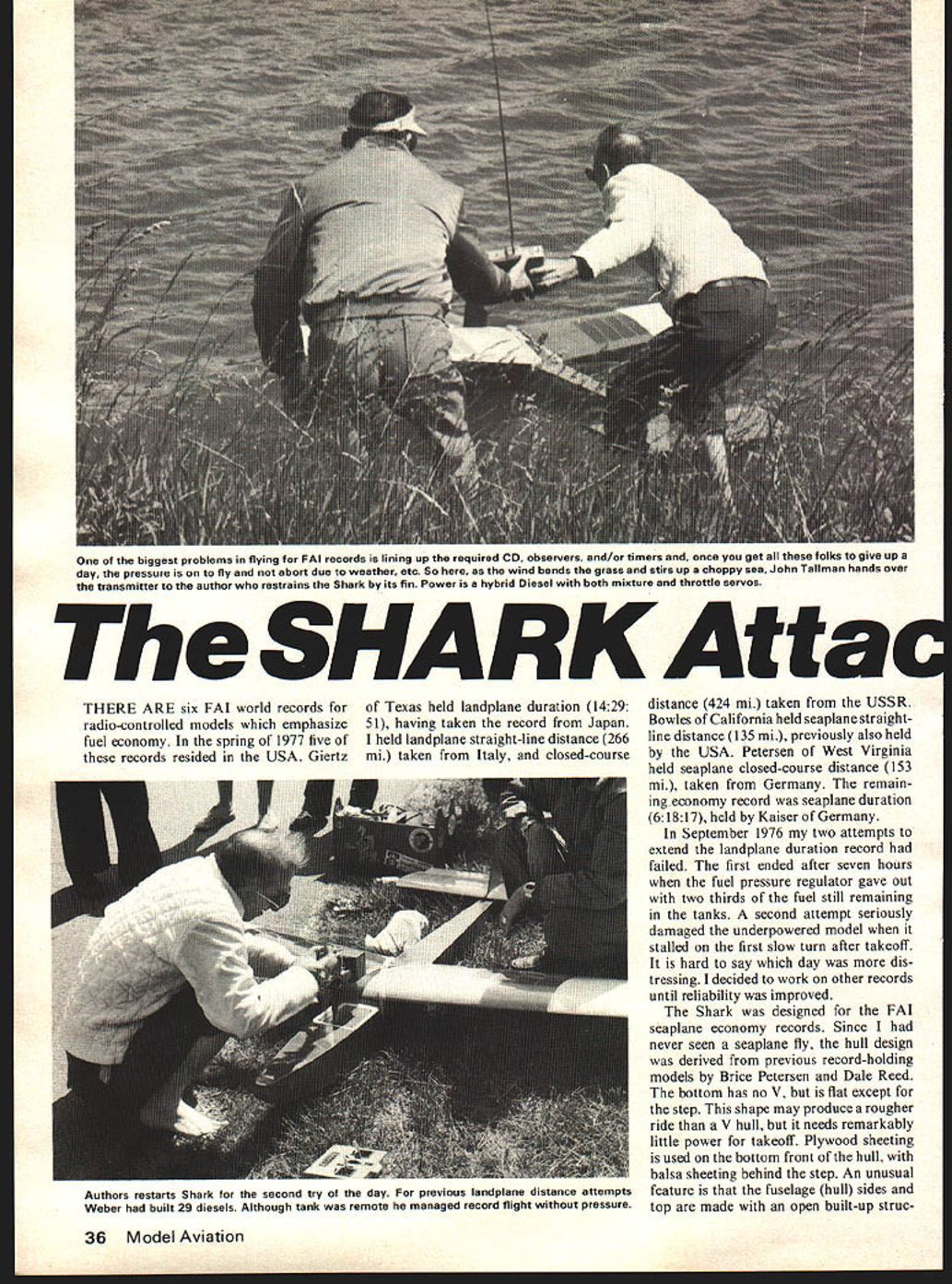
June 3 dawned sunny, cool and windy. The official witnesses for the record attempt met me about 8:30 a.m. at Lake Elkhorn. Assisting were CD Luther Jackson, John Tallman, and Kenny Greenhouse of PGRC and Glenn Sicilian of DCRC. Previous Shark test flights had demonstrated that with a Power Prop .11/.6 it could take off easily both empty and carrying a four-pound bottle of water aboard. The engine had been completely reliable, so we anticipated a troublefree day. After fueling up with 84 fl. oz., weigh-in at just under 11 pounds and some photos, digital watches recorded the start of what was expected to be a long flight.
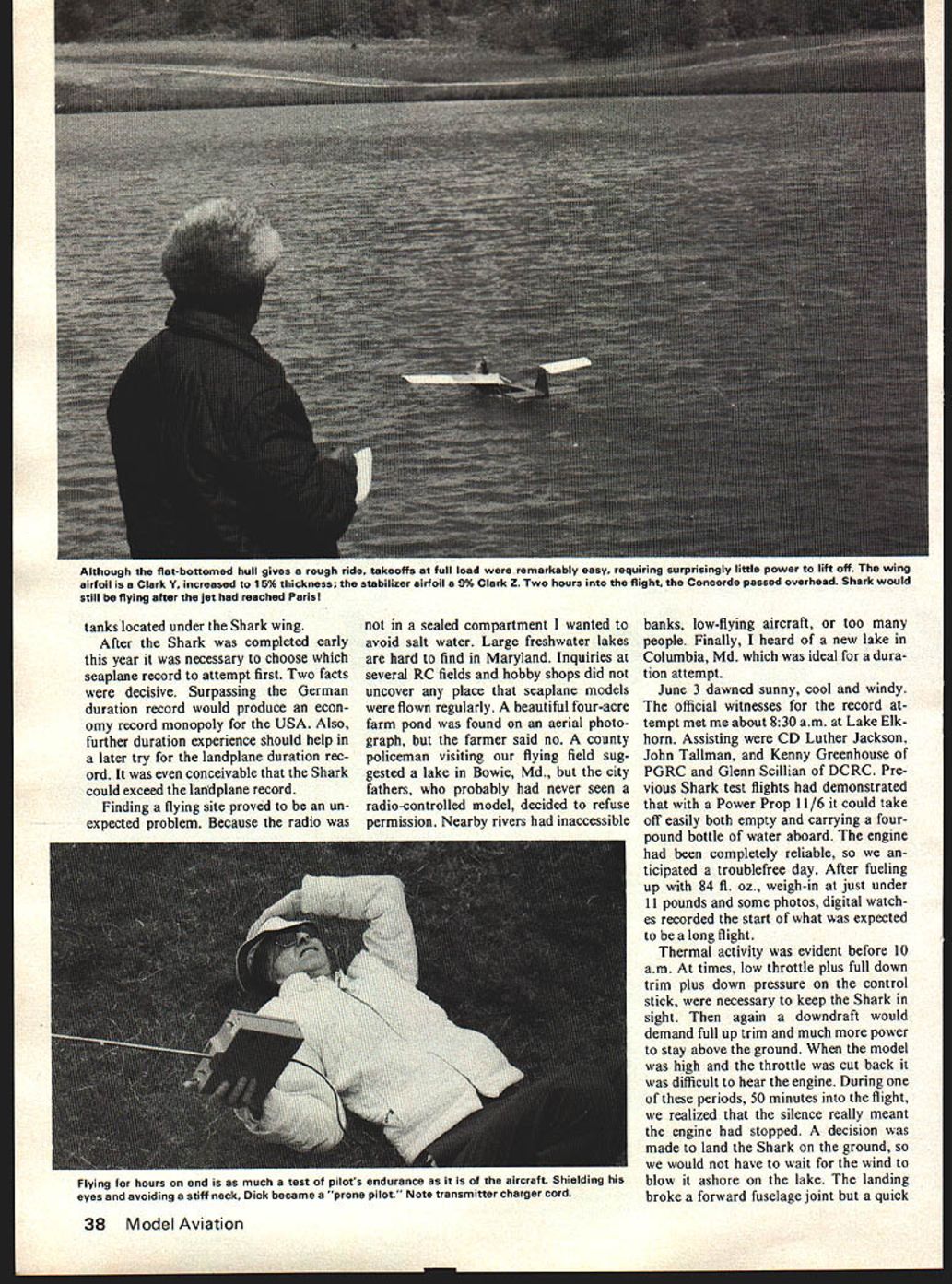
Thermal activity was evident before 10 a.m. At times, low throttle plus full down trim plus down pressure on the control stick, were necessary to keep the Shark in sight. Then again a downdraft would demand full up trim and much more power to stay above the ground. When the model was high and the throttle was cut back it was difficult to hear the engine. During one of these periods, 50 minutes into the flight, we realized that the silence really meant the engine had stopped. A decision was made to land the Shark on the ground, so we would not have to wait for the wind to blow it ashore on the lake. The landing broke a forward fuselage joint but a quick glue job and some sticky MonoKote put us back in business.
The engine apparently had stopped because it was too lean. Test flights had used just a four-ounce tank in the fuselage. Now the long fuel lines connecting the two series tanks had more resistance and caused the overlean condition, even with the servo mixture control at full rich. Moral: test the complete configuration before a record attempt.
After refueling, reweighing and engine adjustments, another flight was tried. The takeoff at near full throttle was a thing of beauty. Then soon after clearing the dam the engine died. A blind landing below the dam would be disastrous. With little altitude or airspeed but much will power the Shark was turned around and nursed back for a water landing. Would the engine continue to misbehave all day? Was suction the wrong approach for the fuel system?
I concluded that near full throttle the engine was still going lean because of the long way down to the tanks. But full throttle was not really needed, so rather than trying to adjust the throttle mixture settings further, the third takeoff was made at half throttle. Maintaining altitude never required more than this, and the smaller throttle opening provided better suction.
After two engine failures the crew and I could not relax, fearing that strike three was to be next. Time passed. At 1:15, over two hours after takeoff, the Concorde from Dulles Airport flew overhead. Someone remarked that we should still be flying when it arrived in Paris — a fantastic thought. In thermals I had to apply down elevator gingerly, for fear of cooling the engine too much in a dive. In downdrafts lots of power was needed to stay above the uneven terrain. It seemed like one or the other was always present.
The transmitter battery was kept charged by connecting it to the battery in my field box. When the field box battery voltage began to drop, a car battery was pressed into service.
A new record had to surpass the German mark by 2%, so we needed 6:25:51. As this duration approached we grew more apprehensive. Would the engine let us down now? How was the fuel holding out with a somewhat rich mixture? How long could we glide if necessary? But the engine kept on purring and we had a new record!
Now let's go for broke and take more risks to stretch the record as far as possible. In thermals the engine was slowed to a bare tick-over. The mixture was adjusted leaner. An hour and a half later these tactics contributed to the sudden termination of the flight. While flying slowly 50 feet from some trees beside the lake the left wingtip stalled. The Shark turned toward the trees, encouraged by the wind blowing that way. Hard right rudder had little immediate effect on the slow-flying plane. In desperation I opened the throttle to blow more air across the rudder, and to try to clear the tops of the trees. The engine immediately died lean and within two seconds the Shark was firmly ensnared 60 feet up in the tallest oak tree; end of record flight. total duration 7:56:23. Fortunately, the FAI Sporting Code states explicitly "It is not required that seaplanes land on water." So there it was. We had a new record and the record-setting plane in a tree top.
While Glenn Scillian went to get help from friends in the area, I spied the ropes holding up his canopy. With ropes and a hatchet from John Tallman's car we plunged through the poison ivy to the base of the plane-eating tree. I climbed the tree and attacked the offending branches. After long exhausting work, the Shark fell in stages to the ground. We were delighted to find that damage was minimal.
Lots of fuel was left. A later measurement showed 35 fl. oz. or 42% of the original fuel remained in the tanks. That was enough for an additional 5 1/2 hours at the same rate of fuel usage, and longer with the cleaner mixture and lighter model. However, records are made of actual rather than potential performance. Surpassing the German record by 25% is quite a satisfying result.
Special thanks are in order to the official witnesses, some of whom took a day of vacation leave to help on Friday when the lake was not busy. Particular recognition is due to the invisible Kenny Greenhouse. Long ago Kenny was assigned the role of documenting our record attempts with my camera, so we have never had his picture in any of my record articles. Thanks also to Dean Smith and Lee Shiflett who supplied critical parts for the flight.
Record setting is an exciting and rewarding activity. It doesn't require weekly travel to follow the contest circuit, yet you can compete with the entire world. Optimizing every element of the model—airframe, engine, fuel system and all the other components—is necessary to succeed. Originality is needed since you won't find the standardized approaches seen in normal competition. Free flight is our most neglected area. The USA has none of the 27 outdoor free flight records; nearly all are held by eastern European countries. Control line and radio control also have room for improved performances. Let's get going!
Transcribed from original scans by AI. Minor OCR errors may remain.

