
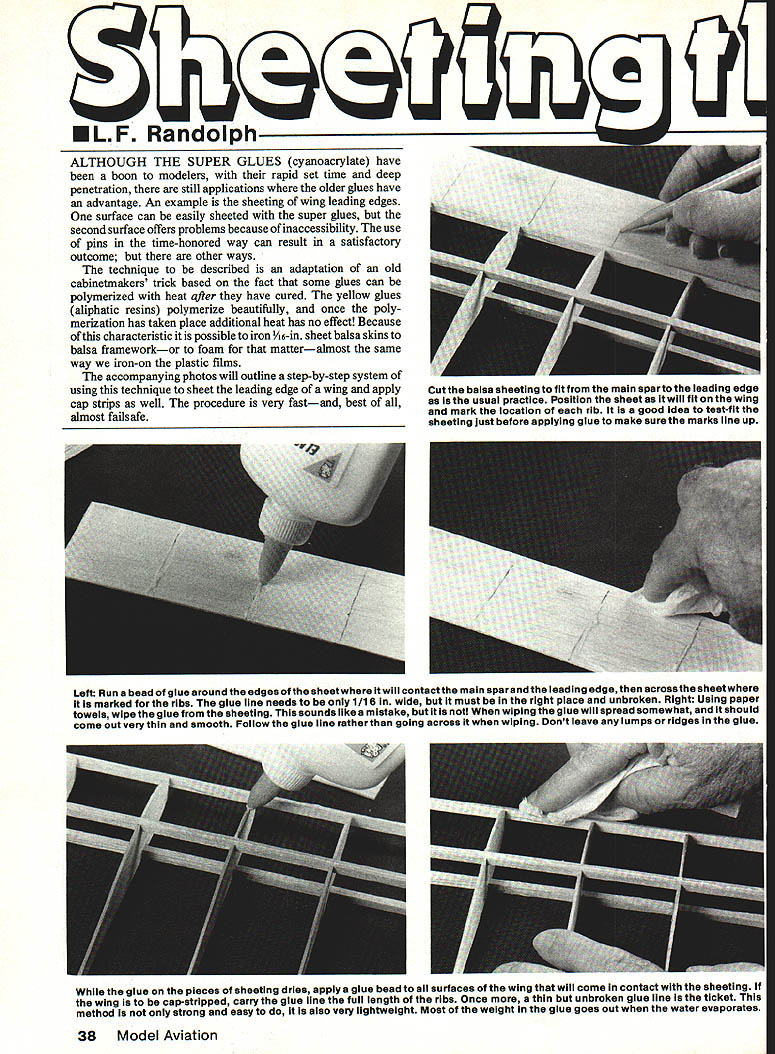
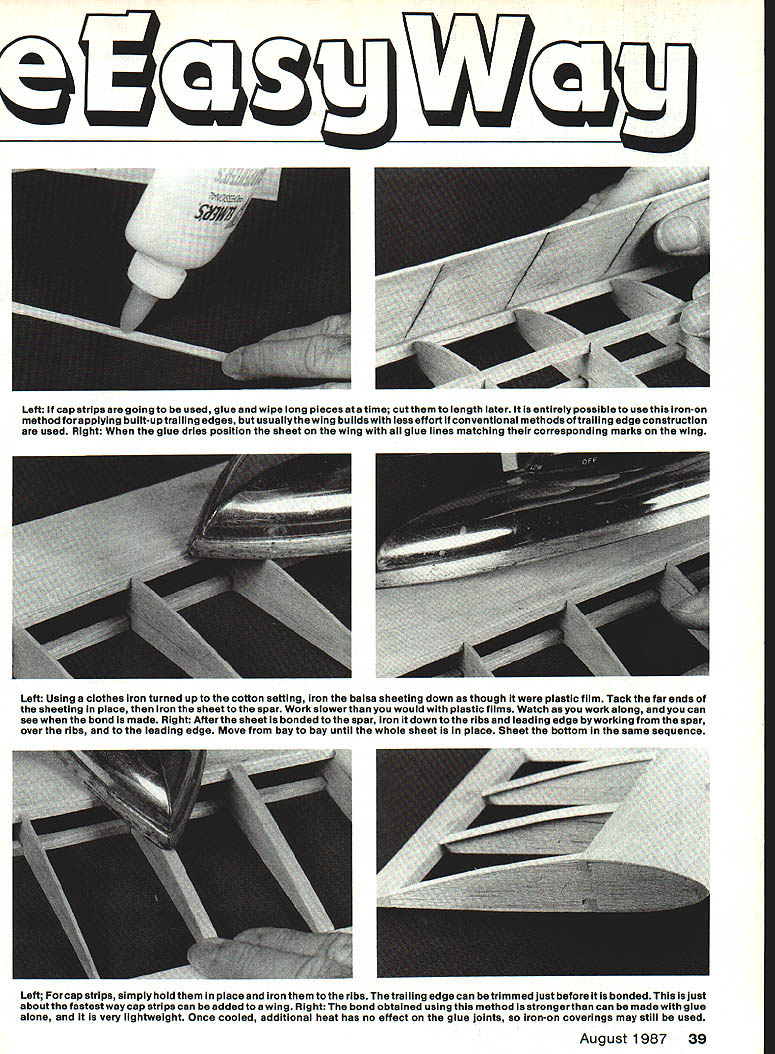
Sheeting the Easy Way
I.L.F. Randolph
Although the super glues (cyanoacrylate) have been a boon to modelers, with their rapid set time and deep penetration, there are still applications where the older glues have an advantage. An example is the sheeting of wing leading edges. One surface can be easily sheeted with the super glues, but the second surface often presents problems because of inaccessibility. Using pins in the time-honored way can result in a satisfactory outcome, but there are other ways.
Principle
The technique described here is an adaptation of an old cabinetmaker's trick based on the fact that some glues can be further polymerized with heat after they have cured. The yellow glues (aliphatic resins) polymerize beautifully, and once the polymerization has taken place additional heat has no effect. Because of this characteristic it is possible to iron 1/16-in. sheet balsa skins to a balsa framework—or to foam, for that matter—almost the same way we iron on plastic films.
The accompanying photos (not included here) outline a step-by-step system of using this technique to sheet the leading edge of a wing and to apply cap strips as well. The procedure is very fast—and, best of all, almost failsafe.
Preparation
While the glue on the pieces of sheeting dries, apply a glue bead to all surfaces of the wing that will come in contact with the sheeting. If the wing is to be cap-stripped, carry the glue line the full length of the ribs. Once more, a thin but unbroken glue line is the ticket. This method is not only strong and easy to do, it is also very lightweight. Most of the weight in the glue goes out when the water evaporates.
Cut balsa sheeting to fit between the main spar and the leading edge. As is usual practice, position the sheet so it will fit the wing and mark the location of the ribs. It is a good idea to test-fit the sheeting just before applying glue—make sure the marks line up.
Sheeting Procedure
- Heat a clothes iron to the cotton setting.
- Iron the balsa sheeting down as though it were plastic film, working slower than you would with plastic coverings.
- Tack the far ends of the sheeting in place, then iron the sheet to the spar. Watch as you work; you can see when the bond is made.
- After the sheet is bonded to the spar, iron it down to the ribs and leading edge by working from the spar, over the ribs, and to the leading edge. Move from bay to bay until the whole sheet is in place.
- Sheet the bottom in the same sequence.
Work carefully and observe the bond as you proceed—the slower pace compared to plastic film application ensures a reliable adhesion.
Cap Strips
For cap strips, simply hold them in place and iron them to the ribs. The trailing edge can be trimmed just before it is bonded. This is one of the fastest ways cap strips can be added to a wing. The bond obtained using this method is stronger than can be made with glue alone and remains very lightweight.
Notes
- Once cooled, additional heat has no effect on the glue joints, so iron-on coverings may still be used.
- A thin, continuous glue line gives the best combination of strength and low weight.
Transcribed from original scans by AI. Minor OCR errors may remain.

