
Shoot that Model on Movie Film
From twenty-odd years experience in shooting for TV, the author tells you how to make movies entertaining for the shooter and spectator alike.
Keith Gebers
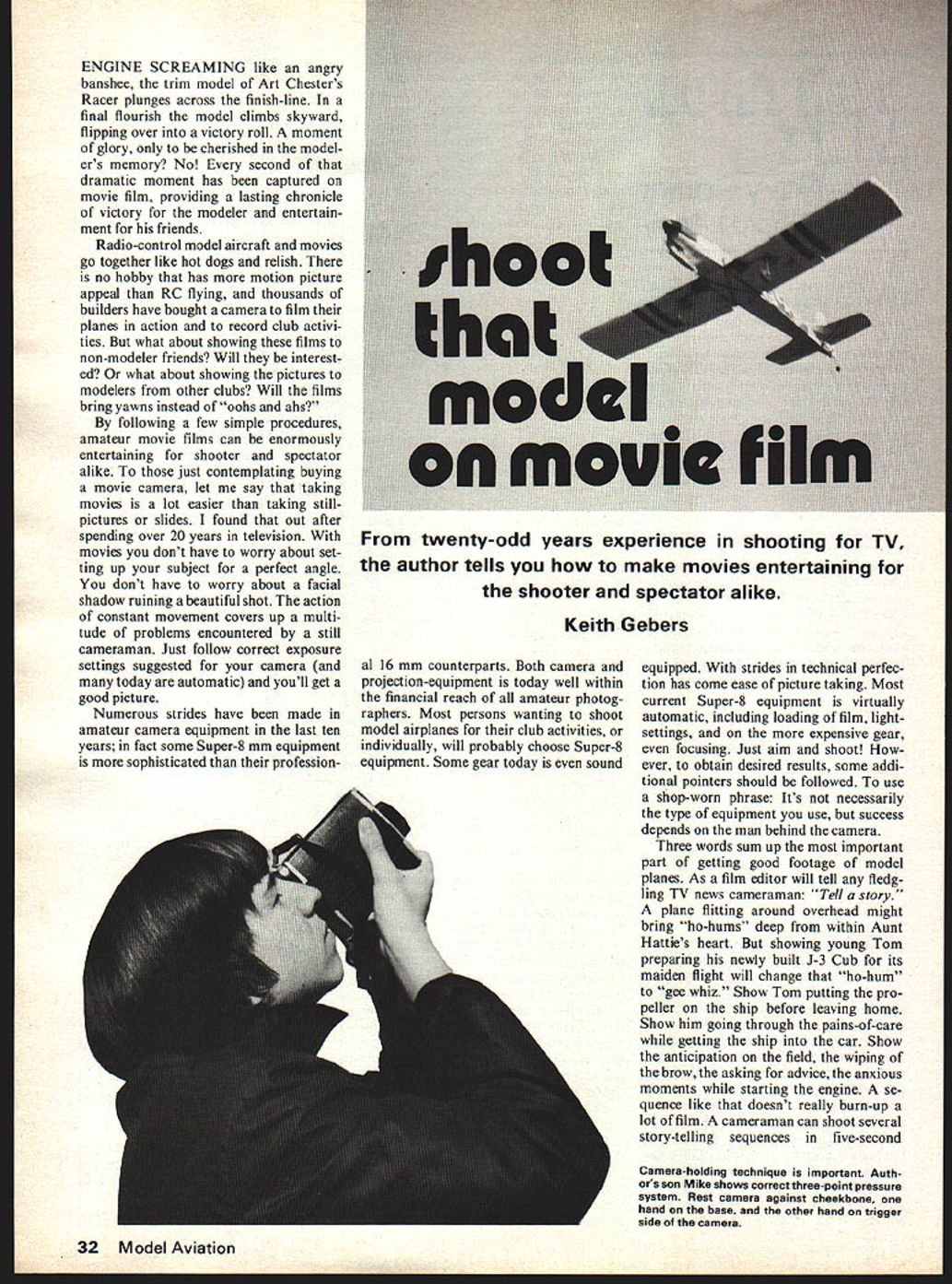
ENGINE SCREAMING like an angry banshee, the trim model of Art Chester's Racer plunges across the finish-line. In a final flourish the model climbs skyward, flipping over into a victory roll. A moment of glory, only to be cherished in the modeler's memory? No! Every second of that dramatic moment has been captured on movie film, providing a lasting chronicle of victory for the modeler and entertainment for his friends.
Radio-control model aircraft and movies go together like hot dogs and relish. There is no hobby that has more motion picture appeal than RC flying, and thousands of builders have bought a camera to film their planes in action and to record club activities. But what about showing these films to non-modeler friends? Will they be interested? Or what about showing the pictures to modelers from other clubs? Will the films bring yawns instead of "oohs and ahs?"
By following a few simple procedures, amateur movie films can be enormously entertaining for shooter and spectator alike. To those just contemplating buying a movie camera, let me say that taking movies is a lot easier than taking still-pictures or slides. I found that out after spending over 20 years in television. With movies you don't have to worry about setting up your subject for a perfect angle. You don't have to worry about a facial shadow ruining a beautiful shot. The action of constant movement covers up a multitude of problems encountered by a still cameraman. Just follow correct exposure settings suggested for your camera (and many today are automatic) and you'll get a good picture.
Numerous strides have been made in amateur camera equipment in the last ten years; in fact some Super-8 mm equipment is more sophisticated than their professional 16 mm counterparts. Both camera and projection-equipment is today well within the financial reach of all amateur photographers. Most persons wanting to shoot model airplanes for their club activities, or individually, will probably choose Super-8 equipment. Some gear today is even sound equipped. With strides in technical perfection has come ease of picture taking. Most current Super-8 equipment is virtually automatic, including loading of film, light-settings, and on the more expensive gear, even focusing. Just aim and shoot! However, to obtain desired results, some additional pointers should be followed. To use a shop-worn phrase: It's not necessarily the type of equipment you use, but success depends on the man behind the camera.
Three words sum up the most important part of getting good footage of model planes. As a film editor will tell any fledgling TV news cameraman: "Tell a story." A plane flitting around overhead might bring "ho-hums" deep from within Aunt Hattie's heart. But showing young Tom preparing his newly built J-3 Cub for its maiden flight will change that "ho-hum" to "gee whiz." Show Tom putting the propeller on the ship before leaving home. Show him going through the pains-of-care while getting the ship into the car. Show the anticipation on the field, the wiping of the brow, the asking for advice, the anxious moments while starting the engine. A sequence like that doesn't really burn-up a lot of film. A cameraman can shoot several story-telling sequences in five-second bursts.
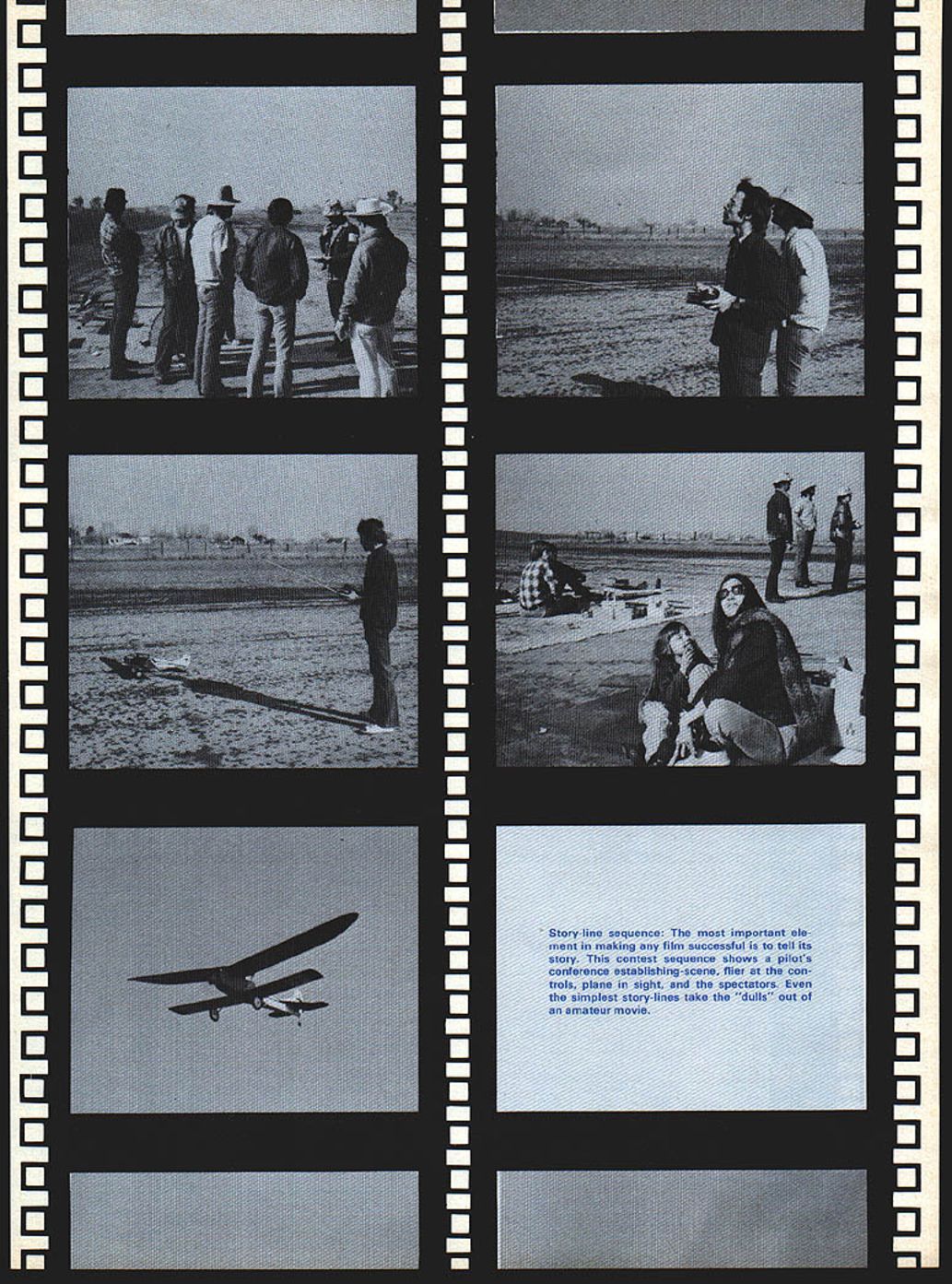
Story-line sequence: The most important element in making any film successful is to tell its story. This contest sequence shows a pilot's conference, establishing scene, pilot at the controls, plane in sight, and the spectators. Even the simplest story-lines take the "dulls" out of an amateur movie. Camera-holding technique is important. The author's son Mike shows the correct three-point pressure system: rest the camera against the cheekbone, support the base with one hand, and use the other hand on the trigger side of the camera.
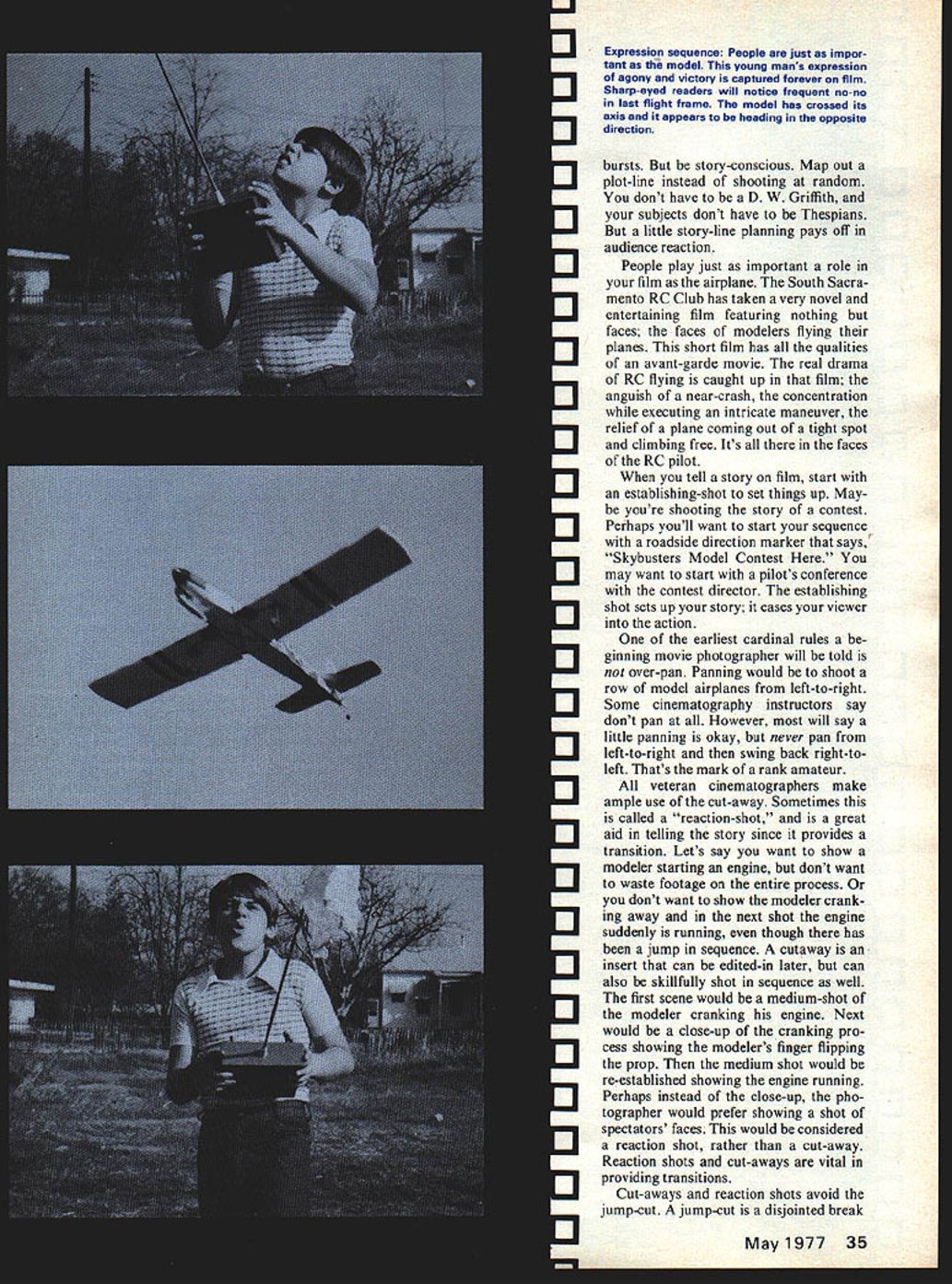
Expression sequence. People's faces are just as important as the model. A young man's expression—agony or victory—is captured forever on film.
Sharp-eyed readers will notice a frequent no-no in flight sequences: in the last frame the model has crossed its yaw axis and appears to be heading in the opposite direction. Bursts of story-conscious shooting help avoid this confusion. Map out a plot line instead of shooting randomly. You don't have to be D.W. Griffith or have Thespians—a little story-line planning pays off.
Audience reaction. People play an important role in any film about airplanes. The South Sacramento R/C Club has made a very novel and entertaining film featuring nothing but the faces of modelers flying planes. The short film has the qualities of an avant-garde movie—real drama of R/C flying captured on film: the anguish of a near-crash, the concentration of executing an intricate maneuver, and the relief when the plane comes out of a tight spot.
Start with an establishing shot to set things up. If you're shooting a contest, perhaps begin the sequence with a roadside direction marker that says "Skybusters Model Contest." You may want to start with the pilots' conference, the contest director, and other establishing shots that set up the story. One of the earliest cardinal rules a beginning movie photographer will be told is not over-pan. Panning would be to shoot a row of model airplanes from left-to-right. Some cinematography instructors say don't pan at all. However, most will say a little panning is okay, but never pan from left-to-right and then swing back right-to-left. That's the mark of a rank amateur.
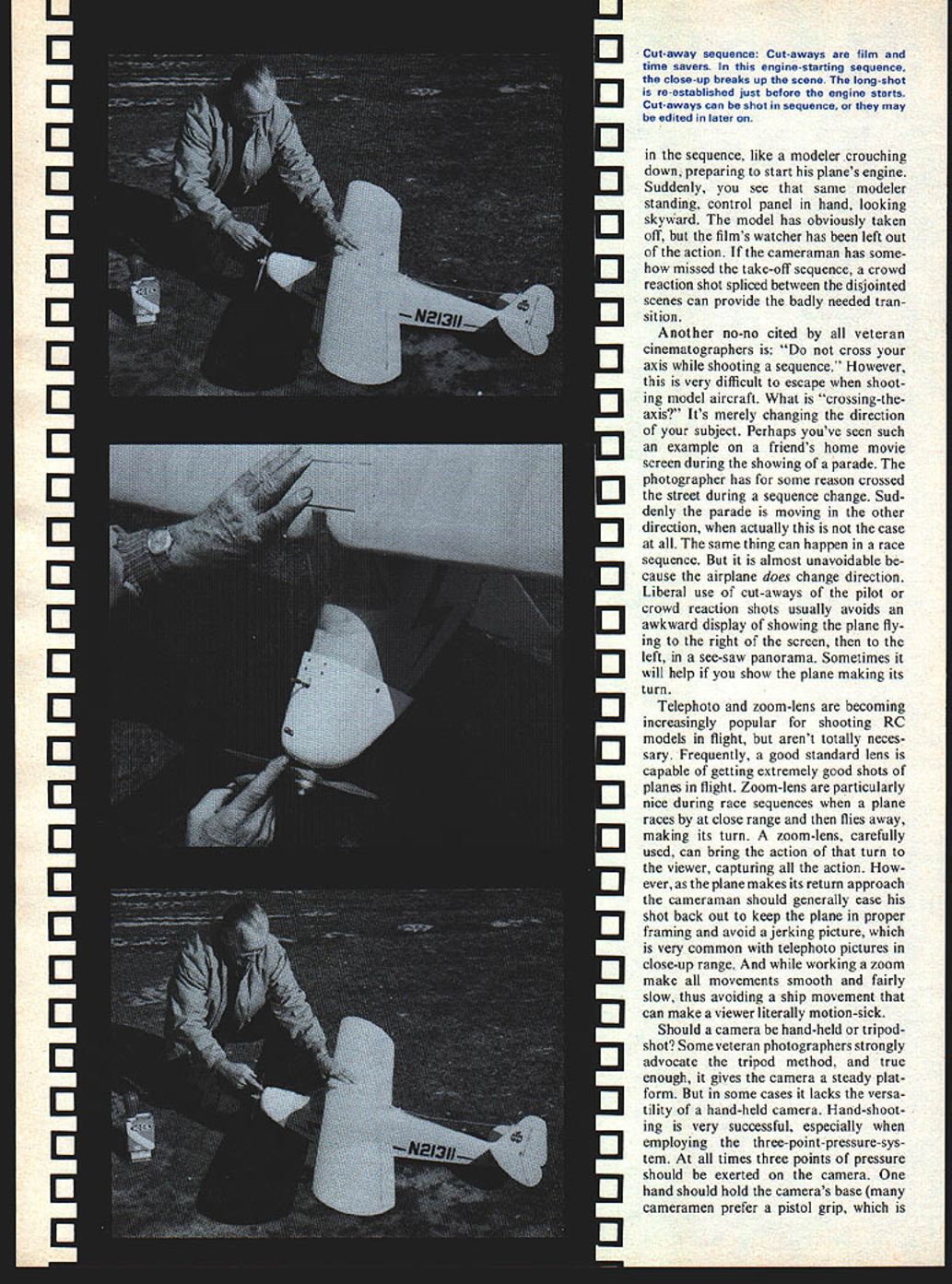
All veteran cinematographers make ample use of the cut-away. Sometimes this is called a "reaction-shot," and is a great aid in telling the story since it provides a transition. Let's say you want to show a modeler starting an engine, but don't want to waste footage on the entire process. Or you don't want to show the modeler cranking away and in the next shot the engine suddenly is running, even though there has been a jump in sequence. A cutaway is an insert that can be edited-in later, but can also be skillfully shot in sequence as well. The first scene would be a medium-shot of the modeler cranking his engine. Next would be a close-up of the cranking process showing the modeler's finger flipping the prop. Then the medium shot would be re-established showing the engine running. Perhaps instead of the close-up, the photographer would prefer showing a shot of spectators' faces. This would be considered a reaction shot, rather than a cut-away. Reaction shots and cut-aways are vital in providing transitions.
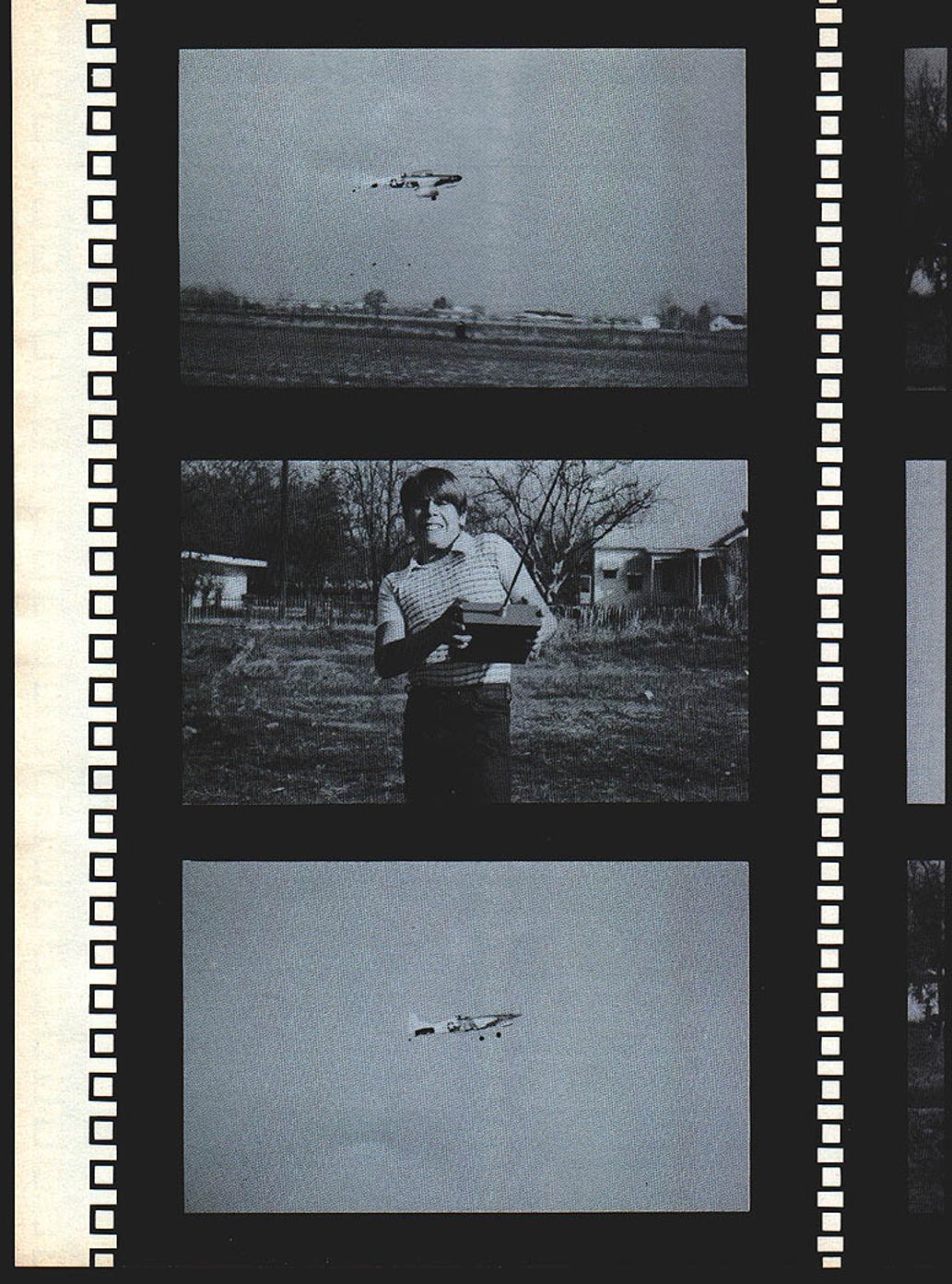
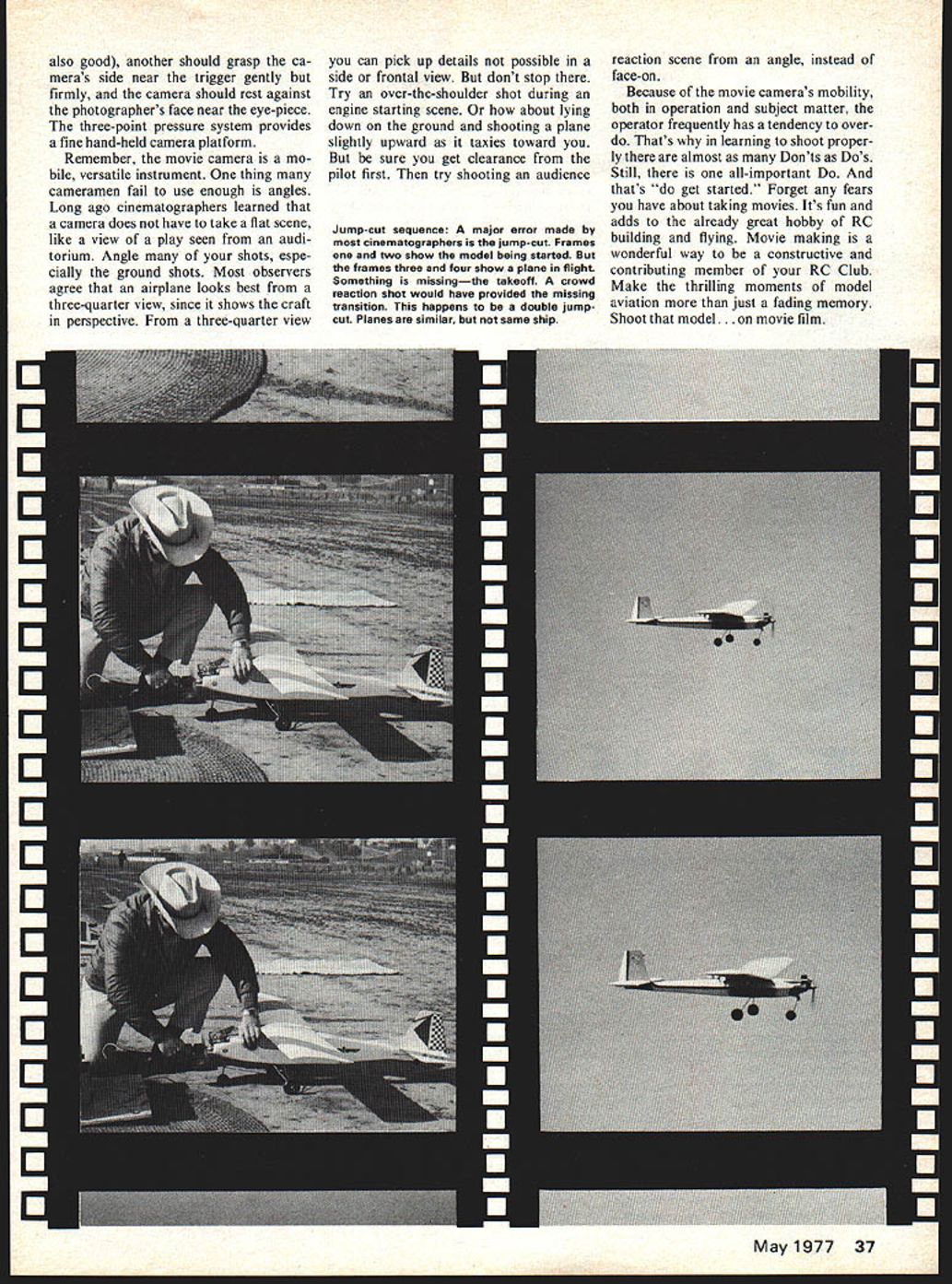
Cut-aways and reaction shots avoid the jump-cut. A jump-cut is a disjointed break in the sequence, like a modeler crouching down, preparing to start his plane's engine. Suddenly, you see that same modeler standing, control panel in hand, looking skyward. The model has obviously taken off, but the film's watcher has been left out of the action. If the cameraman has somehow missed the take-off sequence, a crowd reaction shot spliced between the disjointed scenes can provide the badly needed transition.
Another no-no cited by all veteran cinematographers is: "Do not cross your axis while shooting a sequence." However, this is very difficult to escape when shooting model aircraft. What is "crossing-the-axis?" It's merely changing the direction of your subject. Perhaps you've seen such an example on a friend's home movie screen during the showing of a parade. The photographer has for some reason crossed the street during a sequence change. Suddenly the parade is moving in the other direction, when actually this is not the case at all. The same thing can happen in a race sequence. But it is almost unavoidable because the airplane does change direction. Liberal use of cut-aways of the pilot or crowd reaction shots usually avoids an awkward display of showing the plane flying to the right of the screen, then to the left, in a see-saw panorama. Sometimes it will help if you show the plane making its turn.
Telephoto and zoom-lens are becoming increasingly popular for shooting RC models in flight, but aren't totally necessary. Frequently, a good standard lens is capable of getting extremely good shots of planes in flight. Zoom-lens are particularly nice during race sequences when a plane races by at close range and then flies away, making its turn. A zoom-lens, carefully used, can bring the action of that turn to the viewer, capturing all the action. However, as the plane makes its return approach the cameraman should generally ease his shot back out to keep the plane in proper framing and avoid a jerking picture, which is very common with telephoto pictures in close-up range. And while working a zoom make all movements smooth and fairly slow, thus avoiding a ship movement that can make a viewer literally motion-sick.
Should a camera be hand-held or tripod-shot? Some veteran photographers strongly advocate the tripod method, and true enough, it gives the camera a steady platform. But in some cases it lacks the versatility of a hand-held camera. Hand-shooting is very successful, especially when employing the three-point-pressure-system. At all times three points of pressure should be exerted on the camera. One hand should hold the camera's base (many cameramen prefer a pistol grip, which is pictured at right). The camera should be braced against the cheekbone and the other hand on the trigger side of the camera to provide added stability. Don't be afraid to rest the camera against a fence post or the car while shooting.
Expression sequence
People play just as important role in model films as does the young man's expression of agony or victory captured forever on film. Sharp-eyed readers will notice the frequent no-no in the last flight frame where the model has crossed its yaw axis and appears to be heading in the opposite direction. Map out a plot-line instead of shooting random sequences. You don't have to be D. W. Griffith nor have trained thespians; a little story-line planning pays off.
Audience reaction
People play just as important a role in the model airplane film as the airplanes themselves. South Sacramento RC Club has taken a very novel, entertaining approach featuring nothing but faces—faces of modelers flying planes. The short film has the qualities of an avant-garde movie: the real drama of RC flying is caught up in the film—the anguish of a near-crash, the concentration executing an intricate maneuver, the relief as the plane comes out of a tight spot and climbs free. It's the faces of the RC pilot that tell the story. Start with an establishing shot to set things up. Maybe you're shooting a contest. Perhaps you'll want to start the sequence with a roadside direction marker that says "Skybusters Model Contest." You may want to start with a pilots' conference or the contest director—an establishing shot that sets up the story. also good), another should grasp the camera's side near the trigger gently but firmly, and the camera should rest against the photographer's face near the eye-piece. The three-point pressure system provides a fine hand-held camera platform.
Camera-holding technique important. Author's son Mike shows correct three-point pressure system. Rest camera against cheekbone, hand at base, other hand on trigger side of camera.
Expression sequence. People just as important as the model. Young man's expression—agony or victory—captured forever on film.
Remember, the movie camera is a mobile, versatile instrument. One thing many cameramen fail to use enough is angles. Long ago cinematographers learned that a camera does not have to take a flat scene, like a view of a play seen from an auditorium. Angle many of your shots, especially the ground shots. Most observers agree that an airplane looks best from a three-quarter view, since it shows the craft in perspective. From a three-quarter view you can pick up details not possible in a side or frontal view. But don't stop there. Try an over-the-shoulder shot during an engine-starting scene. Or how about lying down on the ground and shooting a plane slightly upward as it taxies toward you. But be sure you get clearance from the pilot first. Then try shooting an audience reaction scene from an angle, instead of face-on.
Jump-cut sequence: A major error made by most cinematographers is the jump-cut. Frames one and two show the model being started. But the frames three and four show a plane in flight. Something is missing—the takeoff. A crowd reaction shot would have provided the missing transition. This happens to be a double jump-cut. Planes are similar, but not the same ship.
Because of the movie camera's mobility, both in operation and subject matter, the operator frequently has a tendency to overdo. That's why in learning to shoot properly there are almost as many Don'ts as Do's. Still, there is one all-important Do. And that's "do get started." Forget any fears you have about taking movies. It's fun and adds to the already great hobby of RC building and flying. Movie making is a wonderful way to be a constructive and contributing member of your RC Club. Make the thrilling moments of model aviation more than just a fading memory. Shoot that model... on movie film.
Transcribed from original scans by AI. Minor OCR errors may remain.

