

A Short History of Aerobatics: Part I
Rick Allison
Model aerobatics today
Any weekend afternoon at the local radio-control or control-line flying field is a cornucopia of fixed-wing aerobatic flight; the late Bill Winter once compared it to watching young otters at play.
As soon as most novice pilots solo, they push themselves to master the aerobatic fundamentals. Those with the desire and talent to extend themselves go on to an ever-greater mastery of their craft. This behavior is typical of pilots in general—model and full-scale. Deep within the collective psyche of those drawn to aviation, there exists a powerful urge to define and extend the limits of flight.
The majority of model pilots never attempt competition aerobatics, but for those with the urge, a full slate of competitive activities is sanctioned by the Academy of Model Aeronautics (AMA). The events devoted exclusively to aerobatics include Scale Aerobatics, Radio Control Aerobatics (Pattern), and Control Line Precision Aerobatics (Stunt).
The AMA Special Interest Groups for these events are among the largest and healthiest of such organizations:
- IMAC (International Miniature Aerobatic Club)
- NSRCA (National Society of Radio Controlled Aerobatics)
- PAMPA (Precision Aerobatic Model Pilots Association)
RC Fun Fly events offer a slightly less-rigorous aerobatic outlet. The wild gyrations possible with lightning-quick modern Fun Fly models have certainly helped foster the present RC fascination with the close-in, low-speed hovering and tumbling maneuvers known as 3-D aerobatics.
Whether RC or control line, the simple, universal sport pilot's diversion of boring interesting holes in the sky gives a more casual—but no less pleasurable—expression to the acrobatic impulse.
Early full-scale aerobatics
Aerobatic flight existed long before RC or control-line models. In fact, most of the maneuvers seen on any given Sunday at the local field were old hat to full-scale pilots before Lindbergh landed in Paris in 1927. A little research reveals that straight-and-level flight was considered boring almost as soon as it was accomplished.
Alas, alleviating this aeronautical ennui was not without cost. "Flight instruction" was perfunctory, when it existed at all. Pilot qualifications consisted solely of having enough disposable cash to buy a machine, and sufficient courage (and bad judgment) to kick the tires (or skids) and light the tiny fire provided.
The records from this earliest period in aviation history are sketchy and short on detail, but the first aerobatics were likely little more than adrenaline-fueled chandelles and stall-turn–like efforts at recovery from what a modern-day flight instructor might call an "inadvertent unusual attitude."
These primordial stunts may have been termed aerobatics (a contraction of the early term "aerial acrobatics") when they occasionally succeeded. When they did not, which was far more common, they were called "crashes" (or "prangs," if the unfortunate aeronaut happened to be English).
Fortunately, the early aircraft designers proved to be quick on the drawing board, and clever at applying the messy lessons provided by their customer-based testing program. Blind alleys were discarded, and after about 1910 basic configurations were set and the state of the aeronautical art advanced rapidly—so rapidly that this sort of testing program is, unfortunately, still in common use today.
Of course, such matters are now overseen by the Federal Aviation Administration and the National Transportation Safety Board, not to mention many tort lawyers, judges, and juries.
Pilot skill improved almost as quickly as the equipment. Actual flight instruction began to be provided by manufacturers and sellers of aircraft, who no doubt noticed that living customers often bought a second or third airplane, while the dead ones seldom did. Bad pilots were weeded out as they bought the farm, depleted their bank accounts, or broke enough bones to dampen their enthusiasm for aviation.
By 1911, merely flying around the peanut patch had become so routine that semiaerobatic maneuvers (such as shallow wingovers) began to be invented on purpose, for reasons other than just avoiding the ground. Since most pilots of the day were young and male, and flying was widely held to be a romantic and dashing pursuit, it is a safe bet that impressing young ladies was high on the list of possible motivations—a circumstance that no doubt also led to the introduction of the silk flying scarf, and eventually to designers making airplanes into stunt boxes.
The first deliberate maneuvers didn't depend on power, for the simple reason that not much was available. Instead, the gravity well of the planet was used to supply the needed energy.
Pioneers and key maneuvers
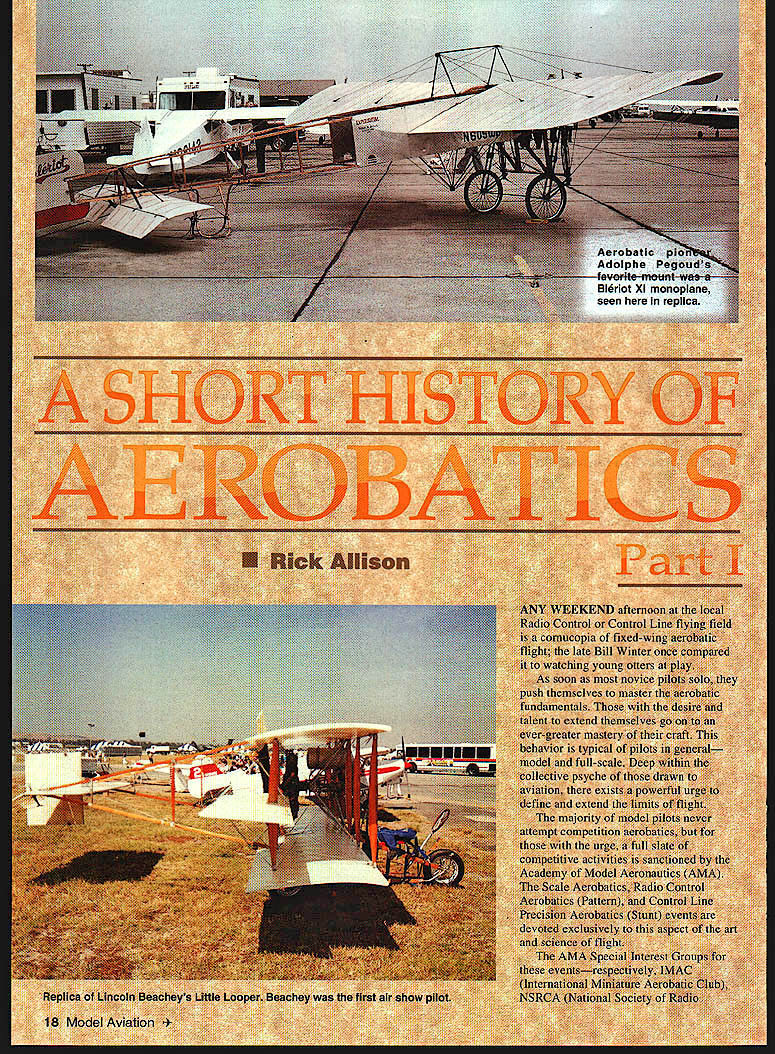
Around 1912, W. E. R. Moorhouse decided to pull his Blériot monoplane to a vertical line and just sit there. Five or six seconds of vigorous shaking and creaking ensued, and one sore neck later, Moorhouse had invented the tail slide.
A year later, Adolphe Pégoud deliberately performed several tail slides for the Blériot company, thereby helping to invent the manufacturing flight test program (and the test-pilot paycheck) in the process.
Pégoud is also famous for another stunt that required breathtaking courage and advanced the cause of aerobatics: on August 19, 1913 he became the first person to safely use a parachute to abandon an airplane in flight. He jumped from his Blériot at about 700 feet over the French countryside in a deliberate test of the new device, which until then had only been tested from tethered balloons. The chute worked flawlessly.
Deprived of its pilot, the abandoned Blériot dutifully crashed—but not before putting on an aerobatic display hitherto thought impossible. The fragile little monoplane dived, looped, twisted, rolled, and tumbled its phugoid way into aviation history, riveting Pégoud's attention as he floated to earth. Until that moment, no one had dared to risk a machine in such wild gyrations, because prevailing "expert" opinion held that the stresses would tear the airframe to pieces.
Pégoud was determined to duplicate the maneuvers he had seen, followed by a landing in one piece rather than several. On September 21, 1913, he became the first pilot to demonstrate sustained inverted flight by stretching the top portion of a loop for a considerable distance; he therefore also deserves credit for the egg-shaped loop.
For the first deliberate loop, credit goes to Lieutenant Pyotr Nikolaevich Nesterov of the Imperial Russian Air Service, who flew one in a Nieuport Type IV near Kiev on September 9, 1913. His superiors jailed him for endangering state property; nearly two weeks later, after the significance of the event had been hailed in the world press, he was released and promoted. He was later killed in action early in World War I; in his honor, the Nesterov Cup is awarded to the winning team at each World Aerobatic Championship.
The new maneuver was christened the "loop" by the American newspapers—a term borrowed from the "loop the loop" vertical circle included in the roller coaster ride at Coney Island.
Lincoln Beachey, an enterprising American pilot, was so taken with the new maneuver that he began doing loops for hire over any venue with a crowd (or even a cow) in it, using a special aircraft called the Little Looper that he had designed. Beachey's act is generally considered the earliest example of the modern aerobatically oriented air show. Unfortunately, he later crashed during a demonstration when a structural failure of the wing bracing was blamed.
In England, on August 12, 1912, Royal Navy Lieutenant Wilfred Parke accidentally discovered that it was possible to recover from an inadvertent spin. After trying nearly everything in the pilot's manual and with just about 50 feet to go, he finally let go of the control column and pushed opposite rudder, whereupon his Avro biplane immediately recovered. He proposed naming the maneuver "Parke's Dive," but the name didn't catch on. Parke's recovery was nonetheless welcome since prior to this time spins had been considered merely a lethal type of landing maneuver.
A year or two later, at the behest of Sopwith Aircraft Ltd., Australian pilot Harry Hawker conducted deliberate spin tests and refined the recovery procedure to a more pilot-friendly recipe: establish the spin, cut power, let go of the stick, and apply immediate rudder opposite to the direction of rotation. This moved spins into the aerobatic pilot's bag of tricks. By 1917, even inverted spins had been conquered.
The development of rolls—snap, barrel, and slow—followed the adoption of ailerons. Barrel rolls were likely the first, as they are nonscary, low-stress, constant-G maneuvers. The slow roll followed and likely contributed to the introduction of modern multipoint seat-belt harnesses; keeping the pilot secured in the airplane near the controls is a great contributor to aerobatic success (and to landing afterwards).
World War I and combat aerobatics
World War I accelerated aerobatic development through the introduction of synchronized forward-firing machine guns. Tony Fokker is credited with perfecting this mechanism, which appeared in 1915 with German airmen.
Prior to that, air-to-air combat had been carried out with dirty looks, rude gestures, and the occasional firearm. Roland Garros had earlier mounted an unsynchronized forward-firing machine gun on his Morane-Saulnier L monoplane and fitted steel deflector plates to the propeller blades. His innovation was effective but dangerous to his own propeller.
Fokker's synchronization gear was an unqualified success and was rapidly copied by the Allies. With lethal fire now a constant hazard, evasive action became essential. The snap roll was likely invented quickly in response—very probably as a desperate reflex.
Other maneuvers followed in rapid succession:
- Max Immelmann discovered that a climbing chandelle followed by a sort of wingover was a handy method of quickly reversing one's field of view. The routine evolved into the half-loop followed by a half-roll and became known as the Immelmann turn.
- The reverse procedure, performed from higher altitude, evolved into the split-S.
By the end of the war, nearly all of the basic aerobatic tool kits in use today had been invented or discovered—accidentally or on purpose. What remained was mostly waiting for equipment to catch up and make further refinements possible.
Postwar barnstorming and the 1920s
After the Armistice, many countries had more pilots and aircraft left over than were strictly necessary for defense. The terms of the Armistice called for the destruction of German arms and goods and the demilitarization of the Luftwaffe, which in turn led to a huge surplus of serviceable aircraft available to civil operators.
Barnstorming, air racing, and exhibition flying blossomed in the 1920s as pilots scrambled to entertain a war-weary public craving thrills. Many of the early aerobatic moves were refined and standardized in this period.
In Europe, the major postwar aviation focus was the development of commercial transport aviation; from 1919 into the early 1920s, new airlines and routes were established regularly. Aerobatics, being far removed from the aims of safe passenger transport, had to wait a few years before reemerging in a big way. In America, however, a new era of display aerobatics began sooner, led by barnstormers and show pilots.
Conclusion
By the 1920s, aerobatics had moved from accidental discovery and combat necessity into deliberate entertainment and sport. Many foundational maneuvers and recovery procedures had been invented, tested, and adopted into pilot practice.
Next month: A new era of "display aerobatics" begins in the States, and the new sport of precision aerobatics develops in Europe.
Illustrations (captions)
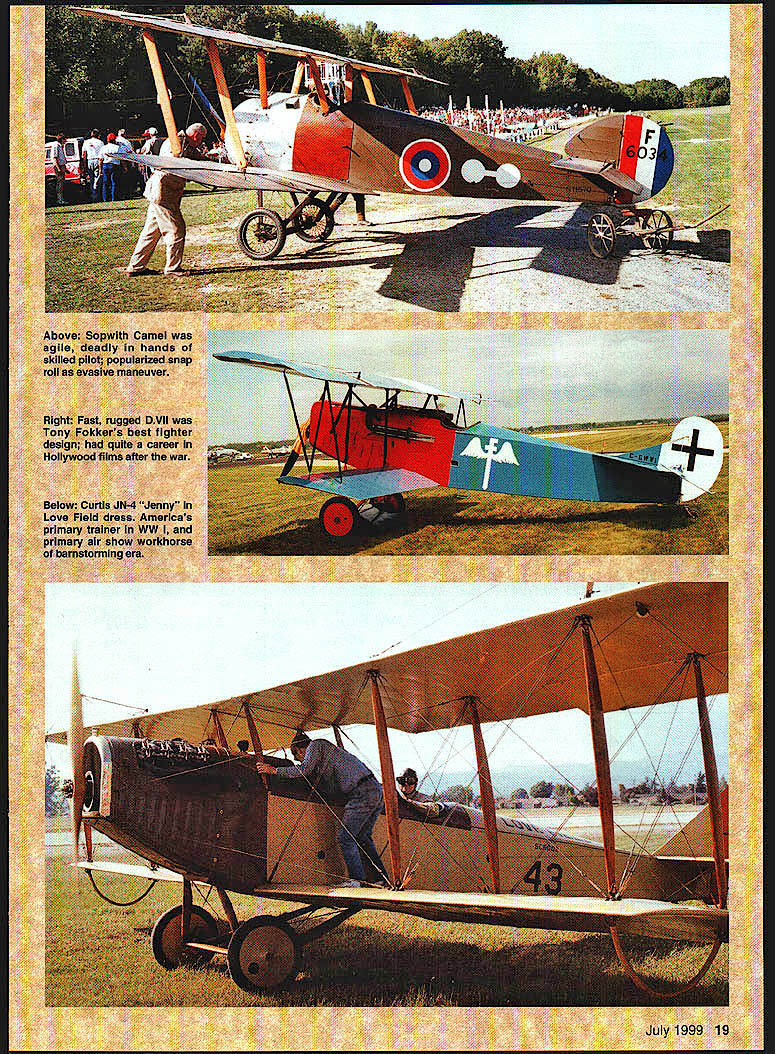
- Sopwith Camel: agile and deadly in the hands of a skilled pilot; popularized the snap roll as an evasive maneuver.
- Fokker D.VII: fast, rugged—Fokker's best fighter design; had quite a career in Hollywood films after the war.
- Curtiss JN-4 "Jenny": America's primary trainer in WWI and the primary air-show workhorse of the barnstorming era.
Transcribed from original scans by AI. Minor OCR errors may remain.

