

A SHORT HISTORY OF AEROBATICS: Part II
Rick Allison
Post‑World War I: America and Barnstorming
Busy with reconstruction, post‑World War I Europe was less‑than‑immediately fertile ground for aerobatic growth. America, however, was a different story. The US population had been less scarred by the war—it was shorter for the US, fought at a distance, and the dogfights of Europe were still marketable romance. Hollywood wartime flying films proved popular and created the new occupation of movie stunt pilot, giving surviving aces some employment and a taste of celebrity.
The main postwar boost to aerobatics, though, came more spontaneously from the grass fields of the American heartland. The American talent for hucksterism that produced traveling medicine shows, Wild West shows, and P.T. Barnum also spawned barnstorming.
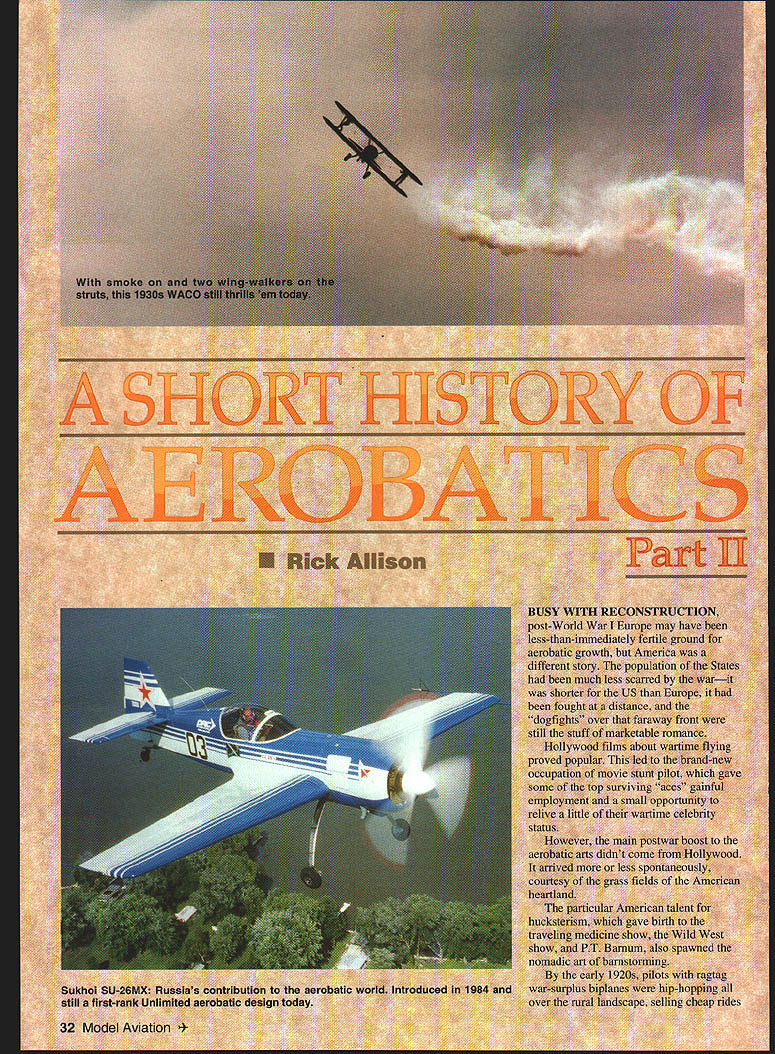
By the early 1920s pilots with rag‑tag war‑surplus biplanes hopped across the rural landscape selling cheap rides. These home airborne hobos lived by their wits—nights under a wing and days hustling enough money for food and gas. Aerobatics became a shill: on arrival over a town, the standard gimmick was a series of loops, rolls, and spins to draw a crowd. It worked—sometimes to the point that onlookers had to be shooed from the makeshift runway. (Unfortunately, crowds attracted by stunts didn't always buy airplane rides.)
Barnstorming was daring, romantic, and showy, and safer than some other flying work, but it was hardly an economic success. Eventually many gypsy pilots settled down and set up fixed operations providing air service to a single community—hence the term FBO, Fixed‑Base Operator. A few independents persisted in roaming, and flying circuses evolved to meet the logistics of larger shows.
Flying Circuses and Display Aerobatics
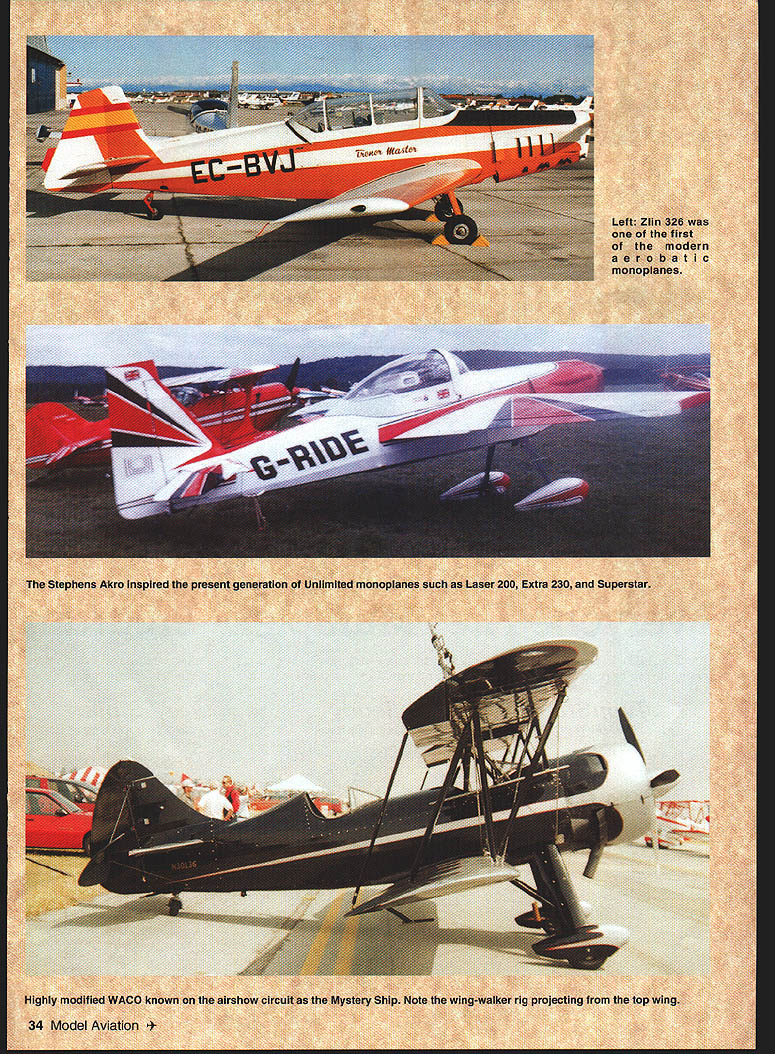
Flying circuses solved the practical problem that one person could not simultaneously fly, work the crowd, and collect money. Barnstormers began banding together in larger groups and borrowing promotional tricks from roadshow carnivals. The first traveling air shows included front men, ticket sellers, wing‑walking, air‑to‑air transfers, and parachutists as window dressing, while aerobatics became the stock‑in‑trade.
New maneuvers appeared almost weekly as pilots competed for reputation and higher pay. Display aerobatics emphasized the spectacular and seemingly impossible; the public paid to be thrilled as spectators rather than as participants.
The Rise of Competitions
The quest for reputations and paydays led to private acrobatic competitions, cups, and trophies. By the mid‑1920s aerobatics had become an established pursuit. With recovering prosperity in Europe, organized competition frameworks appeared: formal maneuver schedules, methods of scoring, and judging standards were developed, culminating in the first Aerobatic World Championships held in Paris in 1934. America, the land of showmanship, was slower to adopt the rigorous European competitive approach.
The famous Freddie Lund Trophy in the United States became the premier invitational aerobatic event for air show pilots, centered on freestyle flying.
Notable Maneuvers and Early Innovators
- Point / Hesitation Roll: One of the first popular display figures.
- Knife‑edge flight: Underpowered biplanes with large fuselages discovered reasonable knife‑edge performance.
- Avalanche: A compound maneuver that followed early rolls and loops.
- Full Vertical Roll (1927): Credited to RAF pilot Allen Wheeler — the first full vertical roll.
- Outside Loop (1927): Jimmy Doolittle flew the first complete outside loop in his Curtiss P‑1B, using ample horsepower to complete what earlier British pilots could only half do.
- Inverted oil/fuel systems and sustained inverted flight: Developed by German pilot Gerhard Fieseler.
- Rolling Circle (1929): Invented by Gerhard Fieseler, a difficult rolling figure.
- Cuban Eight (1936): Invented ad‑lib by Len Povey at the All American Air Race Meeting in Miami; named casually when Povey described a new figure to the press.
Notable pilots of the era include Jimmy Doolittle, Gerhard Fieseler, Len Povey, and later legends such as Chuck Yeager and Bob Hoover.
Military Demonstration Teams
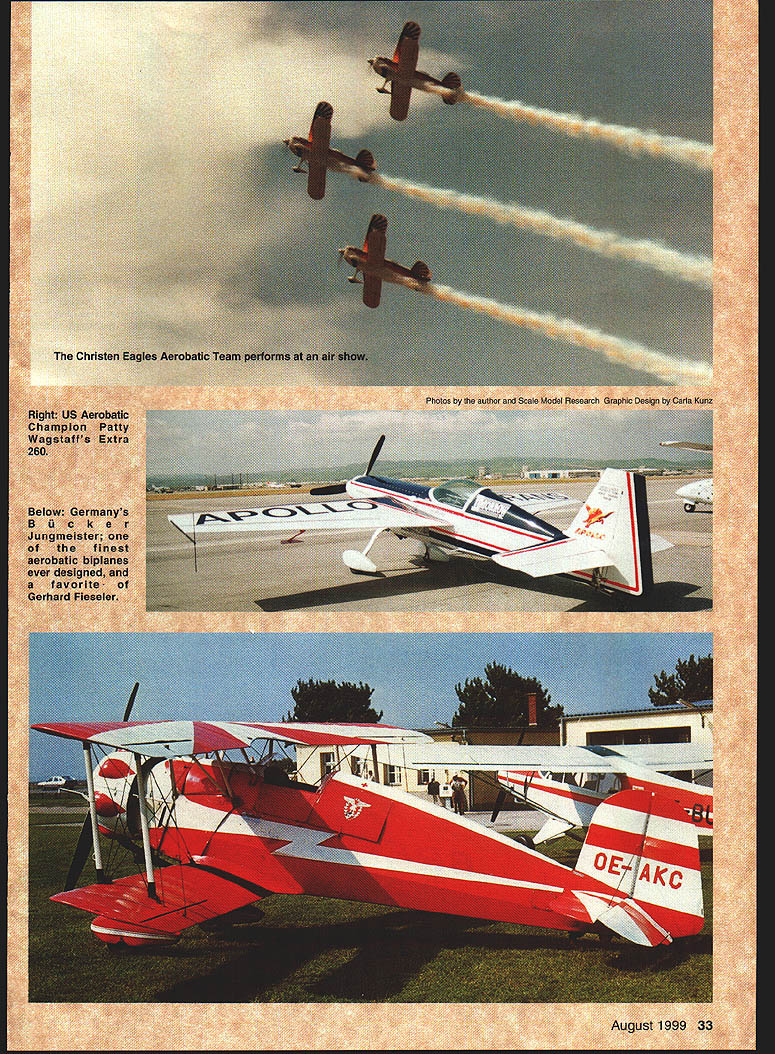
Late in the 1920s the first military flight demonstration teams formed in response to promoters’ requests for military participation. Formation aerobatics emerged as a public spectacle. In the 1930s the US Army Air Corps Red Knights thrilled crowds with Curtiss Hawk biplanes, inspiring recruits and providing a training pipeline for combat pilots. Postwar, the US Navy Blue Angels (formed 1946) and the USAF Thunderbirds continued the tradition. Today most countries with even rudimentary air forces field demonstration teams.
Between the Wars and World War II
Bigger, faster, and stronger aircraft trended up to World War II. Aerobatics became essential training for combat pilots, and public display aerobatics receded as survival skills took precedence.
Postwar: Lockheed Trophy and the Lomcevak
After WWII, the Lockheed Trophy in Britain became the most prestigious international aerobatic event. Unlike later FAI formal competitions, the Lockheed Trophy emphasized freestyle flying and artistic impression.
In the mid‑1950s Czechoslovak pilots introduced the Lomcevak at the Lockheed Trophy. The name is variously translated as “log in the head,” “headache,” or a slangy “look at that drunk trying to walk.” The Lomcevak was the first widely noted gyroscopic maneuver and remains one of the most spectacular.
Gyroscopic maneuvers exploit gyroscopic precession from the spinning propeller. The pilot inputs controls to maximize that force and essentially watches the aircraft tumble until energy dissipates and recovery is possible. The classic Lomcevak is entered from a 45° up line, at cruise speed or below, with full throttle. Full right rudder, full left aileron, and full down elevator are applied; the result is a graceful end‑for‑end tumble across all three axes, often finishing in an inverted spin.
Standardization: Aresti Notation and Competitive Aerobatics
The first postwar modern‑format FAI World Championships were held in Czechoslovakia in 1960; Frank Price was the lone American entrant. In 1962 the Aerobatics Club of America organized the first official US National Aerobatic Championships (Phoenix, Arizona), won by Duane Cole. The US sent a first team to the 1962 World Championships in Budapest (Duane Cole, Lindsey Parsons, Rod Jocelyn); Parsons placed a notable fifth in an underpowered Great Lakes biplane.
The next major development was Count Jose Luis Aresti’s aerobatic shorthand and scoring system (Sistema Aresti). What began as simple line diagrams taped to an instrument panel became the Aresti notation formally used at the 1964 FAI World Championships. Aresti notation evolved into the FAI Aerobatic Catalog and enabled worldwide standardization and objective judging of formal aerobatic flight. The Aresti system is reflected in many competition regulations, including AMA competition references for scale aerobatics.
The Modern Era: Gyroscopic Tumbling, Torque Roll, and Freestyle
Around 1972 Charlie Hillard invented the Torque Roll. The maneuver resembles a tail slide, then the aircraft is hung on the prop and a continuous roll is initiated. With a right‑turning prop, engine torque keeps the roll going until the aircraft begins to slide back; the ailerons are then reversed (because the direction of flight is now reversed) to keep the left roll going. Recovery is by closing the throttle and finishing like a tail slide recovery.
In 1974 Swiss champion Eric Müller invented the Zwirbelturm (Spiral Tower). From a right roll on a vertical up line a tumble begins resembling an inverted ascending spin; controls are reversed to transition to an upright flat spin as the aircraft reaches apogee and descends.
In the mid‑1970s, heavier, more powerful aircraft (with greater inertia and precessive forces) ignited an explosion in tumbling maneuvers. Variations proliferated rapidly; many are so complex that precise Aresti description or standardization is impractical. Consequently, gyroscopic tumbling figures like the Lomcevak and Torque Roll were largely excluded from strict competition judging focused on geometric precision.
However, these figures were too popular to vanish. They became the centerpiece of the modern Four‑Minute Freestyle event (judged similarly to the old Lockheed Trophy), where artistic impression and spectacle are paramount. Freestyle remains the cutting edge of aerobatics and the venue where pioneers still discover new forms of flight.
Influence from Aeromodelling and the Future
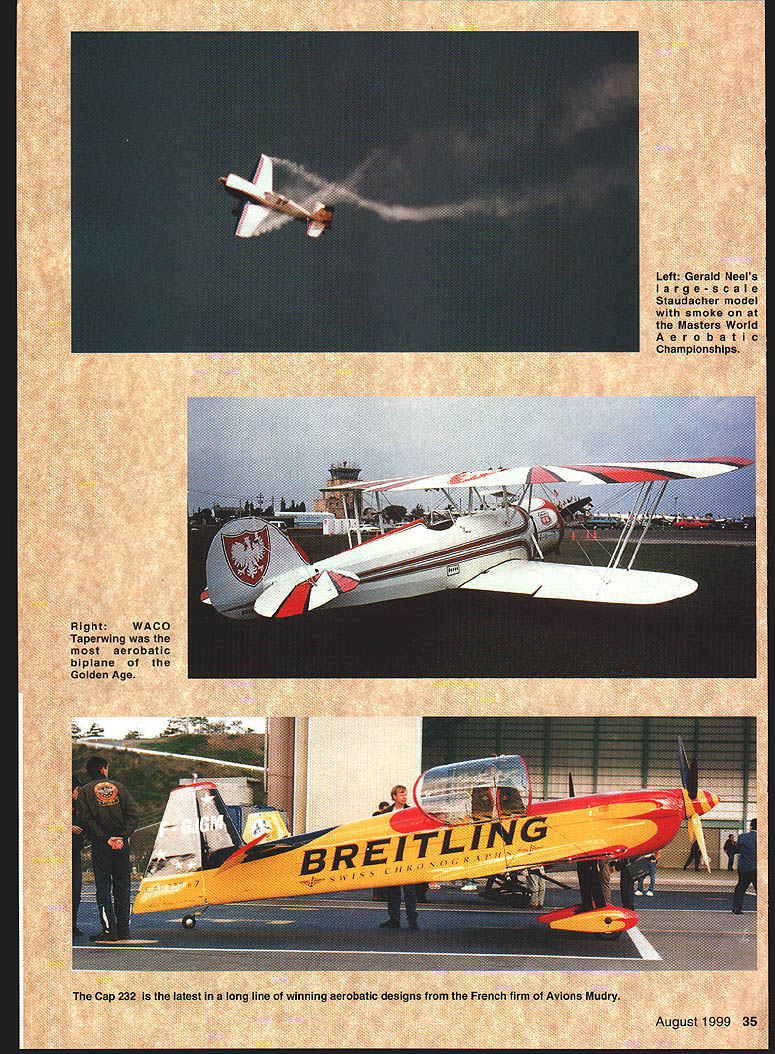
Aeromodelling has long borrowed from full‑scale aerobatics; recently it may be giving back. Full‑scale competitors and air show pilots who have judged or performed at the Tournament of Champions (TOC) in Las Vegas often return inspired by the inventiveness in the Four‑Minute Free. If any spectacular 3‑D moves from model aviation can be scaled to full‑size piloted aircraft, expect to see them soon—down low, at show center, and with smoke on.
Transcribed from original scans by AI. Minor OCR errors may remain.

