
Show and Tell
Nine thousand youngsters at 36 schools have learned about modeling through this gentleman's efforts. His file of thank-you letters from the kids is something to behold.
Jesse F. Shepherd, Sr.
Program and audience
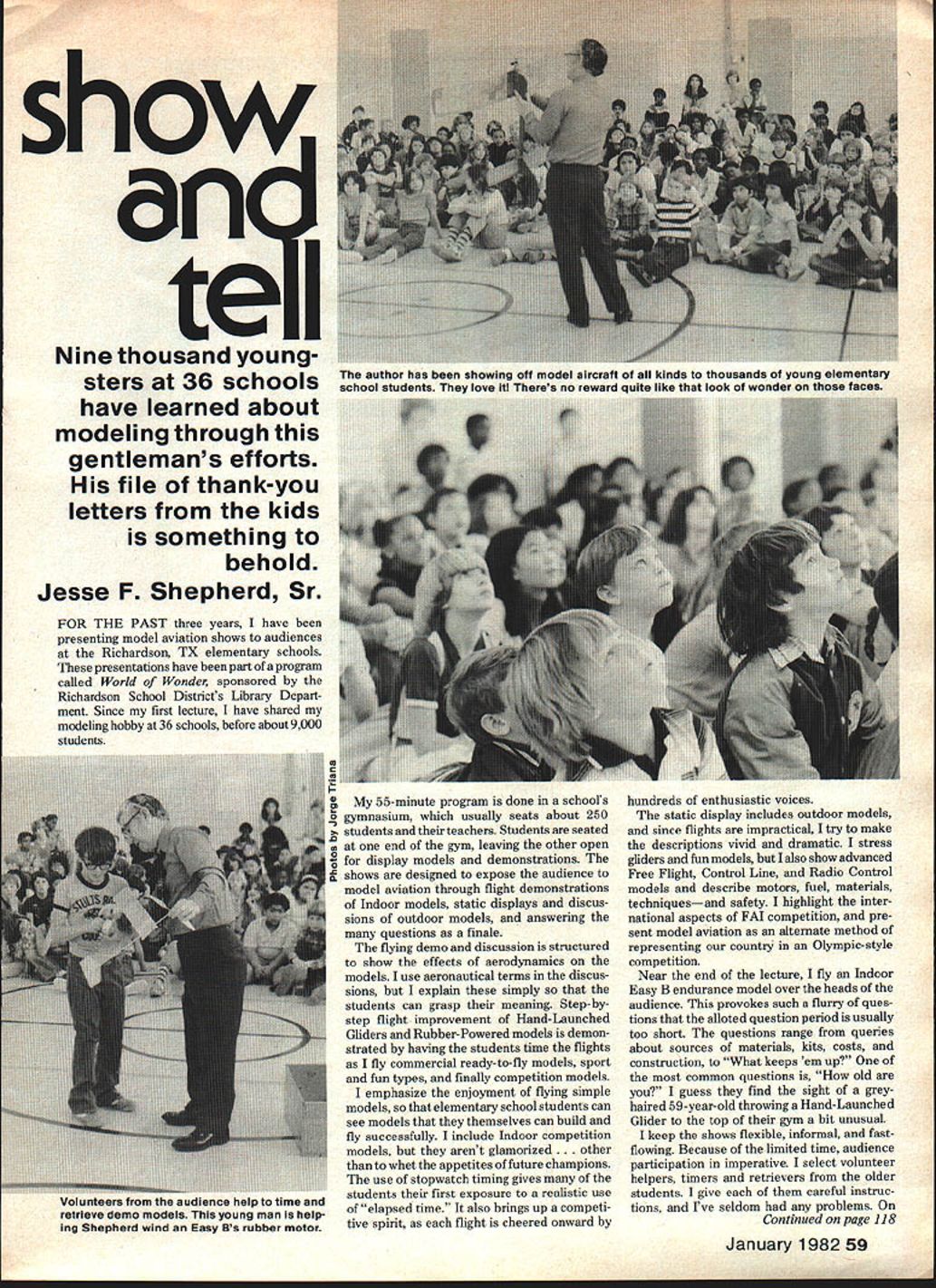
For the past three years I have been presenting model aviation shows to audiences at the Richardson, TX, elementary schools. These presentations have been part of a program called World of Wonder, sponsored by the Richardson School District's Library Department. Since my first lecture, I have shared my modeling hobby at 36 schools, before about 9,000 students.
Format of the presentation
My 55-minute program is done in a school's gymnasium, which usually seats about 250 students and their teachers. Students are seated at one end of the gym, leaving the other open for display models and demonstrations. The shows are designed to expose the audience to model aviation through:
- flight demonstrations of indoor models,
- static displays and discussions of outdoor models, and
- answering the many questions as a finale.
Demonstrations and teaching approach
The flying demo and discussion are structured to show the effects of aerodynamics on the models. I use aeronautical terms in the discussions, but I explain these simply so that the students can grasp their meaning. Step-by-step flight improvement of hand-launched gliders and rubber-powered models is demonstrated by having the students time the flights as I fly commercial ready-to-fly models, sport and fun types, and finally competition models.
I emphasize the enjoyment of flying simple models, so that elementary school students can see models that they themselves can build and fly successfully. I include indoor competition models, but they aren't glamorized—other than to whet the appetites of future champions. The use of stopwatch timing gives many of the students their first exposure to a realistic use of "elapsed time." It also brings up a competitive spirit, as each flight is cheered onward by hundreds of enthusiastic voices.
Static displays
The static display includes outdoor models, and since flights are impractical, I try to make the descriptions vivid and dramatic. I stress gliders and fun models, but I also show advanced Free Flight, Control Line, and Radio Control models and describe:
- motors and fuel,
- materials and construction techniques, and
- safety.
I highlight the international aspects of FAI competition and present model aviation as an alternate method of representing our country in an Olympic-style competition.
Indoor finale and questions
Near the end of the lecture, I fly an Indoor Easy-B endurance model over the heads of the audience. This provokes such a flurry of questions that the allotted question period is usually too short. The questions range from queries about sources of materials, kits, costs, and construction, to "What keeps 'em up?" One of the most common questions is, "How old are you?" I guess they find the sight of a gray-haired 59-year-old throwing a hand-launched glider to the top of their gym a bit unusual.
Audience participation and safety
I keep the shows flexible, informal, and fast-flowing. Because of the limited time, audience participation is imperative. I select volunteer helpers, timers, and retrievers from the older students. I give each of them careful instructions, and I've seldom had any problems.
Crowd control is a must. The space limitations and unpredictable flight patterns of indoor models mean that the audience gets strict instructions on how to handle a model that lands near them. In 36 shows, only three models have ever been damaged, and only one needed extensive repair. I think that's an excellent record.
Thoughts on youth and modeling
I believe that our hobby desperately needs youngsters like these as tomorrow's builders and competitors. Unless we encourage them and give them the attention they deserve, there may be no tomorrow for modeling. I believe that the complex and glamorous models that we advanced modelers are so anxious to show off discourage many youthful builders, especially if they attempt one before success is possible. In my lectures I have tried to return some dignity and glamour to simple, fun-flying models. To go beyond the "show and tell" stage, local modelers, teachers, and parents have to follow up and capture that enthusiasm while it is there.
Invitation
I hope to continue these programs in other nearby towns and cities, and to encourage other modelers to begin programs similar to mine. If anyone would like information about how to start such a program, I'll be glad to assist in any way possible.
Contact
Jesse F. Shepherd, Sr. 2713 Summit View Bedford, TX 76021
Transcribed from original scans by AI. Minor OCR errors may remain.

