
Show Teams
New AMA and HIA national program promotes model aviation to the general public.
MODEL AIR-SHOW TEAMS came of age at Transpo '72, a ten-day aviation extravaganza near Washington, D.C. that had all forms of sport aviation performing daily to large crowds of spectators. AMA fliers stole the show many times at Transpo, especially when full-scale aviation acts were unable to perform due to weather or equipment problems. From the inspiration of that beginning, several more or less permanent model flying show teams have developed; notably the original AMA Air Show Team from the Delaware, Pennsylvania, New Jersey area and Colonel Betkey's Flying Circus in Ohio. Both teams have presented AMA's Distinguished Service Awards for their several years of model aviation promotional activity.
AMA's former PR director, Bob Lopshire, was a key figure in establishing the original AMA Team and the Transpo show format. His efforts laid the groundwork for the nationwide program described here which has been developed by AMA's current PR director, Larry Bolich, and AMA HQ assistant Hobie Steele, under the direction of AMA Executive Director John Worth.
Aside from AMA's effort, many individual hobby industry firms and the Hobby Industry Assoc. have made the new program possible — air shows use a lot of models, props, fuel, engines, radio equipment and related material. Without industry help the program could not be sustained. In grateful appreciation of that help and the hope of expanding what has gone on before, this article is dedicated to all who have contributed.
You've heard the words many times: "The Show Must Go On," or "There's No Business Like Show Business"... they certainly apply to avid modelers who are currently devoting their time, energy, and talents to show the general public what the modern world of model aviation is all about.
Of the over 1200 chartered AMA clubs throughout the country, many, at one time or another have had to generate more enthusiasm for their club, recruit new members, get more recognition with their home-town folks, especially when flying site help is needed. In order to do so the Air-Show Team concept has media appeal. It has become a valuable way to achieve local public recognition. The program is intended to focus on show-biz type flying rather than the type usually seen in contests, since competition events have no spectator appeal. Air shows better relate to the general public and are usually easier to get PR mileage from than typical competition events. Exceptions are national and international meets which have greater prestige and universal appeal; in those cases, however, air shows are helpful to explain what competition flying is about without interfering with or compromising competition events.
The concept of organizing groups of model airplane enthusiasts into show teams solely for the purpose of presenting model aviation shows has come into its own over the last few years. Such teams have annual schedules of shows they present, usually during the spring, summer and fall months when good weather opportunities are available. A lot of dedication is involved. Members of a show team spend off-season time building new aircraft, creating new model aviation acts, exchanging ideas, improving the show, attending rigid practice sessions, holding regular meetings and planning the next season.
Typically an air-show team flies radio-controlled aircraft. However, teams have featured control-line acts. Free-flight demonstrations have proven great crowd pleasers. Most teams have found it best to be flexible and able to stage shows of various lengths designed to fit specific requirements of the time available and the nature of the audience. In some cases a full-scale air show has been scratched because of inclement weather; the model aviation show team has flown instead and saved the day.
Show Teams
have planned and presented static displays in shopping malls, given model demonstrations for local civic groups or have helped a worthy charitable organization raise funds. These are the ingredients upon which AMA's new Air-Show Team concept has been developed.
An important sidelight is the need to change the "Toy Airplane" image which the general public seems to hold concerning model aviation — most of our neighbors still seem to think of model airplanes as something only kids are (or should be) involved with. Few have any appreciation of our activity which is now mostly an adult hobby/sport. AMA HQ has therefore been developing a plan for using a program of air-show teams as a national PR vehicle to get the model aviation sport/hobby message to John Q. Public. The Air-Show Team concept has media appeal — it has become a valuable way to achieve local public recognition. The program is intended to focus on "show biz" type flying, rather than the type usually seen at contests. This is not to say that competition events have no spectator appeal, but air shows better relate to the general public and are usually easier to get PR mileage from than typical competition events. Exceptions are national or international meets which have greater prestige and more universal appeal. In many cases, however, an air show is helpful at a contest to explain what competition flying is all about, without interfering with or compromising competition events.
The concept of organizing groups of model airplane enthusiasts as show teams, solely for the purpose of presenting model aviation shows has come into its own in the last few years. Such teams have annual schedules of shows they present, usually during the spring, summer and fall months when good weather opportunities are available.
A lot of dedication is involved. Members of a show team spend off-season time building new aircraft, creating new model aviation acts, exchanging ideas to improve the show, attending rigid practice sessions, holding regular meetings and planning for the next season.
Typically, an air-show team flies radio-controlled aircraft. However, many teams have featured Control-Line acts and Free-Flight demonstrations which have proven great crowd pleasers. Most teams have found it best to be flexible and able to stage shows of various lengths, designed to fit the specific requirements of the time available and the nature of the audience.
In some cases where a full-scale air show has been scratched because of inclement weather, a model aviation show team has flown instead, and saved the day, to the great satisfaction of an otherwise disappointed crowd. This has happened enough times, especially when low ceilings or windy weather has prevailed, that there is now a show-team motto: "We Fly When Others Won't."
To make the program work, AMA, together with the Hobby Industry Assoc., is sponsoring the concept. Both AMA and HIA contributed matching funds to finance segments of the program. Further evidence of the importance of this effort is reflected in the fact that a new AMA Leader Member category has been created for show-team managers.
Teams are classed according to the number of shows performed annually and will receive a proportionate amount of support. Uniform items such as patches, caps, shirts, jump suits and the like, as well as decals, signs and handouts will be furnished by joint AMA–HIA sponsorship.
Using a nucleus of existing AMA-chartered club teams and others (such as the AMA show team in Pennsylvania, Betkey's Flying Circus in Ohio and DC/RC Club team in Washington, D.C.), the Air Show Team program will be expanded to include new groups as rapidly as they can achieve similar performance records.
Teams will receive incentive both to quality and quantity of their shows by a rating system which will provide more assistance for the most active air-show teams and still help all ASTs with items of merchandise, fuel, accessories, signs and publicity handouts. But this is no mere "freebie" program—supplies will go only to those who meet program requirements.
Administered through AMA, the AST concept promises to be an outstanding program for introducing masses of people to the excitement and fun of model aviation. From the ranks of spectators are expected to come many new aeromodelers, friends of the sport and assistance in the search for additional flying sites. Aeromodeling activity should grow through AST exposure as the public becomes better informed and responds with a more sympathetic ear for aeromodeler's problems. With the support of HIA and industry manufacturers, and the administration of the AST Program by AMA headquarters, the Air-Show Team concept is expected to eventually cover the nation with a network of active, top-quality model aviation fliers selling aeromodeling to the public every weekend. Only a few clubs are involved now, so many more can get in on the ground floor of this new but well-founded program. The following information explains how others can join the effort and the fun.
Guidelines and Rules for an AMA Sanctioned Air-Show Team
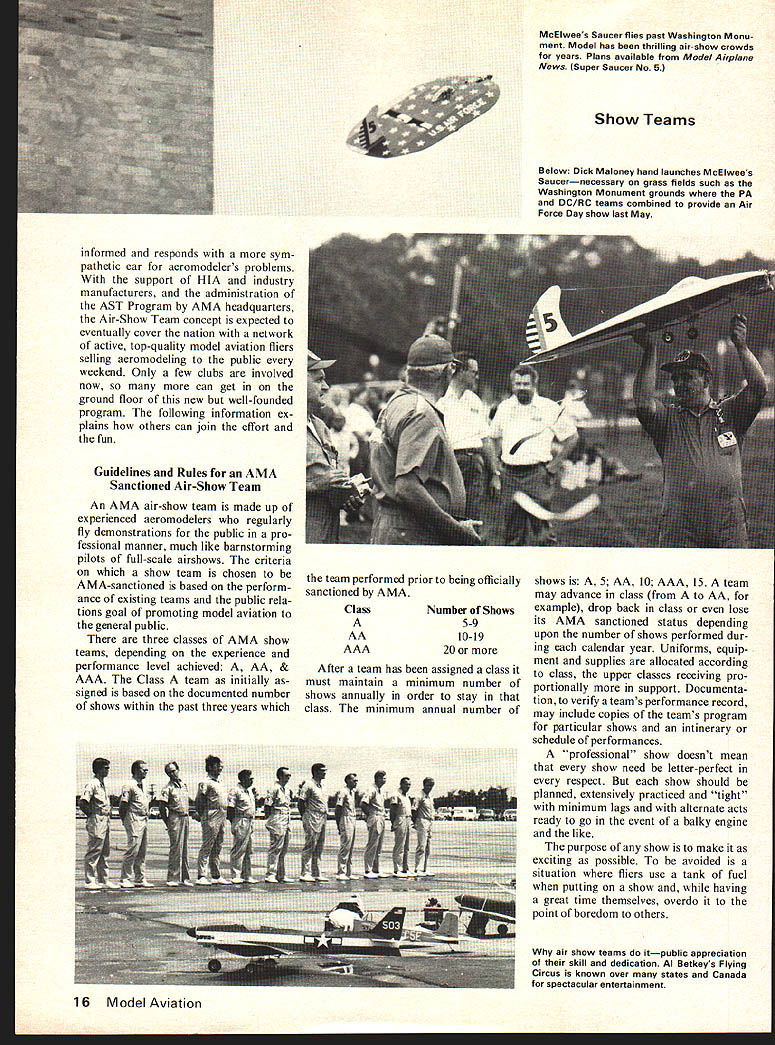
An AMA air-show team is made up of experienced aeromodelers who regularly fly demonstrations for the public in a professional manner, much like barnstorming pilots of full-scale airshows. The criteria on which a show team is chosen to be AMA-sanctioned is based on the performance of existing teams and the public relations goal of promoting model aviation to the general public.
There are three classes of AMA show teams, depending on the experience and performance level achieved: A, AA, & AAA. The Class A team is initially assigned based on the documented number of shows within the past three years which the team performed prior to being officially sanctioned by AMA.
Class Number of Shows A 5-9 AA 10-19 AAA 20 or more
After a team has been assigned a class it must maintain a minimum number of shows annually in order to stay in that class. The minimum annual number of shows is: A, 5; AA, 10; AAA, 15. A team may advance in class (from A to AA, for example), drop back in class or even lose its AMA sanctioned status depending upon the number of shows performed during each calendar year. Uniforms, equipment and supplies are allocated according to class, the upper classes receiving proportionally more in support. Documentation, to verify a team's performance record, may include copies of the team's program for particular shows and an itinerary or schedule of performances.
A "professional" show doesn't mean that every show need be letter-perfect in every respect. But each show should be planned, extensively practiced and "tight" with minimum lags and with alternate acts ready to go in the event of a balky engine or the like.
The purpose of any show is to make it as exciting as possible. To be avoided is a situation where fliers use a tank of fuel when putting on a show and, while having a great time themselves, overdo it to the point of boredom to others. Team fliers should be drilled in performing two-to-five minutes of air time with any given flight—and normally, to never do the same thing twice in the way of show material offered. Lost time should be minimized and at least one aircraft should be in the air at all times, which requires engine starting, if necessary, before the preceding act approaches landing.
Safety is a prime requisite for any air-show team and the AMA safety code must be strictly adhered to at every moment. Flight paths should be parallel to spectator barricade lines and any parachute or confetti drops, rocket firing, and the like should be done away from the crowd; absolutely no flight over spectators should be permitted.
Practice makes perfect and the regular show team members, plus essential alternates, should be dedicated, should practice individually, and be resolved to work together at least weekly during the show season—more often when developing acts and putting the show together initially.
A show team practice field separate from the regular club flying site is a helpful asset. Team members—including pit men, alternates, and announcers—should be willing to work together both in practice sessions and in performances for total team benefit. Those whose jobs or family responsibilities take them out of town during practice sessions or show (as well as modelers who regularly fly the contest circuit) should generally not be included on the team since, regardless of individual inconvenience and other factors, "the show must go on." It's not merely a matter of tradition, it's an obligation to do what has been promised—the honoring of a commitment.
A good show team needs those who are willing to build models although the builder doesn't necessarily have to be a flier. Naturally, the actual performance time for a pilot is very little compared to the time spent in preparation. This ground work includes building the model, test flying, individual practice and team practice sessions to develop and coordinate an overall air show, plus travel time to shows and on-site staging of logistical support equipment.
How large and elaborate an air show should be depends upon how many willing volunteers are available, also their imagination and initiative. The minimum number of AMA Sanctioned Air Show Team members is six, consisting of the team manager, announcer, and four fliers.
One AAA Team has expanded from a crew of 13 members to three six-man teams (including a captain and an announcer for each) plus a coordinator who schedules performances and assigns shows to each team in turn. This way, all requests for shows can be met while fliers need tie-up only two days a month in actual performances (although practice is required nearly every week-end between shows).
The Team Manager must be both "mother hen" and drill sergeant over the team, seeing to it that each member is notified of show dates, ensuring that every man on the team is completely drilled in his part in the show, that each man is always up to expectations in equipment and self, that back-up ships are available to keep the team airborne at all times, doing necessary building for the team himself, watching over frequency conflicts and seeing that product reports are sent back to HQ for supporting manufacturers on a regular basis.
The manager's personality must be firm, but understanding, one that commands respect without being overbearing. Timer of the show, he must be virtually unflappable.
He must notify each man of the precise moment to start his engine, to stand by, then take off while watching and timing those already in the air—and then give the command for landing. He must also note any engine failure in the air—and give the command for landing (and warning to others who may not be aware). He must also be able to stretch an act as necessary. He must be cool at "ground zero" with a definite "show biz" feel for timing and showmanship. The importance of a team manager is recognized by the new AMA Leader Member designation for Show Team Manager. A LM/STM rating is just as meaningful as LM/Judge or LM/Contest Director. Team members are usually picked by the team manager. A good team member is one who is not committed to the contest circuit, and wants to do more than just Sunday flying. He's also an innovator, and normally helpful to others in problem solving or aiding a newcomer in flight training. He's the one who usually has something different at a flying field, and is not an air hog or scorner of safety-first. He should be a cooperative soul rather than a loner, not short tempered, but possessed of a good sense of humor.
Each show team should have minimum family encumbrances to limit his appearances, i.e., parental or marital situations in strain, and none should ever be placed in situations that might cause employment problems to team appearance dates (sometimes mid-week, etc.). In addition to all the above, each team member should be a good builder and a good repair man, keeping his equipment in show condition at all times. Finally, each team member must be one who works well with others, the crux of any team. Picked by the team manager, members may be removed from the team at his discretion for missing two or three shows (or practice sessions), for unsafe flying, or lack of team work.
The announcer is the team mouthpiece, the one who tells the public what the team is all about—and what modeling is all about—the prime reason for the team's existence. He is a key man, and one to be chosen carefully. He need not be a "comic" but must be quick thinking. He should be sensitive, with a good speaking voice and the ability to ad-lib as necessary. He need not be a great flier, but well informed on all the facets of aeromodeling.
This will be the first experience with modern miniature aircraft for most spectators since they outgrew the 10¢ gliders of their youth, so it is extremely important that the announcer describes accurately what is happening, explains the mechanics of the aircraft and promotes a favorable public impression of the sport of aeromodeling.
An AMA sanctioned Air Show Team (AST) can begin with a nucleus of two or three dedicated club members or neighboring fliers to develop a possible program, routines and simple rules for AST membership. Recruiting of additional members may be through announcements at club meetings or on a one-to-one basis by the original members. Interest should grow as public performances begin and the AST may eventually have to choose members from many applicants. After five shows, applications may be made to AMA HQ for AST charter and Leader Member/STM for the manager if desired.
Team Requirements
The following was edited from carefully prepared and proven rules of Col. Betkey's Flying Circus, the AMA Ohio area AST. It is recommended for basic guidelines to any team:
Members of the Air-Show Team should be chosen because of their ability, personalities, and capability of working well with others. Technicians on the team who have flying ability should be given the opportunity to fill a pilot's slot when an opening arises.
When a new member is being considered for the team, he must first demonstrate his flying ability before consideration is given his membership by other members of the team.
The membership should look for a number of the following qualities and attributes when considering a new team member:
Have the ability to work well with others? Possess good sportsmanship qualities? Have a pleasing personality? Reflect loyalty in his past actions? Have proficiency in the area to which he is being selected? Reflect perseverance? Have family support and understanding of the time that he must put forth in the team activities (building sessions, meetings, practice, shows, and the like)? Have past contribution toward his local club efforts? Have the willingness to forgo contests to appear in shows?
New Members
Each new member will bring to the team his own aircraft, radios, and certain uniform items at which time he will be presented Silver AMA wings. These wings must be worn on the right collar, near tip for every show team function. Failure to wear these wings will be considered improper dress and the new member will be excused from that performance or function (shows, static displays, speaking engagements, radio and television appearances, etc.).
Each new member must complete one flying season with the Team (May–October, for example) or at least ten shows, whichever comes first, before he receives his gold AMA wings and full-team benefits.
During the trial period, a new member will receive certain supplies depending on his function and the availability of material. Other benefits will be reserved unless he damages his own aircraft during a show team performance, or the team manager designates this man to perform a particular routine where a special aircraft is needed.
Responsibility
Each man is assigned a specific function in the setting up, tearing down and packing away the equipment for each show and is expected to be ready for the next performance. (Aircraft ready; uniform and shoes clean, plus any show prop ready that he is responsible for.) Each member is responsible to support other members and to alleviate a situation where there may be any adverse or loose gossip concerning any of his fellow team members.
No profane language is permitted during a performance.
While flying a routine, smoking is not permitted.
Personal conduct should at all times be conducive to that of an AMA-sanctioned Show-Team Member.
Show-team meetings will be held at regular intervals with an emergency meeting called as necessary.
All show dates, team static displays and special functions must be agreed upon before a date is confirmed to the sponsoring organization.
No letters should be sent out except on team letterhead and with the approval of the team manager.
All information concerning the team dress code, safety, etc., should be discussed at meetings. New routines will be introduced to the team, for approval, before being used.
Try your suggestions out on the entire team membership, not on one or two individuals. By putting your ideas before the members, the team can discuss them and work together to make final decisions as a unit. The sole aim is to see that the entire team moves in the same proper direction.
Correct uniform must be worn at all times (including wings). No tennis shoes. All pockets empty before line-up and during performance. No additional patches or lettering on uniform unless agreed upon by the full membership. Location of same is also decided on by the full membership.
When a crowd is anticipated to be in excess of 500 people, the show sponsor must have relief facilities and make arrangements for the Red Cross to have a first-aid station at the flying site.
Immediately upon arrival at the show site, a spectator line is established and no one is allowed beyond this point, with the exception of uniformed team members and special invited guests.
No spectator is permitted across either end of the aircraft take-off or approach strip.
If anyone disregards these rules, the show must be stopped and will not resume until spectators are behind the lines.
A pilot's meeting will precede each show during which the entire program is reviewed, double checking assigned responsibilities, the sequence of routines and last minute checks of wiring and switches for pyrotechnics and special effects.
Pre-flight inspection is a must. Check exterior linkages, engine mounting bolts, hinges, props for fractures, radio range check, and the like.
Pilots are required to sacrifice their aircraft with full-blown elevator, if circumstances require—such as dead-stick approach with a cross-wind condition which would cause an apparent landing into the spectators.
All turns must be made away from the spectators. Always have a team member calling for the pilot during such events as Combat, to prevent straying over or near spectators.
Certain routines will be scratched where rough wind conditions could cause the aircraft to turn toward the spectators during the take-off and landing.
AMA prop nuts and plastic rounded spinners of no less than 1/4" radius are required on all powered aircraft.
(Our sincere thanks to Col. Al Betkey for the material from which the preceding was edited. Betkey's Flying Circus is one of the most successful air show teams so their example is a good model for all to follow.)
Show Acts
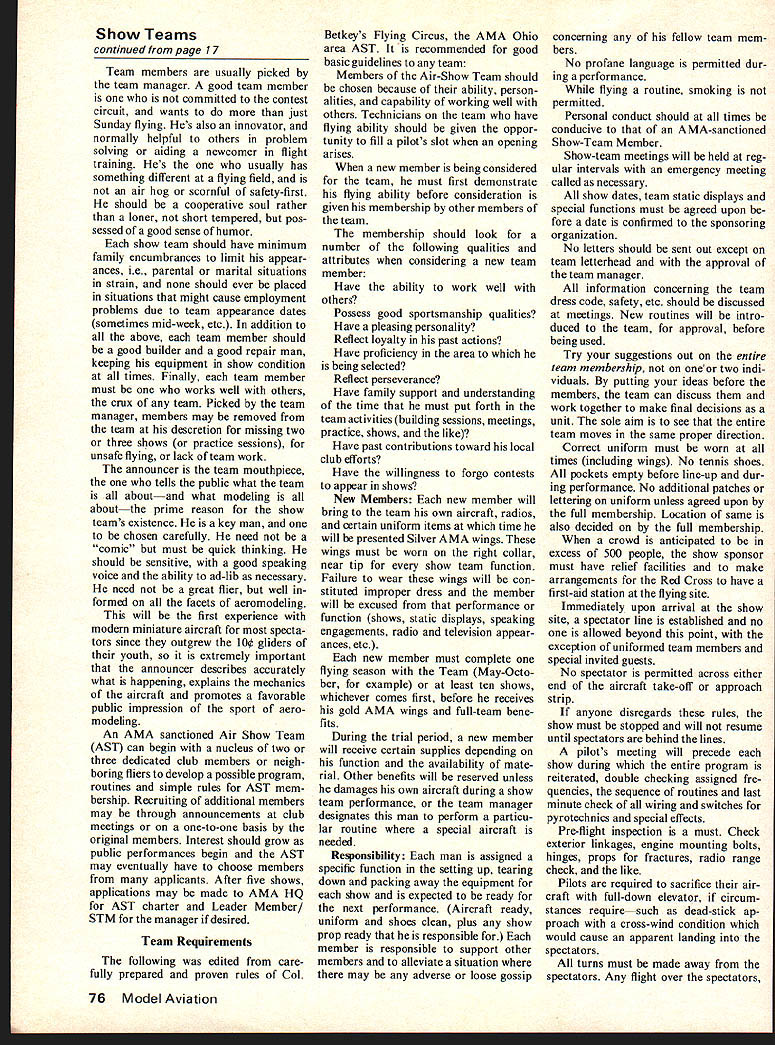
A typical RC show might begin with a demonstration flight showing how each control (rudder, elevator, aileron and throttle) affected the aircraft, then some maneuvers based on combinations of controls (rolls, Immelmann and the like). The announcer, who must use a public address system for crowd coverage, can contribute much to keeping things moving and entertaining the spectators if flight action becomes slow.
A powered sailplane makes a good appearance as it soars aloft and spectators may be safely offered the opportunity to take the stick while the ship has plenty of altitude.
Aerobatic demonstration using a biplane or pattern aircraft with the announcer explaining the intricacies of complex maneuvers like 4- or 8-point rolls can be easily included in any show.
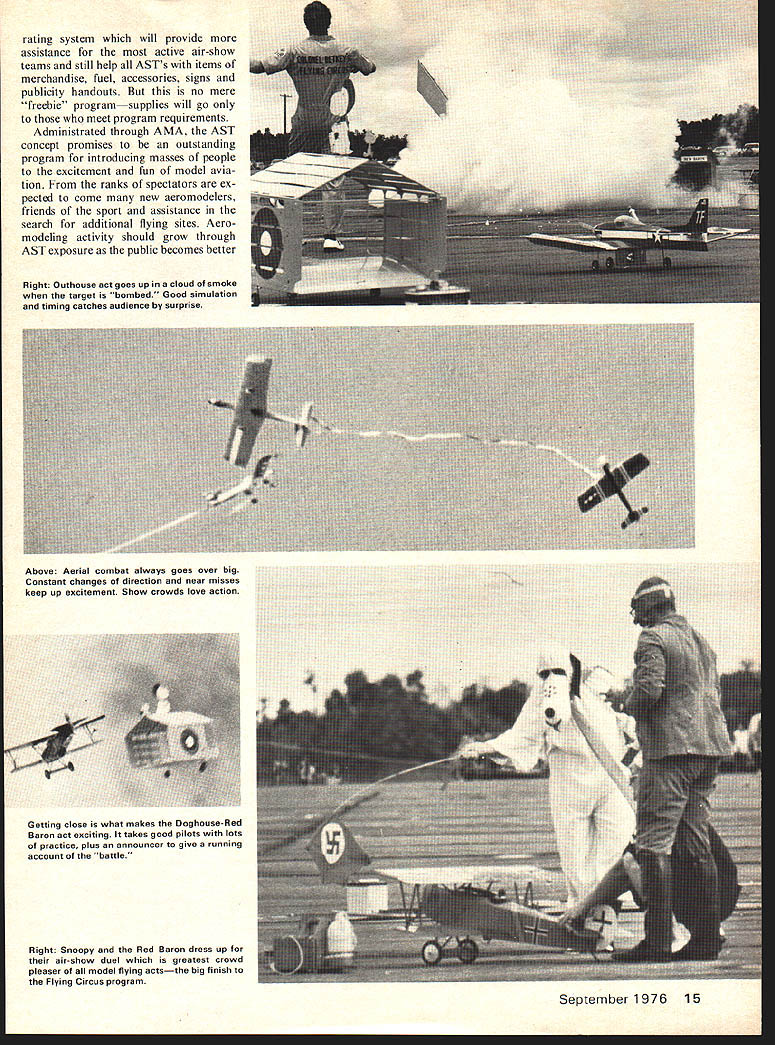
Smoke bombs can add much to any solo acrobatic flight or formation aerobatics and are always crowd-pleasers.
A good closing act is a dog-fight between Snoopy and the Red Baron with the melodrama of the announcer's appeal to cheer Snoopy and boo the Baron. Pyrotechnics and smoke can heighten the excitement.
Other exciting acts can be developed as the team grows—good acts are as unlimited as the team's imagination. More elaborate acts require a good deal more time, material and practice than the basic airshow but many ASTs have added them to their repertoire.
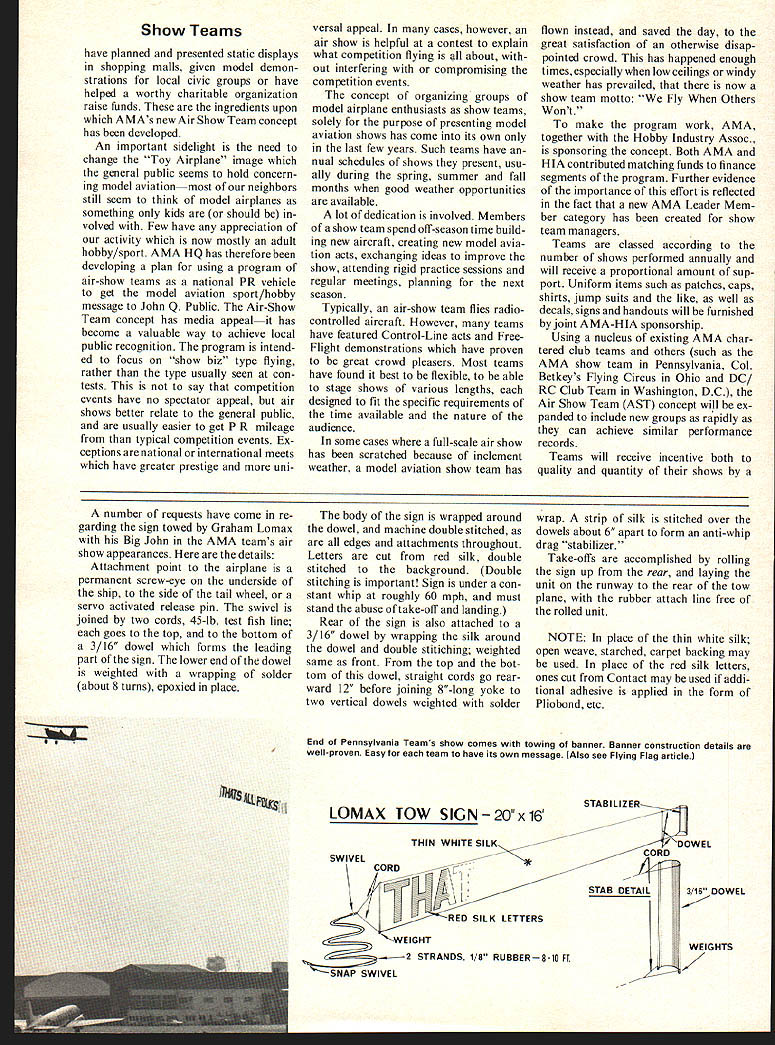
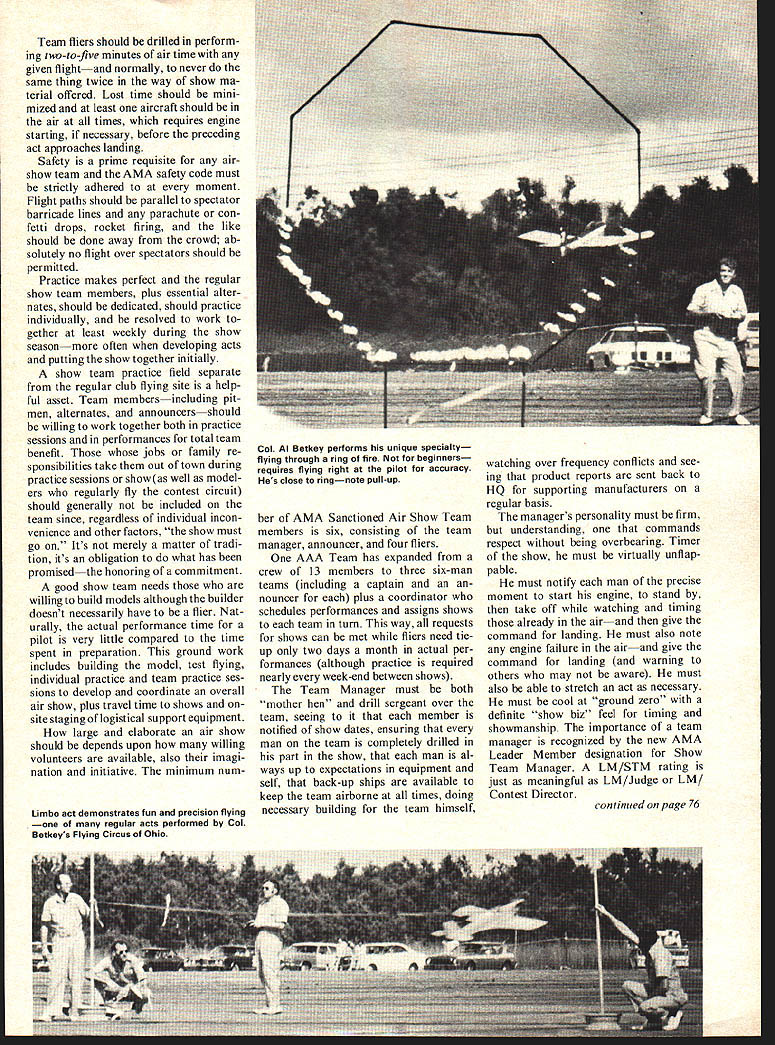
Banner towing apparatus can be added to conventional aircraft and either towed off the ground with a long towline or "snatched" from between standing poles. A flying "lawn mower" can get away from the person "cutting grass" and take off. A "tipsy rube" from the audience can "steal" a plane for daring aerobatics and end by dumping confetti upwind of an unsuspecting crowd. The announcer warns spectators of the "water" ballast the aircraft holds. These types of acts require careful timing, a good script and plenty of rehearsal between the announcer and the performers but make for an exciting and professional show when properly done.
Control line can be exciting for air-show work, too. Competition type flying and variations or simulations of Slow Combat, Team Racing, Fast Combat, Team Stunt Flying and Carrier-type events can develop into an outstanding miniature show within a show. In some circumstances, particularly if wind conditions are favorable, Free Flight model demonstrations are also appropriate—spectators are greatly impressed by modern engine-powered competition models, large rubber-powered craft, graceful tow-line gliders, and scale models.
Fund Raising: In order to show a team's support of community endeavors, it's highly recommended that they perform at fund raising events for such organizations as the Cancer Society, Heart Funds, children's hospitals, and the like. Contributions at such events can be split to help the team with their expenses while raising money for a worthy cause. Buddy Box flights can be sold to the general public on one or more trainer-type aircraft for $1 per minute or so.
Program Administration: AMA HQ administers the air-show program and the disbursement of kits, materials, supplies, publicity handouts, and uniform items including patches, caps, jumpsuits, jackets, shirts, decals, signs and stickers. Direct contact with industry contributors to teams or members is not permitted unless arranged through AMA HQ, to protect the sponsors from unauthorized solicitations.
Pledges from industry are solicited by AMA for the national AST effort and each team will receive items from AMA HQ as earned and required. This makes for a better working relationship between the teams and industry than if every team contacts manufacturers for assistance in haphazard fashion. In this way all teams will receive their fair share so it isn't necessary for teams to solicit material individually. Furthermore, industry sponsors insist that donated material be distributed only as approved by AMA HQ to prevent abuse of good intentions and misuse of promotional merchandise.
The AST concept potentially offers more PR value than any promotion ever undertaken on behalf of aeromodeling. You can start your own AST Program in your community.
For further information on the Air-Show Team Program, write Larry Bolich, Public Relations Director, AMA HQ, for reprints of these rules and guidelines for an AMA Sanctioned Show Team, an application for an AMA Sanctioned Show Team and application for Leader Membership as an Air-Show Team Manager. Performing before crowds of non-modelers is what the Air-Show Team program is about. MODEL AIR-SHOW TEAMS came of age at Transpo '72, the ten-day aviation extravaganza near Washington, D.C. With daily shows for large crowds of spectators, AMA fliers stole the show at Transpo, especially when many full-scale aviation acts were unable to perform due to weather and equipment problems. The inspiration beginning then and in subsequent years is that several less permanent model-flying show teams have developed — notably the original AMA Air-Show Team in the Delaware-Pennsylvania-New Jersey area and Colonel Betkey's Flying Circus in Ohio. Both teams have presented AMA's Distinguished Service Awards and have been active in model aviation promotional activity.
AMA's former PR director Bob Lopshire was a key figure in establishing the original AMA Team and the Transpo show format. His efforts laid the groundwork for the nationwide program described here. AMA's current PR director Larry Bolich and AMA HQ assistant Hobie Steele, under the direction of AMA Executive Director John Worth, have continued the program. Aside from AMA's effort, individual hobby industry firms (HIA) have made the new program possible — air shows use lots of models, props, fuel, engines, radio equipment and related material. Without industry help the program could not be sustained; AMA expresses its grateful appreciation for that help and hopes to expand on what has gone before. This article is dedicated to those who have contributed.
You've heard the words many times — "The Show Must Go On" and "There's No Business Like Show Business." They certainly apply to the avid modelers currently devoting time, energy and talent to showing the general public what the modern world of model aviation is about. With over 1,200 chartered AMA clubs throughout the country, now is the time to generate enthusiasm, recruit new members, get recognition in home-town newspapers and with local flying-site authorities. Help is needed in order to do this.
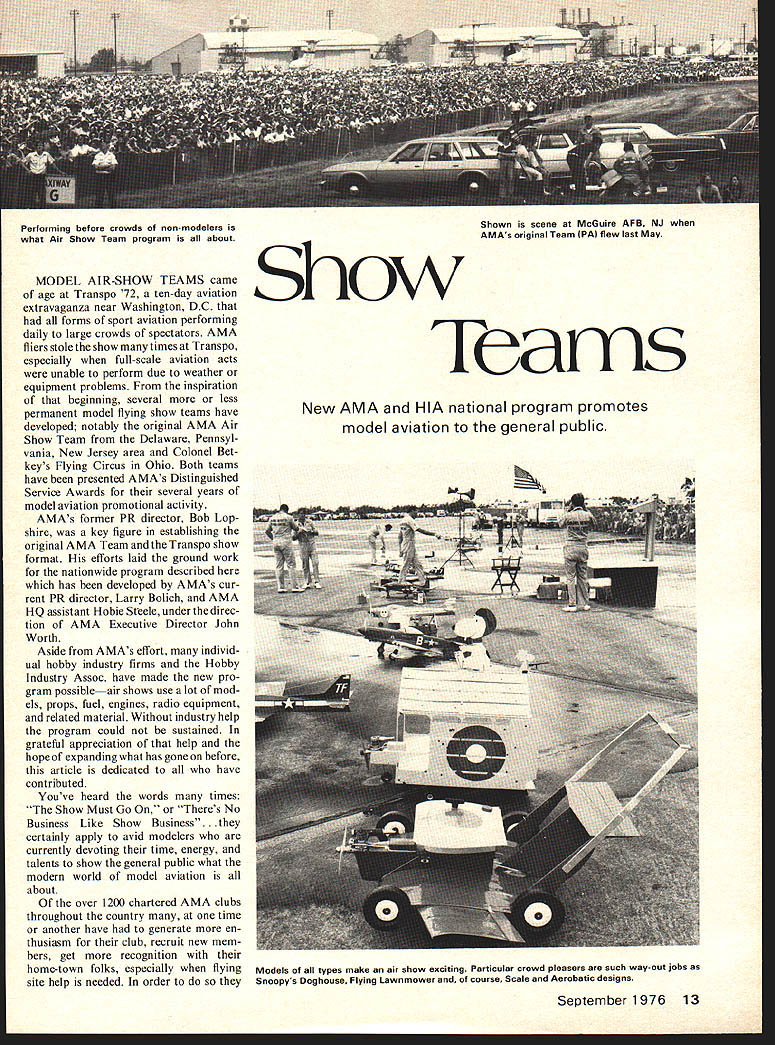
Shown here (photo) at McGuire AFB, N.J., AMA's original Team PA flew last May to show model aviation to the general public.
As of September 1976, 13 teams are participating in the new AMA-HIA national program that promotes models and types that make air shows exciting. Particular crowd-pleasers include the way-out jobs — Snoopy's Doghouse, the Flying Lawnmower course, scale aerobatic designs, etc. Show Teams have planned and presented static displays in shopping malls, given model demonstrations to local civic groups and have helped worthy charitable organizations raise funds. These are some of the ingredients upon which AMA's new Air-Show Team concept has developed.
An important sidelight to the program is the need to change the "toy airplane" image the general public seems to hold concerning model aviation. Most neighbors still seem to think model airplanes are something children should be involved with. Few have an appreciation of the activity now, which is mostly an adult hobby and sport. AMA HQ has therefore developed a plan using the Air-Show Team program as a national PR vehicle to get the model aviation sport/hobby message to John Q. Public.
The Air-Show Team concept has media appeal. It has become a valuable way to achieve local public recognition. The program is intended to focus on show-biz type flying rather than the type usually seen in contests; competition events have no spectator appeal. Air shows relate better to the general public and usually are easier to get PR mileage from than typical competition events. (Exceptions are national and international meets which have greater prestige and universal appeal.) In such cases, however, air-show presentations can be helpful to explain what competition flying is about without interfering with or compromising competition events.
The concept of organizing groups of model-airplane enthusiasts into show teams solely for the purpose of presenting model-aviation shows has come into its own during the last few years. Such teams have annual schedules of shows to present, usually during the spring, summer and fall months when good weather opportunities are available. A lot of dedication is involved. Members of a show team spend the off-season time building new aircraft, creating new model-aviation acts, exchanging ideas, improving the show, attending rigid practice sessions and regular meetings, and planning the next season.
Typically, an air-show team flies radio-controlled aircraft. However, teams have also featured control-line acts and free-flight demonstrations, which have proven great crowd pleasers. Most teams have found it best to be flexible and able to stage shows of various lengths designed to fit specific requirements of time available and the nature of the audience. In some cases a full-scale air show has been scratched because of inclement weather and a model-aviation show team has flown instead, saving the day.
Transcribed from original scans by AI. Minor OCR errors may remain.

