
Shuriken Streak
Designed as a test bed for the new high-tech Shuriken .049/.05 engine, this control-line (CL) sport/trainer has other uses as well. With it you can try out and monitor engine improvements, fuels, props, and other performance items. Additionally, this peppy model makes an excellent Monoline trainer. — John Hunton
The Cox Tee Dee engines, with their steel pistons suited for moderate rpm ranges, have long been the standard of the 1/2A class. Two newly available .049 engines—the Chinese CS and the BV Shuriken (named after the star-shaped weapon used by the Ninja)—offer excellent alternatives. These modern engines use ABC aluminum pistons and chrome-plated brass sleeves, allowing much higher rpm operation and considerably more power. The Shuriken is designed to turn about 30,000 rpm for sport flying and up to 40,000 rpm for limited Speed use.
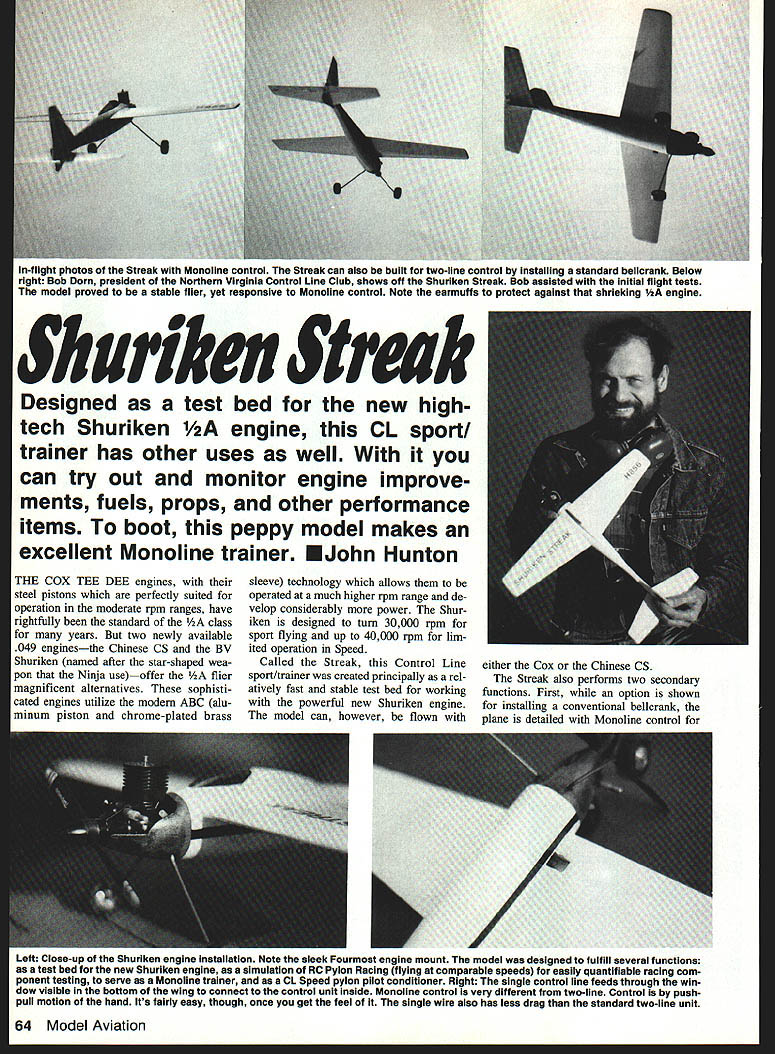
Called the Streak, this CL sport/trainer was created principally as a relatively fast, stable test bed for the powerful new Shuriken engine. The model can, however, be flown with either the Cox or the Chinese CS.
The Streak performs two secondary functions:
- It is detailed for Monoline control (an option for a conventional bellcrank/bellcrank installation is shown).
- It is intended as a test bed for 1/2A RC Pylon Racing.
Control-Line Speed flying, the most macho of the racing events, remains alive and healthy. Many of the best engine people are involved in Speed—it's relatively easy to quantify results—and with the new 1/2A engines on the market there should be renewed interest in 1/2A racing of all types. Many RC racing pilots gained their background in Speed circles, where they learned engine preparation and high-speed flying techniques.
With the incredible speeds of today's models, however, the pilot can become the limiting factor. If you're not small, wiry, and quick, you may have trouble getting around the pylon. The Streak allows you to practice pylon flying by adjusting line length to achieve a desired lap speed.
The Shuriken-powered Streak flies at approximately the same speed as RC Pylon racers (around 85 mph), making it an excellent test bed for engine improvements, fuels, and, most of all, propellers. Flown on 42-ft lines, the model can be accurately timed for five laps using a stopwatch. By dividing 900 by the five-lap time (seconds), you arrive at mph.
Current CL Speed records and the lap times required to match them:
- 1/2A Speed: Charlie Legg — 144.17 mph; 42.0 ft lines; 1.25 sec lap time
- A Speed: Dub Jett — 180.83 mph; 52.5 ft lines; 1.42 sec lap time
- B Speed: Sher / Garzon / Brown — 218.23 mph; 60.0 ft lines; 1.28 sec lap time
- D Speed: Garzon / Brown — 212.43 mph; 70.0 ft lines; 1.41 sec lap time
To get some idea of how difficult these lap times are, try swinging around a basketball backstop post 12 laps in under 1.25 seconds per lap.
Monoline
Control-line modeling began with simple tethered free-flight-style models. In the 1930s the Victor Stanzel Company produced a series designed for tethered flight called the Sharks. Control for those airplanes was simple—one line and a long bamboo pole. The flier lowered the pole for down; not very effective in wind, but it was a beginning. Later, Jim Walker developed and patented U-control using two lines and a bellcrank—the control system commonly used today.
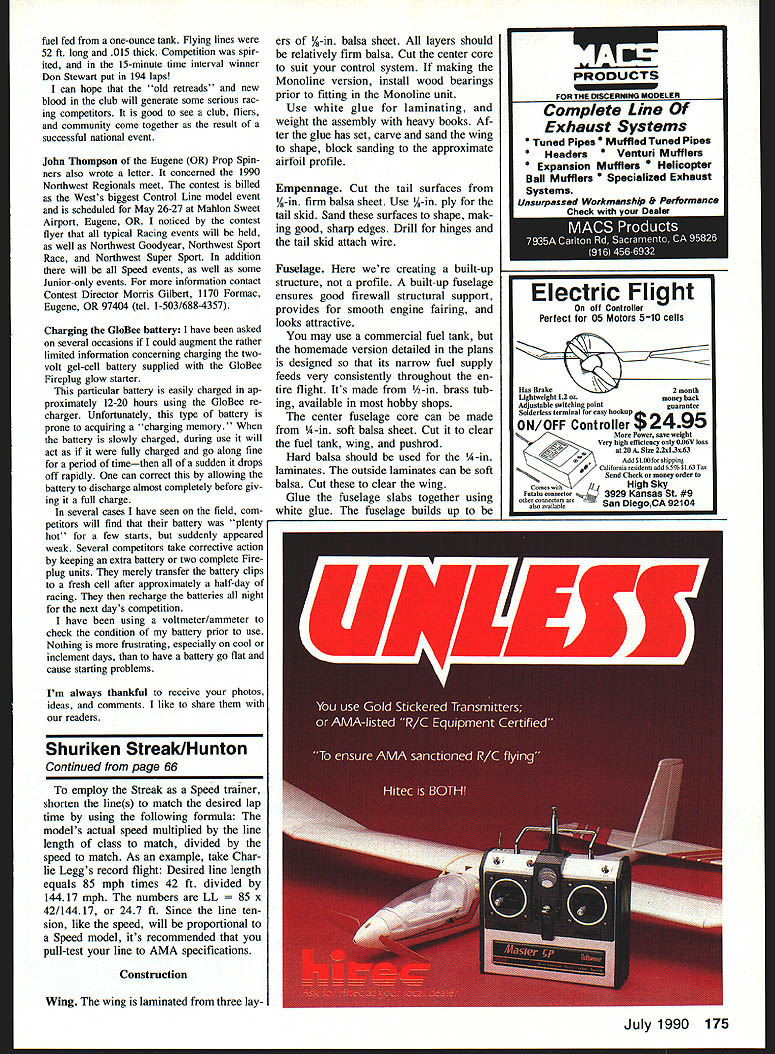
Stanzel did not give up on single-line control and developed the Monoline system. Monoline control is achieved by rotating or twisting a single line. The control unit uses a twisted pair of steel wires rotated by a control knob; the twist is transmitted to the in-model unit and translated into fore-aft pushrod motion. Monoline is usually rigged so that up is button-back and down is button-forward. Expert fliers can even fly CL precision aerobatics patterns with Monoline.
Despite requiring a heavier wire, Monoline is more efficient from a drag standpoint than a two-line bellcrank system. Monoline is still used in Speed flying.
Flying Monoline is fun. With a stable model like the Streak, transition from two lines to one is quite easy. Keeping the control unit straight is important for friction-free, responsive controls.
Monoline in-model torque-type control units and articulated handles are available from:
- Ned Morris, 9044 Rushmore Blvd. S., Indianapolis, IN 46234
- Original Stanzel Monoline control handle units: Dale Kirn, 283 N. Spruce Dr., Anaheim, CA 92805
Using the Streak as a Speed Trainer
To employ the Streak as a Speed trainer, shorten the lines to match the desired lap time. Use this formula:
- Desired line length = (model actual speed × line length of class to match) ÷ speed to match
Example: To match Charlie Legg's 1/2A record:
- Desired line length = 85 mph × 42 ft ÷ 144.17 mph = 24.7 ft
Because line tension (and speed) will be proportional to a Speed model, pull-test your lines to AMA specifications before flying.
Construction
#### Wing
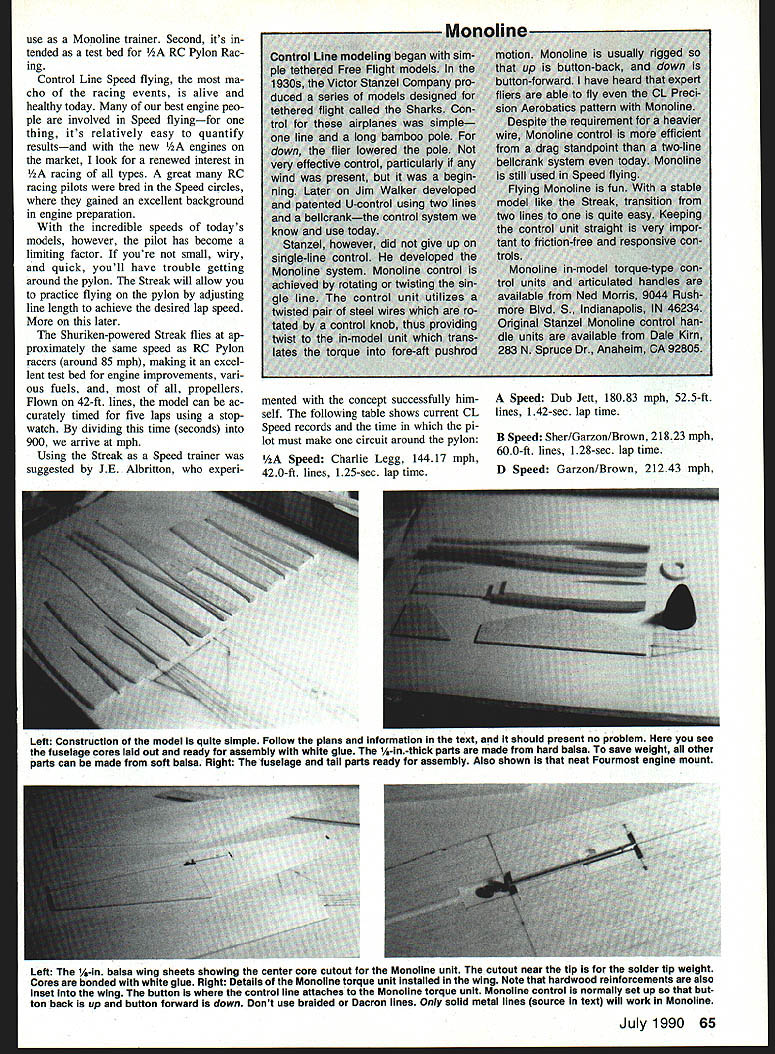
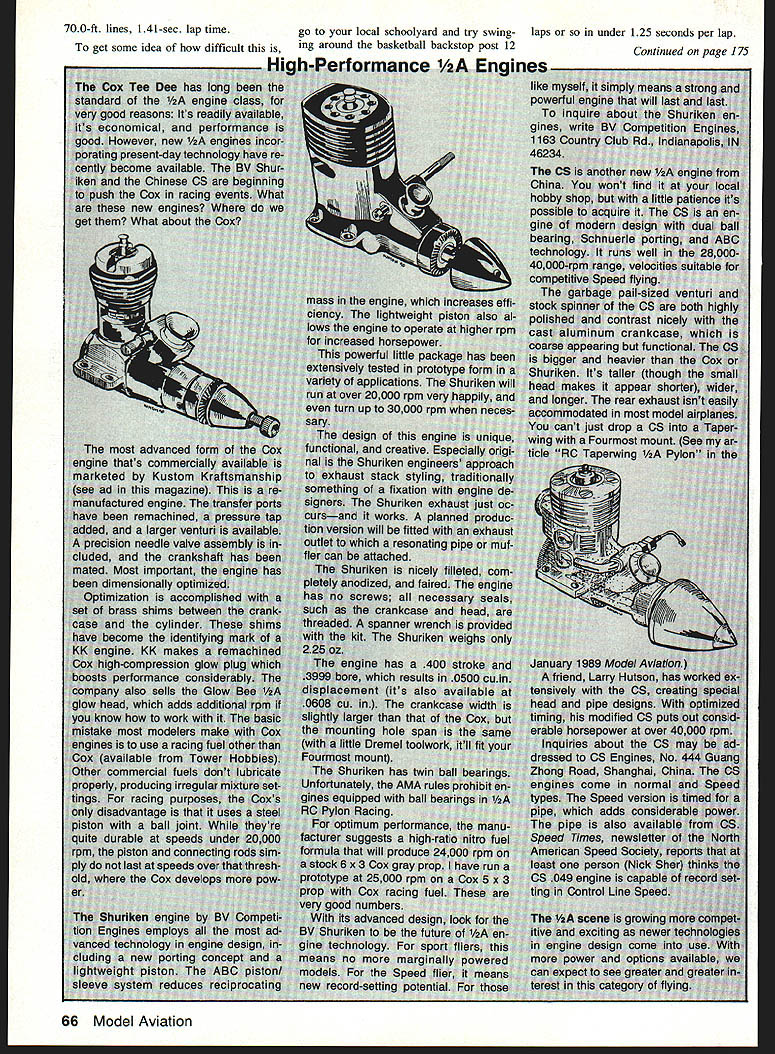
- The wing is laminated from three layers of 1/8-in. balsa sheet. Use relatively firm balsa for all layers.
- Cut the center core to suit your control system. If making the Monoline version, install wood bearings prior to fitting the Monoline unit.
- Use white glue for laminating and weight the assembly with heavy books. After the glue sets, carve and sand the wing to shape, block-sanding to the approximate airfoil profile.
#### Empennage
- Cut tail surfaces from 1/8-in. firm balsa sheet.
- Use 1/8-in. plywood for the tail skid.
- Sand surfaces to shape, making good, sharp edges. Drill for hinges and the tail-skid attach wire.
#### Fuselage
- This is a built-up fuselage, not a profile. A built-up structure gives good firewall support, allows a smooth engine fairing, and looks attractive.
- You may use a commercial fuel tank, but the homemade tank detailed in the plans is designed to feed consistently. It is made from 1/8-in. brass tubing (available in hobby shops).
- The center fuselage core can be made from 1/4-in. soft balsa sheet, cut to clear the fuel tank, wing, and pushrod.
- Use hard balsa for the 1/4-in. laminates; the outside laminates can be soft balsa. Cut these to clear the wing.
- Glue the fuselage slabs together with white glue. The fuselage will be slightly narrower than the Fourmost engine mount; fair the mount to fit as needed.
- Cut the 1/4-in. plywood firewall to shape. Install blind nuts to fit the Fourmost engine mount (see advertisers' index for Fourmost products) and epoxy the firewall in place.
- Make additional 1/4-in. ply spacers to position the engine for proper balance. On my model the Shuriken required one spacer; the Chinese CS required none.
- Carve the fuselage and canopy to final shape, then sand smooth.
Assembly and finishing
- Prime and sand all parts smooth before final assembly.
- Use thin cyanoacrylate (CyA) glue for final assembly. Fillets can be made from drywall joint compound.
- Cut windows in the model to rig the controls, unless you can rig without them.
- Finish: I applied Sig sanding sealer, then three coats of Sig butyrate dope, and a finish coat of Black Baron clear gloss polyurethane. Apply any vinyl markings before the gloss coat.
- Landing gear: mount between the engine mount and firewall. One robust installation method is to drill the engine mount and insert the gear; this is very durable.
- Wheel installation (for 3/32-in. landing gear wire): countersink aluminum hub wheels 1/8 in. deep on both sides, solder a 5/16-in. long, 1/8-in. brass tube as the inner retainer, slip a longer 1/8-in. tube into the wheel and solder, then cut flush. This yields a sleek installation without wheel collars.
Flying
- For first flights, install an extra 1/4-in. spacer between the engine mount and firewall. This makes the model more nose-heavy and less sensitive to controls; the shim can be removed later for greater responsiveness.
- Start with relatively short lines (about 35 ft).
- Do not use braided or Dacron lines for Monoline controls—only solid lines will work (available from Kustom Kraftsmanship).
- While AMA rules permit .014-in. lines, begin with .018-in. lines for better control.
- To ensure Monoline controls are neutral before flying, relax the line to check for curls. If there are curls, straighten them by twisting the unit by hand, then center the control knob by spinning it to the center of travel.
- Use typical takeoff precautions. Do not apply too much up control until speed increases. With Monoline you still have control even with a momentarily slack line, so remain calm if the line slackens briefly.
Your Shuriken Streak will be a fast, stable flier. Have fun!
Transcribed from original scans by AI. Minor OCR errors may remain.

