
Sidewinder Stick
By Mark Fineman
Overview
Here's a rubber-powered model that is simplicity itself. The all-sheet-balsa structure is just heavy enough (and durable) for it to be a great small-field flier.
Stick models have many positive qualities. It is curious that more modelers do not fly them. For the inexperienced modeler, a simple stick job can be a rewarding introduction to building and flying, offering ease of construction coupled with good performance. Experienced modelers will find that the variety of these models is astounding, since nearly every planform and propulsion arrangement has been tried by someone at some time or other. In fact, the stick-fuselage model even predates the Wright brothers; it was the single most popular type of model in the infancy of our pastime. Over the years, literally thousands of stick-job plans have been conceived and published.
The beauty of this type of model is its inherent simplicity. Construction of even the most complicated stick job rarely takes more than a few evenings. Adjustments are straightforward, a particularly important feature for beginners. To those who have had little experience with this type of model, it may also come as a surprise to learn that performance can be extraordinary. It is no exaggeration to say that I have had more out-of-sight flights with stick jobs than with any other type of model.
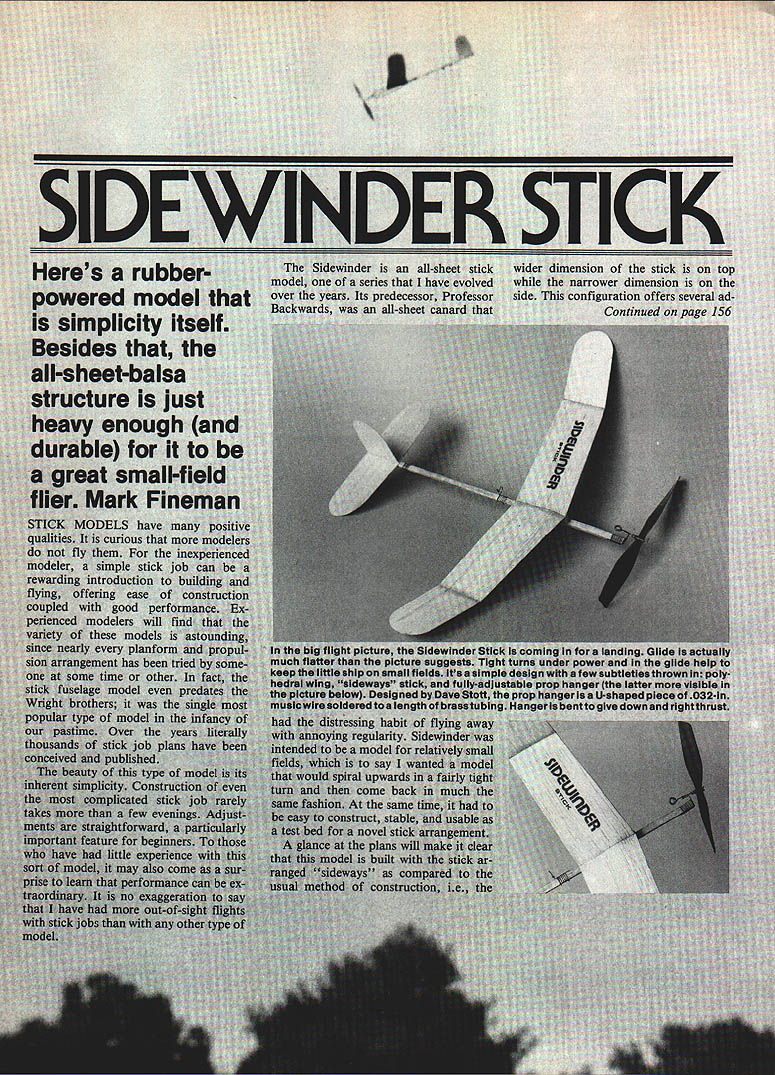
The Sidewinder is an all-sheet stick model, one of a series I have evolved over the years. Its predecessor, Professor Backwards, was an all-sheet canard that had the distressing habit of flying away with annoying regularity. Sidewinder was intended to be a model for relatively small fields: I wanted a model that would spiral upwards in a fairly tight turn and then come back in much the same fashion. At the same time, it had to be easy to construct, stable, and usable as a test bed for novel stick arrangements.
Design
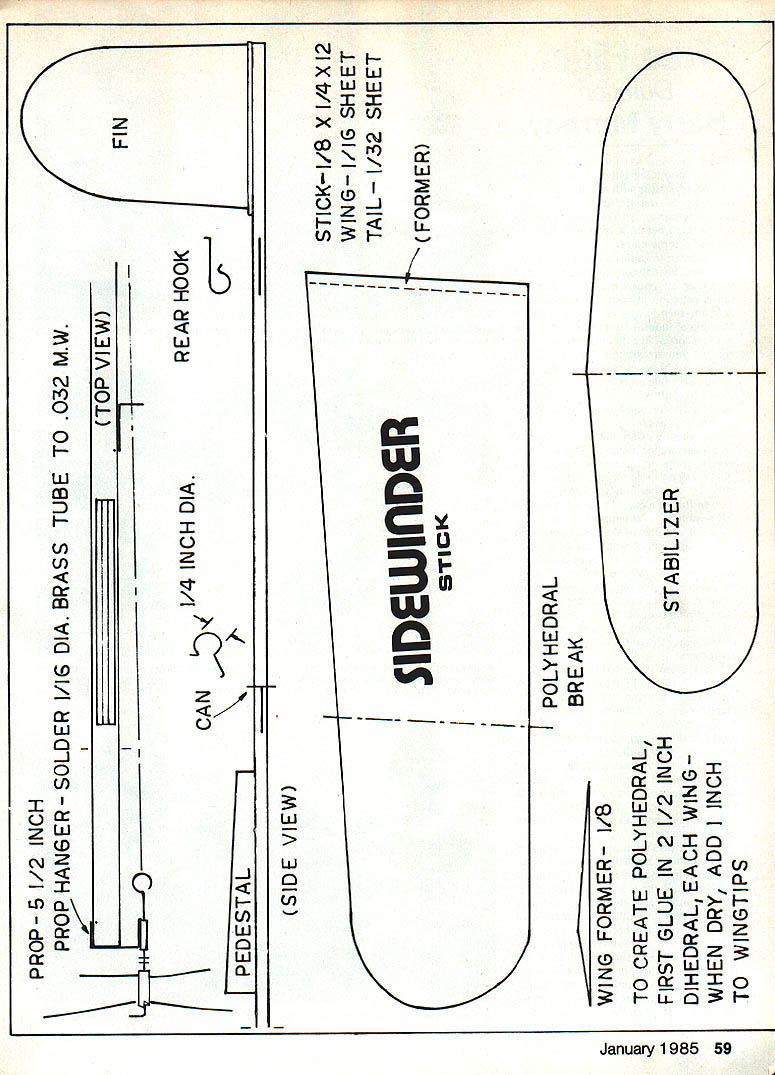
A glance at the plans will make it clear that this model is built with the stick arranged "sideways" compared to the usual method of construction — the wider dimension of the stick is on top while the narrower dimension is on the side. This configuration offers several advantages:
- Increased torsional stiffness with a low parts count.
- A compact, durable structure suitable for small fields.
- Easy mounting for rubber motor and fittings.
- Good stability and forgiving handling for beginners.
Materials and Components
- Propeller: 5-1/2 in.
- Prop hanger: solder 1/16 in. dia. brass tube to 0.032 in. music wire (top view).
- Rear hook: 1/4 in. dia. (hook for rubber motor).
- Can pedestal (side view) — mounting detail shown on plans.
- Stick: 1/8 x 1/4 x 12 in. (balsa)
- Wing: 1/16 in. sheet (balsa)
- Tail: 1/32 in. sheet (balsa)
- Wing former: 1/8 in.
- Stabilizer: (as shown on plans)
- Former and polyhedral break locations shown on plans
Assembly
- Fit and glue main components per the plans, keeping surfaces true and square. Use the all-sheet construction method indicated.
- Install prop hanger: solder a 1/16 in. diameter brass tube to 0.032 in. music wire as shown in the top-view detail, and mount to the nose per the drawing.
- Install the rear hook (1/4 in. dia.) and can pedestal as shown.
- Create the wing polyhedral:
- First glue in a 2-1/2 in. dihedral at each wing panel.
- When dry, add 1/4 in. to the wing tips (as indicated on the plans) to complete the polyhedral shaping.
- Install stabilizer and tail surfaces from 1/32 in. sheet, ensuring alignment and incidence match the plan.
Notes and Tips
- Keep construction simple and tidy; stick models reward careful glue joints and straight assembly.
- Adjustments are straightforward — start with small trims and test-fly in calm conditions.
- The Sidewinder is intended as a small-field flier and a stable test bed; use it to explore different stick arrangements and rubber motor setups.
Transcribed from original scans by AI. Minor OCR errors may remain.

