
Sig Cub Contest
For those who love airplanes, it doesn't take a super-sophisticated one to catch the eye. About anything able to stay aloft for a while will do. Because of that love of flying machines, even small local or club contests involving a plane as simple as the Sig Cub are more fun than you may think.
Background
Three years ago, at the January meeting of our model club, interest had waned to the extent that the group was in danger of folding. Members were getting older and few new faces were showing up. After discussing the usual schemes, we decided a fresh approach was needed.
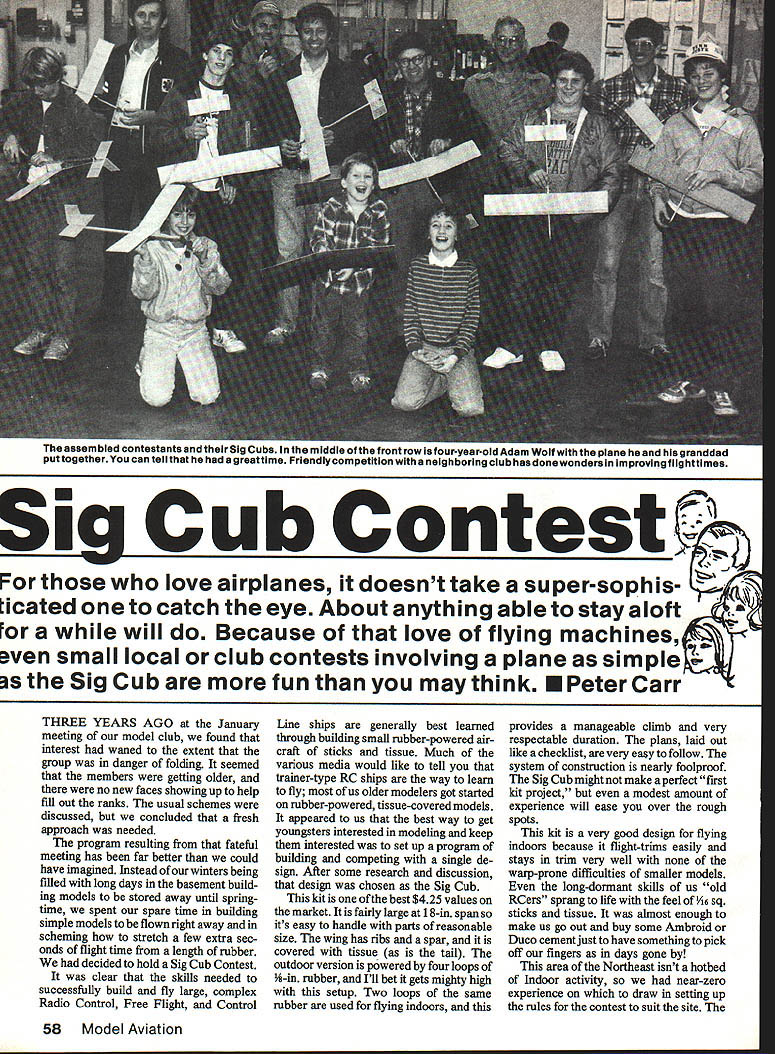
Instead of spending winters building large models to be stored until spring, we spent spare time building simple rubber-powered models to be flown right away and figuring out how to stretch a few extra seconds of flight from a length of rubber. We decided to hold a Sig Cub Contest.
We do not suggest this is the only approach that will work, but it worked for us. It gave kids and adults an inexpensive, attainable goal that could be shared by fathers and sons — and that sharing proved to be the best trophy of all.
The Kit
- The Sig Cub kit is one of the best $4.25 values on the market.
- Span: 18 in., large enough to handle easily with reasonably sized parts.
- Construction: wing has ribs and a spar; wing and tail covered with tissue.
- Power: outdoor version — four loops of 1/8-in. rubber; indoor — two loops of the same rubber.
- Plans: laid out like a checklist and very easy to follow; construction is nearly foolproof.
- Good as a first kit project; a modest amount of experience helps with rough spots.
- Flies and trims easily indoors and stays trim well, without the warp-prone difficulties of smaller models.
- Working with 1/16-in. sticks and tissue reawakened long-dormant skills for many older modelers; Ambroid Duco cement was fondly recalled.
The Site
- Venue: Brockway Glass Co. hangar at DuBois-Jefferson County Airport.
- Ceiling height: very usable 35 ft.
- Floor: large enough for four basketball courts, so drift is not much of a problem.
- Retrieval: ladders normally used to wash and service full-size aircraft make model retrieval straightforward if models hang on lights or pipes.
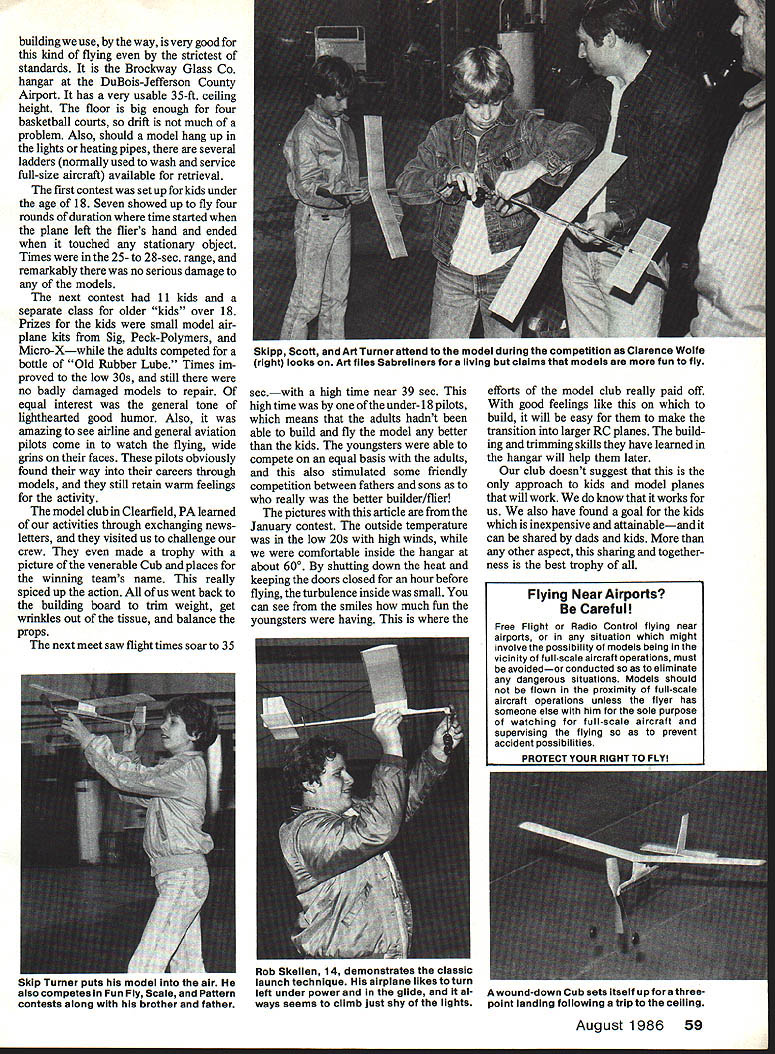
- For the January contest we shut down the heat and kept doors closed for an hour before flying to minimize turbulence; outside temperature was in the low 20s while it was comfortable inside (about 60°F).
Contest Setup and Rules
- Events: duration flights; time starts when the plane leaves the flier's hand and ends when it touches any stationary object.
- Rounds: typically four rounds per flier.
- Classes: junior class (under 18) and an older class (over 18) in later contests.
Contests, Results, and Prizes
- First contest:
- Junior class only (under 18).
- Seven youngsters flew four rounds.
- Typical times: 25–28 seconds.
- Remarkably, no serious damage to models.
- Second contest:
- Eleven kids and a separate class for older fliers.
- Prizes for kids: small model airplane kits from Sig, Peck Polymers, and Micro-X.
- Prizes for adults: a bottle of "Old Rubber Lube."
- Times improved into the low 30s; still no major repairs needed.
- Tone: lighthearted and in good humor.
- Interclub challenge:
- A model club from Clearfield, Pa., visited after learning of our activities via exchanged newsletters.
- They made a trophy featuring the venerable Cub and places for the winning team's name, which spiced up the action.
- Later meets:
- Continued trimming (board-trimming, weight trimming), tissue smoothing, and prop balancing.
- Flight times soared into the mid-30s with a high near 39 seconds.
- The high time was posted by an under-18 pilot — youngsters competed on equal footing with adults, sparking friendly father-and-son rivalry.
Community Impact and Observations
- The contests attracted airline and general aviation pilots who watched with wide grins; many had found their way into aviation through models and retained warm feelings for the activity.
- The program revitalized club interest, brought in spectators (about 60 at one January meet), and encouraged both building and repair work.
- The skills learned — building, trimming, and flight trimming — provide an excellent foundation for moving on to larger RC planes.
- Above all, the program fostered togetherness between dads and kids and renewed enthusiasm for modeling.
Transcribed from original scans by AI. Minor OCR errors may remain.

