
Simple Toy
By Jim Wilson
Introduction
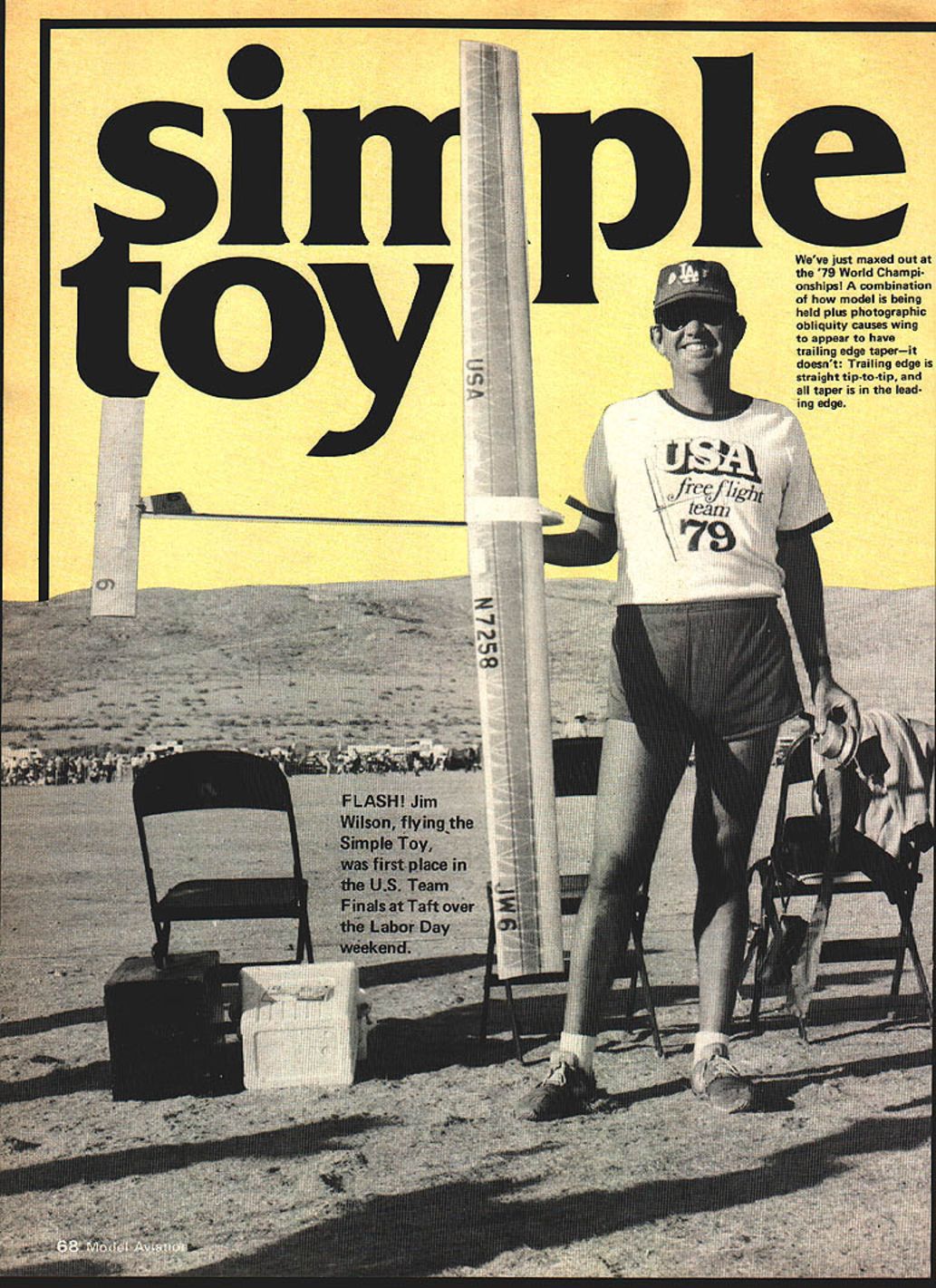
Simple Toy is my FAI towline glider that evolved through four years of study and seven model iterations. It was not formally designed so much as developed by experimenting with different layouts and flying styles. Technically similar to other world-class gliders, Simple Toy reached a practical optimum in airfoils, aspect ratio, stability margins and turning tendencies. The result is a strong, stable model that suits a high-attention, park-style flying technique: obedient on tow, robust in zoom launches, and able to thermal reliably.
Development and competition history
- Number 6 (the original Simple Toy) has well over 1,000 flights; Number 2 is approaching 500.
- Both have maxed in still morning air and survived violent thermals at Taft.
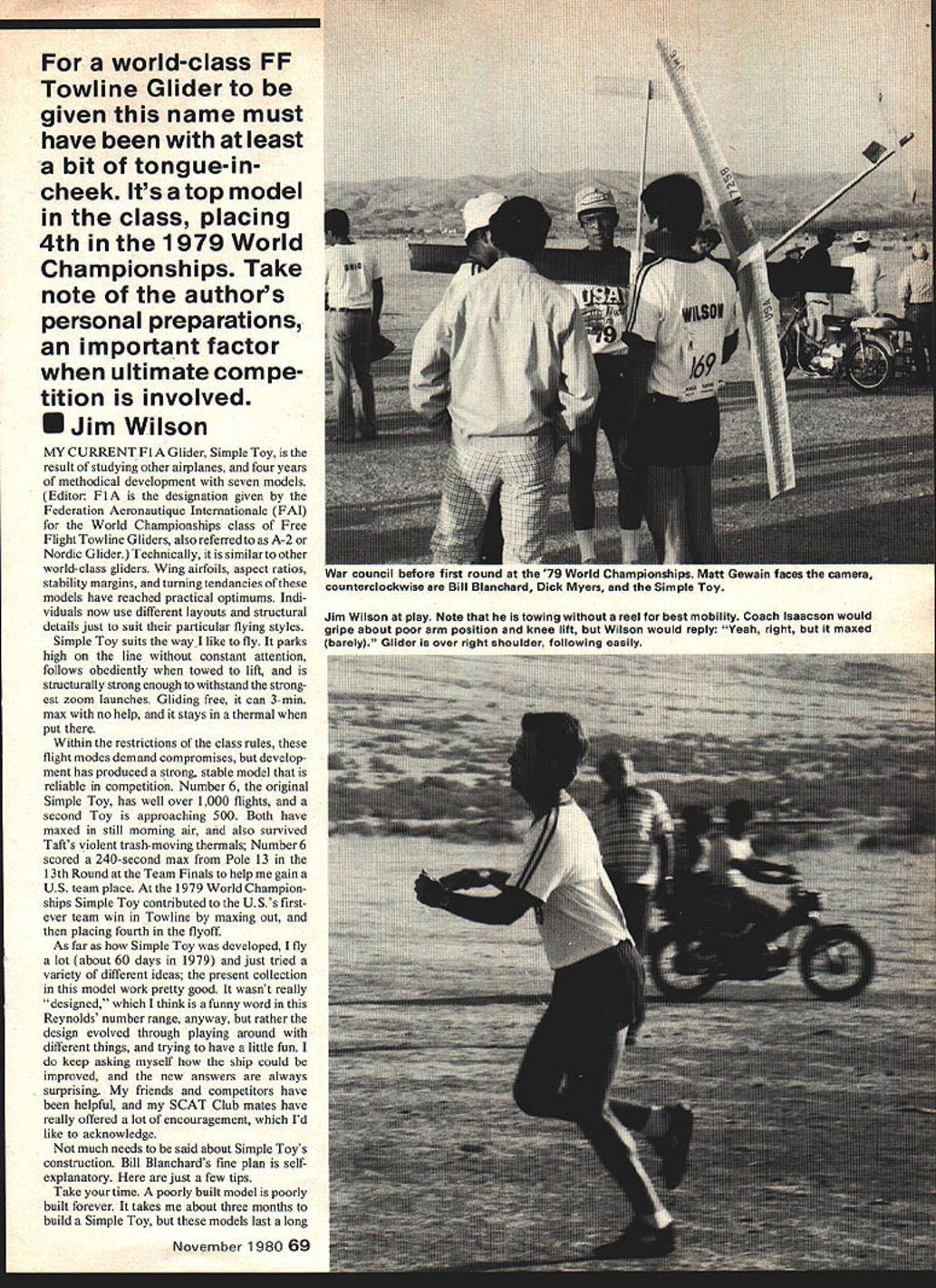
- Number 6 scored a 240-second max in Pole 13, 13th Round Team Finals, contributing to the U.S. team's finish at the 1979 World Championships.
- Simple Toy helped the U.S. win its first-ever team title; a Towline pilot maxed out and placed fourth in the flyoff.
I flew Simple Toy intensively (about 60 days in 1979), continually asking, "Could the ship be improved?" Friends, competitors and SCAT Club mates offered encouragement and useful feedback. Bill Blanchard’s plan is the baseline for construction; here are a few practical tips and observations from my experience.
Construction: basic principles
- Take time.
- A poorly built model is poorly built forever. Expect about three months to build a Simple Toy. Time invested yields durable models that last.
- Build straight.
- Cut parts accurately and fit carefully. A ship with few built-in stresses is less likely to warp and won’t constantly surprise you with trim changes.
- Build light.
- Add ballast to reach the 410-gram minimum plus a margin. Watch wood densities, especially in sheeted areas. Use only small amounts of glue.
Materials and adhesives:
- I use Titebond glue thinned about 10% with water for most wood construction.
- Epoxy is required for metal-to-wood joints.
- Apply light fiberglass cloth to the D-box and boom using clear K&B Super Poxy paint.
- Use nitrate dope for other covering and finish coats.
- Spray the tops of the wing and stabilizer with commercial lacquer flattener to provide controlled surface roughness.
- Double-cover the wing to improve torsional rigidity and make punctured-tissue repairs easier.
Tissue and color:
- Modern tissue is about as light and strong as decades ago; colors may be less vivid.
- Color can be enhanced after leaching dyes out. A Magic Marker wicked with lacquer thinner can produce thin colored dope. Spraying dope of the same color onto tissue yields a dense, lightweight finish.
- Simple Toy uses black underwings for increased visibility. Opaque black plus V-dihedral makes the plane easier to spot and can help it gain another max.
Build the wing flat and introduce washout at the tips before final doping. Washout prevents tip stall and smooths the flight in turbulence.
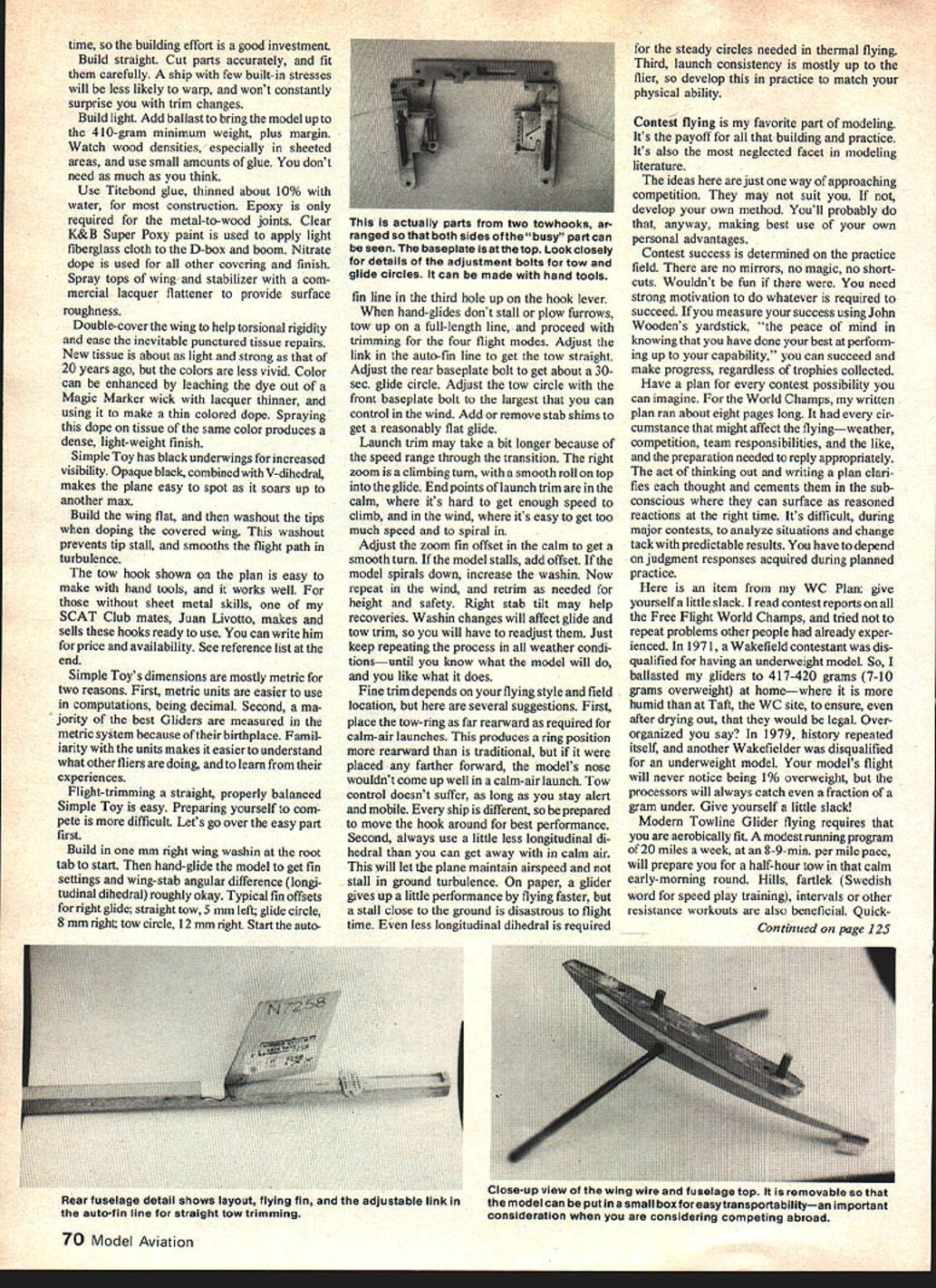
The tow hook shown on the plan is easy to make with hand tools and works well. For those without sheet-metal skills, SCAT Club mate Juan Livotto makes and sells ready-to-use hooks — write him for price and availability.
Units and dimensions
Simple Toy’s dimensions are mostly metric because:
- Metric units are easier to use in computations.
- Many top gliders are measured in metric units; familiarity helps when learning from other fliers.
Flight trimming (basic sequence)
- Build in 1 mm right wing wash-in at the root tab to start.
- Hand-glide the model to establish fin settings and the wing–stab angular difference (longitudinal dihedral) roughly.
- Typical fin offsets for right glide:
- Straight tow: 5 mm left
- Glide circle: 8 mm right
- Tow circle: 12 mm right
- Start the auto-fin line in the third hole up on the hook lever.
- When hand-glides don’t stall or plow, tow up on a full-length line and trim for the four flight modes: straight tow, tow circle, launch/zoom, and glide circle.
- Adjust the auto-fin link to get the tow straight.
- Adjust the rear baseplate bolt to get about a 30-second glide circle.
- Adjust the front baseplate bolt to set the tow circle as large as you can safely control in wind.
- Add or remove stab shims to get a reasonably flat glide.
Launch/zoom trim:
- Launch trim is sensitive because of the speed range through transition.
- The ideal zoom is a climbing turn with a smooth roll-on-top into the glide.
- Trim zoom in calm conditions for a smooth turn: if it stalls, add offset; if it spirals down, increase wash-in.
- Repeat trimming in wind and calm until you have safe height and reliable performance.
- Right stab tilt can help recoveries. Be aware wash-in changes affect glide and tow trim, so readjust iteratively.
Fine trim suggestions:
- Place the tow-ring as far rearward as required for calm-air launches. A rearward ring may be farther back than traditional, but it helps the nose come up in calm launches without hurting tow control if you stay alert and mobile.
- Use slightly less longitudinal dihedral than you can get away with in calm air. This helps maintain airspeed and avoid stalls in ground turbulence; slightly faster flight on paper can be worth much greater practical stability.
- Launch consistency is a flier skill—practice to match your physical ability.
Contest preparation and fitness
- Contest flying rewards building and practice. Success is primarily determined on the practice field; there are no shortcuts.
- Have a plan for every contest possibility. For the World Championships I prepared an eight-page written plan covering weather, competition, team responsibilities and preparations. Writing a plan clarifies decisions and builds reliable responses under pressure.
- Give yourself a little slack on weight. After reading past contest reports, I ballasted gliders to 417–420 grams at home (more humid conditions) so they would remain legal after drying at the contest site. Your model won’t notice 1% overweight, but officials will detect underweight models.
- Aerobic fitness is important. A running program of about 20 miles per week at an 8–9 minute per mile pace prepares you for a half-hour tow in early-morning rounds. Hills, fartlek, intervals and resistance workouts improve speed, quickness and stamina.
- Practice towing: use a winch or a partner to simulate contest launches. Practice starts and adjusting tow-bolt position. Learn to get the model off with minimal rolling and to climb without stalling. Know your glider’s behavior on the line and how it reacts to variations in line tension.
Final notes and acknowledgements
- Simple Toy accepts compromises demanded by class restrictions but is a robust, reliable competition model when properly built and trimmed.
- The design evolved through playing around with different ideas and persistent questioning. Friends, competitors and SCAT Club mates provided valuable encouragement and help.
- Bill Blanchard’s plan is recommended for construction details; use the tips above to augment the plan for best results.
If you need a ready-made tow hook, contact Juan Livotto (SCAT Club) for price and availability.
Transcribed from original scans by AI. Minor OCR errors may remain.

