
Sixty Years of AMA
SIXTY YEARS! In some cases, it's an entire lifetime. In others, it's one tick of eternity's clock. For an association like the Academy of Model Aeronautics, it is an accomplishment to reach that age, especially when it shows continued growth and development over such a lengthy time span. This year, 1996, marks the sixtieth anniversary of AMA.
Background and the 50th Anniversary Retrospective
Ten years ago, the June 1986 Model Aviation featured a lengthy special article prepared by then–Executive Director John Worth. Eight pages of text and photos provided considerable information concerning events within the Academy from 1936 to 1986, and background from before that time. The details in that article will not be repeated here, but because it provides such an excellent overview of the first fifty years, a reprint will be made available to individuals or groups who do not have copies. Contact the Membership Department at AMA Headquarters for a reprint.
Like all long-lived organizations, the Academy has experienced periods of significant change and the accompanying stress. Over the last ten years since our fiftieth birthday, many such changes occurred.
AMA has slowly evolved from an organization heavily composed of youth to one whose membership is predominantly adult. Likewise, there has been a gradual shift away from a large percentage of members involved with structured, rulebook competition flying toward non-competitive, so-called Sunday fliers. This steady pace of change has shifted the Academy’s focus and direction—especially during the last ten years.
The conclusion of John Worth's article mentioned the establishment of the museum at the Reston, Virginia, home of the Academy. The collection of modeling memorabilia quickly became a focal point for members visiting the Washington, D.C. area, and the library’s availability as a resource heightened the appeal. The establishment of these services serves as a keynote to the many elements of change since 1985.
Leadership Changes
During the late 1980s the elements of change became very prominent. John Worth’s retirement as Executive Director was a significant factor. Between 1964, when John took over as Executive Director, and the end of the 1980s, the Academy grew to some 120,000 members. The system of chartered clubs swelled to more than 2,000 and some 2,500 events were sanctioned each year. As Worth neared 65 and retirement, a search for a new Executive Director began. Worth agreed to continue an additional year to serve as a resource for the incoming director and to work on special projects.
After a lengthy selection process, Vince Mankowski was chosen to serve as Executive Director. Hired by AMA in 1980, Mankowski had been serving as Nats Manager and had played a key role in the construction of the Reston Headquarters. As is common when leadership changes, the Academy experienced a change in management style from John Worth to Vince Mankowski.
Prior to the Executive Director change, the leadership of the Executive Council also changed, with Don Lowe succeeding John Grigg as President. Lowe maintained that position for nine years until he stepped down at the end of his third term in 1995.
On July 26, 1993, Executive Director Vince Mankowski resigned. President Don Lowe contacted Technical Director Bob Underwood, asking whether he would serve, at least on an interim basis, as Executive Director. Underwood agreed and for the next nine months served in that role. Early in 1994, Jerry Rouillard was hired as Executive Director and Bob Underwood moved back to the St. Louis area, working as Technical Director and then Education Director on a reduced schedule. In February 1996, Jerry resigned to pursue an MBA at Ball State University and Joyce Hager was again asked to serve as Acting Executive Director. Joyce’s 26 years of experience and dedication have been important to AMA during these transitions.
Frequency, Radio Control, and Technology
Technology played an important role in Academy operations. In 1982, AMA successfully achieved the addition of model-only designated frequencies from the FCC. Implementing those frequencies proved more complex than securing them. Rapid growth in commercial frequency use threatened to interfere with continued use of AMA frequencies and equipment. Significant portions of the membership initially sought to cling to equipment that could not safely cope with the new demands. While methods were formulated to maintain safe operations and newer generations of equipment evolved, integration stretched longer than anticipated.
Three important points can be noted regarding frequency transition:
- Early fears have faded and the plans set by the Frequency Committee and finalized by the Executive Council have been vindicated.
- The Academy and industry, through a vigorous writing campaign to the FCC, successfully weathered a proposed FCC rule making in 1992 that could have threatened frequency use.
- The frequency phase-in will not be completed until 1998—some 16 years after the change was initiated.
Beyond radio frequencies, the new computer age consumed time and financial resources as departments adapted to emerging technology.
National Flying Site: Search, Selection, and Development
Two of the most significant decisions affecting the Academy in the past ten years were purchasing land for a national flying site and relocating Headquarters operations to that site. The concept of a national flying site had roots in discussions years earlier—names such as Hutchinson, Kansas, and West Baden, Indiana were considered in the 1970s.
When the drive to purchase land intensified, a number of sites were considered. While a few surfaced in the East near Reston and in the West, the bulk of the search centered in the Midwest because of membership distribution and land costs. A Property Acquisition Committee, under District VII Vice President Pete Waters, was established by the Executive Council and later expanded to oversee site development.
After a lengthy search and presentations by several communities, the decision was made to locate the site in the Muncie, Indiana area. The decision was influenced by Muncie’s location—within 400 miles of 60% of the Academy's membership—and by the physical layout of the land and considerations offered by Muncie. Negotiations to purchase the site were long and complicated, involving multiple landowners. Funding for the purchase and development were key elements. A considerable number of objections to the purchase also came from within the membership.
The second part of the decision—moving the Museum and Headquarters to Muncie—also generated member reaction. Criticism centered on two major points:
- Many felt the presence of Academy headquarters in the Washington, D.C. area was vitally important.
- The Reston facility was relatively new, and some questioned moving from a newer building.
A strong argument for the move was that operating costs could be reduced by more than $500,000 a year. Once the decision was made, plans for the move proceeded.
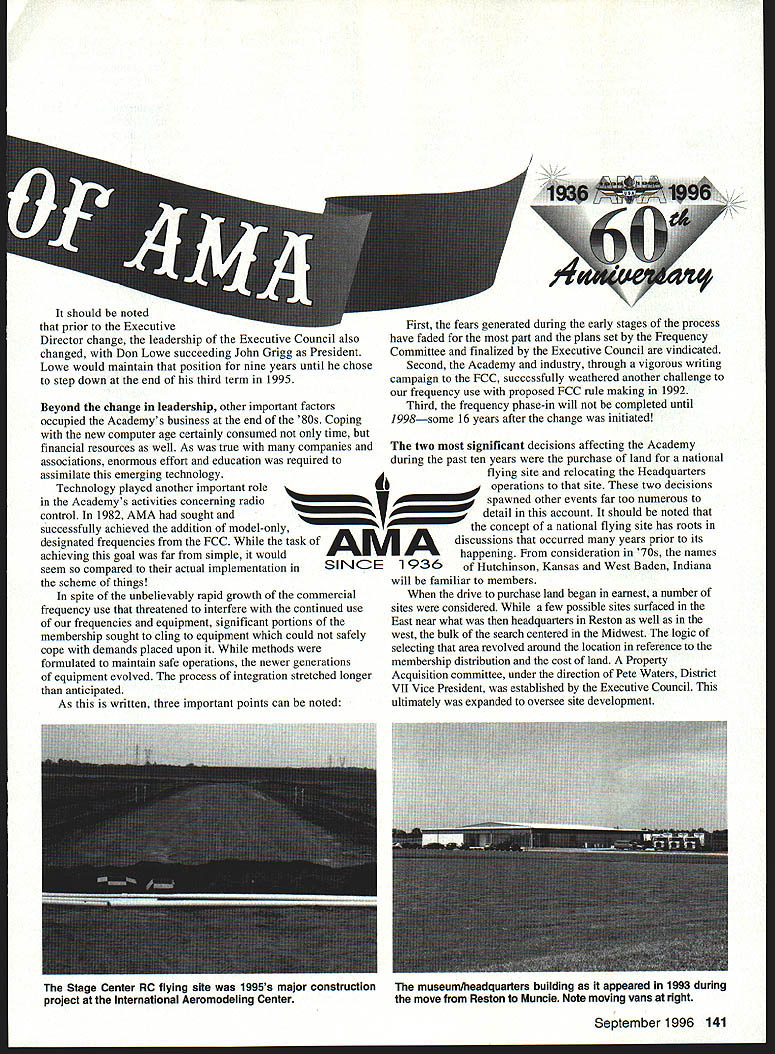
Early development at Muncie involved construction of a modified Butler building to serve as a home for the museum and a base of operations, design of a multipurpose flying site, and a general layout for roads and future development. A small staff was hired to operate the facility.
The Move: Staffing and Operational Challenges
Moving the museum materials and Headquarters operation was extremely complicated and traumatic. It became clear that most of the Reston staff would be unable to relocate. The resulting turnover created hardship in maintaining normal operations, but the move was accomplished.
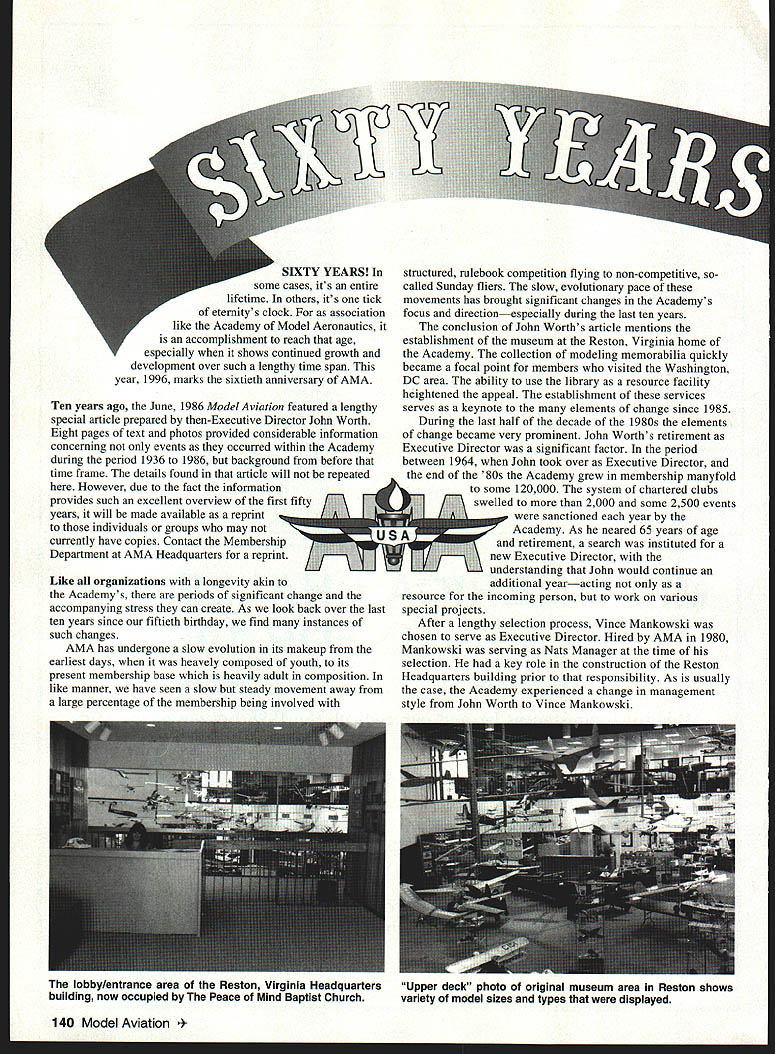
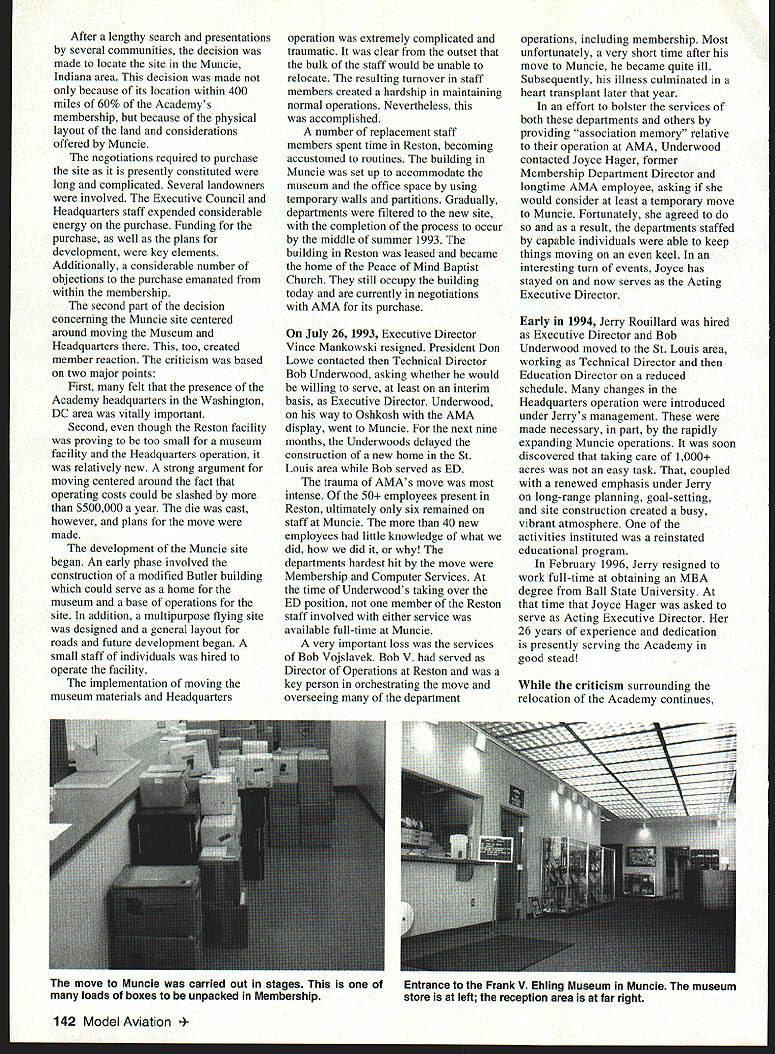
A number of replacement staff spent time in Reston to learn routines. The building in Muncie was set up temporarily with walls and partitions to accommodate museum and office space. Departments were gradually transferred to the new site, with completion of the process targeted for mid-summer 1993. The Reston building was leased and became the home of the Peace of Mind Baptist Church; the church still occupies the building and is in negotiations with AMA for its purchase.
Of the 50+ employees present in Reston, ultimately only six remained on staff in Muncie. The more than 40 new employees often had limited knowledge of AMA operations. Membership and Computer Services were the departments hardest hit—at the time Underwood took over the ED position, not one member of the Reston staff involved with either service was available full-time at Muncie.
A very important loss was the services of Bob Vojslavec, who had served as Director of Operations at Reston and was key in orchestrating the move and overseeing many department operations, including membership. Shortly after his move to Muncie he became quite ill and subsequently underwent a heart transplant later that year.
To bolster institutional memory and department continuity, Underwood contacted Joyce Hager, the former Membership Department Director and longtime AMA employee, asking if she would temporarily move to Muncie. She agreed, and her presence helped stabilize departments. Joyce later stayed on and now serves as Acting Executive Director.
Early under Jerry Rouillard’s management, many changes were introduced at Headquarters, driven in part by the rapidly expanding Muncie operations. Managing 1,000+ acres proved demanding. A renewed emphasis on long-range planning, goal-setting, site construction, and reinstated educational programs created a busy, vibrant atmosphere.
Museum, Site Use, and Community Reception
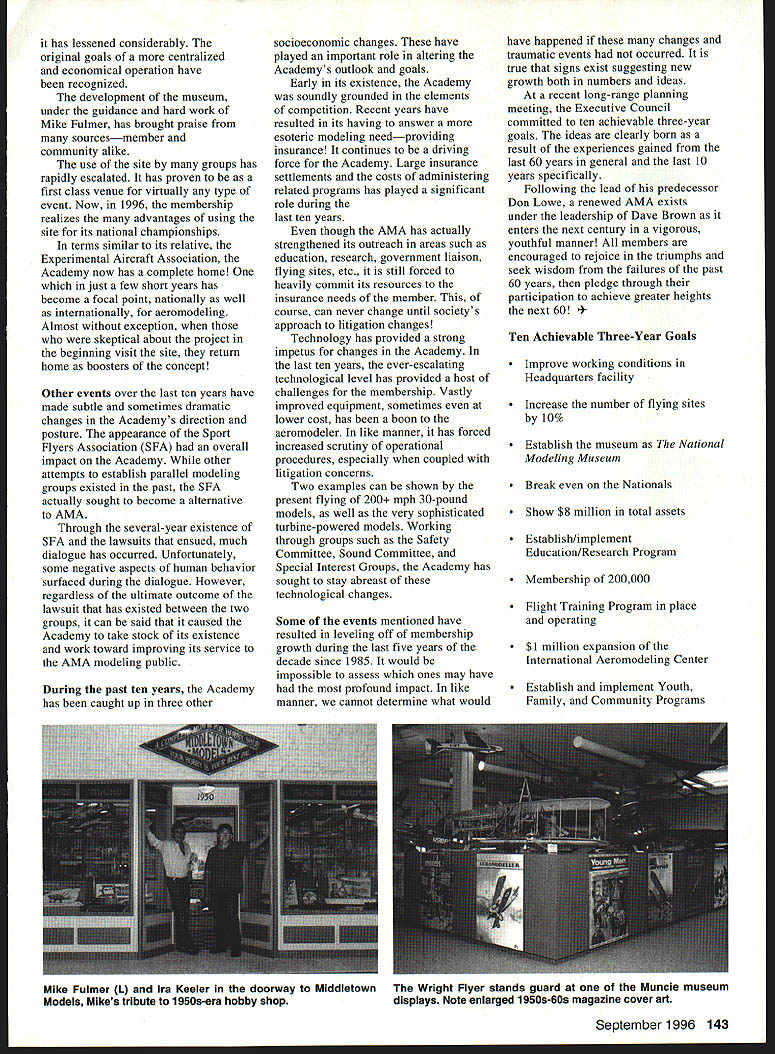
The development of the museum under the guidance and hard work of Mike Fulmer has brought praise from many sources—members and community alike. The use of the site by many groups has rapidly escalated; it has proven to be a first-class venue for virtually any type of event. By 1996 the membership recognized many advantages of using the site for national championships.
In terms similar to its relative, the Experimental Aircraft Association, the Academy now has a complete home: a focal point for aeromodeling nationally and internationally. Almost without exception, those skeptical early on who visit the site return as boosters of the concept.
Organizational Challenges: SFA and Litigation
Other events over the last ten years made subtle and sometimes dramatic changes in the Academy's direction. The appearance of the Sport Flyers Association (SFA) had an overall impact. While other attempts to establish parallel modeling groups existed in the past, the SFA sought to become an alternative to AMA. Through SFA’s several-year existence and ensuing lawsuits, much dialogue has occurred. Unfortunately, some negative aspects of human behavior surfaced during that dialogue. Regardless of the ultimate outcome of the lawsuit between the two groups, it caused the Academy to reassess its existence and work toward improving service to the modeling public.
Insurance, Litigation, Technology, and Membership Trends
During the past ten years the Academy has been affected by broader socioeconomic changes that have altered its outlook and goals.
Early in its existence, the Academy was grounded in competition. Recent years have required AMA to answer a different modeling need—providing insurance. Insurance issues continue to be a driving force. Large settlements and administration costs for related programs have played a significant role. Even though AMA has strengthened outreach in areas such as education, research, government liaison, and flying sites, it must still commit substantial resources to insurance needs. This will remain true until society’s approach to litigation changes.
Technology has provided a strong impetus for change. Ever-escalating technological levels have presented a host of challenges as vastly improved equipment—sometimes at lower cost—has become available to modelers. This is a boon but has required increased scrutiny of operational procedures, especially when coupled with litigation concerns. Two examples: present flying of 200+ mph 30-pound models and very sophisticated turbine-powered models. Working through groups such as the Safety Committee, Sound Committee, and Special Interest Groups, the Academy has sought to stay abreast of technological changes.
Some of these events contributed to a leveling off of membership growth during the last five years of the decade since 1985. It is difficult to assess which events had the most profound impact or what might have happened without these changes. Nonetheless, signs suggest new growth both in numbers and ideas.
Looking Forward
At a recent long-range planning meeting, the Executive Council committed to ten achievable three-year goals. These ideas are clearly born of experiences from the last 60 years in general and the last 10 years specifically.
Following the lead of predecessors like Don Lowe, a renewed AMA now exists under the leadership of Dave Brown as it enters the next century in a vigorous, youthful manner. All members are encouraged to rejoice in the triumphs and seek wisdom from the failures of the past 60 years, then pledge through participation to achieve greater heights in the next 60.
Ten Achievable Three-Year Goals
- Improve working conditions in the Headquarters facility
- Increase the number of flying sites by 10%
- Establish the museum as The National Modeling Museum
- Break even on the Nationals
- Show $8 million in total assets
- Establish/implement Education and Research Program
- Membership of 200,000
- Flight Training Program in place and operating
- $1 million expansion of the International Aeromodeling Center
- Establish and implement Youth, Family, and Community Programs
Transcribed from original scans by AI. Minor OCR errors may remain.

