
Small-Field Flying
Paul Bradley
32238 Spinnaker Run, Magnolia TX 77354 E-mail: bradleyp@ix.netcom.com
One of the benefits of writing this column is the new friends I get to make. Most are in the form of pen pals. It’s great to correspond with and talk to others who share a common interest. Once in a while someone who lives in my general area will check in and say hello. Even better is when an opportunity comes along to get together and share some airspace in my favorite small-field venue: my back yard.
During the summer flying season I had the pleasure of such a meeting and flying session. After a few telephone calls to make contact, Don Lincoln, his father Howard, and Mark Mullins joined me for a nice Sunday afternoon of small-field flying.
The gathering and the models
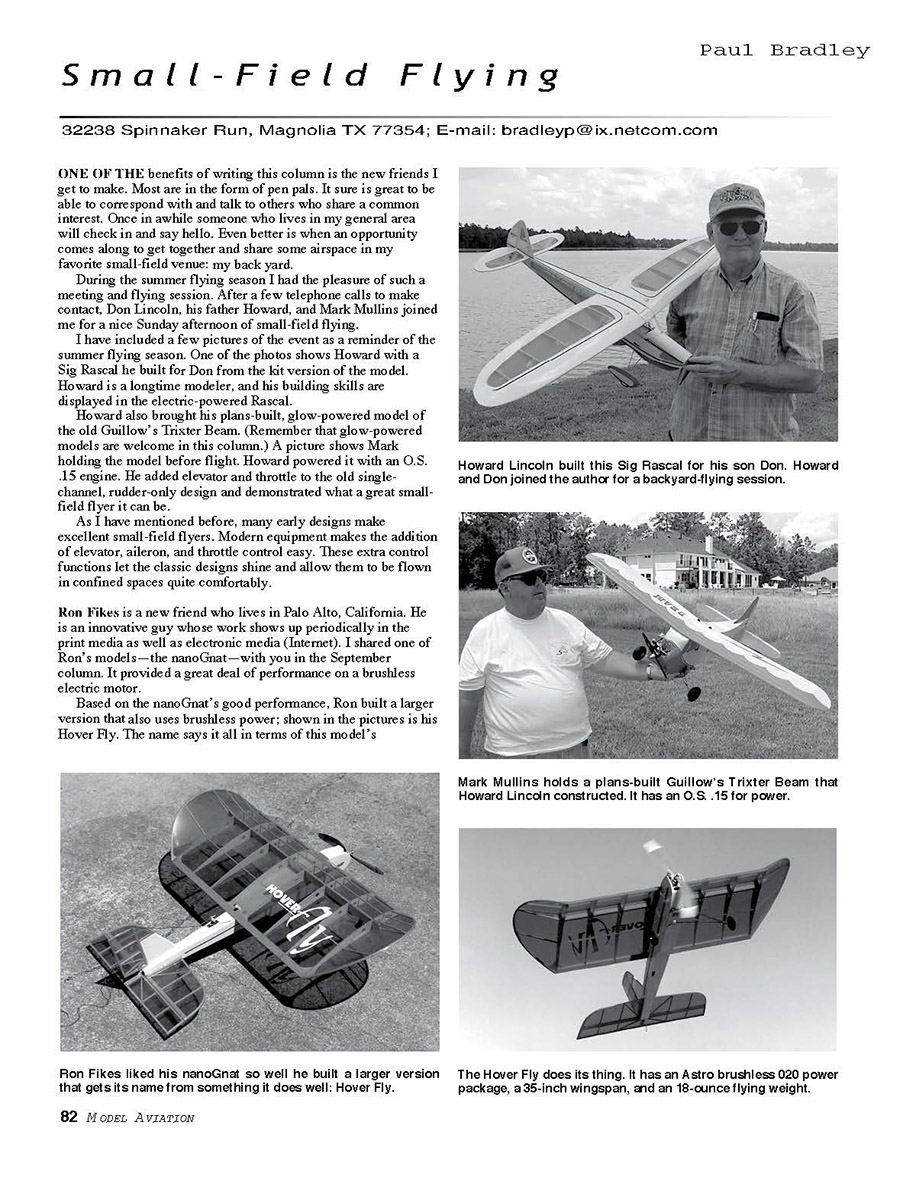
I have included a few pictures of the event as a reminder of the summer flying season. One photo shows Howard with a Sig Rascal he built for Don from the kit version of the model. Howard is a longtime modeler, and his building skills are displayed in the electric-powered Rascal.
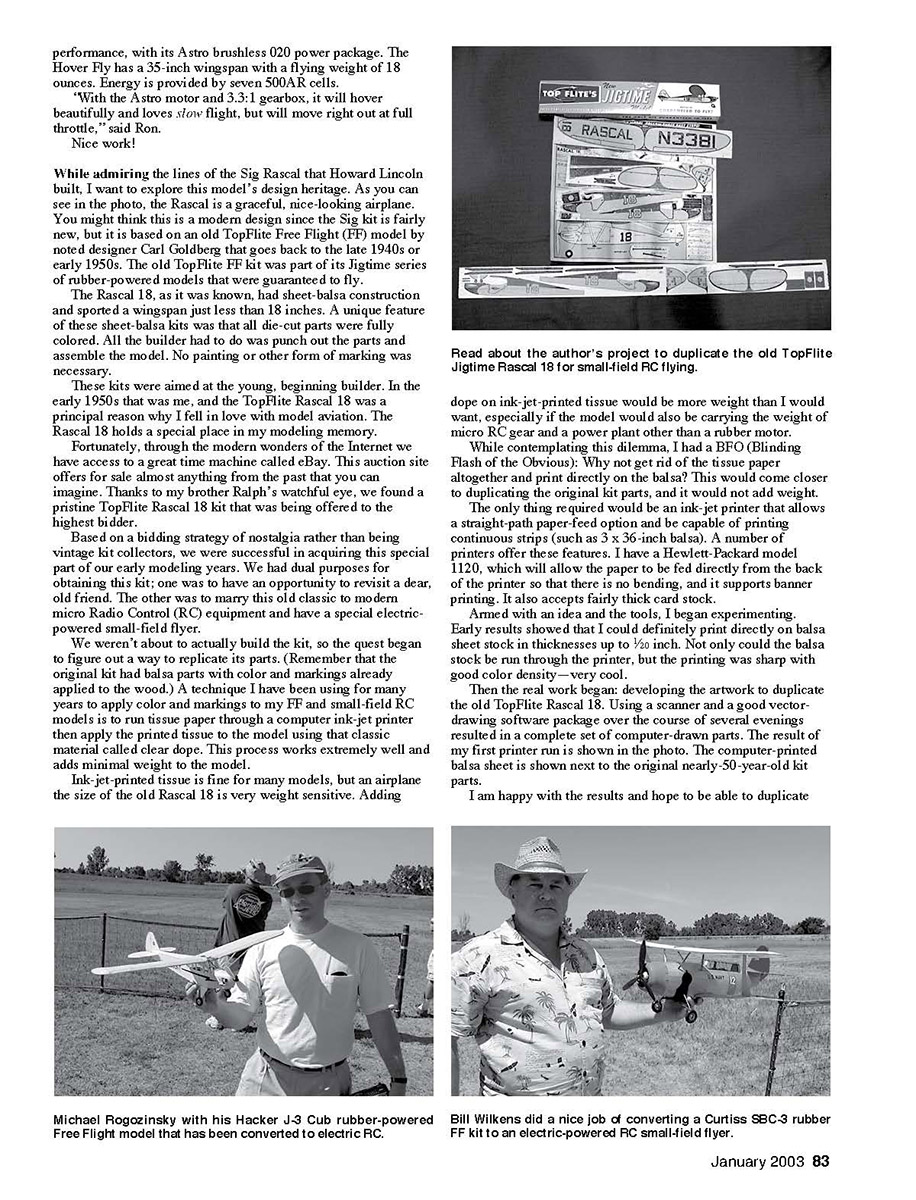
Howard also brought his plans-built, glow-powered model of the old Guillow’s Trixter Beam. (Remember that glow-powered models are welcome in this column.) A picture shows Mark holding the model before flight. Howard powered it with an O.S. .15 engine. He added elevator and throttle to the old single-channel, rudder-only design and demonstrated what a great small-field flyer it can be.
As I have mentioned before, many early designs make excellent small-field flyers. Modern equipment makes the addition of elevator, aileron, and throttle control easy. These extra control functions let the classic designs shine and allow them to be flown in confined spaces quite comfortably.
Ron Fikes’ models
Ron Fikes is a new friend who lives in Palo Alto, California. He is an innovative guy whose work shows up periodically in print and on the Internet. I shared one of Ron’s models — the nanoGnat — with you in the September column. It provided a great deal of performance on a brushless electric motor.
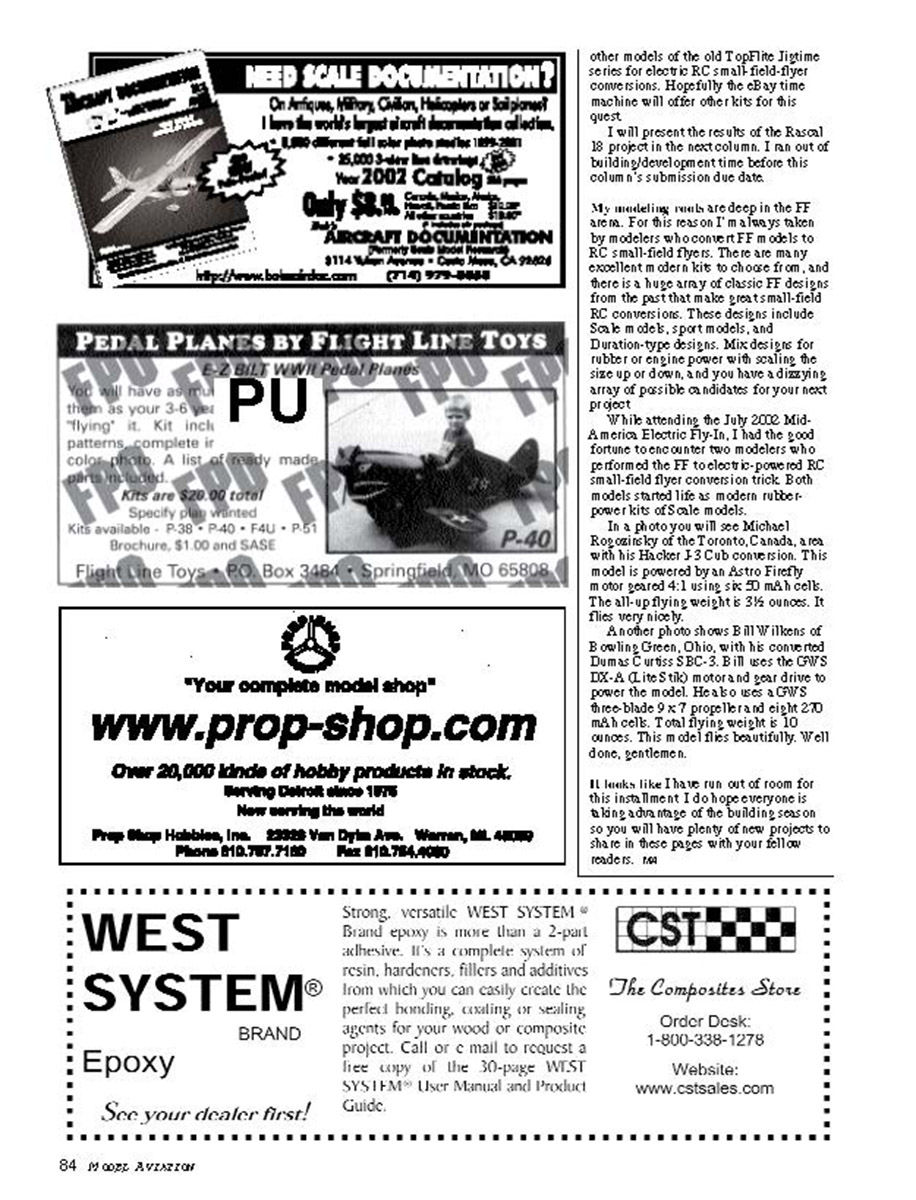
Based on the nanoGnat’s good performance, Ron built a larger version that also uses brushless power; shown in the pictures is his Hover Fly. The name says it all in terms of this model’s performance, with its Astro brushless 020 power package. The Hover Fly has a 35-inch wingspan with a flying weight of 18 ounces. Energy is provided by seven 500AR cells. “With the Astro motor and 3.3:1 gearbox, it will hover beautifully and loves slow flight, but will move right out at full throttle,” said Ron. Nice work!
The Sig Rascal and its heritage
While admiring the lines of the Sig Rascal that Howard Lincoln built, I want to explore this model’s design heritage. As you can see in the photo, the Rascal is a graceful, nice-looking airplane. You might think this is a modern design since the Sig kit is fairly new, but it is based on an old TopFlite free-flight model by noted designer Carl Goldberg that dates to the late 1940s or early 1950s.
The old TopFlite kit was part of its Jigtime series of rubber-powered models that were guaranteed to fly. The Rascal 18, as it was known, had sheet-balsa construction and sported a wingspan just less than 18 inches. A unique feature of these sheet-balsa kits was that all die-cut parts were fully colored. All the builder had to do was punch out the parts and assemble the model. No painting or other marking was necessary. These kits were aimed at the young, beginning builder.
In the early 1950s that was me, and the TopFlite Rascal 18 was a principal reason why I fell in love with model aviation. The Rascal 18 holds a special place in my modeling memory.
Fortunately, through the modern wonders of the Internet we have access to a great time machine called eBay. This auction site offers for sale almost anything from the past that you can imagine. Thanks to my brother Ralph’s watchful eye, we found a pristine TopFlite Rascal 18 kit that was being offered to the highest bidder.
Based on a bidding strategy of nostalgia rather than vintage-kit collecting, we were successful in acquiring this special part of our early modeling years. We had dual purposes for obtaining the kit: one was to have an opportunity to revisit a dear, old friend; the other was to marry this old classic to modern micro-RC equipment and have a special electric-powered small-field flyer.
We weren’t about to actually build the kit, so the quest began to figure out a way to replicate its parts. (Remember that the original kit had balsa parts with color and markings already applied to the wood.) A technique I have used for many years to apply color and markings to my free-flight and small-field RC models is to run tissue paper through a computer ink-jet printer, then apply the printed tissue to the model using clear dope. This process works extremely well and adds minimal weight.
Ink-jet-printed tissue is fine for many models, but an airplane the size of the old Rascal 18 is very weight sensitive. Adding dope on ink-jet-printed tissue would add more weight than I wanted, especially if the model would also carry the weight of micro-RC gear and a power plant other than a rubber motor.
Printing directly on balsa: the idea and the process
While contemplating this dilemma, I had a BFO (Blinding Flash of the Obvious): why not get rid of the tissue paper altogether and print directly on the balsa? This would come closer to duplicating the original kit parts, and it would not add weight.
The only thing required would be an ink-jet printer that allows a straight-path paper-feed option and is capable of printing continuous strips (such as 3 x 36-inch balsa). A number of printers offer these features. I have a Hewlett-Packard 1120, which allows the paper to be fed directly from the back of the printer so there is no bending, and it supports banner printing. It also accepts fairly thick card stock.
Armed with an idea and the tools, I began experimenting. Early results showed that I could definitely print directly on balsa sheet stock in thicknesses up to 1/16 inch. Not only could the balsa stock be run through the printer, but the printing was sharp with good color density—very cool.
Then the real work began: developing the artwork to duplicate all the old TopFlite Rascal 18 parts. Using a scanner and a good vector-drawing software package over the course of several evenings resulted in a complete set of computer-drawn parts. The result of my first printer run is shown in the photo: the computer-printed balsa sheet next to the original nearly 50-year-old kit parts.
I am happy with the results and hope to be able to duplicate other models of the old TopFlite Jigtime series for electric RC small-field-flyer conversions. Hopefully the eBay time machine will offer other kits for this quest.
I will present the results of the Rascal 18 project in the next column. I ran out of building and development time before this column’s submission due date.
Free-flight conversions and other examples
My modeling roots are deep in the free-flight arena. For this reason I’m always taken by modelers who convert free-flight models to RC small-field flyers. There are many excellent modern kits to choose from, and there is a huge array of classic free-flight designs from the past that make great small-field RC conversions. These designs include scale models, sport models, and duration-type designs. Mix designs for rubber or engine power with scaling the size up or down, and you have a dizzying array of possible candidates for your next project.
While attending the July 2002 Mid-America Electric Fly-In, I had the good fortune to encounter two modelers who performed the free-flight to electric-powered RC small-field conversion.
- Michael Rogozinsky (Toronto, Ontario) with his Hacker J-3 Cub conversion:
- Power: Astro Firefly motor, geared 4:1
- Batteries: six 30 mAh cells
- All-up flying weight: 3½ ounces
- Notes: Flies very nicely.
- Bill Wilkens (Bowling Green, Ohio) with his converted Dumas Curtiss SBC-3:
- Power: GWS DXL-A (Lite Stik) motor and gear drive
- Propeller: GWS two-blade 9x7
- Batteries: eight 270 mAh cells
- All-up flying weight: 10 ounces
- Notes: Flies beautifully.
It looks like I have run out of room for this installment. I do hope everyone is taking advantage of the building season so you will have plenty of new projects to share in these pages with your fellow readers.
PB
Transcribed from original scans by AI. Minor OCR errors may remain.

