
Small-Field Flying
Paul Bradley
32238 Spinnaker Run, Magnolia TX 77354 E-mail: bradleyp@ix.netcom.com
One facet of this hobby that I really enjoy is scheduled flying events. This can be in the form of a competition or a fun-fly. Being able to see what other people are doing, sharing airspace, and swapping stories makes for an enjoyable time. Such events are normally held at larger flying sites but do provide an opportunity to showcase some of the models intended for small-field flying.
That was the setup at the October 2002 Dallas Electric Aircraft Flyers (DEAF) annual fly-in — a relaxed two-day gathering emphasizing fun-flying with a few competitive events thrown in to add a little spice. One event is All-Up/Last-Down, or AULD.
AULD (All-Up/Last-Down)
As the name implies, AULD is a mass-launch event in which all the participants release their models at the same time. Talk about a few moments of excitement! There is nothing like watching a group of a dozen or more models take to the air at once, especially if you're guiding one of the models with your trusty transmitter in hand. Amazingly enough, there are few midairs. The goal is to be the last person standing — I mean the last to land.
It's a simple enough concept, but like most simple concepts there are many ways to skin the proverbial cat. The most common approach to the AULD event is to use a model that can climb to thermal height quickly then hunt for those magic rising bubbles of air. If high enough, all you need to do is move from thermal to thermal and your model stays up forever. Yeah, right.
To make things interesting, the DEAF group runs its AULD event with no restrictions; truly, anything goes. That means you are free to use any airframe, any electric motor, and any battery technology. This produces an interesting range of models. The most common are the electric-powered sailplanes, but there are a few who walk to a different beat.
Pat Tritle, who does many of the Dare kit designs, enters some of his small-field scale models. Ralph Bradley is another entrant who likes to depart from the norm and also uses his small-field models. Pat and Ralph take the approach of not depending on thermal help, but rather continuous motor runs. Mix in a little thermal help, and you get some interesting results. Pat has placed in the money on several occasions with his lovely small-field scale models.
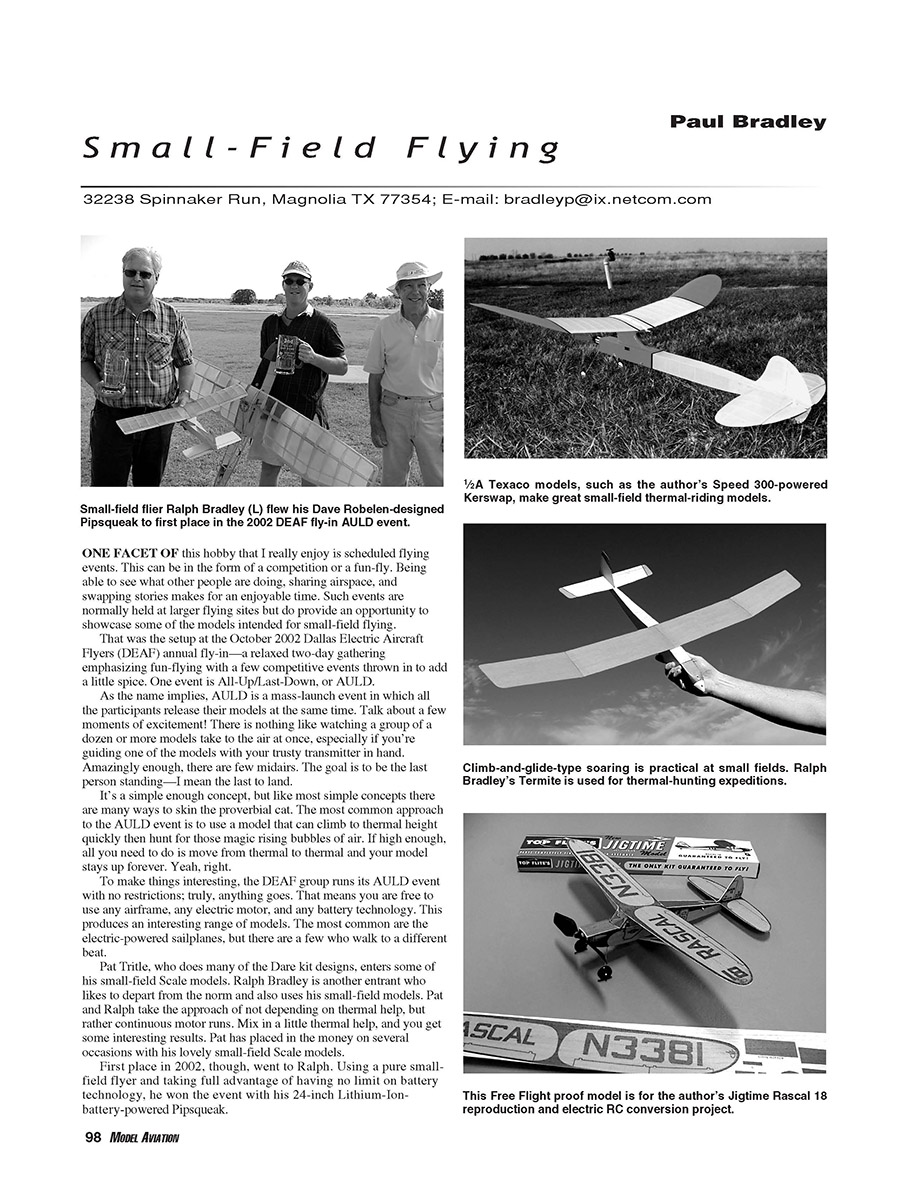
First place in 2002, though, went to Ralph. Using a pure small-field flyer and taking full advantage of having no limit on battery technology, he won the event with his 24-inch lithium-ion-battery-powered Pipsqueak.
In case you don't recognize it, the Pipsqueak design comes from well-known pioneer of small-field flying and Model Aviation columnist Dave Robelen. In April 1966 Dave had the Pipsqueak design published in Radio Control Modeler. The plan is available as number 162 from RCM. Based on the Midwest Esquire, the Pipsqueak was designed for glow-engine power. Ralph's rendition of Dave's design is powered with a GWS ducted-fan motor mated to a home-brew gear drive. This setup produces plenty of flying power on a single lithium-ion cell. With two 830 mAh cells in parallel, Ralph's model was up for more than an hour when second-place finisher Jason Nowell had to land. Watch out for the small-field-flying crowd; you just don't know what strategy it might throw at you.
Small-field soaring — myths and approaches
At first blush, we might not think small-field soaring is practical for small-field fliers. Thermal-chasing often requires covering a lot of ground and seems to require fairly wide-open spaces. It is certainly true that soaring in the most open sense does entail large venues and models capable of flying at great distances from the pilot, but thermal flying and soaring can be enjoyed by the small-field flyer. You just go about it a bit differently.
Choose something with a wingspan a bit smaller than 2.0 or 3.0 meters — probably something more like just less than 1.0 meter to maybe 1.5 meters. There are many choices. If you like Old-Time Free Flight designs, the ones sized for 1/2A Texaco competition flying make great small-field fliers. With wing areas typically near 288 square inches (2 square feet) and weights in the 16- to 18-ounce range, the 1/2A Texaco models are lightly loaded and require little power to stay up. I mention the latter because I want to take you down a path like the one Pat Tritle and Ralph Bradley used for their AULD entries.
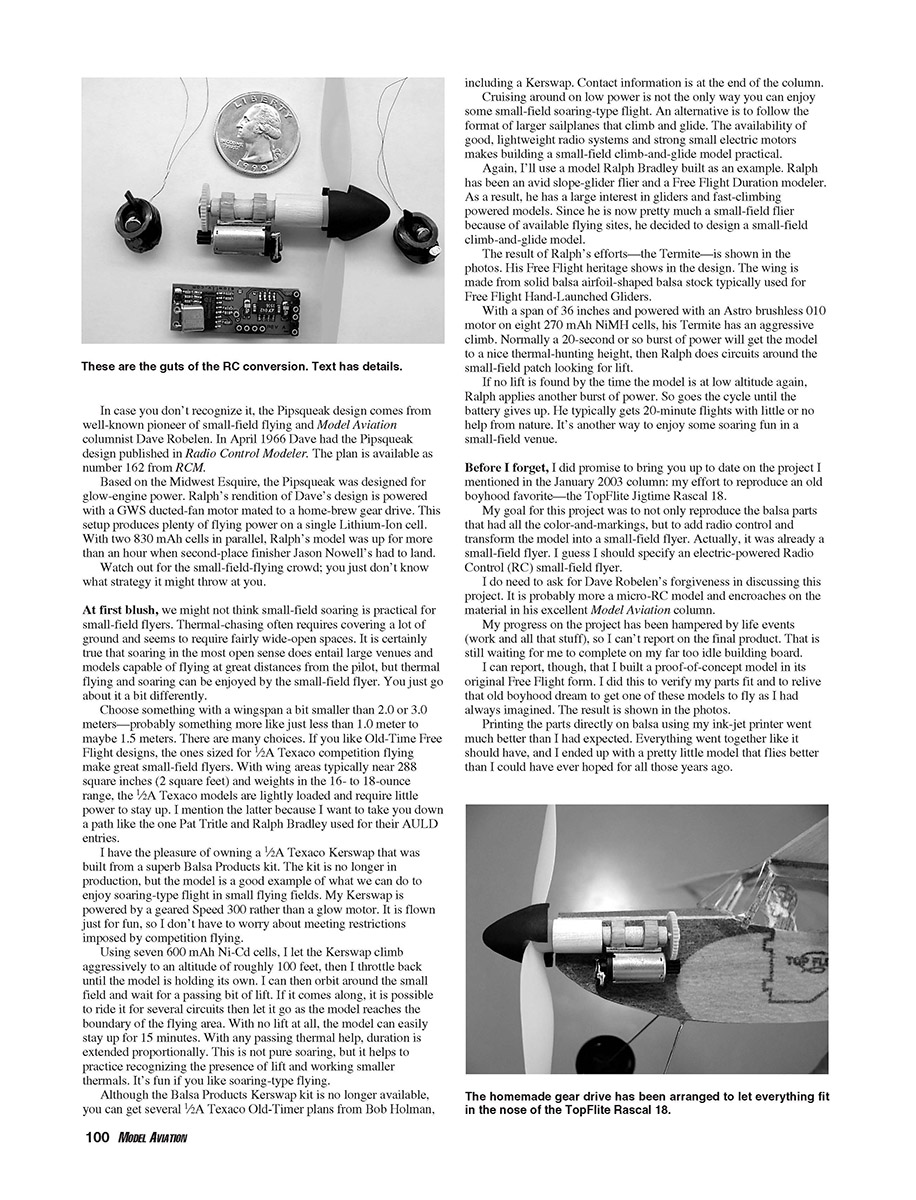
I have the pleasure of owning a 1/2A Texaco Kerswap that was built from a superb Balsa Products kit. The kit is no longer in production, but the model is a good example of what we can do to enjoy soaring-type flight in small flying fields. My Kerswap is powered by a geared Speed 300 rather than a glow motor. It is flown just for fun, so I don't have to worry about meeting restrictions imposed by competition flying.
Using seven 600 mAh NiCd cells, I let the Kerswap climb aggressively to an altitude of roughly 100 feet, then I throttle back until the model is holding its own. I can then circle down over the small field and wait for a passing bit of lift. If it comes along, it is possible to ride it for several circuits then let it go as the model reaches the boundary of the flying area. With no lift at all, the model can easily stay up for 15 minutes. With any passing thermal help, duration is extended proportionally. This is not pure soaring, but it helps to practice recognizing the presence of lift and working smaller thermals. It's fun if you like soaring-type flying.
Although the Balsa Products Kerswap kit is no longer available, you can get several 1/2A Texaco Old-Timer plans from Bob Holman, including a Kerswap. Contact information is at the end of the column.
Climb-and-glide: the Termite
Cruising around on low power is not the only way you can enjoy some small-field soaring-type flight. An alternative is to follow the format of larger sailplanes that climb and glide. The availability of good, lightweight radio systems and strong small electric motors makes building a small-field climb-and-glide model practical.
Again, I'll use a model Ralph Bradley built as an example. Ralph has been an avid slope-glider flier and a Free Flight Duration modeler. As a result, he has a large interest in gliders and fast-climbing powered models. Since he is now pretty much a small-field flier because of available flying sites, he decided to design a small-field climb-and-glide model.
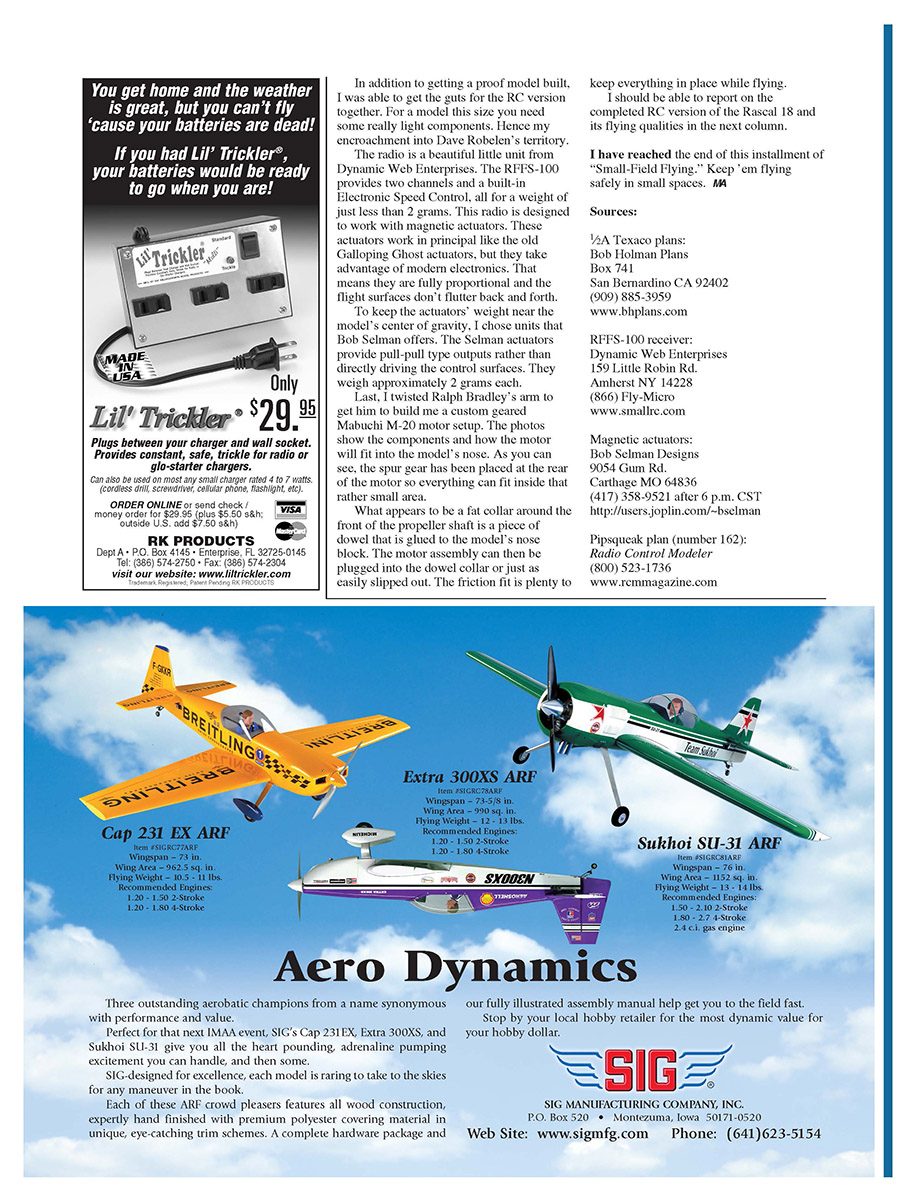
The result of Ralph's efforts — the Termite — is shown in the photos. His Free Flight heritage shows in the design. The wing is made from solid balsa airfoil-shaped stock typically used for Free Flight hand-launched gliders.
With a span of 36 inches and powered with an Astro brushless 010 motor on eight 270 mAh NiMH cells, his Termite has an aggressive climb. Normally a 20-second or so burst of power will get the model to a nice thermal-hunting height, then Ralph does circuits around the small-field patch looking for lift.
If no lift is found by the time the model is at low altitude again, Ralph applies another burst of power. So goes the cycle until the battery gives up. He typically gets 20-minute flights with little or no help from nature. It's another way to enjoy some soaring fun in a small-field venue.
Rascal 18 project (work in progress)
Before I forget, I did promise to bring you up to date on the project I mentioned in the January 2003 column: my effort to reproduce an old boyhood favorite — the TopFlite Jigtime Rascal 18.
My goal for this project was not only to reproduce the balsa parts that had all the color-and-markings, but to add radio control and transform the model into a small-field flyer. Actually, it was already a small-field flyer. I guess I should specify an electric-powered radio-control (RC) small-field flier.
I do need to ask for Dave Robelen's forgiveness in discussing this project. It is probably more a micro-RC model and encroaches on the material in his excellent Model Aviation column.
My progress on the project has been hampered by life events (work and all that stuff), so I can't report on the final product. That is still waiting for me to complete on my far-too-little building board.
I can report, though, that I built a proof-of-concept model from one of the original Free Flight plans I had. I did this to verify my parts fit and to relive that old boyhood dream to get one of these models to fly as I had always imagined. The result is shown in the photos.
Printing the parts directly on balsa using my ink-jet printer went much better than I had expected. Everything went together like it should have, and I ended up with a pretty little model that flies better than I could have ever hoped for all those years ago.
In addition to getting a proof model built, I was able to get the guts for the RC version together. For a model this size you need some really light components. Hence my encroachment into Dave Robelen’s territory.
The radio is a beautiful little unit from Dynamic Web Enterprises. The RFFS-100 provides two channels and a built-in electronic speed control, all for a weight of just less than 2 grams. This radio is designed to work with magnetic actuators. These actuators work in principle like the old Galloping Ghost actuators, but they take advantage of modern electronics. That means they are fully proportional and the flight surfaces don’t flutter back and forth.
To keep the actuators’ weight near the model’s center of gravity, I chose units that Bob Selman offers. The Selman actuators provide pull-pull type outputs rather than directly driving the control surfaces. They weigh approximately 2 grams each.
Last, I twisted Ralph Bradley’s arm to get him to build me a custom geared Mabuchi M-20 motor setup. The photos show the components and how the motor will fit into the model’s nose. As you can see, the spur gear has been placed at the rear of the motor so everything can fit inside that rather small area.
What appears to be a flat collar around the front of the propeller shaft is a piece of dowel that is glued to the model’s nose block. The motor assembly can then be plugged into the dowel collar or just as easily slipped out. The friction fit is plenty to keep everything in place while flying.
I should be able to report on the completed RC version of the Rascal 18 and its flying qualities in the next column.
Keep ’em flying safely in small spaces.
—Paul Bradley
Sources
- 1/2A Texaco plans:
Bob Holman Plans Box 741 San Bernardino CA 92402 (909) 885-3959 www.bhplans.com
- RFFS-100 receiver:
Dynamic Web Enterprises 159 Little Robin Rd. Amherst NY 14228 (866) FLY-MICRO www.smallrc.com
- Magnetic actuators:
Bob Selman Designs 9054 Gum Rd. Carthage MO 64836 (417) 358-9521 after 6 p.m. CST http://users.joplin.com/~bselman
- Pipsqueak plan (number 162):
Radio Control Modeler (800) 523-1736 www.rcmmagazine.com
Transcribed from original scans by AI. Minor OCR errors may remain.

