
Small-Field Flying - 2004/01
Paul Bradley 32238 Spinnaker Run, Magnolia, TX 77354 E-mail: bradleyp@ix.netcom.com
Recreating the Jigtime Models
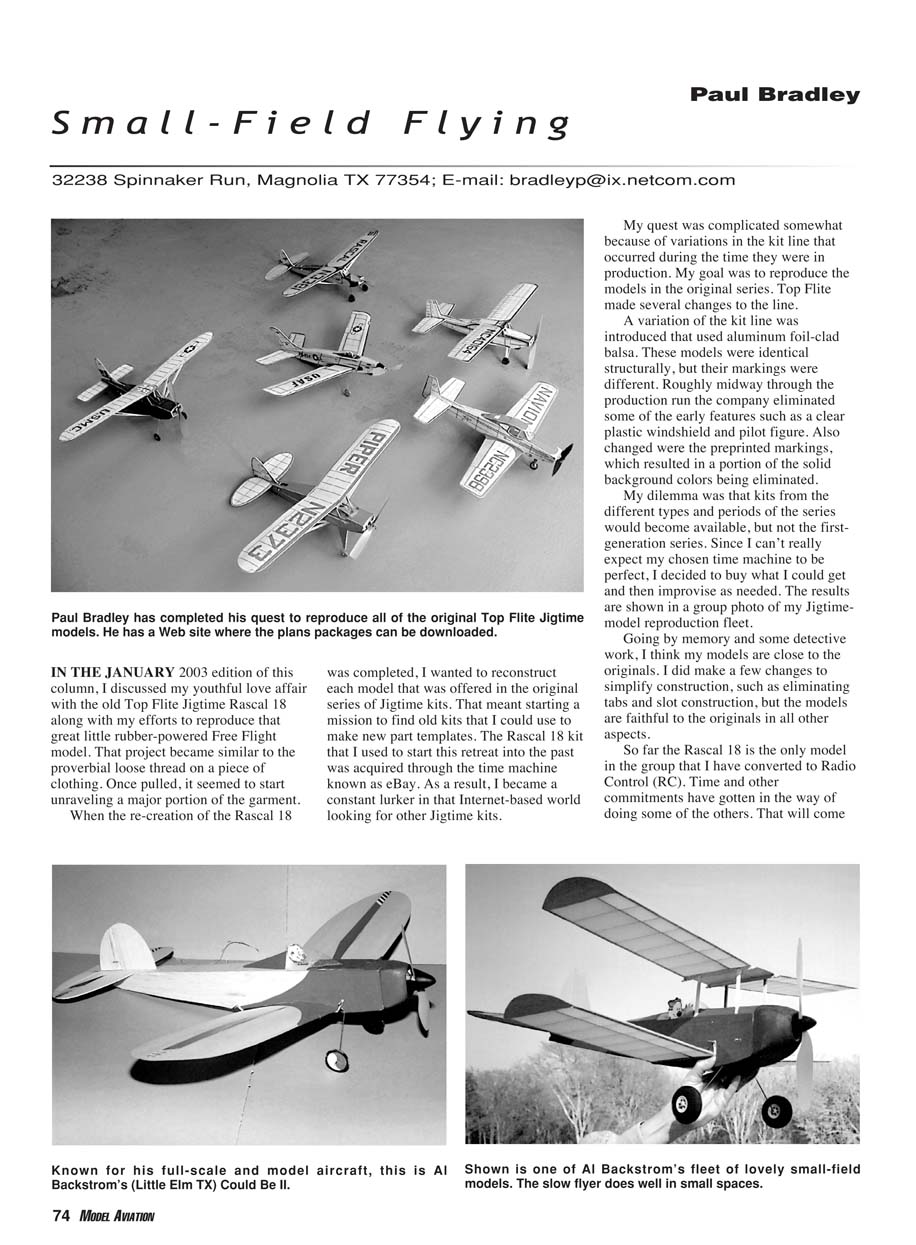
In the January 2003 edition of this column, I discussed my youthful love affair with the old Top Flite Jigtime Rascal 18 and my efforts to reproduce that great little rubber-powered Free Flight model. That project became similar to the proverbial loose thread on a piece of clothing — once pulled, it seemed to start unraveling a major portion of the garment.
When the re-creation of the Rascal 18 was completed, I wanted to reconstruct each model offered in the original series of Jigtime kits. That meant starting a mission to find old kits to use as templates for new parts. The Rascal 18 kit I used to start this retreat into the past was acquired through the time machine known as eBay, and I became a constant lurker in that Internet-based world looking for other Jigtime kits.
My quest was complicated somewhat by variations in the kit line that occurred during production. My goal was to reproduce the models in the original series, but Top Flite made several changes. A variation introduced aluminum foil–clad balsa; these models were identical structurally, but their markings were different. Roughly midway through the run the company eliminated some early features such as the clear plastic windshield and pilot figure and altered preprinted markings, removing portions of solid background colors.
Kits from different periods of the series would become available, but not always first-generation kits. Since I couldn't expect my chosen time machine to be perfect, I decided to buy what I could get and improvise as needed. Going by memory and some detective work, I think my reproductions are close to the originals. I did make a few changes to simplify construction — for example, eliminating tab-and-slot construction — but the models remain faithful to the originals in most respects.
So far, the Rascal 18 is the only model in the group I have converted to radio control (RC). Time and other commitments have delayed conversions of others, but that will come in due time. I thought some of you might be interested in building one or more of these great vintage models.
Plans and Resources
For those with Internet access, I created a website where plans and parts templates can be downloaded at no charge. I would appreciate a photo now and then from anyone who builds a model from the supplied drawings. If you perform an RC conversion, please share the details so they can be published here.
- Plans packages and templates: www.parmodels.com/Plans
- The site includes a description of the process I use to print colorful parts directly on balsa with a computer-driven ink-jet printer.
May the Carl Goldberg–designed and -inspired Jigtime models live on.
Al Backstrom’s Models
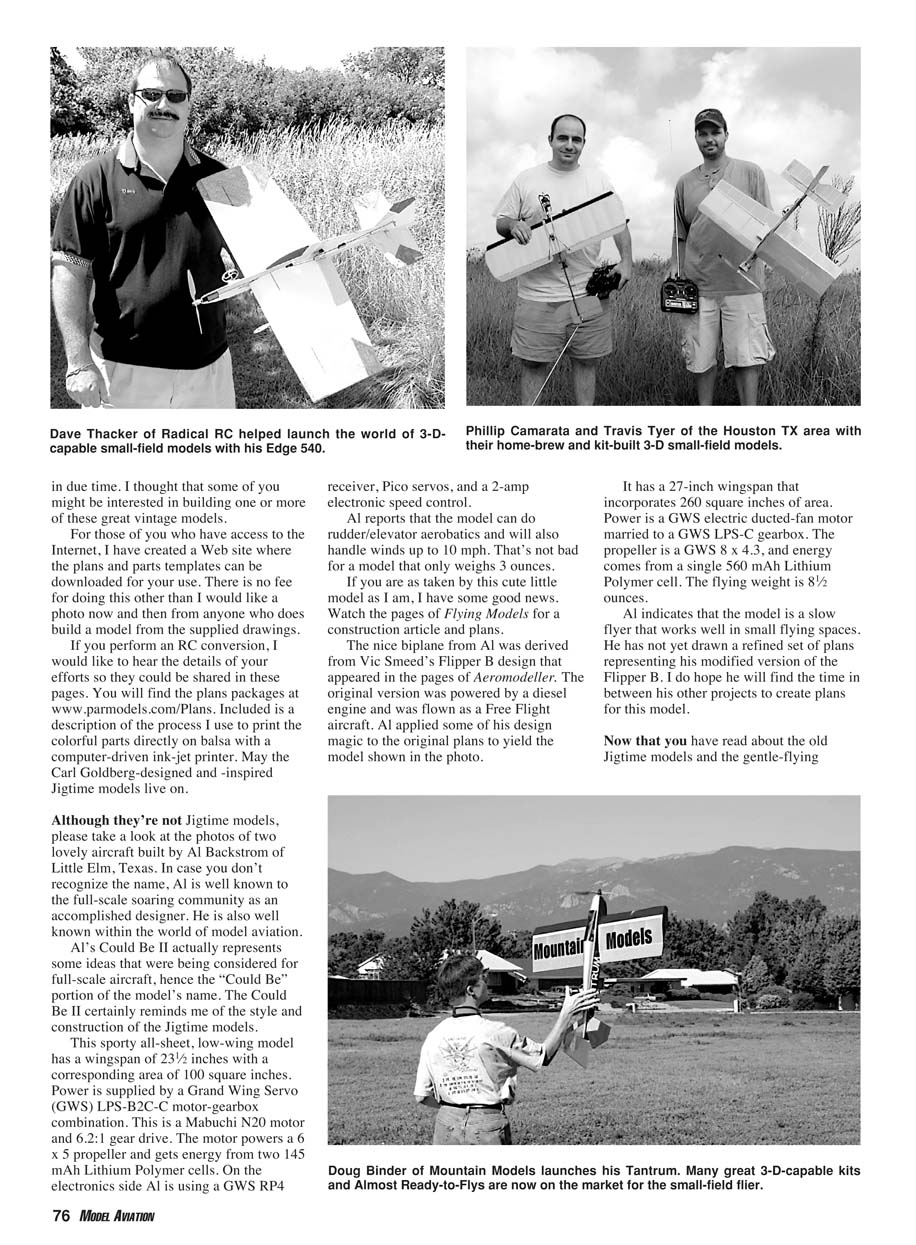
Although they're not Jigtime models, take a look at two lovely aircraft built by Al Backstrom of Little Elm, Texas. Al is well known in the full-scale soaring community as an accomplished designer and is also well known within the model aviation world.
Al's Could Be II reflects ideas being considered for full-scale aircraft, hence the name. The Could Be II reminds me of the style and construction of the Jigtime models.
Could Be II — key specs:
- Configuration: sporty all-sheet, low-wing model
- Wingspan: 23½ inches
- Wing area: 100 square inches
- Power: Grand Wing Servo (GWS) LPS-B2C-C motor-gearbox (Mabuchi N20 motor, 6.2:1 gear drive)
- Propeller: 6 x 5
- Battery: two 145 mAh Lithium Polymer cells
- Electronics: GWS RP4 receiver, Pico servos, 2-amp electronic speed control
- Flying weight: 3 ounces
- Performance: capable of rudder/elevator aerobatics; handles winds up to ~10 mph
Watch the pages of Flying Models for a construction article and plans.
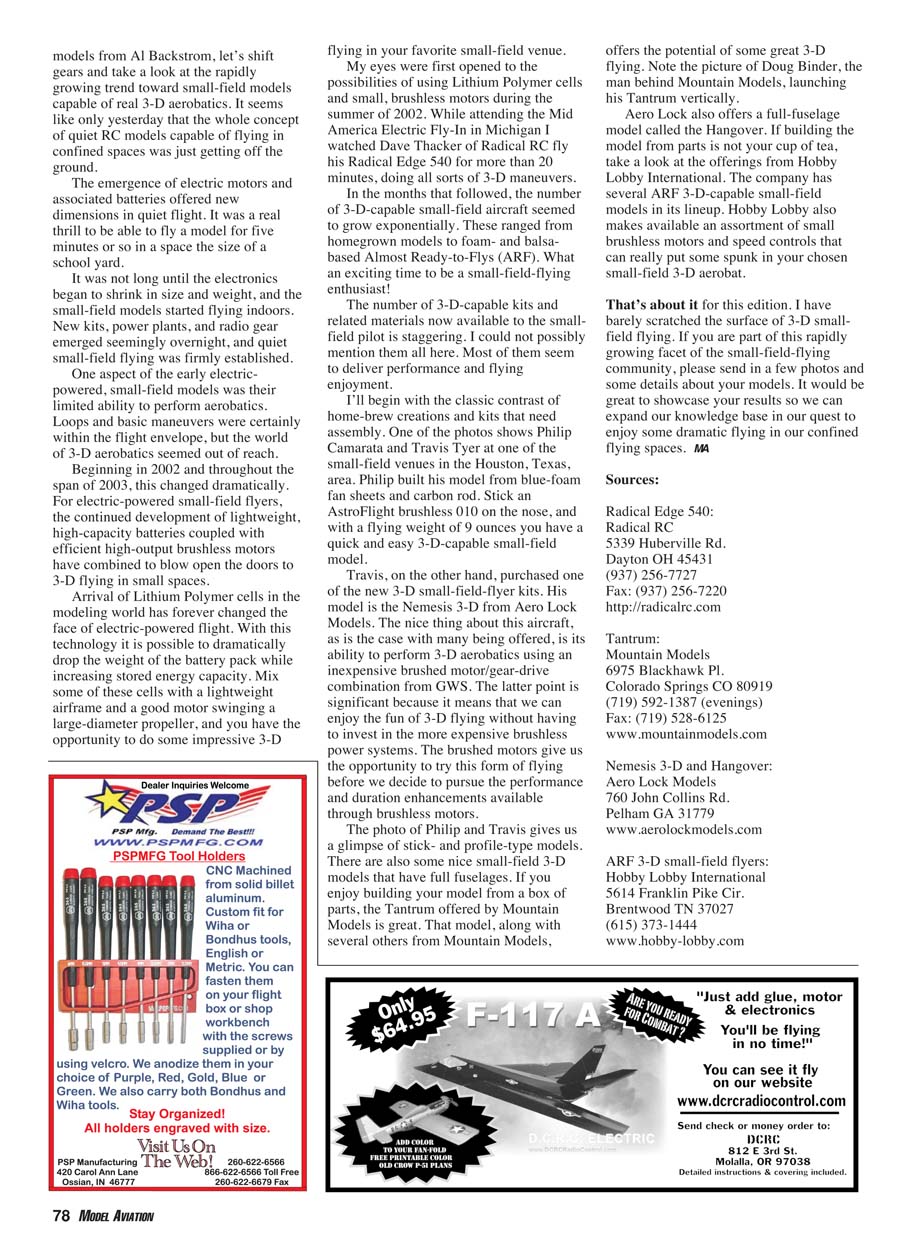
The biplane Al built was derived from Vic Smeed's Flipper B design that appeared in Aeromodeller. The original was a diesel-powered Free Flight model; Al applied his design magic to create the model shown.
Flipper B derivative — key specs:
- Wingspan: 27 inches
- Wing area: 260 square inches
- Power: GWS electric ducted-fan motor with GWS LPS-C gearbox
- Prop/impeller: GWS 8 x 4.3
- Battery: single 560 mAh Lithium Polymer cell
- Flying weight: 8½ ounces
- Performance: slow flyer that works well in small flying spaces
Al has not yet produced a refined set of plans for his modified Flipper B, but I hope he will find time to do so.
The Rise of Small-Field 3-D Flying
Now let's shift gears and look at the rapidly growing trend toward small-field models capable of real 3-D aerobatics. It seems like only yesterday that quiet RC models capable of flying in confined spaces were just getting off the ground.
The emergence of electric motors and batteries offered new dimensions in quiet flight. It was thrilling to fly a model for five minutes or so in a space the size of a schoolyard. As electronics shrank in size and weight, small-field models started flying indoors. New kits, power plants, and radio gear emerged rapidly, and quiet small-field flying became firmly established.
One aspect of early electric small-field models was limited aerobatic ability — loops and basic maneuvers were common, but 3-D aerobatics seemed out of reach. Beginning in 2002 and throughout 2003, this changed dramatically. Lightweight, high-capacity batteries (notably Lithium Polymer cells) coupled with efficient high-output brushless motors opened the doors to 3-D flying in small spaces.
Lithium Polymer cells changed electric-powered flight by allowing dramatic weight reduction and increased energy capacity. Pair LiPo cells with a lightweight airframe and a good motor swinging a large-diameter propeller, and you can achieve impressive 3-D performance in confined venues.
My eyes were opened to these possibilities in summer 2002 at the Mid America Electric Fly-In in Michigan, where I watched Dave Thacker of Radical RC fly his Radical Edge 540 for more than 20 minutes, performing all sorts of 3-D maneuvers. In the months that followed, the number of 3-D-capable small-field aircraft grew exponentially — from homebuilts to foam- and balsa-based ARFs. What an exciting time for small-field-flying enthusiasts!
Kits, Homebuilts, and Examples
The variety of 3-D-capable kits and materials available to small-field pilots is staggering. Many deliver excellent performance and flying enjoyment. Here are a few examples and contrasts between homebuilt creations and kits.
- Philip Camarata: built a model from blue-foam sheets and carbon rod, powered by an AstroFlight brushless 010. Flying weight: 9 ounces — a quick and easy 3-D-capable small-field model.
- Travis Tyer: flew a Nemesis 3-D from Aero Lock Models. Many current 3-D models can perform using inexpensive brushed motor/gear-drive combinations from GWS. This allows pilots to try 3-D flying without the initial expense of brushless power systems.
- Mountain Models Tantrum: a full-fuselage kit that offers excellent potential for 3-D flying. Doug Binder (behind Mountain Models) is pictured launching his Tantrum vertically.
- Aero Lock Hangover: another full-fuselage 3-D-capable model from Aero Lock.
- Hobby Lobby International: offers several ARF 3-D-capable small-field models and an assortment of small brushless motors and speed controls to increase performance.
These examples barely scratch the surface of 3-D small-field flying. If you are part of this rapidly growing facet of the community, please send photos and details about your models. It would be great to showcase your results and expand our collective knowledge so we can enjoy dramatic flying in confined spaces.
MA
Sources:
- Radical Edge 540: Radical RC
5339 Huberville Rd., Dayton, OH 45431 Phone: (937) 256-7727 Fax: (937) 256-7220 http://radicalrc.com
- Tantrum: Mountain Models
6975 Blackhawk Pl., Colorado Springs, CO 80919 Phone: (719) 592-1387 (evenings) Fax: (719) 528-6125 www.mountainmodels.com
- Nemesis 3-D and Hangover: Aero Lock Models
760 John Collins Rd., Pelham, GA 31779 www.aerolockmodels.com
- ARF 3-D small-field flyers: Hobby Lobby International
5614 Franklin Pike Cir., Brentwood, TN 37027 Phone: (615) 373-1444 www.hobby-lobby.com
Transcribed from original scans by AI. Minor OCR errors may remain.

