
Small-Field Flying
Paul Bradley
32238 Spinnaker Run, Magnolia TX 77354 E-mail: bradleyp@ix.netcom.com
THE MARCH 2004 issue of Model Aviation is on my desk as I am writing this column. One article in it that strikes my fancy is "Electric Flash" by Harry Stewart — talk about being up the small-field-flyer alley!
What is especially interesting is the inspiration for the model: an old Comet rubber-powered Free Flight design. Reviewing Harry’s construction article made me think that examining vintage model-airplane designs—especially old rubber-powered Free Flight models—would be a good topic for this forum.
Vintage Free Flight designs for modern RC small-field flyers
The idea of using vintage designs for modern RC models is not new; there are many examples. What leads me to open this topic is selecting models that make good small-field flyers.
Regardless of the choice of power system, some vintage designs work much better than others when converted to controllable RC models. Good Free Flight sport designs often have positive inherent stability: they are lightly loaded, and features such as long, pointed wings are not a problem in gentle Free Flight flight. Rubber-powered models often have fairly long nose moments to keep them in balance when loaded with a rubber motor. These features are fine for the original intent, but moving those designs into the realm of engine- or electric-motor-powered RC can present issues.
Wing planform, taper, and tip-stall
Models designed in the 1930s and 1940s provide appealing subjects but commonly feature highly tapered wings (the Comet Flash used by Harry Stewart is an example). Highly tapered wings tend to tip-stall when maneuvered.
For Free Flight models flying gentle circles with light wing loading, tip-stalling is usually not a problem. When we start controlling the model from the ground and add the weight of an internal-combustion engine or electric motor and radio gear, tip-stall can appear and bite us if we are not careful.
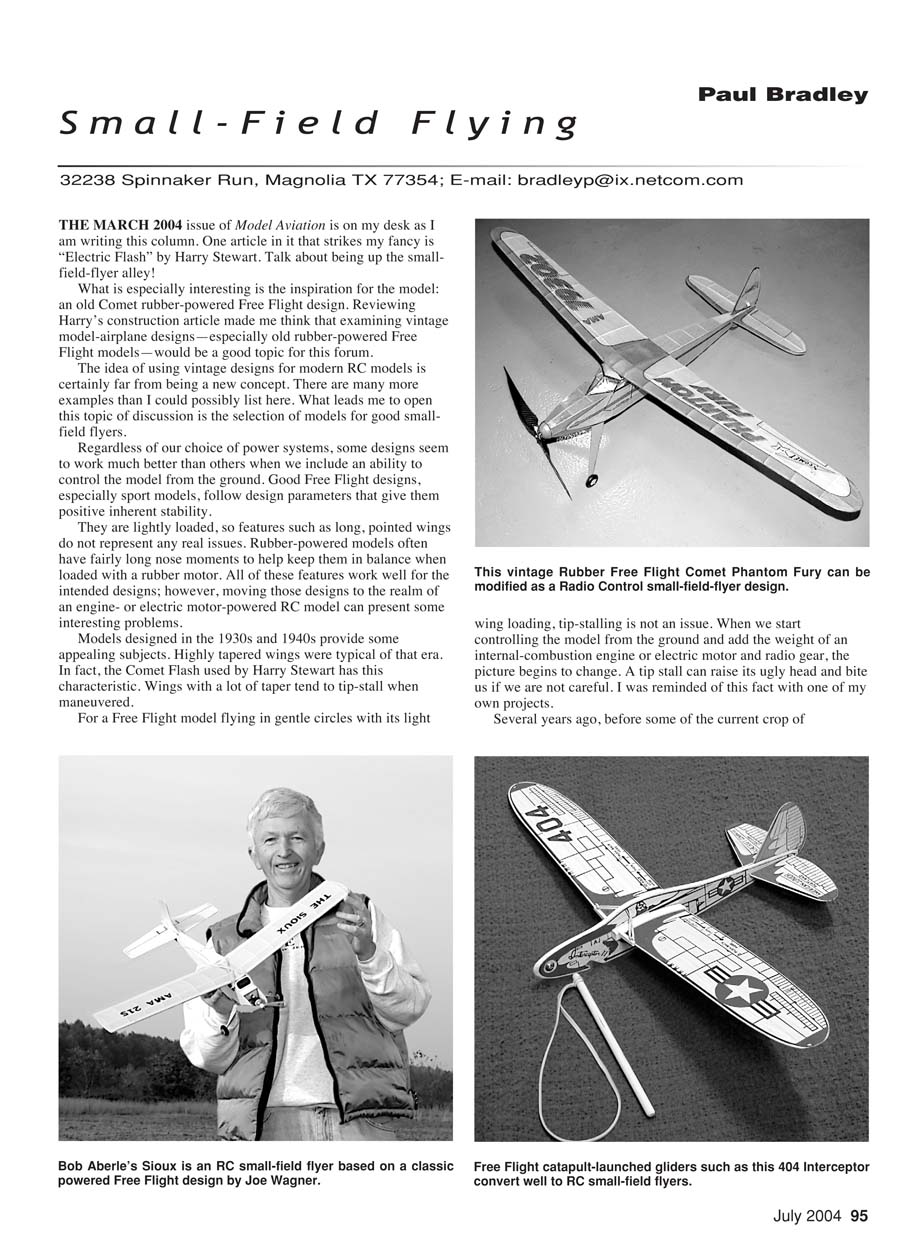
Phantom Fury — a conversion example
Several years ago, before the current crop of lightweight radio gear became widely available, I converted a Comet Phantom Fury to an electric-powered RC model. The prolific offerings from the defunct Comet Models are a great resource for developing small-field RC models. The Phantom Fury is a perfect size for small-field flying: a 32-inch wingspan and a generous fuselage cross-section. Its wing planform is highly tapered with an area of roughly 94 square inches. My RC version flies at 4 ounces, giving a wing loading of about 6.2 ounces per square foot — a great value for a gentle small-field model.
Early flights showed the Phantom Fury to be a keeper, but it displayed a strong tendency to tip-stall if I applied more than the gentlest rudder input. The combination of the highly tapered wing and the increased wing loading (versus the original Free Flight configuration) revealed the issue clearly.
Two remedies are effective:
- Reduce flying weight (modern lighter equipment and Li-Poly cells instead of Ni-Cd packs help).
- Add washout to the tips (making the trailing edge higher than the leading edge at the tips) to tame tip-stalling.
Pay attention to wing planform if you base a new small-field-flyer on a vintage design. Adding tip washout will help the model be a fun flyer rather than one prone to sweaty, stressful flights.
Nose and tail moments — equipment placement
Another factor is nose length. Original rubber-powered models had weight in the rubber motor located behind the model's center of gravity (CG); the propeller and a long nose helped balance the model. When the rubber motor is removed, the CG moves forward. Replacing a lightweight Free Flight propeller with an engine- or motor-driven prop makes the CG move forward even more. Plan to locate batteries and servos toward the rear of the area encompassed by the wing.
Ensure the source model has enough fuselage area to allow equipment installation farther aft. Most do, but it's wise to consider this up front.
Vintage engine-powered models often had relatively short nose moments, which generally makes converting them to small-field RC simpler. Where trouble can arise is the typical long tail moment: the Free Flight configuration worked because there were no heavy components between the CG and the tail. When converting to RC we add radio gear and batteries; the short nose moment can make it difficult to place these components ahead of the CG, so servos and batteries may end up aft of the CG and the model becomes tail-heavy. When evaluating vintage powered-model designs, look at the space between the engine firewall and the model's CG — can you place heavier components like batteries in that area?
Example conversions and projects
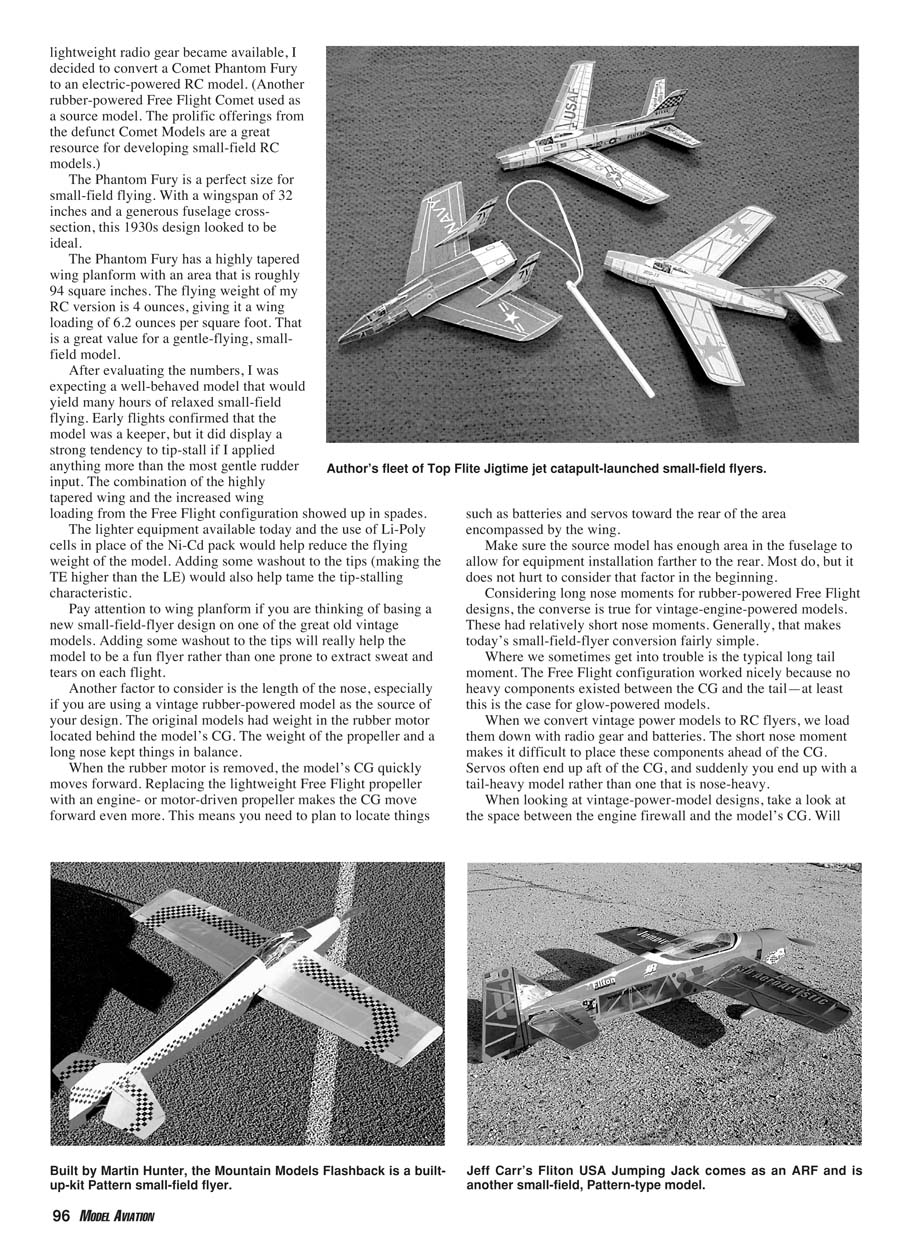
- A great powered Free Flight model converted to an RC small-field flyer is one of Bob Aberle’s projects: his conversion of Joe Wagner’s classic The Sioux. Bob’s model has a 27-inch wingspan and is electric powered. A construction article for Bob’s model appears in the April 2004 issue of Quiet Flyer (see sources).
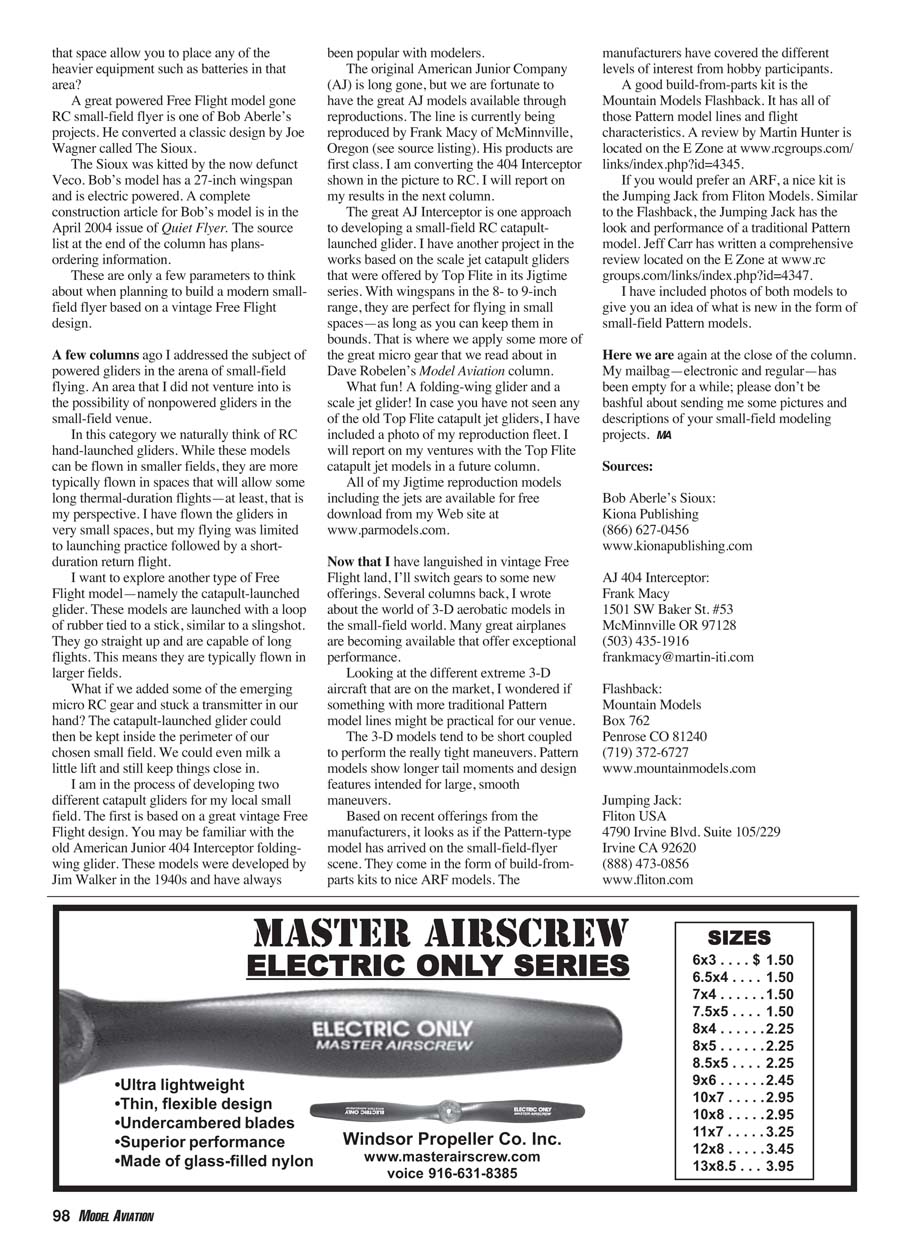
- Catapult-launched gliders: I want to explore catapult-launched Free Flight gliders (launched with a rubber loop on a stick like a slingshot). These go straight up and can achieve long flights, so they are typically flown in larger fields. But with emerging micro RC gear, a catapult-launched glider could be flown inside a small field while keeping it within bounds and milking any lift.
I am developing two catapult gliders for my local small field:
- A conversion of the vintage American Junior 404 Interceptor folding-wing glider (designed by Jim Walker in the 1940s). Reproductions of AJ models are available from Frank Macy; his reproductions are first class. I am converting the 404 Interceptor to RC and will report results in my next column.
- A reproduction based on Top Flite’s Jitglite series of scale jet catapult gliders. With wingspans in the 8–9 inch range, they are well suited to small spaces if kept in bounds — again, micro gear helps. I have a reproduction fleet of the old Top Flite catapult jet gliders and will report on those ventures in a future column.
All my Jitglite reproduction models, including the jets, are available for free download from my website: www.parmodels.com.
New offerings — Pattern-style small-field models
Several columns back I wrote about 3-D aerobatic models in the small-field world. Many great airplanes are now available with exceptional performance. Looking at extreme 3-D aircraft made me wonder whether more traditional Pattern-model lines could work for small-field flying.
3-D models tend to be short-coupled for tight maneuvers; Pattern models show longer tail moments and are intended for smooth, larger maneuvers. Based on recent manufacturer offerings, Pattern-type models have arrived in the small-field-flyer scene as build-from-parts kits and ARFs.
- Mountain Models Flashback (build-from-parts kit): classic Pattern lines and flight characteristics. See Martin Hunter’s review on the E Zone at www.rcgroups.com/links/index.php?id=4345.
- Fliton Models Jumping Jack (ARF): similar look and performance to the Flashback. Jeff Carr’s comprehensive review is on the E Zone at www.rcgroups.com/links/index.php?id=4347.
I have included photos of both models in the original column to show what’s new in small-field Pattern models.
Closing / Mailbag
My mailbag — electronic and regular — has been quiet for a while. Please don’t be bashful about sending pictures and descriptions of your small-field modeling projects.
Sources
- Bob Aberle’s Sioux:
Kiona Publishing (866) 627-0456 www.kionapublishing.com
- AJ 404 Interceptor (reproductions):
Frank Macy 1501 SW Baker St. #53 McMinnville OR 97128 (503) 435-1916 frankmacy@martin-iti.com
- Mountain Models — Flashback:
Mountain Models Box 762 Penrose CO 81240 (719) 372-6727 www.mountainmodels.com
- Jumping Jack (Fliton USA):
Fliton USA 4790 Irvine Blvd. Suite 105/229 Irvine CA 92620 (888) 473-0856 www.fliton.com
Transcribed from original scans by AI. Minor OCR errors may remain.

