
Small-Field Flying
Paul Bradley
Endless Power
When solar cells first emerged, I began dreaming about the possibility of building a model airplane that could fly all day long. That was long before practical electric-powered models and the associated radio gear we enjoy today were even a concept in some designer's imagination. The thought of getting energy from the sun seemed a perfect way to power model airplanes. Heck, it seemed like a perfect way to power the world!
Much has happened in the world of solar cells and their applications since the early ones appeared. A number of solar-powered, unmanned airplanes have been developed, including some produced by modelers.
Solar cells are intriguing, but they are notorious for being inefficient. If we want very much power, we need a number of cells. The result is a fairly large model or solar-powered aircraft to carry enough cells to produce the power needed for flight.
My dream of endless power from the sun for a model airplane is also shared by my brother Ralph. "Large" and "model airplane" are words that are mutually exclusive with him. He is devoted to small and micro RC models.
Ralph decided to see if a small, practical, solar-powered model could be developed — in other words, the perfect small-field flyer. There would be no batteries, no charging, no fuel, no fuss, and no muss. You would simply turn it on and fly as long as you wanted (or until your transmitter battery was empty). It's a nice goal, but as you might expect, the path from the idea to the result was littered with lessons learned.
The Sol Mite — a pure solar small-field flyer
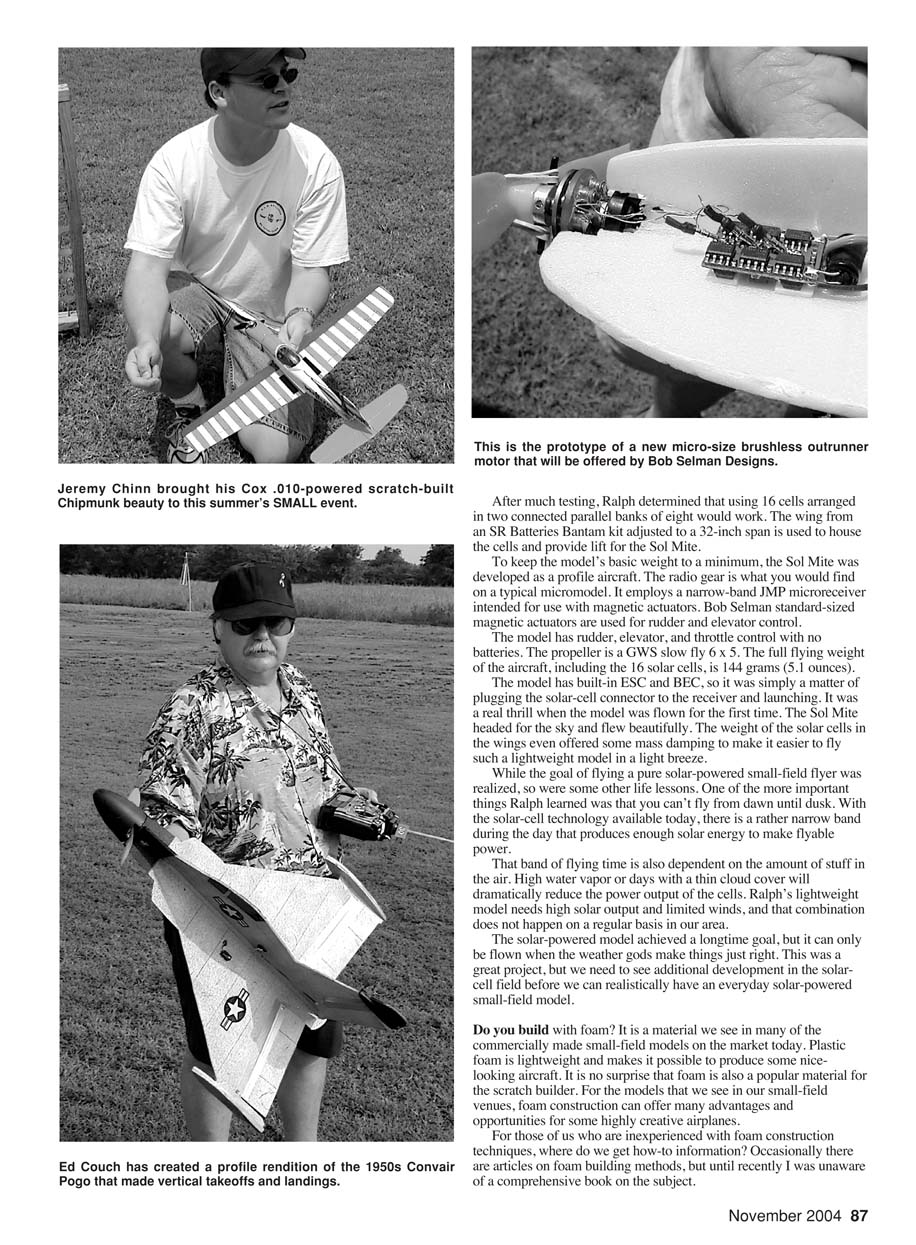
Ralph did develop a solar-powered small-field flyer and learned much while doing so. Called the Sol Mite, the aircraft is powered with a custom-geared GWS EDF-50 ducted-fan motor. There are no batteries of any type on the model. It is purely solar-powered.
The key to keeping it at the desired size was some higher-efficiency solar cells developed for the space industry and obtainable by the general public. The cells Ralph used are not the highest efficiency available, but they are better than those commonly available to the home experimenter. The source for these cells is given in the Sources section below.
After much testing, Ralph determined that using 16 cells arranged in two connected parallel banks of eight would work. The wing from an SR Batteries Bantam kit, adjusted to a 32-inch span, is used to house the cells and provide lift for the Sol Mite.
To keep the model's basic weight to a minimum, the Sol Mite was developed as a profile aircraft. The radio gear is what you would find on a typical micromodel. It employs a narrow-band JMP microreceiver intended for use with magnetic actuators. Bob Selman standard-sized magnetic actuators are used for rudder and elevator control.
The model has rudder, elevator, and throttle control with no batteries. The propeller is a GWS Slow Fly 6 x 5. The full flying weight of the aircraft, including the 16 solar cells, is 144 grams (5.1 ounces).
The model has a built-in ESC and BEC, so it was simply a matter of plugging the solar-cell connector into the receiver and launching. It was a real thrill when the model was flown for the first time. The Sol Mite headed for the sky and flew beautifully. The weight of the solar cells in the wings even offered some mass damping to make it easier to fly such a lightweight model in a light breeze.
Lessons learned
While the goal of flying a pure solar-powered small-field flyer was realized, so were some other life lessons. One of the more important things Ralph learned was that you can't fly from dawn until dusk. With the solar-cell technology available today, there is a rather narrow band during the day that produces enough solar energy to make flyable power.
That band of flying time is also dependent on the amount of stuff in the air. High water vapor or days with thin cloud cover will dramatically reduce the power output of the cells. Ralph's lightweight model needs high solar output and limited winds, and that combination does not happen on a regular basis in our area.
The solar-powered model achieved a longtime goal, but it can only be flown when the weather gods make things just right. This was a great project, but we need to see additional development in the solar-cell field before we can realistically have an everyday solar-powered small-field model.
Building with foam
Do you build with foam? It is a material we see in many of the commercially made small-field models on the market today. Plastic foam is lightweight and makes it possible to produce some nice-looking aircraft. It is no surprise that foam is also a popular material for the scratch builder. For the models that we see in our small-field venues, foam construction can offer many advantages and opportunities for some highly creative airplanes.
For those of us who are inexperienced with foam construction techniques, where do we get how-to information? Occasionally there are articles on foam building methods, but until recently I was unaware of a comprehensive book on the subject.
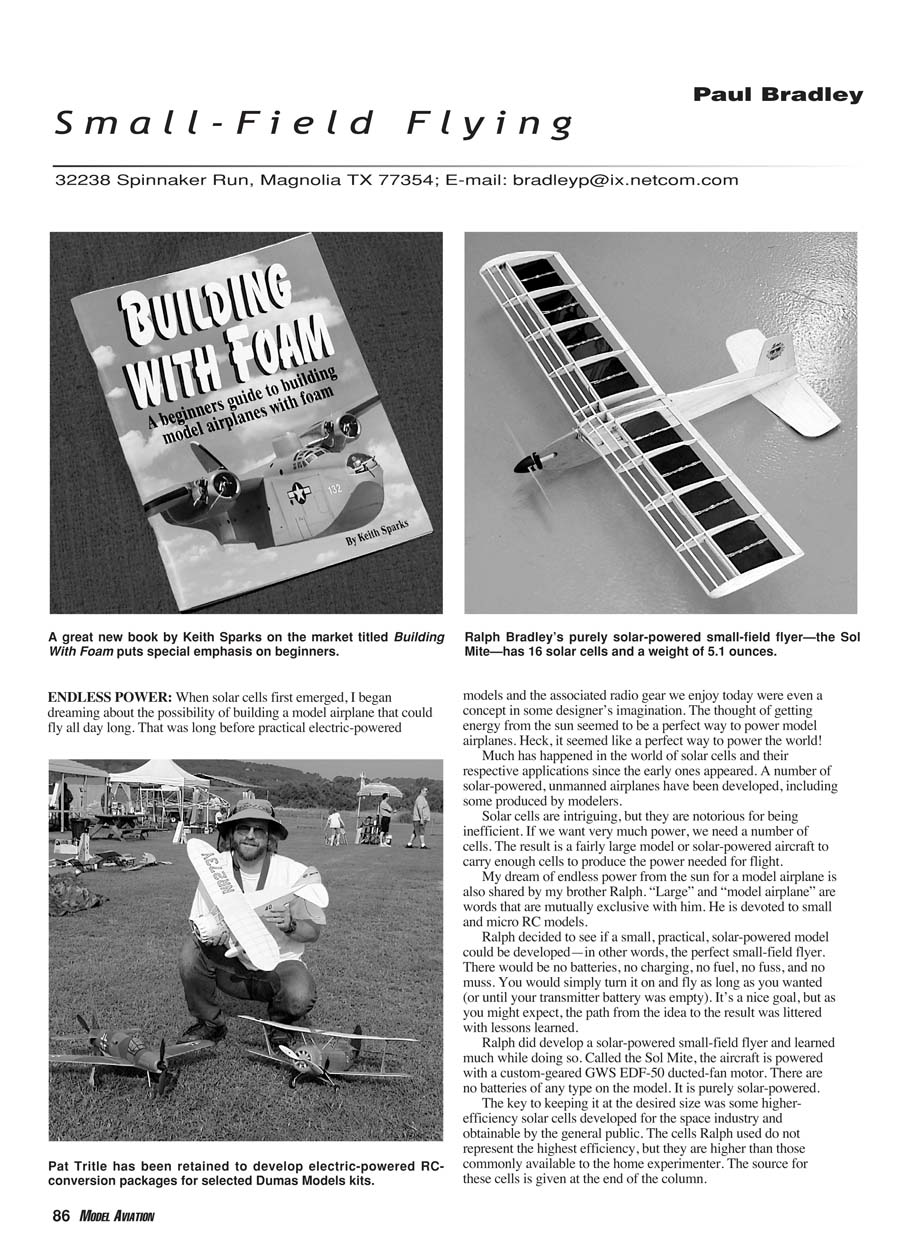
Keith Sparks, a master foam modeler, has published a nice book titled Building With Foam. It covers the full gamut of foam-building techniques with special emphasis on the beginner. I highly recommend this book to anyone who is interested in learning the art of building model airplanes using plastic foam. Ordering information is provided in the Sources section.
Old-Timer FF plans and laser-cut parts
Awhile back I commented on using some of the older Free Flight (FF) designs for small-field RC models. Unless you happen to have a number of Old-Timer plans or kits lying around, finding a source for these older models can be a problem. Fortunately, Bob Holman Plans offers an extensive list of plans and laser-cut parts for some of the best vintage designs.
A review of Bob's catalog reveals a surprising number of excellent plans and laser-cut parts for models that would make great small-field conversions. The nice thing about the plans from Bob Holman is that each set has been redrawn using CAD. This helps ensure that they are accurate.
If you have experienced an urge for a small-field flyer based on one of the vintage FF designs, get a copy of the Bob Holman Plans catalog. The plans list is free. Send an SASE with a few stamps to the address in the Sources section.
Summer flying fun — SMALL event highlights
It is hard to believe that the cover date on this issue is November. Where does the time go? The summer flying months are just too short.
This year I had the opportunity to attend the annual Small Aircraft Model Lover's League (SMALL) event in Little Rock, Arkansas. This well-known event has taken place for a number of years and represents a wonderful collection of models that are typically flown in small-field venues.
I don't have the space to provide a full event report here, but there are several things that I want to highlight.
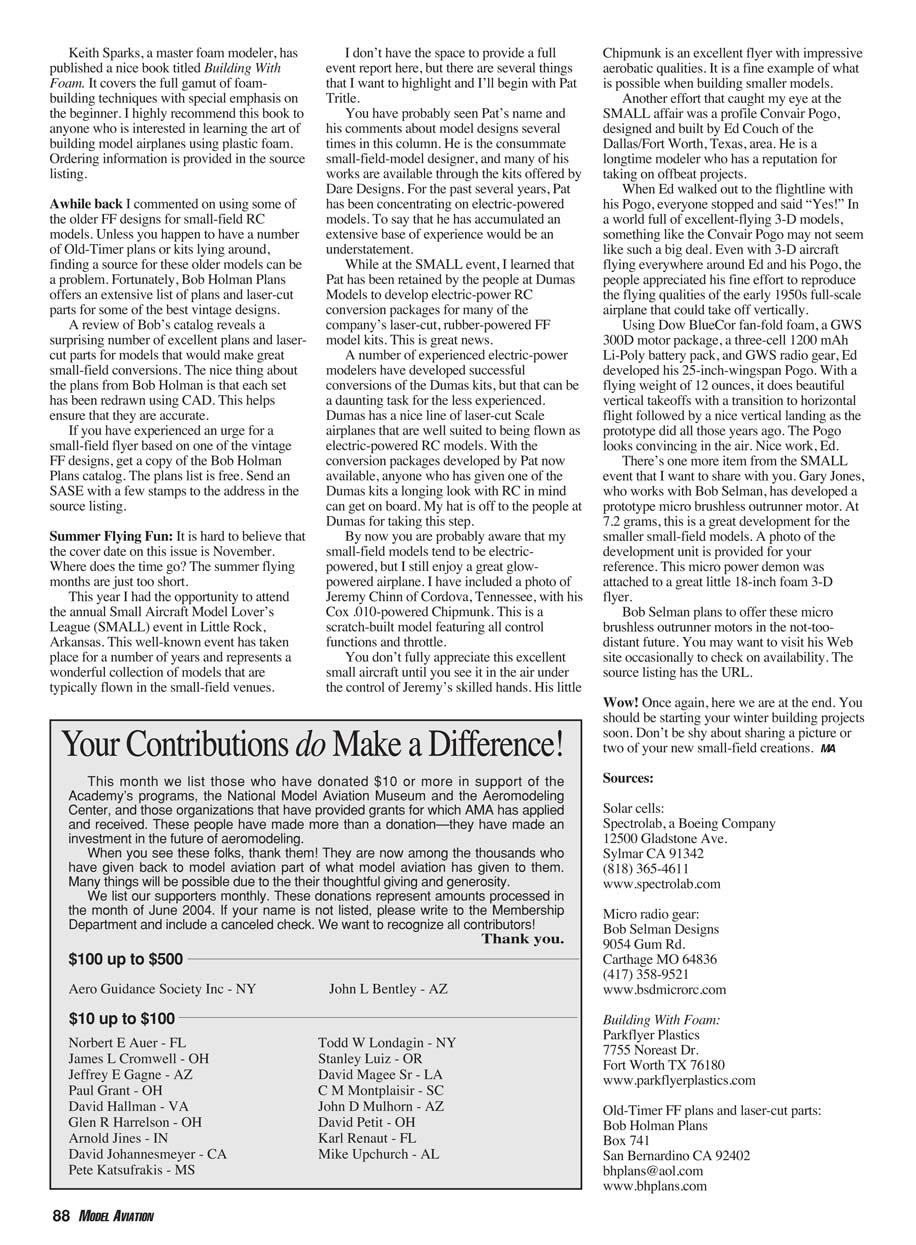
- Pat Tritle: You have probably seen Pat's name and his comments about model designs several times in this column. He is the consummate small-field-model designer, and many of his works are available through the kits offered by Dare Designs. For the past several years, Pat has been concentrating on electric-powered models and has accumulated an extensive base of experience. While at the SMALL event, I learned that Pat has been retained by Dumas Models to develop electric-power RC conversion packages for many of the company's laser-cut, rubber-powered FF model kits. This is great news for less experienced modelers who want to convert Dumas kits to electric power.
- Jeremy Chinn: By now you are probably aware that my small-field models tend to be electric-powered, but I still enjoy a great glow-powered airplane. I included a photo of Jeremy Chinn of Cordova, Tennessee, with his Cox .010-powered Chipmunk. This is a scratch-built model featuring all control functions and throttle. You don't fully appreciate this excellent small aircraft until you see it in the air under the control of Jeremy's skilled hands. His little Chipmunk is an excellent flyer with impressive aerobatic qualities—a fine example of what is possible when building smaller models.
- Ed Couch's Convair Pogo: Another effort that caught my eye at the SMALL affair was a profile Convair Pogo, designed and built by Ed Couch of the Dallas/Fort Worth, Texas, area. He is a longtime modeler who has a reputation for taking on offbeat projects. When Ed walked out to the flightline with his Pogo, everyone stopped and said "Yes!" Even with 3-D aircraft flying everywhere around Ed and his Pogo, people appreciated his fine effort to reproduce the flying qualities of the early-1950s full-scale airplane that could take off vertically. Using Dow BlueCor fan-foil foam, a GWS 300D motor package, a three-cell 1200 mAh Li-Poly battery pack, and GWS radio gear, Ed developed his 25-inch wingspan Pogo. With a flying weight of 12 ounces, it does beautiful vertical takeoffs with a transition to horizontal flight followed by a nice vertical landing as the prototype did. The Pogo works convincingly in the air. Nice work, Ed.
- Micro brushless outrunner motor: There's one more item from the SMALL event I want to share. Gary Jones, who works with Bob Selman, has developed a prototype micro brushless outrunner motor. At 7.2 grams, this is a great development for the smaller small-field models. This micro power demon was attached to a great little 18-inch foam 3-D flyer. Bob Selman plans to offer these micro brushless outrunner motors in the not-too-distant future. You may want to visit his website occasionally to check on availability. See the Sources section for the URL.
Wow! Once again, here we are at the end. You should be starting your winter building projects soon. Don't be shy about sharing a picture or two of your new small-field creations.
— MA
Sources
- Solar cells:
Spectrolab, a Boeing Company 12500 Gladstone Ave. Sylmar, CA 91342 (818) 365-4611 www.spectrolab.com
- Micro radio gear:
Bob Selman Designs 9054 Gum Rd. Carthage, MO 64836 (417) 358-9521 www.bsdmicrocr.com
- Building With Foam:
Parkflyer Plastics 7755 Noreast Dr. Fort Worth, TX 76180 www.parkflyerplastics.com
- Old-Timer FF plans and laser-cut parts:
Bob Holman Plans Box 741 San Bernardino, CA 92402 bhplans@aol.com www.bhplans.com
Transcribed from original scans by AI. Minor OCR errors may remain.

