
Small-Field Flying
Paul Bradley 32238 Spinnaker Run, Magnolia TX 77354; E-mail: bradleyp@ix.netcom.com
“That’s too big for my small field.” How many times have you looked at a model and said to yourself, “I would like one of those but it is too large for my small-field site”?
There are numerous models sized for .40 glow power or larger engines that look appealing. Unfortunately they don’t normally come in a size that is more commonly used for small-field flying.
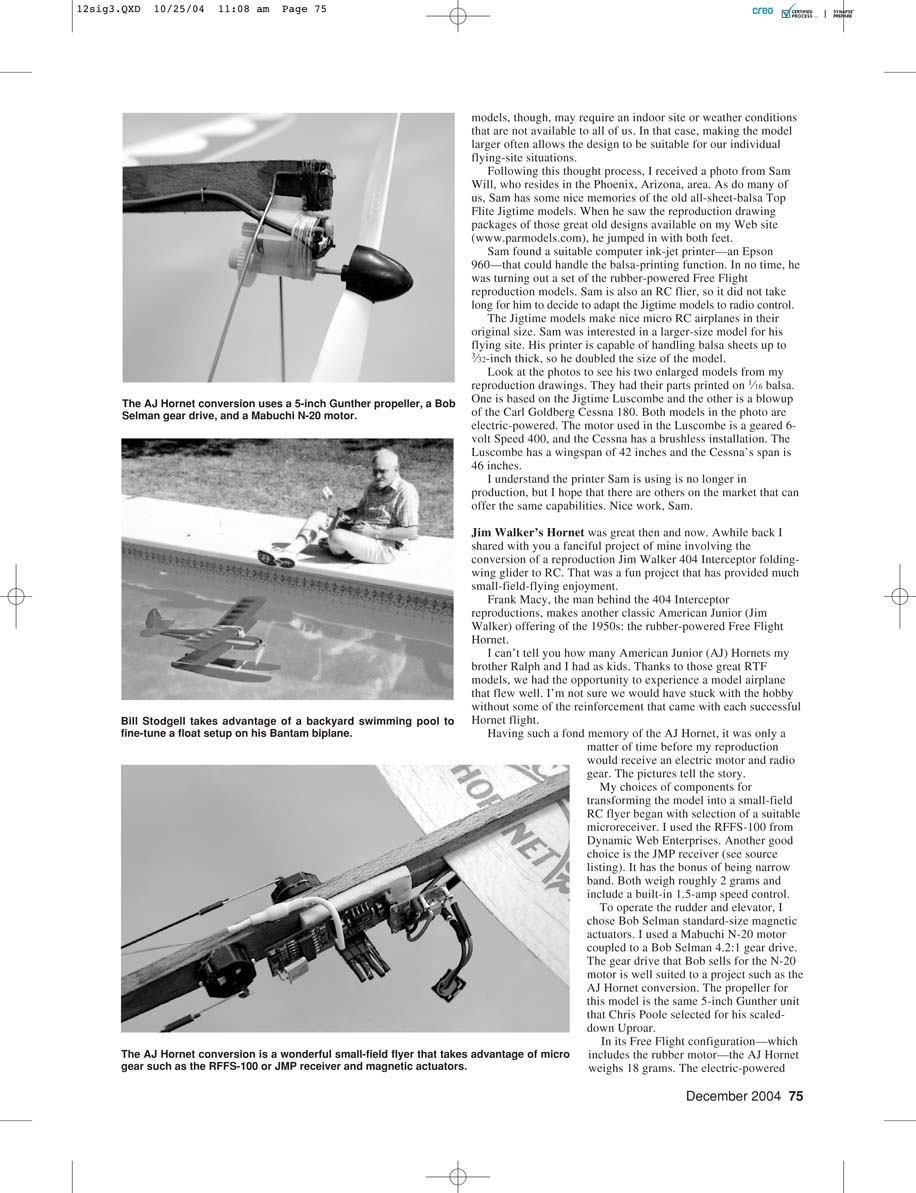
Chris Poole, who lives in the high elevations of Colorado, ran into this problem with the Tower Hobbies Uproar. The model had the features he was looking for, but the kit produced a model that was not suitable for his small field. Being an innovative 16-year-old, Chris did not let the unavailability of a kit for the size airplane he desired stop him from having a small-field version of the Uproar.
Chris developed plans for the aircraft at the reduced dimensions. The result of his efforts is shown in the photo. Power for the model comes from a direct-drive Mabuchi 280 electric motor turning a 5-inch Gunther propeller (the type used on the Zagi). A two-cell 720 mAh Li-Poly battery pack supplies the power. The airplane has full-house controls, using three HS-55 servos coupled to a JR Electron 6 receiver. With a wingspan of 24 inches, Chris reports that the model is a great flier.
It’s nice to have such a young modeler who is not intimidated by having to rescale a model and then take on a scratch-building project to achieve a desired result. Our hats are off to you, Chris.
A more common approach to rescaling a given model design for a different venue is to make it smaller. The many great designs from the early days of model aviation tended to be large, and they are a common source of designs that are scaled to a smaller size. We certainly have some excellent examples of this being done for the small-field-flying community.
Less common but equally valuable is to make a small model larger. It is truly amazing to see what some of the people who are capable of building the small and really small micro RC models can achieve. Many of these designs are quite appealing.
These models, though, may require an indoor site or weather conditions that are not available to all of us. In that case, making the model larger often allows the design to be suitable for our individual flying-site situations. Following this thought process, I received a photo from Sam Will, who resides in the Phoenix, Arizona, area. As do many of us, Sam has some nice memories of the old all-sheet-balsa Top Flite Jigtime models. When he saw the reproduction drawing packages of those great old designs available on my website (www.parmodels.com), he jumped in with both feet.
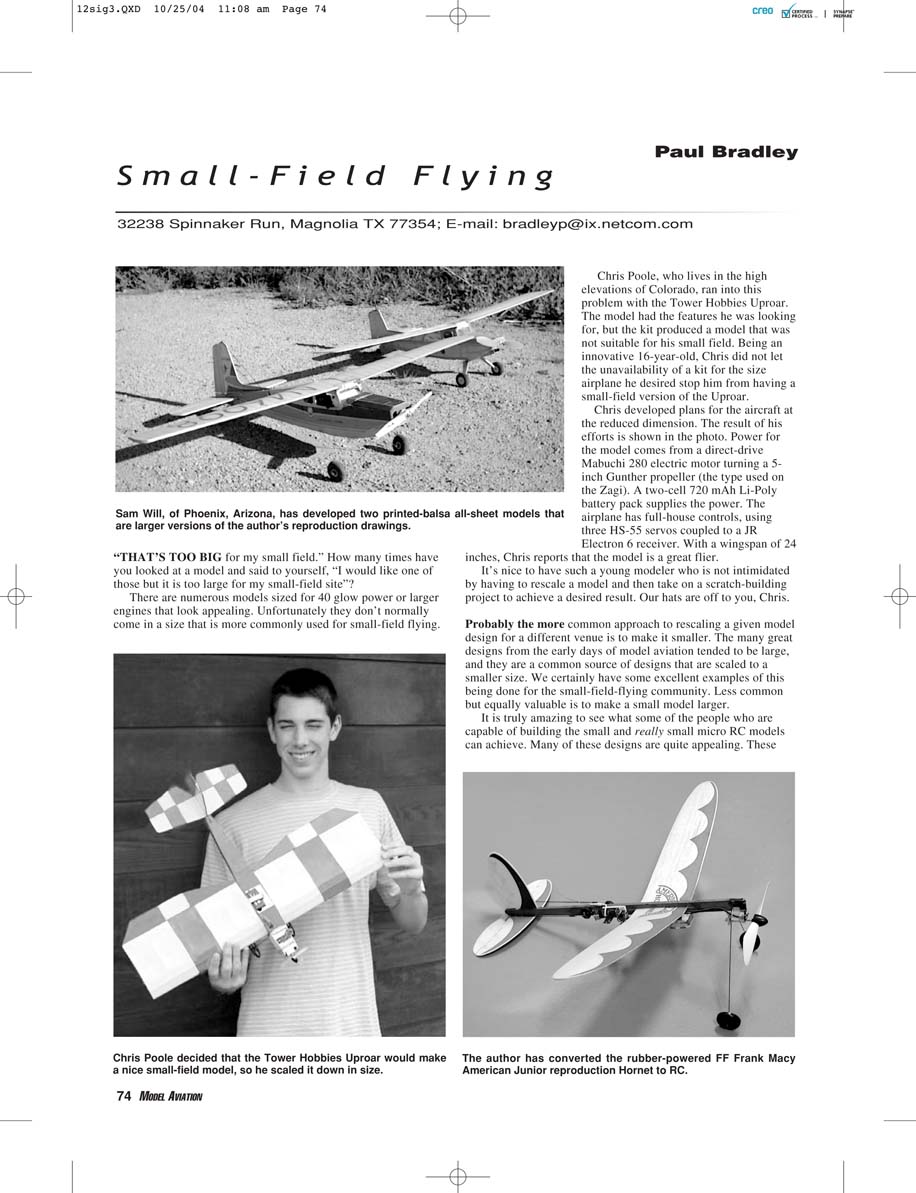
Sam found a suitable computer ink-jet printer—an Epson 960—that could handle the balsa-printing function. In no time, he was turning out a set of the rubber-powered free-flight reproduction models. Sam is also an RC flier, so it did not take long for him to decide to adapt the Jigtime models to radio control. The Jigtime models make nice micro RC airplanes in their original size. Sam was interested in a larger-size model for his flying site. His printer is capable of handling balsa sheets up to 3/32-inch thick, so he doubled the size of the model. He had the parts printed on 1/16-inch balsa.
One of his enlarged models is based on the Jigtime Luscombe and the other is a blowup of the Carl Goldberg Cessna 180. Both models in the photo are electric-powered. The motor used in the Luscombe is a geared 6-volt Speed 400, and the Cessna has a brushless installation. The Luscombe has a wingspan of 42 inches and the Cessna’s span is 46 inches.
I understand the printer Sam is using is no longer in production, but I hope that there are others on the market that can offer the same capabilities. Nice work, Sam.
Jim Walker’s Hornet
Jim Walker’s Hornet was great then and now. A while back I shared with you a fanciful project of mine involving the conversion of a reproduction Jim Walker 404 Interceptor folding-wing glider to RC. That was a fun project that has provided much small-field-flying enjoyment.
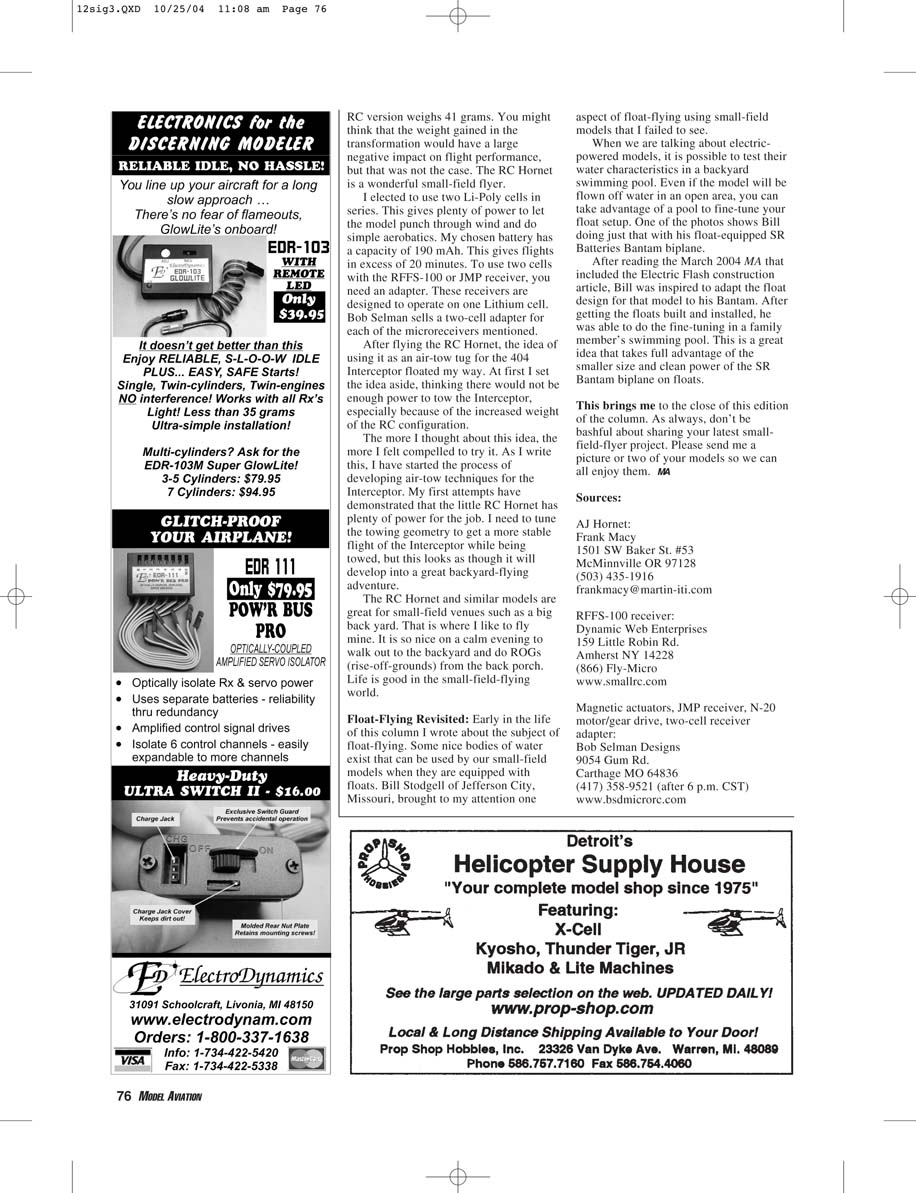
Frank Macy, the man behind the 404 Interceptor reproductions, makes another classic American Junior (Jim Walker) offering of the 1950s: the rubber-powered free-flight Hornet.
I can’t tell you how many American Junior (AJ) Hornets my brother Ralph and I had as kids. Thanks to those great RTF models, we had the opportunity to experience a model airplane that flew well. I’m not sure we would have stuck with the hobby without some of the reinforcement that came with each successful Hornet flight.
Having such a fond memory of the AJ Hornet, it was only a matter of time before my reproduction would receive an electric motor and radio gear. The pictures tell the story.
My choice of components for transforming the model into a small-field RC flyer began with selection of a suitable micro receiver. I used the RFFS-100 from Dynamic Web Enterprises. Another good choice is the JMP receiver (see source listing). Both weigh roughly 2 grams and include a built-in 1.5-amp speed control; the JMP receiver has the bonus of being narrow-band.
To operate the rudder and elevator, I used Bob Selman standard-size magnetic actuators. I used a Mabuchi N-20 motor coupled to a Bob Selman 4.2:1 gear drive. The gear drive that Bob sells for the N-20 motor is well suited to a project such as the AJ Hornet conversion. The propeller for this model is the same 5-inch Gunther unit that Chris Poole selected for his scaled-down Uproar.
In its free-flight configuration—which includes the rubber motor—the AJ Hornet weighs 18 grams. The electric-powered RC version weighs 41 grams. You might think that the weight gained in the transformation would have a large negative impact on flight performance, but that was not the case. The RC Hornet is a wonderful small-field flyer.
I elected to use two Li-Poly cells in series. This gives plenty of power to let the model punch through wind and do simple aerobatics. My chosen battery has a capacity of 190 mAh. This gives flights in excess of 20 minutes. To use two cells with the RFFS-100 or JMP receiver, I used an adapter. These receivers are designed to operate on one lithium cell. Bob Selman sells a two-cell adapter for each of the micro receivers mentioned.
After flying the RC Hornet, the idea of using it as an air-tow tug for the 404 Interceptor floated my way. At first I set the idea aside, thinking there would not be enough power to tow the Interceptor, especially because of the increased weight of the RC configuration.
The more I thought about this idea, the more I felt compelled to try it. As I write this, I have started the process of developing air-tow techniques for the Interceptor. My first attempts have demonstrated that the little RC Hornet has plenty of power for the job. I need to tune the towing geometry to get a more stable flight of the Interceptor while being towed, but this looks as though it will develop into a great backyard-flying adventure.
The RC Hornet and similar models are great for small-field venues such as a big backyard. That is where I like to fly mine. It is so nice on a calm evening to walk out to the backyard and do ROGs (rise-off-ground) from the back porch. Life is good in the small-field-flying world.
Float-Flying Revisited
Early in the life of this column I wrote about the subject of float-flying. Some nice bodies of water exist that can be used by our small-field models when they are equipped with floats. Bill Stodgell of Jefferson City, Missouri, brought to my attention one aspect of float-flying using small-field models that I failed to see.
When we are talking about electric-powered models, it is possible to test their water characteristics in a backyard swimming pool. Even if the model will be flown off water in an open area, you can take advantage of a pool to fine-tune your float setup. One of the photos shows Bill doing just that with his float-equipped SR Batteries Bantam biplane.
After reading the March 2004 MA that included the Electric Flash construction article, Bill was inspired to adapt the float design for that model to his Bantam. After getting the floats built and installed, he was able to do the fine-tuning in a family member’s swimming pool. This is a great idea that takes full advantage of the smaller size and clean power of the SR Bantam biplane on floats.
This brings me to the close of this edition of the column. As always, don’t be bashful about sharing your latest small-field-flyer project. Please send me a picture or two of your models so we can all enjoy them. MA
Sources
- AJ Hornet:
Frank Macy 1501 SW Baker St. #53 McMinnville OR 97128 (503) 435-1916 frankmacy@martin-iti.com
- RFFS-100 receiver:
Dynamic Web Enterprises 159 Little Robin Rd. Amherst NY 14228 (866) FLY-MICRO www.smallrc.com
- Magnetic actuators, JMP receiver, N-20 motor/gear drive, two-cell receiver adapter:
Bob Selman Designs 9054 Gum Rd. Carthage MO 64836 (417) 358-9521 (after 6 p.m. CST) www.bsdmicrorc.com
Transcribed from original scans by AI. Minor OCR errors may remain.

