
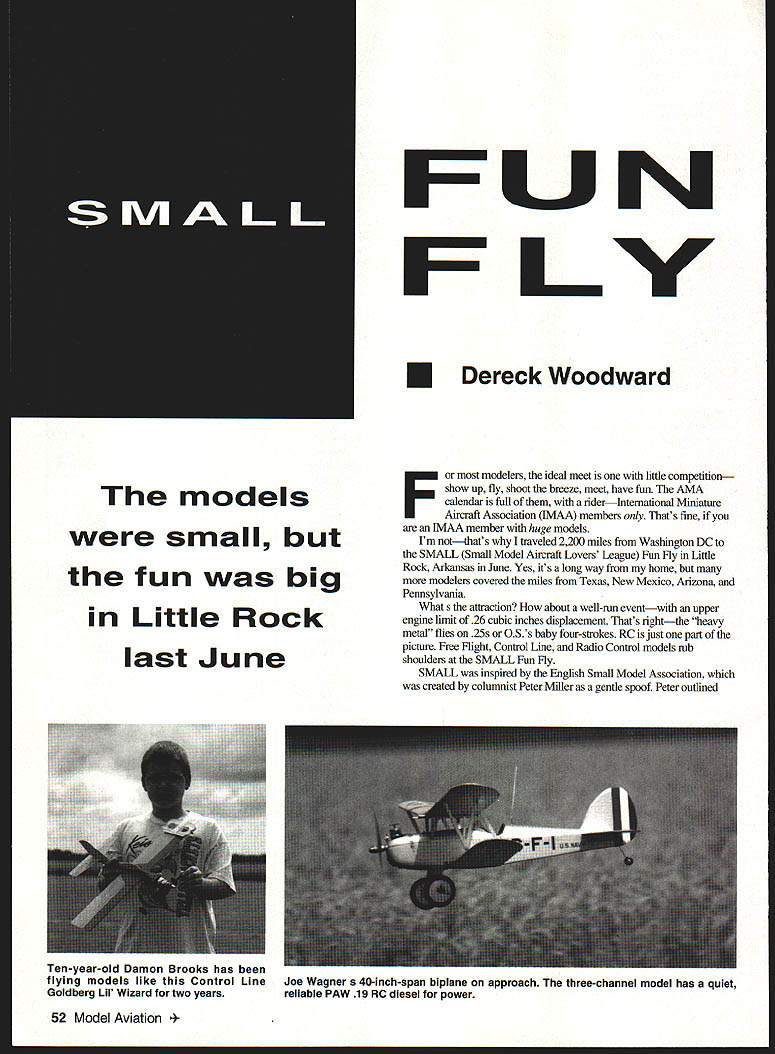
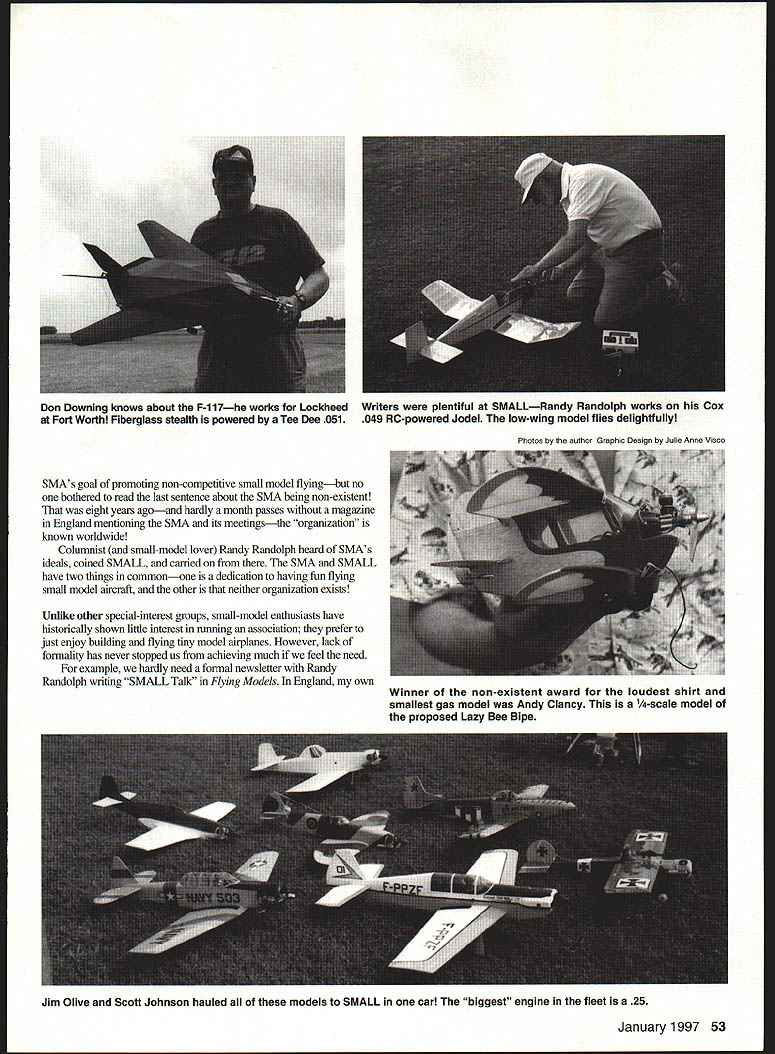
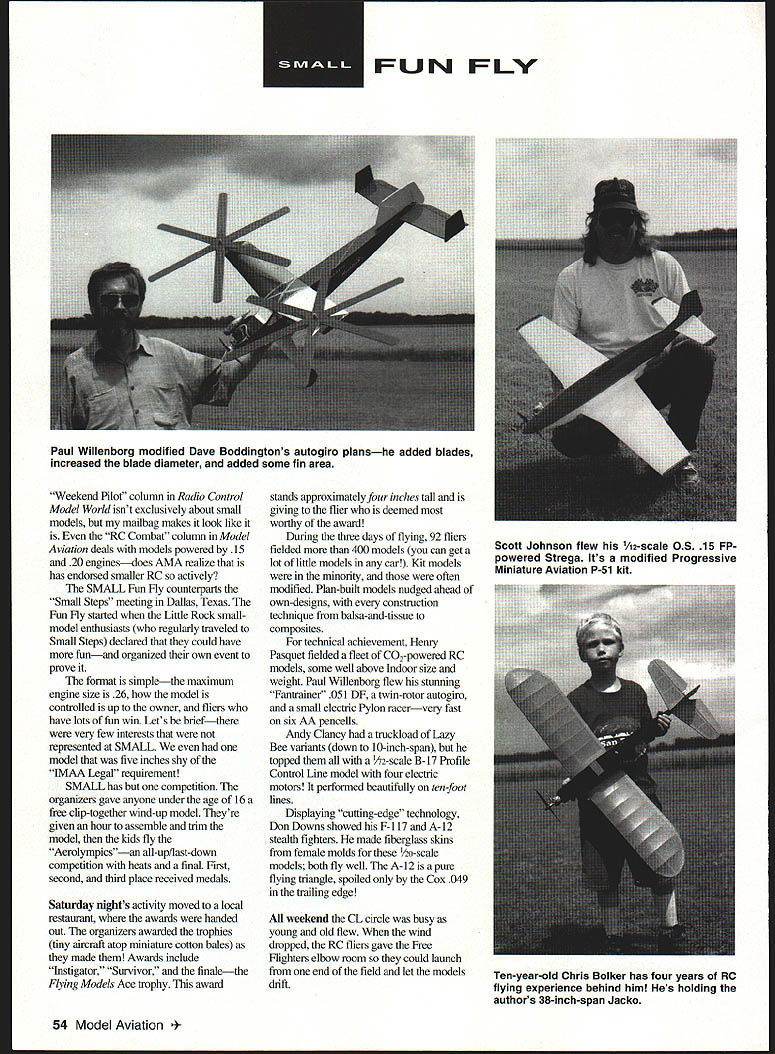
Small: Fun Fly
Dereck Woodward
The models were small, but the fun was big in Little Rock last June.
Why SMALL?
For most modelers, the ideal meet is one with little competition—show up, fly, shoot the breeze, meet, have fun. The AMA calendar is full of them, with a rider—International Miniature Aircraft Association (IMAA) members only. That's fine, if you are an IMAA member with huge models. I'm not—that's why I traveled 2,200 miles from Washington, D.C., to the SMALL (Small Model Aircraft Lovers' League) Fun Fly in Little Rock, Arkansas, in June. Yes, it's a long way from my home, but many more modelers covered the miles from Texas, New Mexico, Arizona, and Pennsylvania.
What is the attraction? How about a well-run event—with an upper engine limit of .26 cubic inches displacement. That's right—the "heavy metal" flies on .25s or O.S.'s baby four-strokes. RC is just one part of the picture. Free Flight, Control Line, and Radio Control models rub shoulders at the SMALL Fun Fly.
SMALL was inspired by the English Small Model Association (SMA), created by columnist Peter Miller as a gentle spoof. Peter outlined SMA's goal of promoting non-competitive small model flying—but no one bothered to read the last sentence about the SMA being non-existent! That was eight years ago—and hardly a month passes without a magazine in England mentioning the SMA and its meetings—the "organization" is known worldwide.
Columnist (and small-model lover) Randy Randolph heard of SMA's ideals, coined SMALL, and carried on from there. The SMA and SMALL have two things in common—one is a dedication to having fun flying small model aircraft, and the other is that neither organization really exists!
Unlike other special-interest groups, small-model enthusiasts have historically shown little interest in running an association; they prefer to just enjoy building and flying tiny model airplanes. However, lack of formality has never stopped us from achieving much if we feel the need.
The Event
The SMALL Fun Fly is the counterpart to the "Small Steps" meeting in Dallas, Texas. The Fun Fly started when the Little Rock small-model enthusiasts (who regularly traveled to Small Steps) declared that they could have more fun—and organized their own event to prove it.
The format is simple:
- Maximum engine size: .26 cubic inches.
- How the model is controlled: up to the owner (Free Flight, Control Line, Radio Control).
- Fliers who have lots of fun win.
There were very few interests that were not represented at SMALL. We even had one model that was five inches shy of the "IMAA Legal" requirement!
SMALL has just one competition. The organizers gave anyone under the age of 16 a free clip-together wind-up model. The kids were given an hour to assemble and trim the model, then they flew the "Aerolympics"—an all-up/last-down competition with heats and a final. First, second, and third place received medals.
Awards and Evening Activities
Saturday night's activity moved to a local restaurant, where the awards were handed out. The organizers awarded trophies (tiny aircraft atop miniature cotton bales) as they made them! Awards included:
- Instigator
- Survivor
- Flying Models Ace (a finale trophy about four inches tall, given to the flier deemed most worthy)
Attendance and Models
During the three days of flying, 92 fliers fielded more than 400 models (you can get a lot of little models in any car!). Kit models were in the minority, and those were often modified. Plan-built models nudged ahead of own-designs, with every construction technique from balsa-and-tissue to composites represented.
For technical achievement, Henry Pasquet fielded a fleet of CO2-powered RC models, some well above indoor size and weight. Paul Willenborg flew his stunning Fantrainer, a .051 DF, a twin-rotor autogiro, and a small electric pylon racer—very fast on six AA pen cells. Andy Clancy had a truckload of Lazy Bee variants (down to 10-inch span), but he topped them all with a 1/2-scale B-17 profile control-line model with four electric motors! It performed beautifully on ten-foot lines.
Don Downs displayed "cutting-edge" technology with his F-117 and A-12 stealth fighters. He made fiberglass skins from female molds for these 1/20-scale models; both fly well. The A-12 is a pure flying triangle, spoiled only by the Cox .049 in the trailing edge!
Activities and Atmosphere
All weekend the C/L circle was busy as young and old flew. When the wind dropped, the RC fliers gave the free flighters elbow room so they could launch from one end of the field and let the models drift.
Complimenting someone on a good-flying model often resulted in the transmitter being offered. Many got to fly more than they brought. To the well-rounded modeling enthusiast, imagine the Flying Aces Club meet crossed with a non-competitive RC meet, with a Control Line circle on site.
The weather gave its all, from calm to thunderstorm. While the rain lashed Saturday, we had a raffle. The rest of the time, we flew! Small models can handle wind as well as larger ones—witness three Lazy Bees hovering in stationary formation between strange-looking aerobatics.
Later on, lightweight free-flight and control-line–powered RC models flew in near-calm conditions. The biggest headache in the impound was allocating flights fairly.
Organizers and SendAero
Who was behind this meet? The chief perpetrators were Steve Staples and Emmett Fry. These two, plus the stalwarts who ran the transmitter impound, cooked burgers, and did gofer duty, produced an AMA-sanctioned event with seamless organization. They're folks who do a good job but don't want the spotlight.
Steve and Emmett are part of a group called "SendAero Aviation." "SendAero" is a play on "sendero," which is Spanish for "pathway"—in this case, a pathway to education and advancement through model aeronautics. Like SMALL, SendAero doesn't really exist as a formal organization—but still ran a slick show to equal the best.
SendAero doesn't exist through competitive wrangling and internal politics; perhaps it exists like the small model movement—through actions that stand for themselves.
Sponsors and Thanks
SMALL has commercial support. Contributors and donors included:
- Flying Models
- Eric "Dr. Diesel" Clutton (demonstrations on glow plug alternatives)
- Betty Fox and the Fox team
- Ace R/C
- Sig
- Advance Hobbies
- Cox
- A.A. Lindberg
- John Brodak
We thank them all for donating raffle prizes and supporting youthful participation.
A special thank-you goes to Penn McCrae, a lively young fellow of 82 years who offers his landing strip and hangar for this event. His lovely plantation has been his family home for many years and it's still a working farm. In the hangar, our backroom was a Cessna owned by Mr. Penn—who still flies full-scale, as he has since his youth. Thank you, sir, and long may you fly on.
We even made the paper in Bill Clinton's hometown! The Arkansas Democrat-Gazette recorded our weekend in a half-page special. This was a well-written piece that portrayed us accurately.
Final Notes
Take a look at the photos. Imagine the fun we had. Figure the cost of joining us with your own small model. Go do it!
We need more small meetings on the East Coast or the mid-Atlantic region; I'm looking into it. What we really need first is an open-minded club with a spacious field for the non-RC events, but maybe we could start with an RC-only event. The file on interest is slowly growing; send serious inquiries to dwmstw@aol.com.
Transcribed from original scans by AI. Minor OCR errors may remain.

