
Small Radio Control Modeling
Where Less is More!
by Larry Marshall
WHETHER YOU'RE flying aerobatics, a heavy-metal warbird, or just boring holes in the sky with your Stinger, "bigger flies better" is undeniably true; large models track better in a wind and fly more realistically than smaller models.
However, with bigger models comes the need for travel to distant flying fields and considerable time spent packing airplanes and paraphernalia in the ultimate big-model tool: the minivan. At the field, significant time is spent assembling and disassembling the model, and building these large models requires large shops and power tools.
What many modelers have come to understand is that although bigger may fly better, "small flies more often" — mostly because small, light models can be flown pretty much anywhere there's an open area. Small models can also be built, transported, and stored more easily than their larger brethren, and these are big advantages to the growing number of people living in condos and apartments.
This has prompted, almost literally, an explosion of activity with smaller, simpler models. The really neat thing is that this small-model activity is happening in addition to, rather than instead of, large-model activity. When it's possible to get to a formal flying field to fly the big stuff, modelers are doing just that and they're flying big and small models during those sessions.
However, when modelers come home after work, they enjoy a few flights down the street, flying from a vacant field, parking lot, or school soccer field. As a bonus, small-field flying is putting model aviation under the noses of prospective modelers and, to some extent, this movement is solving the visibility problem we've had because of our isolated flying fields.
Why all the interest now? Many modelers are building small models because they have less time and space for modeling, but there are other important reasons for current interest, and most are related to the availability of first-class, inexpensive products that make small models practical.
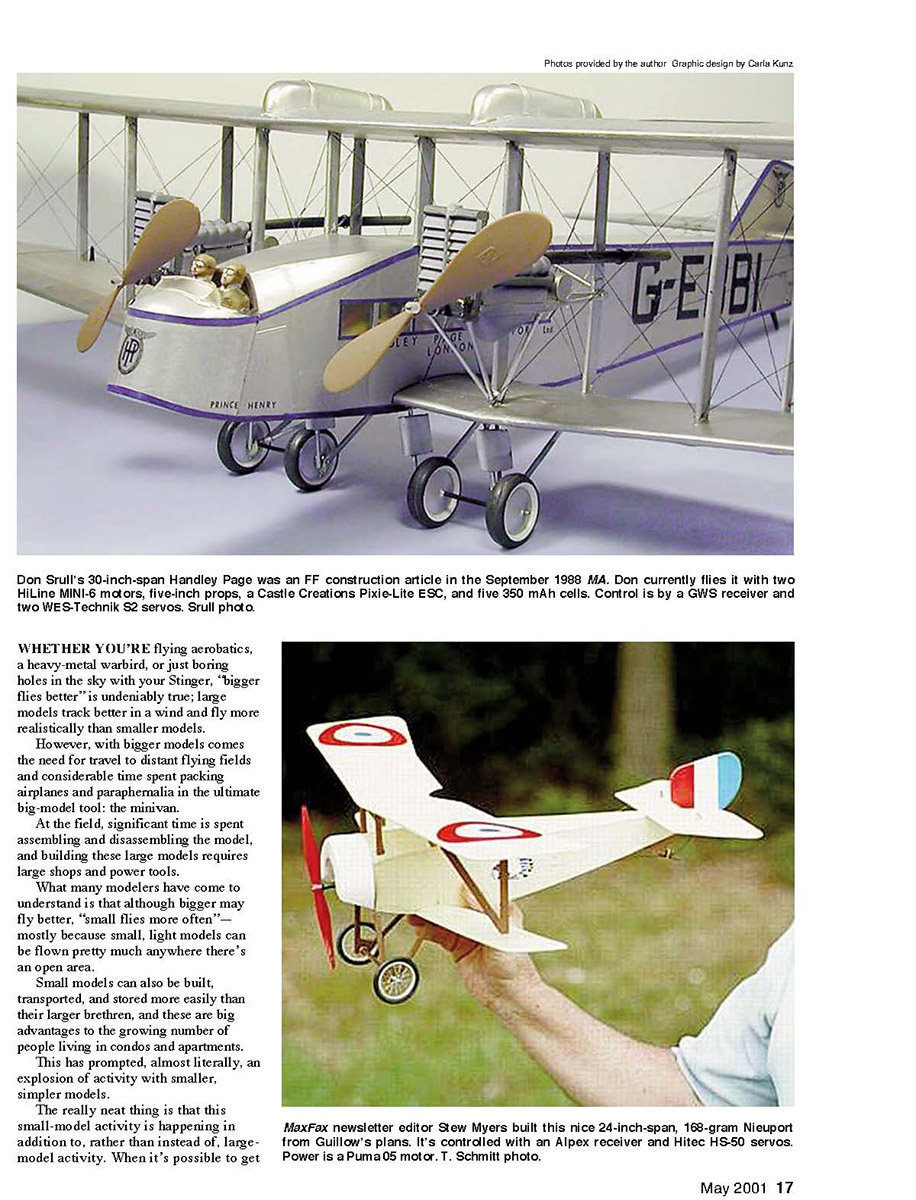
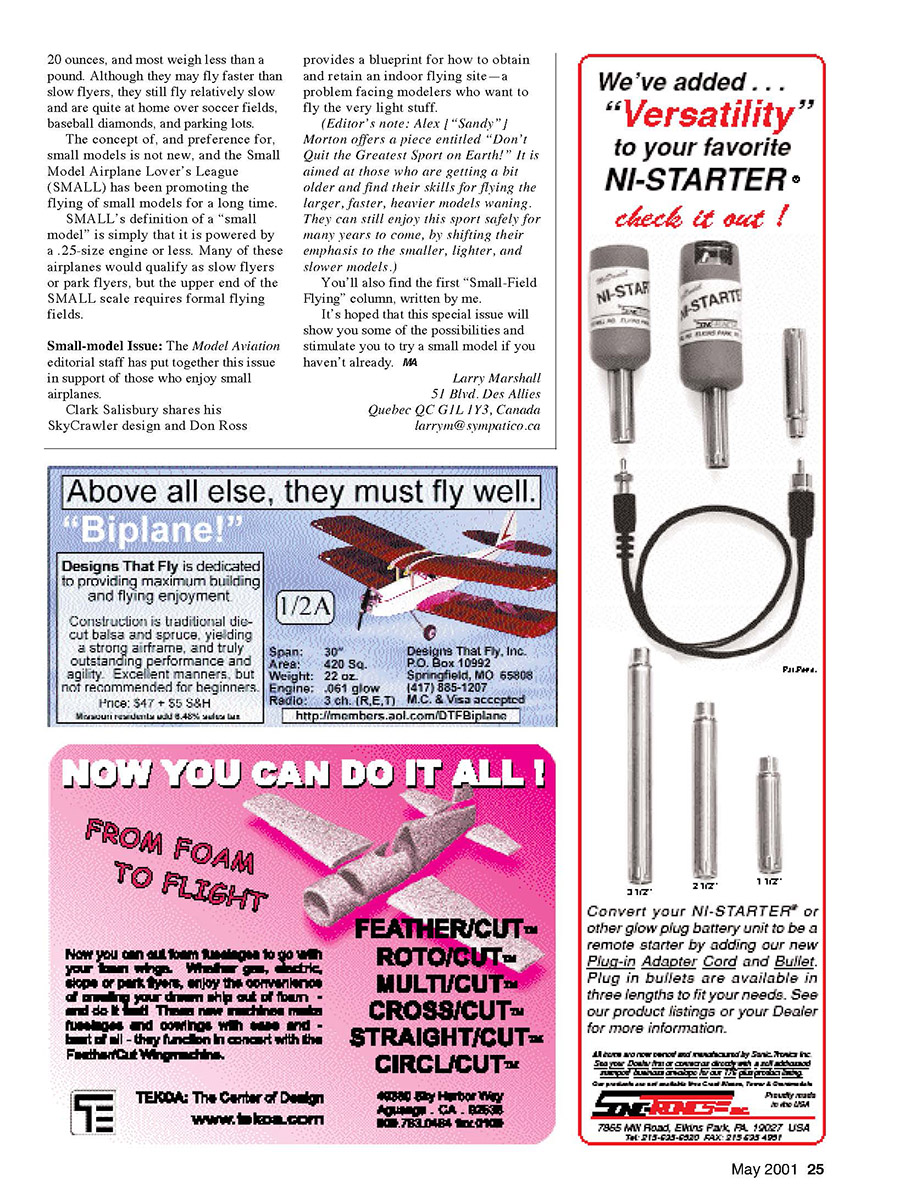
Smaller, cheaper radio gear is at our fingertips. Submicro servos, such as Hitec's HS-50s, make very small models possible at a very low cost. Hitec's Focus III three-channel radio system allows small models to be flown with a $100 radio system, and now we're seeing the release of complete radio/motor/model packages in this price range, such as the Firebird from Horizon Hobby. Although more expensive, the market abounds with truly tiny servos and receivers. WES-Technik's S2 servos weigh 2.4 grams and are the definition of "small" when it comes to servos.
Sky Hooks and Riggings, Pico, GWS, Hitec, and others have short-range two-channel receivers that are being used to control very small and/or very light models that are flown indoors and outdoors.
Better Power Systems
Those who like the sound and tradition of glow power are happy as can be with a host of easy-starting, reliable small engines. Novelties in importing first-class throttled .049 and .061 engines opened this area wide, and the product lines have expanded to larger sizes, all with effective mufflers and throttles. Other companies, notably Thunder Tiger and Global Model Products, have provided really nice .07-size engines. Small PAW diesels are also part of the available power arsenal, and they have the advantage that a fuel bottle and rag provide complete ground support.
CO2 has its aficionados—especially within the Free Flight (FF) community. The micro-RC group has also begun to embrace these motors; they are light and they turn a relatively large propeller. Gasparin has even released throttled CO2 motors to serve RCers' needs.
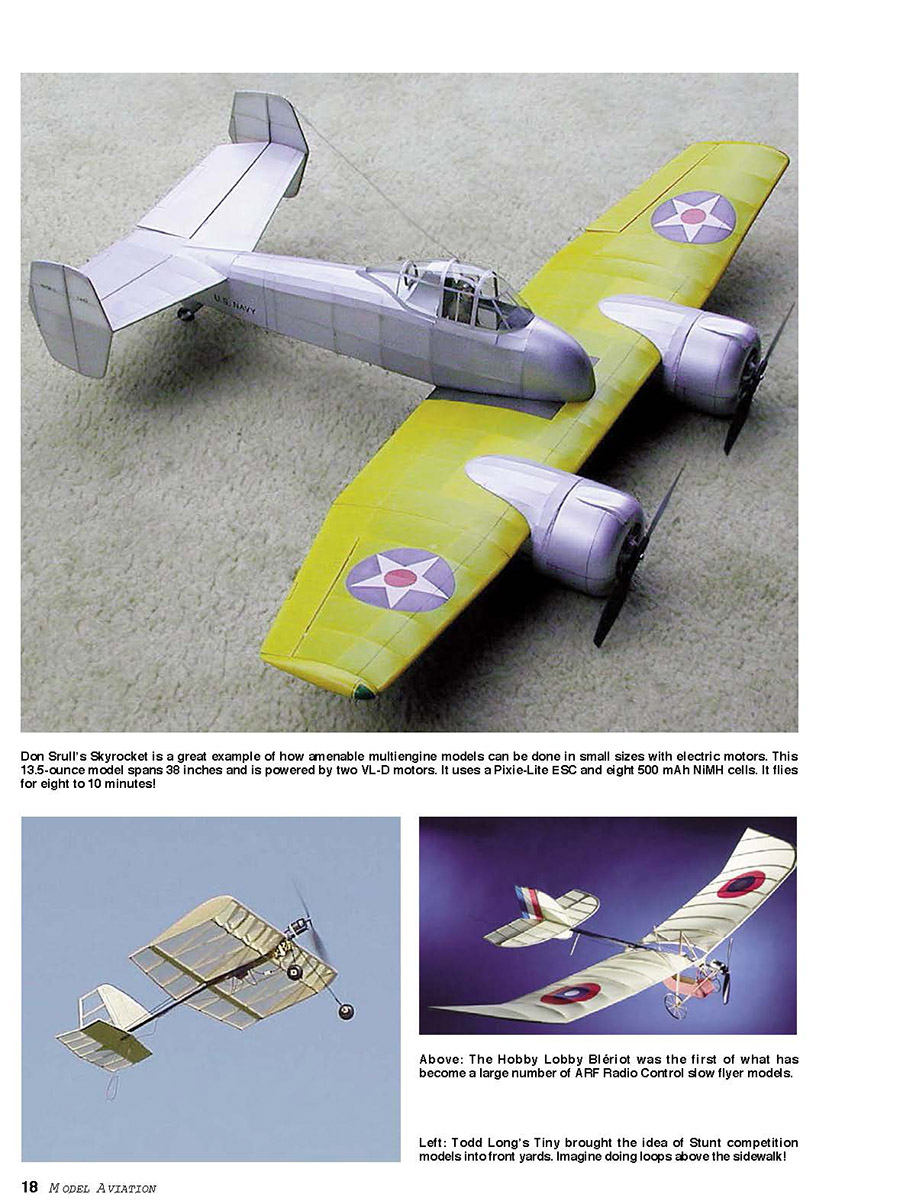
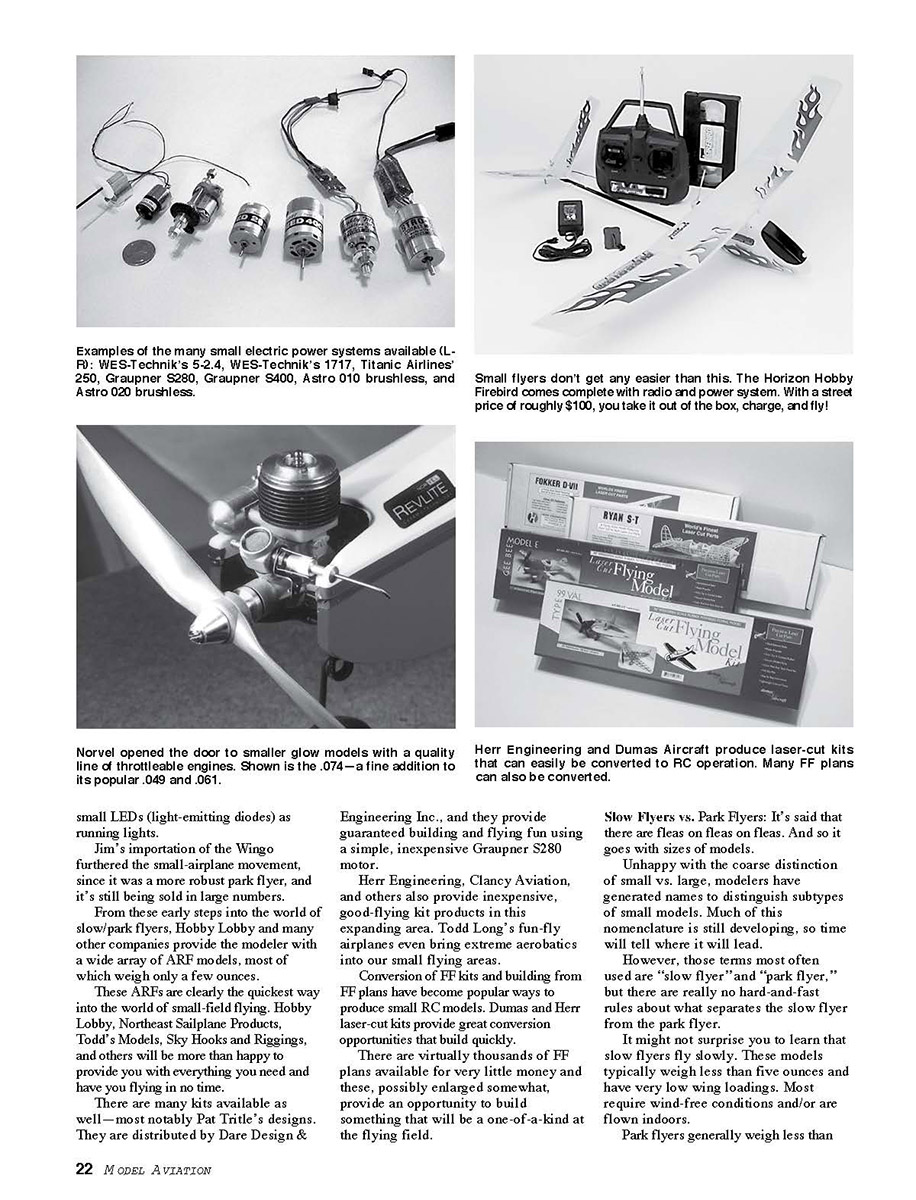
However, it's electric power systems by far that are allowing small RC models onto soccer fields and into parks, and are powering them over indoor basketball courts across the country. Golf domes that dot the snowbelt of North America are becoming hot spots of indoor flying activity; operators are finding model fliers to be great customers during the summer lull, when their primary customers—the golfers—are outdoors.
Electric motors are quiet and absolutely reliable. These two virtues make the motors ideal for flying in small spaces. The wide range of motors, propellers, and gearboxes on the market makes it easy to find an appropriate power system for any model. Small nickel-cadmium (Ni-Cd) cells and the higher-density nickel-metal hydride (NiMH) and lithium cells are providing light "fuel tanks" for these small motors.
Join the Fun
When Hobby Lobby owner Jim Martin imported the original Blériot (a lightweight Almost Ready to Fly [ARF], complete with motor), I don't think he knew what it would become. Blériots have spread across the continent and are very popular in the evenings at the end of other model events. I've even had the opportunity to fly one of these airplanes in the dark, with it sporting small LEDs (light-emitting diodes) as running lights.
Jim's importation of the Wingo furthered the small-airplane movement, since it was a more robust park flyer, and it's still being sold in large numbers. From these early steps into the world of slow/park flyers, Hobby Lobby and many other companies provide the modeler with a wide array of ARF models, most of which weigh only a few ounces. These ARFs are clearly the quickest way into the world of small-field flying.
Suppliers and kit sources include:
- Hobby Lobby
- Northeast Sailplane Products
- Todd's Models
- Sky Hooks and Riggings
- Pat Tritle designs (distributed by Dare Design & Engineering Inc.)
- Herr Engineering
- Clancy Aviation
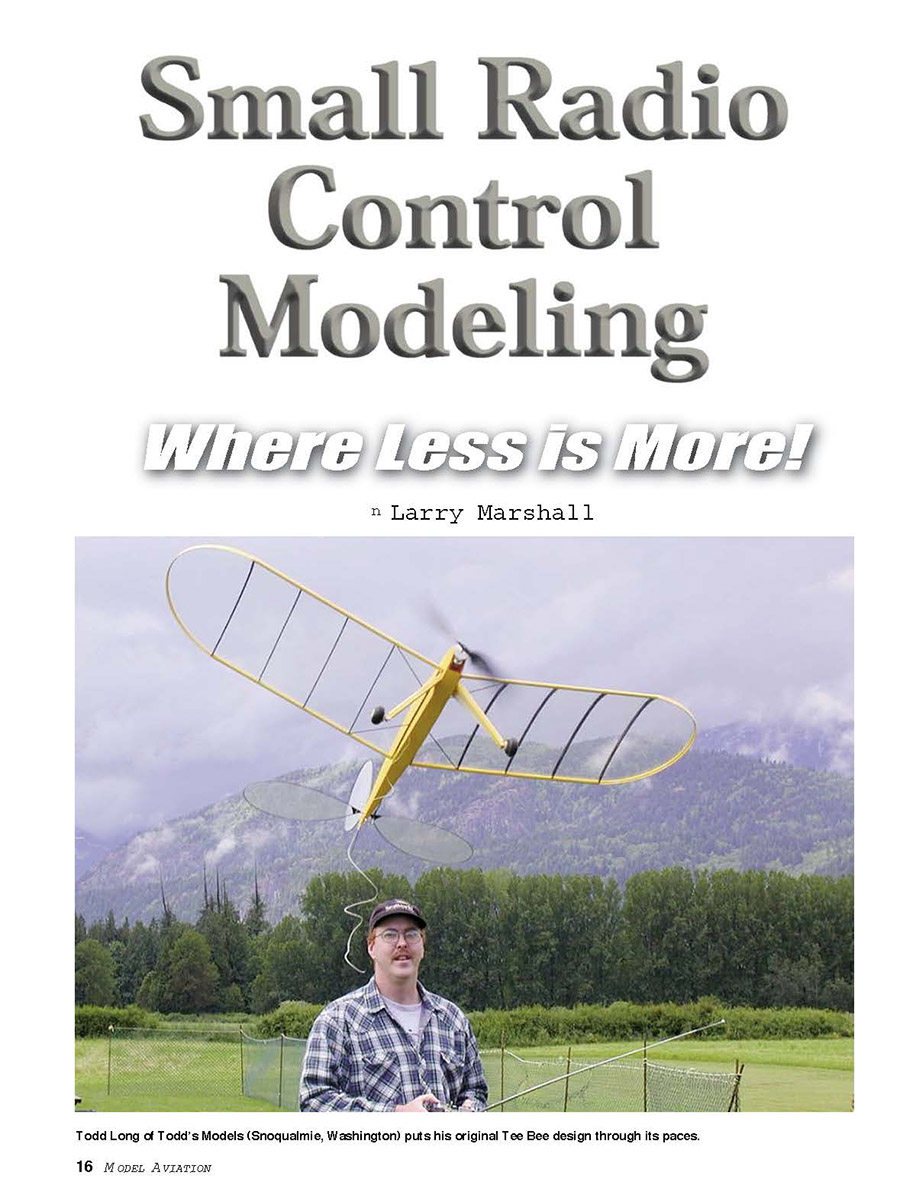
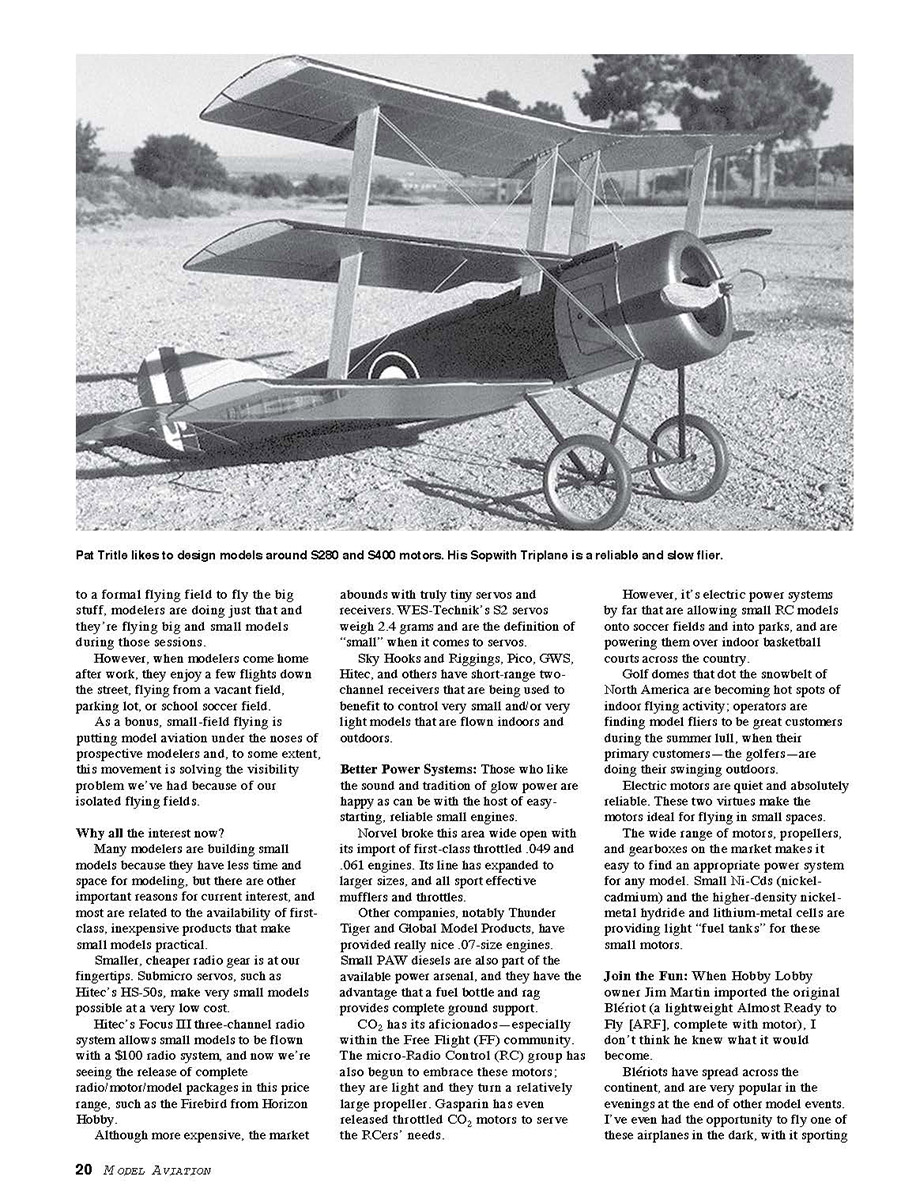
These companies will be more than happy to provide you with everything you need and have you flying in no time. There are many kits available as well—most notably Pat Tritle's designs—and they provide guaranteed building and flying fun using a simple, inexpensive Graupner S280 motor. Herr Engineering, Clancy Aviation, and others also provide inexpensive, good-flying kit products in this expanding area. Todd Long's fun-fly airplanes even bring extreme aerobatics into our small flying areas.
Conversion of FF kits and building from FF plans have become popular ways to produce small RC models. Dumas and Herr laser-cut kits provide great conversion opportunities that build quickly. There are virtually thousands of FF plans available for very little money and these, possibly enlarged somewhat, provide an opportunity to build something that will be a one-of-a-kind at the flying field.
Slow Flyers vs. Park Flyers
It's said that there are fleas on fleas on fleas. And so it goes with sizes of models. Unhappy with the coarse distinction of small vs. large, modelers have generated names to distinguish subtypes of small models. Much of this nomenclature is still developing, so time will tell where it will lead.
Those terms most often used are "slow flyer" and "park flyer," but there are really no hard-and-fast rules about what separates the slow flyer from the park flyer. It might not surprise you to learn that slow flyers fly slowly. These models typically weigh less than five ounces and have very low wing loadings. Most require wind-free conditions and/or are flown indoors.
Park flyers generally weigh less than 20 ounces, and most weigh less than a pound. Although they may fly faster than slow flyers, they still fly relatively slow and are quite at home over soccer fields, baseball diamonds, and in parking lots.
The concept of, and preference for, small models is not new, and the Small Model Airplane Lover's League (SMALL) has been promoting the flying of small models for a long time. SMALL's definition of a "small model" is simply that it is powered by a .25-size engine or less. Many of these airplanes would qualify as slow flyers or park flyers, but the upper end of the SMALL scale requires formal flying fields.
Small-model Issue
The Model Aviation editorial staff has put together this issue in support of those who enjoy small airplanes. Clark Salisbury shares his SkyCrawler design and Don Ross provides a blueprint for how to obtain and retain an indoor flying site — a problem facing modelers who want to fly the very light stuff.
(Editor's note: Alex "Sandy" Morton offers a piece entitled "Don't Quit the Greatest Sport on Earth!" It is aimed at those who are getting a bit older and find their skills for flying the larger, faster, heavier models waning. They can still enjoy this sport safely for many years to come, by shifting their emphasis to the smaller, lighter, and slower models.)
You'll also find the first "Small-Field Flying" column, written by me.
It's hoped that this special issue will show you some of the possibilities and stimulate you to try a small model if you haven't already.
MA
Larry Marshall 51 Blvd. Des Allies Quebec QC G1L 1Y3, Canada larrym@sympatico.ca
Transcribed from original scans by AI. Minor OCR errors may remain.

