

Small Radio Control Modeling
Where Less is More!
by Larry Marshall
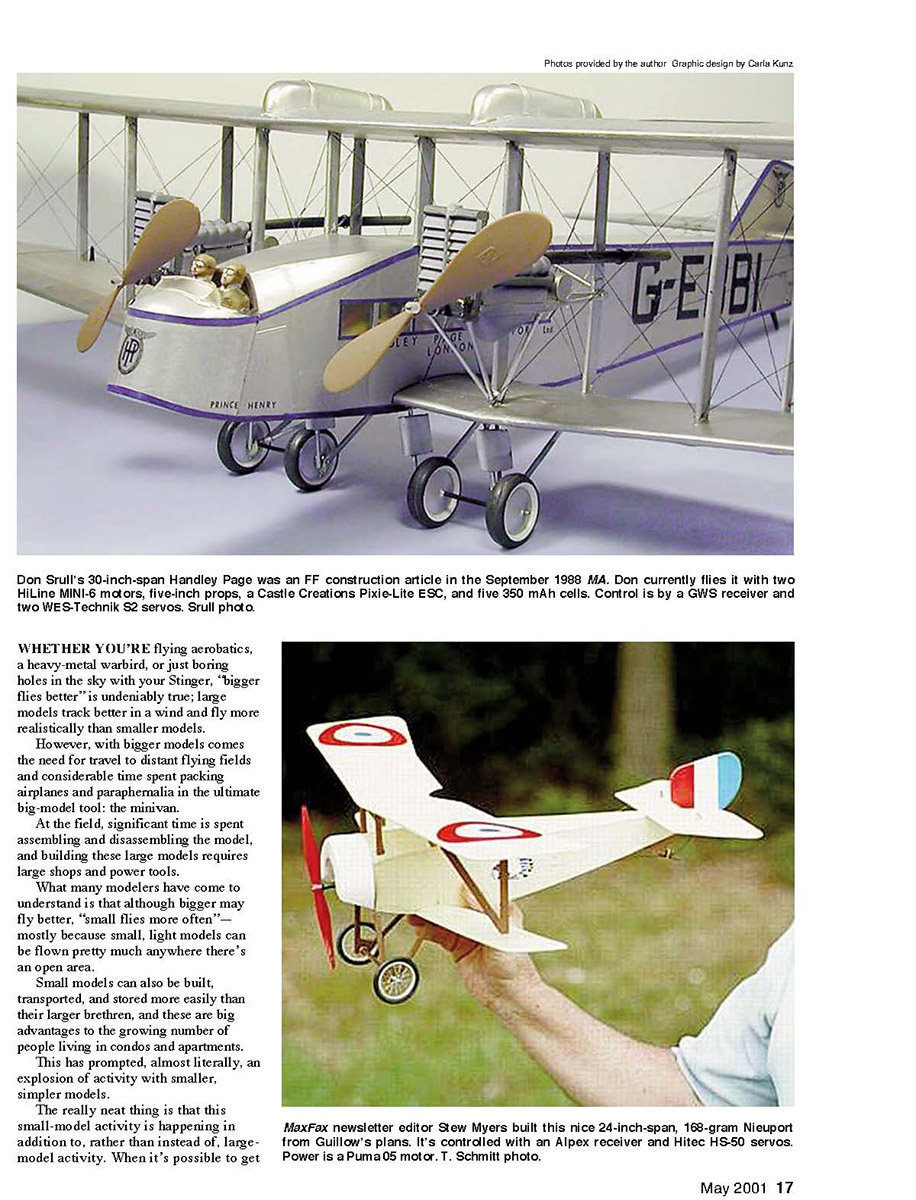
Whether you're flying aerobatics, a heavy-metal warbird, or just boring holes in the sky with your Stinger, "bigger flies better" is undeniably true: large models track better in a wind and fly more realistically than smaller models. However, bigger models require travel to distant flying fields and considerable time spent packing airplanes and paraphernalia into the ultimate big-model tool: the minivan. At the field, significant time is spent assembling and disassembling the model, and building these large models requires large shops and power tools.
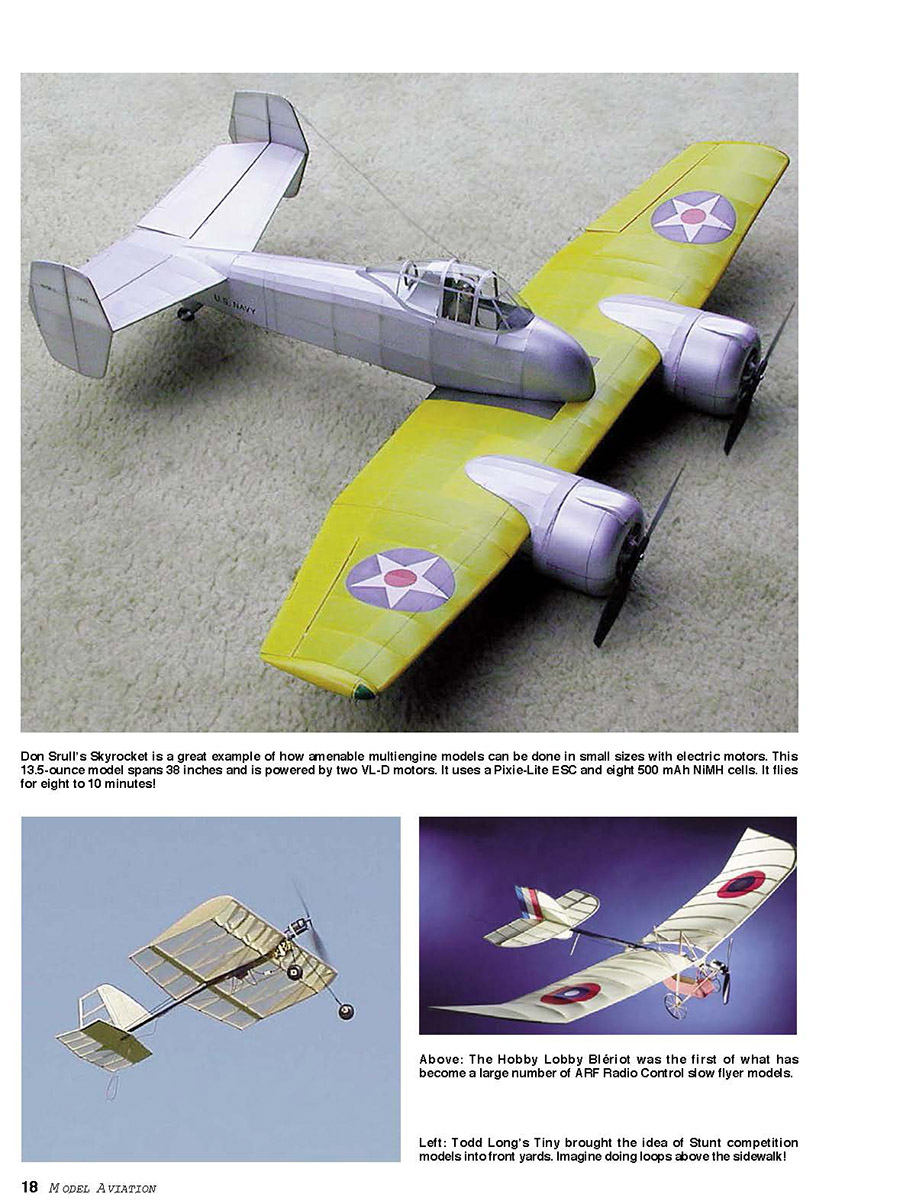
What many modelers have come to understand is that although bigger may fly better, "small flies more often"—mostly because small, light models can be flown pretty much anywhere there's an open area. Small models are easier to build, transport, and store, which is a big advantage for the growing number of people living in condos and apartments. This has prompted an explosion of activity with smaller, simpler models.
The nice thing is that small-model activity is happening in addition to, rather than instead of, large-model activity. When modelers can get to a formal flying field they still fly the big stuff, but after work many enjoy a few flights down the street from a vacant lot, parking lot, or school soccer field. As a bonus, small-field flying puts model aviation in view of prospective modelers and helps solve the visibility problem created by isolated flying fields.
Why all the interest now? Many modelers are building small models because they have less time and space, but an equally important factor is the availability of first-class, inexpensive products that make small models practical.
Smaller, cheaper radio gear and miniaturized components are now readily available:
- Submicro servos such as Hitec HS-50s make very small models possible at low cost.
- Hitec's Focus III three-channel radio lets you fly small models with about a $100 system.
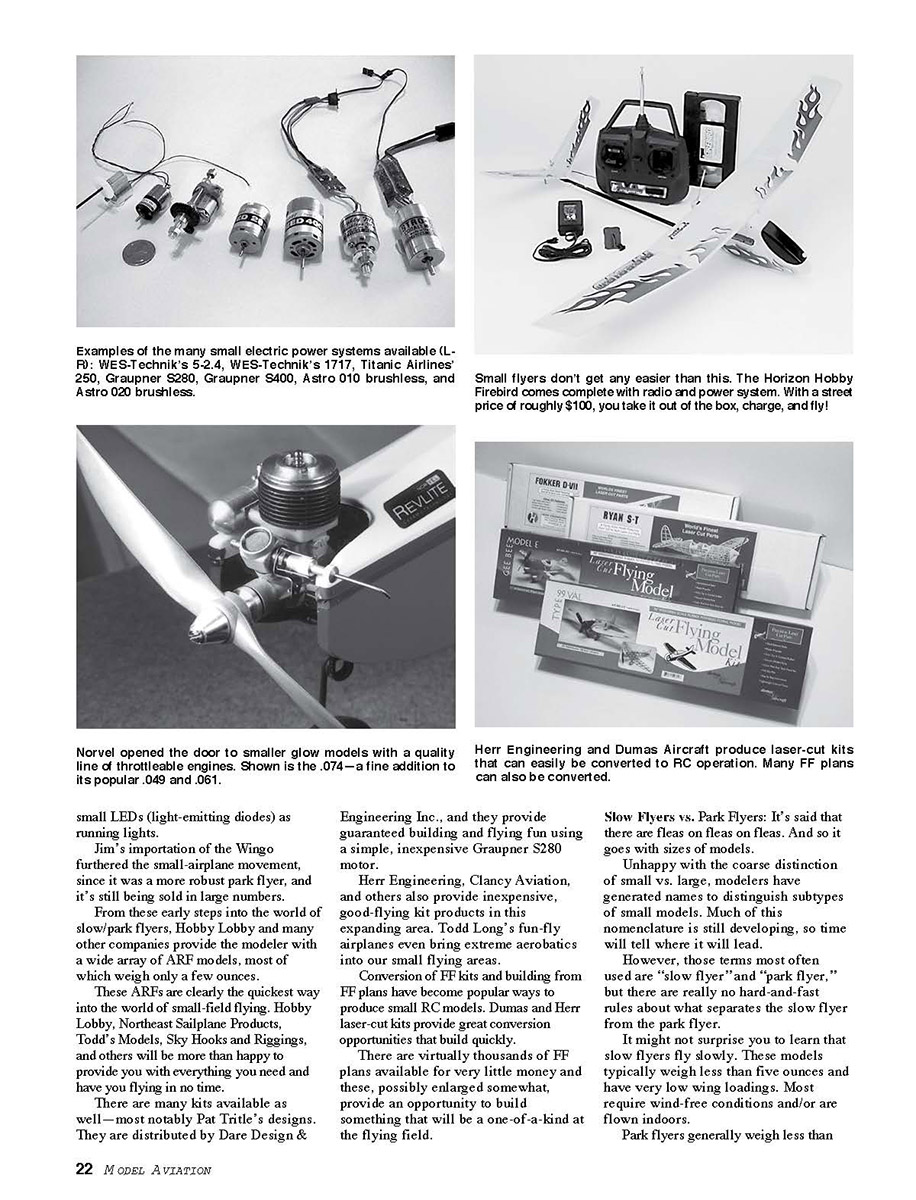
- Complete radio/motor/model packages (for example, the Firebird from Horizon Hobby) are appearing in this price range.
- The market also offers truly tiny servos and receivers; WES-Technik's S2 servos weigh about 2.4 grams.
- Short-range two-channel receivers from suppliers such as Sky Hook and Rigging, Pico, GWS, and Hitec are used to control very small or very light models flown indoors and outdoors.
Better Power Systems
Those who prefer glow power have plenty of easy-starting, reliable small engines available. Novar helped open this area with import throttled .049 and .061 engines; their line has expanded and includes effective mufflers and throttles. Other manufacturers, notably Thunder Tiger and Global Model Products, offer nice .07-size engines. Small PAW diesels are also available and have the advantage of minimal ground support (a fuel bottle and rag).
CO2 motors have fans among Free Flight modelers and are gaining interest in micro-RC circles because they are light and can turn relatively large props. Some manufacturers, such as Gasparin, have released throttled CO2 motors for RC use.
Electric power systems are the biggest enabler for small RC models flying in parks, on soccer fields, and inside gymnasiums:
- Electric motors are quiet and highly reliable—important for flying in small or shared spaces.
- A wide range of motors, propellers, and gearboxes makes it easy to find appropriate power for any model.
- Small Ni-Cd, higher-density NiMH, and lithium cells provide increasingly light and energy-dense "fuel tanks."
- Indoor venues such as basketball courts and seasonal golf domes are becoming popular spots for small-model flying.
Join the Fun
When Hobby Lobby owner Jim Martin imported the original Blériot (a lightweight ARF complete with motor), it helped popularize slow/park flyers. Blériots spread across the continent and are commonly flown in the evenings; some even sport small LEDs for night flying. The importation of the Wingo—a more robust park flyer—furthered the movement.
ARFs are the quickest way into small-field flying. Suppliers and manufacturers offering ARFs and complete packages include:
- Hobby Lobby
- Northeast Sailplane Products
- Todd's Models
- Sky Hook and Rigging
There are many kits available as well. Notable kit designers and suppliers include:
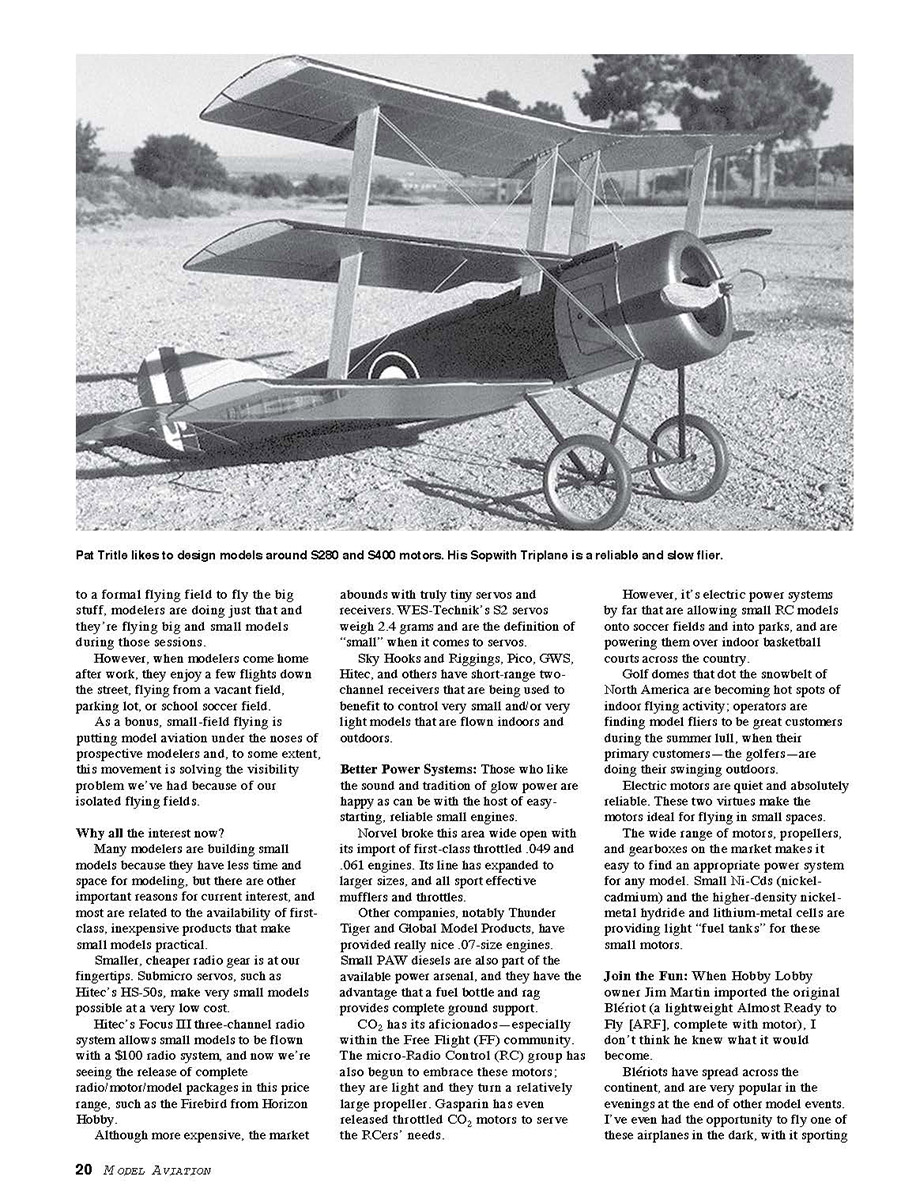
- Pat Tritle (distributed by Dare Design & Engineering Inc.) — simple, inexpensive designs often using a Graupner S280 motor
- Herr Engineering
- Clancy Aviation
- Todd Long (fun-fly airplanes for extreme aerobatics)
- Dumas and Herr (laser-cut kits suitable for converting free-flight plans)
Conversion of free-flight (FF) kits and building from FF plans has become popular. There are thousands of FF plans available inexpensively; many can be adapted or slightly enlarged to produce unique, one-of-a-kind small RC models.
Slow Flyers vs. Park Flyers
Modelers have developed more precise terms for subtypes of small models. Two commonly used categories are "slow flyers" and "park flyers," though the boundaries are not strict.
- Slow flyers
- Typically weigh less than five ounces
- Have very low wing loading
- Fly very slowly and usually need wind-free conditions or indoor spaces
- Park flyers
- Generally weigh less than two pounds
- Have higher wing loading than slow flyers
- Expected to fly in light winds outdoors and be robust enough to survive rough fields and novice landings
- Typically have higher power-to-weight ratios and more aggressive performance
Whatever you call them, small models are not toys. They deserve the same respect and care as full-size models:
- Perform preflight checks
- Charge and test batteries
- Do radio range checks
- Be considerate of people and property around the flying area
Advantages of small models:
- Less expensive to build and repair
- Require less storage space
- Easier to transport
- Allow more flying time per hour
Challenges of small models:
- Harder to see in flight
- More affected by gusts relative to their mass
The future of small electric RC looks bright. Motors, batteries, servos, and radios continue to shrink and fall in price, making capable small models more accessible. Many clubs are embracing small-field and indoor flying, and manufacturers are responding with more products aimed at this growing market.
Transcribed from original scans by AI. Minor OCR errors may remain.

