
Smilin' Jack
H. Alfred Lehmberg
Zack Mosley's "Smilin' Jack" comic strip captured the imaginations of several generations of future pilots with its tales of derring-do in the skies. Here is a look at how the cartoonist came to create his aviator hero and a vivid cast of characters.
A Sunday ritual
It was a comfortable room. There was a fireplace, and a Majestic radio sat in one corner. I liked to come there to read the Sunday funnies. But even sprawled on the floor with the comics all around me, I could never feel all that relaxed. No matter where I went in the room, my grandfather's eyes followed, staring soberly down at me from a sepia-toned photograph over the mantel.
Grandfather was a Methodist preacher, and he wore his clerical collar in the portrait. He was flanked on one side by a ceramic camel filled with Raleigh coupons and on the other by a red-breasted robin perched on the edge of a small basket. A beautiful pair of George and Martha Washington bisque figurines stood at either end of the mantel. I liked to pretend they were real. George's head was glued on with LePage's cement. I was glad I hadn't broken it, because my mother's face looked sad every time she glanced at it.
I shifted a bit, checked the portrait of my grandfather, and watched his eyes register my slight change of position. A boy couldn't get away with anything in this room! Even safely contained within the picture frame, Grandfather's ecclesiastical turn of mind somehow increased his power to seek out and destroy corruption and sinners.
Glancing over at the radio, I again shifted in impatience. The speaker was still broadcasting a commercial. A little switch on the radio turned it off. The other side was supposed to change the radio into something called a shortwave, but it didn't work. My father said it didn't have enough antenna, or something like that.
Suddenly the voice changed to a deep, pleasant timbre. Uncle Bob was back to reading the funnies.
My Sunday ritual was to read all the strips for myself, then listen to Uncle Bob dramatize them. I liked the way he used his voice, modulating from happy, to sad, to brave, to mean. He could scare a kid's pants off as Ming the Merciless, then turn soft as a kitten as Aleta of the Misty Isles. Prince Valiant was always looking for her when he wasn't doing important things like fighting the Vikings.
Uncle Bob read the last strip and closed with his usual sign-off—something about seeing all you kids next week, same time, same station. But this Sunday was different. I heard a rustle of paper, a sigh, then, "That ought to hold the little brats for another week!" I reared up on my hands and knees and stared at the radio in disbelief—Uncle Bob had used the B-word!
Had my grandfather been listening? I could have sworn his eyes had taken on a disapproving look, sort of like Prince Valiant's lance piercing the Black Knight's breastplate. He had heard the B-word! I fled from the room, leaving George, Martha, the camel and the robin to listen to Grandfather's sermon alone.
Comics then and now
The comics section of even the largest dailies today could probably be covered by Uncle Bob in five minutes. All he'd have would be a couple of soap operas, assorted animal-character vignettes, and a pretty good one about some kids and a dog who thinks he's a World War I fighter pilot. There's also a strip about a bunch of yuppies who snidely pick everything apart without offering anything better.
Contemporary cartoonists produce little that requires imagination, artistic ability, or research. Though a few of the strips have entertainment value, most fail to interest any large segment of the public. Ask people to name their favorite comic strip. Most will tell you, "Don't read 'em." Today's comics are thin gruel compared with those created in the heyday of the great cartoonists.
Among the many entertaining cartoons that took off during the Thirties, my favorites were "Prince Valiant," "Terry and the Pirates" (later to become "Steve Canyon"), and "Smilin' Jack"—choices that were shared by countless others. Their creators—Hal Foster, Milton Caniff and Zack Mosley, respectively—were more than just superb artists. All three did time-consuming research before sitting down to their drawing boards, and all had boundless imagination. To borrow from aviation parlance, one might sum up their talents as ceiling and visibility unlimited (CAVU).
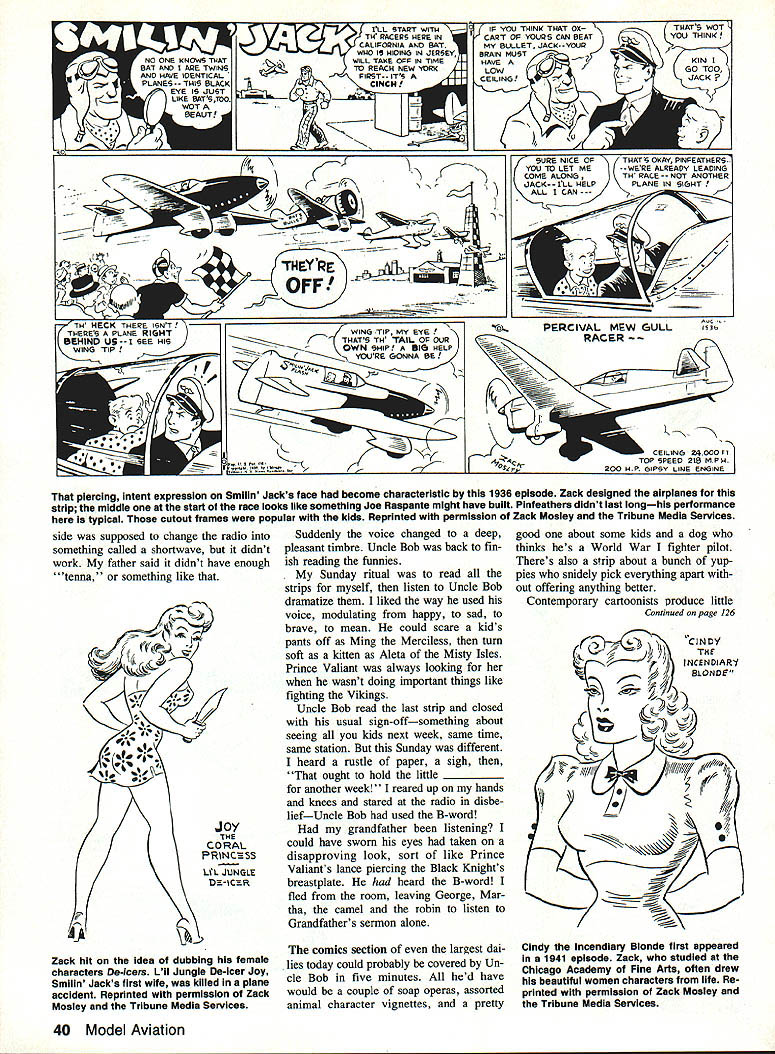
Of the three, my gold medal goes to Zack Mosley. Zack is an absolute master of the line. Working with several types of pens and using India ink on three-ply Strathmore board, he produced simple artwork that is without peer in the genre. With a stroke he could change a face from furious to thoughtful to seductive.
With other young aviation enthusiasts, I used to clip out and collect a special frame from the Sunday paper called "Flyin' Facts." It featured an accurate drawing of an airplane with a different fact about aviation each week. Usually presented by Fat Stuff or Downwind Jackson, and sometimes by Jack, it often was directed to a scantily clad De-icer with a steno pad labeled "Flyin' Facts." I wish I had kept that collection.
Zack's artistic talents went beyond line drawings. He carried a sketch pad about with him and produced many character studies in pencil and charcoal, using them later as the basis for unusual faces in his strip. The expressions he captured in these beautifully done sketches make one wonder about their subjects' thoughts.
Early impressions of aviation
A remarkable, imaginative man, Zack Mosley might have channeled his abilities to a different end but for certain chance events.
Zack is a card-carrying Okie and proud of it. His first impression of aviation came as a small boy in Roff in 1913, just a year before the guns of August set off the war to end all wars, when he watched a pile of materials off-loaded from a flatcar and magically assembled into an airplane. Enthralled with the pilot's tales about the wonders of flight, the adventure and thrills it offered, Zack decided that that was what he wanted to do when he grew up.
Then the plane crashed in a cornfield, and the sight of the bloody pilot crawling out from beneath a heap of cloth and sticks made young Zack a lot less certain about his future in the skies. Nor did the aviator's "This is a pretty normal landing" do much to reassure him.
Seeing a Jenny crash without pilot injury in 1917 gave Zack a few second thoughts about aviation as a career. But he knew a guy could get hurt playing with these dangerous machines and still held back. Having found that he was pretty good at copying the comic characters in the local papers, Zack tried his hand at some sketches of the Jenny being rebuilt. Friends and relatives liked them so well that he set his mind on a career of drawing these fascinating machines.
Education, Chicago, and early career
While still in high school and working at part-time jobs, Zack took a correspondence course in cartooning. He spent all his spare time drawing airplanes and building models. Then he discovered girls, that fantastic product that made the state of Oklahoma famous.
In 1926 Zack entered the Chicago Academy of Fine Arts. Though he had little more than tuition money in his pocket, the academy found him a job in a movie theater. That brought him enough for a room and food. This was the height of the gangster era, and Zack was troubled by what he saw. When O'Banion was machine-gunned in front of a flower shop almost next door to the room he slept in, Zack came close to leaving town.
Maybe the appearance of nude female models in the second week at the academy had something to do with his deciding to stay. Zack grew adept at drawing pretty girls, a skill he exploited later in introducing De-icers to his "Smilin' Jack" strip.
Just before the stock market collapse in 1929, Zack was hired as assistant to chief cartoonist Dick Calkins, who was drawing the Dille-syndicated "Buck Rogers" and an aviation strip called "Skyroads." Zack had much in common with another assistant, Russ Keaton. Both loved looking at airplanes, delighted in drawing them, and were petrified at the very thought of riding in them. The two became close friends.
For a visit back home, Zack wanted to arrive in a style appropriate to a big-time cartoonist. He'd appear at the door of his airplane in Oklahoma City, pause dramatically, and look in surprise at those waiting to greet him. Then he'd disembark to the cheers of the crowd. Of course, there was just one little problem. He was afraid to fly.
Zack finally decided on a compromise. He took a train to St. Louis, then boarded a Ford Trimotor to Oklahoma City. It's safe to assume that shortening his time in the air was as much a factor as his alleged reason of reducing the expensive air fare.
In those days the main navigation instruments were an altimeter and a magnetic compass, and flying was done by what today is called visual flight rules. The pilot needed an unobscured view of the ground to find landmarks, railroad tracks and roads. Low clouds could turn a short flight into a long, bad dream. The record has it that on some flights the pilot was the first to jump out after landing and kiss the ground.
Zack's careful planning for a safe flight was foiled when the plane ran into a bad storm. The pilot flew lower and lower trying to break through the clouds to find ground, then managed a landing in a muddy field. Being told by the air crew that they thought the plane was in Arkansas did little to reassure the excited passengers.
When the storm eased, the pilot managed a muddy takeoff, amusing his passengers with a splendid show of ground acrobatics in the process. As if that weren't enough, he nearly overturned the airplane on a hastily planned landing in Tulsa. That did it—Zack made a solemn pledge never to fly again.
From student to creator: "On the Wing" becomes "Smilin' Jack"
Zack was encouraged by Chet Gould, the creator of "Dick Tracy," to originate a comic strip of his own using an aviation theme. Gould also recommended Zack to his boss, Captain Joe Patterson, the founder of the Chicago Tribune/New York News syndicate and an aviation enthusiast who was learning to fly. Gould suggested that Zack also learn to fly, which might help his chances for the new job.
Zack signed up for lessons—then panicked when told to take the controls at his first session. Student and teacher felt equally discouraged about continuing. This experience inspired the idea for his new strip. He'd use a scared-pilot theme, a subject on which he felt highly qualified. But working hard all day and playing just as hard at night left him no time to begin the project—until fate stepped in.
On a summer afternoon in 1933 Zack was playing volleyball on an undeveloped stretch of beach along Lake Michigan. Volleyball is an excellent spectator sport—and even better to participate in—when the players are mixed in gender. Zack, probably wearing a daring (for 1933) bathing suit, chased a missed ball into the underbrush. He woke up the next morning looking like the Rubberman in the Michelin ads—or the villain in his friend's "Dick Tracy" strip.
The doctor had never seen a more magnificent case of poison ivy. In fact it was so outstanding that Zack might be wearing nothing but a gaping shirt collar for a month. Russ brought Zack's work to his room, so he was able to keep his job and his weekly paycheck.
The rest from visiting his watering holes gave Zack plenty of time to work on his scribbled pilots project. It was some time before he could dress normally and return to work. By then his ideas for the new comic strip were sketched out on bond and ready for presentation.
How Zack got his artwork under Captain Patterson's nose, why he titled his strip "On the Wing," and how he learned that he was competing with 400 other cartoonists for only eight new strips makes an interesting story in itself. "On the Wing" made the final cut. Zack's new scared-pilot strip would see print.
After "On the Wing" had run for a few weeks in the Sunday editions of the Chicago Tribune and the New York News, Captain Patterson wired Zack to change the name to "Smilin' Jack." Captain Joe was famous for issuing mandates without explanation—yet they all seemed to work. Still, Zack saw no reason for the change and was against it.
Consider this double whammy. If Zack had spent that long-ago afternoon in a Chicago gin mill instead of playing volleyball with the De-icers, and if Captain Joe hadn't sent that telegram ordering the name change, there never would have been a "Smilin' Jack." Sometimes chance events direct the course of our lives.
Zack's next order from the Captain was to fly on all syndicate photo missions. Was the Captain aiming to cure Zack of his fear of flying? Probably not. It was the boss's way to push his strong feeling for aviation on his employees, so chances are he had no ulterior motive in Zack's case.
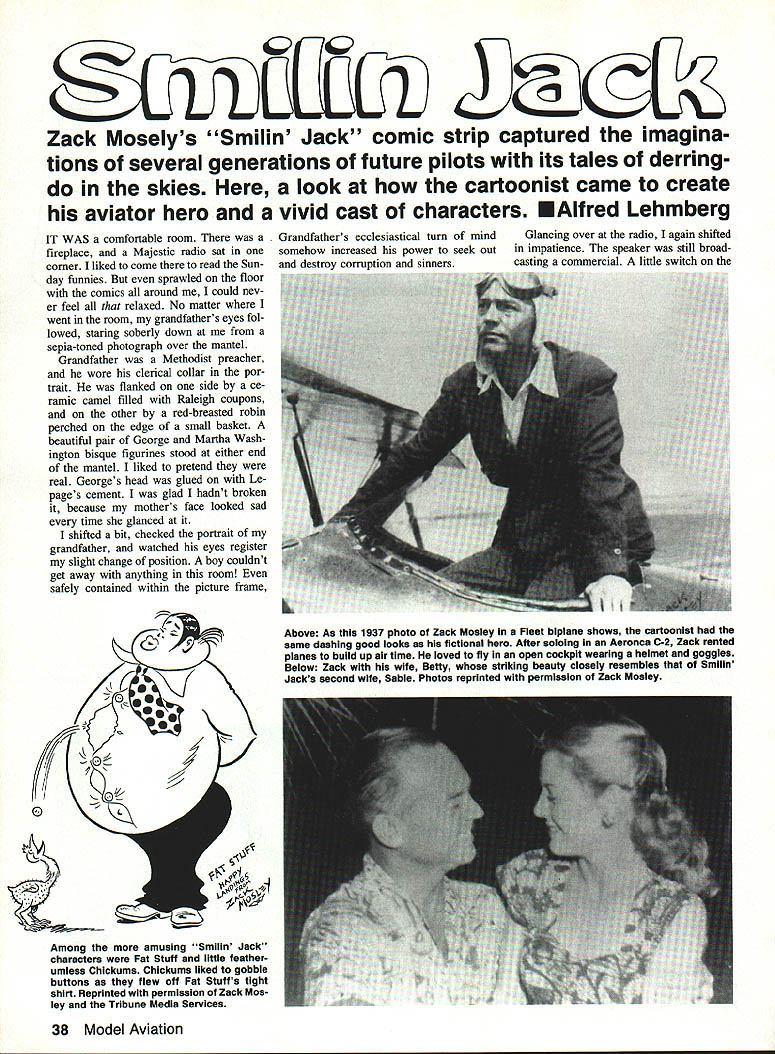
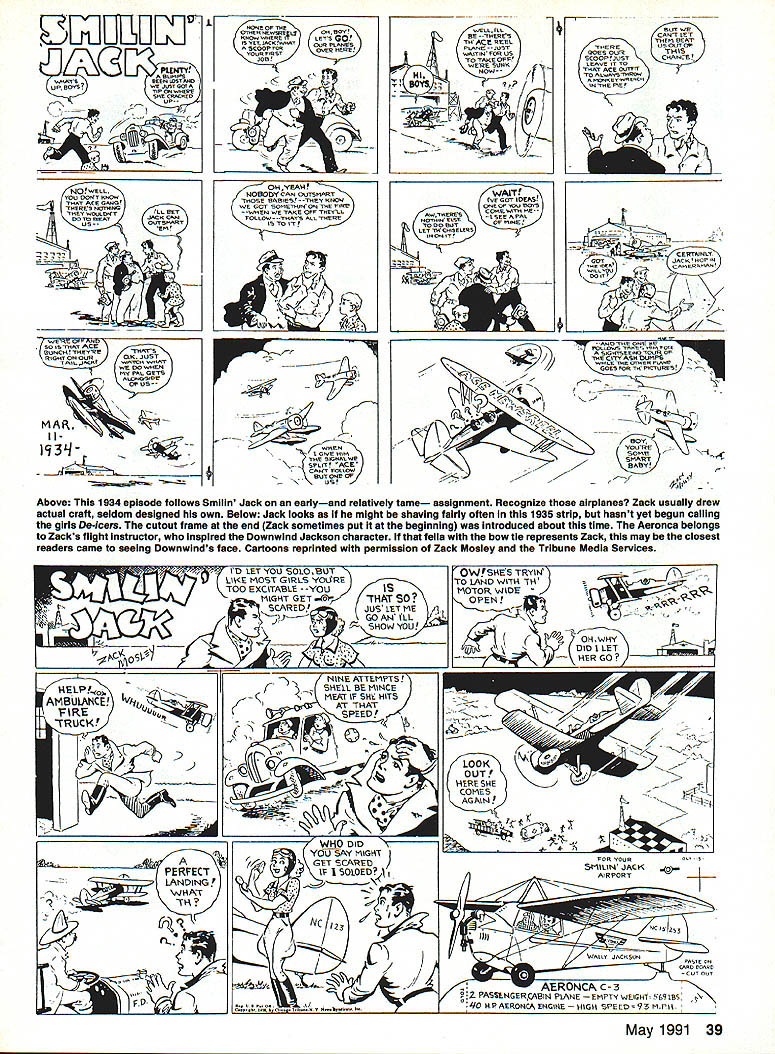
Once he'd been on a good many of these photo missions, Zack was brave enough to take flying lessons. His teacher, Wally Jackson, who operated a flying school, later became the inspiration for the character of Downwind Jackson in the "Smilin' Jack" strip. Zack soloed and—after overcoming a few more moments of abject fear—eventually became an enthusiastic, skilled aviator.
Zack received his pilot's license on November 13, 1936. In the five decades since, he's entered over 3,000 hours in his personal log, owned nine aircraft—and crashed none. About two million air miles have slipped under the Mosley fuselage since the day Zack stepped off that Ford Trimotor and vowed never to fly again.
A sample storyline: Death Rock
In the many adventures of "Smilin' Jack," its creator introduced almost as many new characters, some of whom became regulars. One episode—the tale of Jack's imprisonment on Death Rock, a sort of Devil's Island in the Pacific—brought in two new characters: Fat Stuff and Downwind Jackson. Typical of Zack's stories, the Devil Island plot is a wild farago of extremely implausible happenings woven together by incidents and circumstance so that somehow it all seems to make sense.
As the following outline shows, each twist was essential to the ultimate shape of the plot:
- The government asks Jack's assistance. He must impersonate an arch-criminal and spy called Powder, who had been caught and was secretly being held in the United States. As Powder, Jack is supposed to set up a scam leading to the capture of The Head, a powerful super-spy.
- It is believed The Head is responsible for the disappearance of secret and expensive government aircraft—one of which turns out to be a $200,000 four-engined flying boat bomber.
- Jack makes the appointment with The Head and takes up residence on his yacht, but is soon discovered as an impostor. He escapes in the $200,000 flying boat when it is delivered to the yacht and is chased by The Head and the cruel Hook in a fighter plane. Both craft are damaged in the shooting and fall into different parts of the ocean.
- Jack, nearly drowned, is pushed ashore by porpoises and discovered by natives, including Fat Stuff, an escaped prisoner from Death Rock. Bonna Goo, a native doctor, appears. To avoid marriage, Jack and Fat Stuff jump into a river that disappears underground.
- The river empties into the ocean, where they are picked up by a ship with a vacationing prison guard, called Limehouse, aboard. Limehouse recognizes Fat Stuff and takes Jack for Powder, who also was an escapee.
- Arriving at the prison, Jack finds that The Head and the cruel Hook had also become "guests." After the four manage an escape, Fat Stuff and Jack slip away into the jungle. The courageous pair are captured by natives and returned to prison for the reward.
- They are thrown into Devil's Kitchen, a super-solitary on an adjacent island directly on the path of the China Clipper. Jack makes friends with a monkey called Ringtail, and escapes with him in a glider built with Limehouse's daughter's clothes and bamboo from the guards' recreation center. Fat Stuff is forced to stay behind because of his weight problem.
- Jack is picked up at sea by the China Clipper, but the captain, following international law, returns him to prison. Also on the Clipper is Downwind Jackson, an old barnstorming pal from Jack's past. Downwind gets the government to identify Jack, and the prison frees him.
- Jack persuades the prison to free Fat Stuff, since his records had been destroyed in a prison fire anyway. The tale ends with everyone back on Jack's airfield.
Zack explains the details that make the story almost believable in his book Hot Rock Glide, one of the three he's authored.
Characters and character creation
Fat Stuff and Downwind played prominent roles in a number of the "Smilin' Jack" adventures, and appeared in the last frame of the final strip on April 1, 1973. Interestingly, Zack never showed Downwind Jackson's face, but always drew him facing away or with his features blocked by part of an airplane or another character's body. This had begun as a holding ploy for the first few months—the cartoonist simply hadn't thought of the right combination of features for Downwind's face. But Captain Joe liked the gimmick so well that he told Zack to make it permanent.
Zack was one of the first cartoonists to age his characters over time (Chet Gould was another). Most artists flash-freeze their characters. In the same vein, none of the characters in "Little Orphan Annie" ever got pupils for their eyeballs.
Smilin' Jack never killed anyone in his adventures. The bad guys always blew themselves up, were eaten by their pet animals or piranhas, or ended up as shark bait. One villain fell into a fissure caused by an earthquake just as he was about to shoot Jack—and another tremor swallowed him up on cue.
Zack occasionally arranged for those who were close to Smilin' Jack to die, too. The textbook bachelor married a girl named Joy. They had a son, Jack Junior, called Jungle Jolly in one tale. Jack blamed himself for Joy's death in an aircraft accident. Nine years later he married the beautiful Sable Lotalotta, modeled after Zack's own lovely wife, Betty.
Jack Junior appeared in many adventures as he grew up. In the last frame of "Smilin' Jack" he married a young woman named Sizzle.
Many characters were modeled on real people, and many episodes were based on real events.
Among these was one of my favorite fat characters—a chicken without feathers. "Little featherless Chickums" was created as a pet for Fat Stuff. Chickums's special diet supplement was the buttons that popped off Fat Stuff's tight shirt; he'd catch them in flight and gobble them up.
Zack had had a featherless chicken as a pet when his family lived on a farm in his boyhood. One night a cold, wet norther had blown in, almost wiping out about a hundred recently hatched chicks. The family collected the nearly dead chicks and tried to revive them in the warm wood-stove oven in the kitchen. If a chick chirped, they removed it to a tub under a warm blanket.
So it was with chicken-house experience that all such crises seem to occur in the middle of the night, usually with rain, hail, or snow. In any case, Zack and his family saved about half the chicks. Zack returned to the henhouse just to make sure they'd found them all—and sure enough, there was one more.
This chicken never grew feathers like the others. It became a pet and followed Zack around like a dog. Years later, the Chickums of the "Smilin' Jack" strip sometimes fancied himself to be an airplane and at other times thought he was human. I think he finally settled on the latter.
Other recurring characters included Limehouse, The Head, the cruel Hook, Ringtail the monkey, and Jack Junior's eventual wife Sizzle.
Zack Mosley and real-life aviation
Zack Mosley's love of airplanes went beyond drawing and flying them. He helped organize and strongly supported the Civil Air Patrol (CAP), which became an official government branch a few days before Pearl Harbor. Zack is one of a few hundred civilian pilots in the CAP (now the CAP Auxiliary USAF) who received the USAF Air Medal for flying more than 100 hours in bomb-laden civilian aircraft over Atlantic coastal waters during the first 18 months of World War II. A colonel in the CAP Auxiliary USAF, he joined that organization's Hall of Fame in 1976. Zack is also a member of numerous societies, associations and fraternities.
Zack is the only cartoonist who has written his autobiography, Brave Coward Zack. He also penned De-icers Galore and Hot Rock Glide. All three books sold well and went through several editions.
Publication history and legacy
- "On the Wing" began in the Sunday editions of the Chicago Tribune and the New York News on October 2, 1933.
- It was renamed "Smilin' Jack" for the December 30 editions of the same papers.
- "Smilin' Jack" appeared as a syndicated daily on June 9, 1936.
- From the mid-1930s through the next three decades it was syndicated to over 300 major newspapers with a combined circulation of over 25 million.
- "Smilin' Jack" was retired on April 1, 1973.
By the early Seventies, interest in both aviation and adventure strips had declined. "Smilin' Jack" was deeply missed when it ended.
Final reflections
This review of "Smilin' Jack" will reach perhaps 200,000 readers, primarily representing a new generation. I am most grateful for the permission of Zack Mosley and the Tribune Media Services to reprint the "Smilin' Jack" material.
A collection of framed Zack Mosley cartoons hangs on the wall above my desk. It includes the last frame of the final episode, showing the marriage of Jack Junior and Sizzle, along with all the regulars attending (even The Head). There's also a memento from Zack—a shadowbox with a penholder and eight pens that he used to draw "Smilin' Jack" characters (I'd never dream of using them!).
Sometimes when I'm sitting at my desk and my thinking hits a snag, I'll lean back to stretch the kinks and look up at that wall. Suddenly I'm back in my youth, sitting on the floor under the watchful eyes in Grandfather's portrait, the funnies spread around me. I can almost hear Uncle Bob, the voice of authority, giving instructions to Jack . . .
"Jack accepts the new assignment. Gee, Jack, I'm thinking, you may not come back from this one. If I turn it down—if I were you, Willikers, you couldn't make me do it for a million dollars."
A commercial cuts in on Uncle Bob's voice. I look up at Grandfather. His eyes meet mine gently, and there's the tiniest shadow of a smile playing about his mouth.
I turn back to my keyboard and am off the snag.
Transcribed from original scans by AI. Minor OCR errors may remain.

