
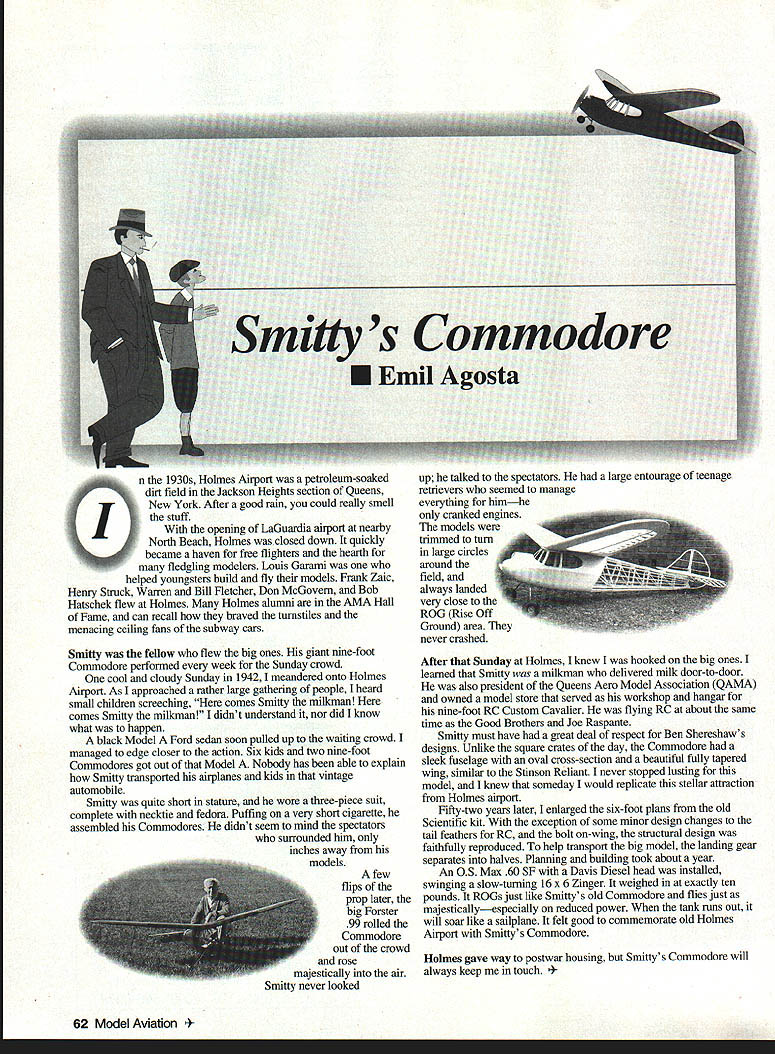
Smitty's Commodore
Emil Agosta
In the 1930s, Holmes Airport was a petroleum-soaked dirt field in the Jackson Heights section of Queens, New York. After a good rain, you could really smell the stuff. With the opening of LaGuardia Airport at nearby North Beach, Holmes was closed down. It quickly became a haven for free fliers and the heart of many fledgling modelers.
Many flyers gathered there. Louis Garami helped youngsters build and fly their models. Other regulars included:
- Frank Zaic
- Henry Struck
- Warren Fletcher
- Bill Fletcher
- Don McGovern
- Bob Hatschek
Many Holmes alumni are in the AMA Hall of Fame and can recall how they braved the turnstiles and the menacing ceiling fans of the subway cars.
Smitty was the fellow who flew the big ones. His giant nine-foot Commodore performed every week for the Sunday crowd.
One cool, cloudy Sunday in 1942, I meandered onto Holmes Airport. As I approached a rather large gathering of people, I heard small children screeching, “Here comes Smitty the milkman! Here comes Smitty the milkman!” I didn't understand it, nor did I know what was to happen.
A black Model A Ford sedan soon pulled up to the waiting crowd. I managed to edge closer to the action. Six kids and two nine-foot Commodores got out of that Model A. Nobody has been able to explain how Smitty transported his airplanes and kids in that vintage automobile.
Smitty was quite short in stature, and he wore a three-piece suit complete with necktie and fedora. Puffing on a very short cigarette, he assembled his Commodores. He didn't seem to mind the spectators who surrounded him, only inches away from his models.
A few flips of the prop later, the big Forster 99 rolled the Commodore out of the crowd and rose majestically into the air. Smitty never looked up; he talked to the spectators. He had a large entourage of teenage retrievers who seemed to manage everything for him—he only cranked engines.
The models were trimmed to turn in large circles around the field and always landed very close to the ROG (Rise Off Ground) area. They never crashed.
After that Sunday at Holmes, I knew I was hooked on the big ones. I learned that Smitty was a milkman who delivered milk door-to-door. He was also president of the Queens Aero Model Association (QAMA) and owned a model store that served as his workshop and hangar for his nine-foot RC Custom Cavalier. He was flying RC at about the same time as the Good Brothers and Joe Raspante.
Smitty must have had a great deal of respect for Ben Shereshaw's designs. Unlike the square crates of the day, the Commodore had a sleek fuselage with an oval cross-section and a beautiful fully tapered wing, similar to the Stinson Reliant. I never stopped lusting for this model, and I knew that someday I would replicate this stellar attraction from Holmes Airport.
Fifty-two years later, I enlarged the six-foot plans from the old Scientific kit. With the exception of some minor design changes to the tail surfaces for RC and the bolt-on wing, the structural design was faithfully reproduced. To help transport the big model, the landing gear separates into halves. Planning and building took about a year.
An O.S. Max .60 SF with a Davis Diesel head was installed, swinging a slow-turning 16 x 6 Zinger. It weighed in at exactly ten pounds. It ROGs just like Smitty's old Commodore and flies just as majestically—especially on reduced power. When the tank runs out, it will soar like a sailplane. It felt good to commemorate old Holmes Airport with Smitty's Commodore.
Holmes gave way to postwar housing, but Smitty's Commodore will always keep me in touch.
Transcribed from original scans by AI. Minor OCR errors may remain.

