
SNAPDRAGON
"Easy and Cute" FF Sport Model
- Dave Thornburg
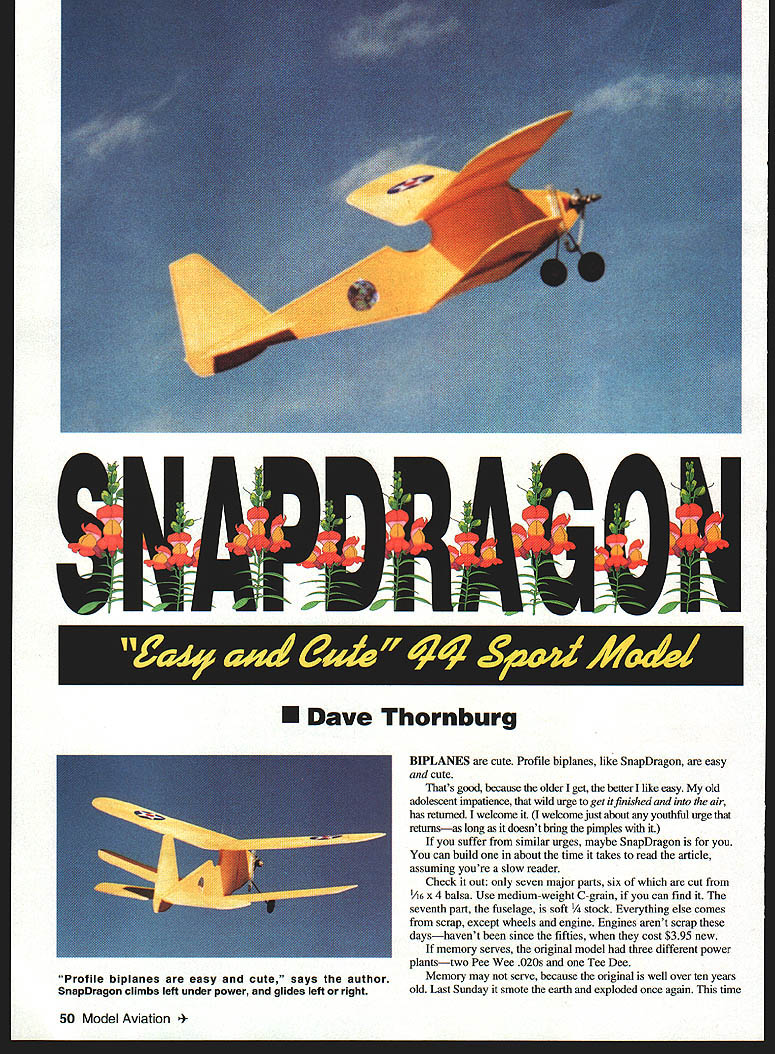
Biplanes are cute. Profile biplanes, like the SnapDragon, are easy and cute.
That's good, because the older I get, the better I like easy. My old adolescent impatience—the wild urge to get it finished and into the air—has returned. I welcome it. (I welcome just about any youthful urge that returns—as long as it doesn't bring the pimples with it.)
If you suffer from similar urges, maybe SnapDragon is for you. You can build one in about the time it takes to read this article, assuming you're a slow reader.
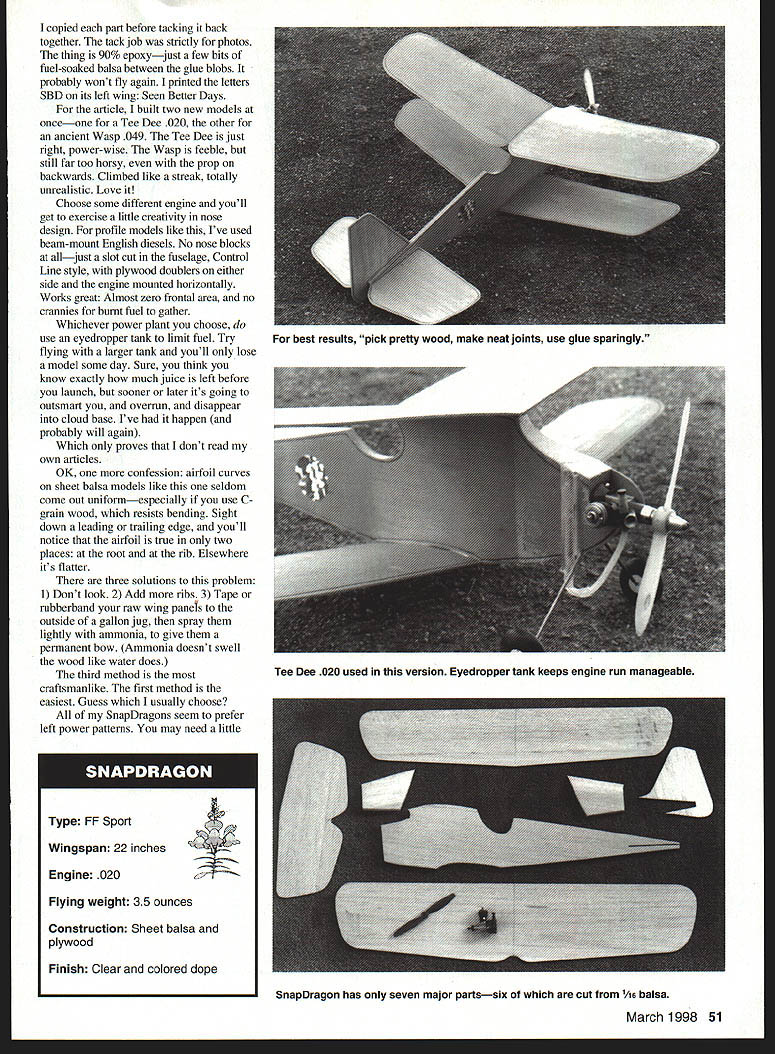
Check it out: only seven major parts, six of which are cut from 1/16" × 4" balsa. Use medium-weight C-grain if you can find it. The seventh part, the fuselage, is soft 1/4" stock. Everything else comes from scrap, except wheels and engine. Engines aren't scrap these days—haven't been since the fifties, when they cost $3.95 new.
If memory serves, the original model had three different power plants—two Pee Wee .020s and one Tee Dee .020. Memory may not serve, because the original is well over ten years old. Last Sunday I smote the earth and exploded once again. This time I copied each part before tacking it back together. The tack job was strictly for photos. The thing is 90% epoxy—just a few bits of fuel-soaked balsa between the glue blobs. It probably won't fly again. I printed the letters SBD on its left wing: "Seen Better Days."
For the article I built two new models at once—one for a Tee Dee .020, the other for an ancient Wasp .049. The Tee Dee is just right, power-wise. The Wasp is feeble, but still far too horsy, even with the prop on backwards. Climbed like a streak, totally unrealistic. Love it!
Choose a different engine and you'll get to exercise a little creativity in nose design. For profile models like this, I've used beam-mount English diesels—no nose blocks at all, just a slot cut in the fuselage, Control-Line style, with plywood doublers on either side and the engine mounted horizontally. Works great: almost zero frontal area and no crannies for burnt fuel to gather.
Whichever power plant you choose, do use an eyedropper tank to limit fuel. Try flying with a larger tank and you'll only lose a model someday. Sure, you think you know exactly how much juice is left before you launch, but sooner or later it's going to outsmart you, overrun, and disappear into cloud base. I've had it happen (and probably will again).
OK, one more confession: airfoil curves on sheet-balsa models like this seldom come out uniform—especially if you use C-grain wood, which resists bending. Sight down a leading or trailing edge and you'll notice that the airfoil is true in only two places: at the root and at the rib. Elsewhere it's flatter.
There are three solutions to this problem:
- Don't look.
- Add more ribs.
- Tape or rubber-band your raw wing panels to the outside of a gallon jug, then spray them lightly with ammonia to give them a permanent bow. (Ammonia doesn't swell the wood like water does.)
The third method is the most craftsmanlike. The first method is the easiest. Guess which I usually choose?
Most of my SnapDragons seem to prefer left-power patterns. You may need a little right thrust. The plans show quite a bit of downthrust—two undercambered wings generate lots of lift. Reduce downthrust and you'll avoid looping. Looping is dangerous to yourself and to others.
Two of three Dragons glided right; the third liked a left climb and glide. Balsa wood is nothing mil‑spec about 'em—take half a dozen to the Free Flight field almost every weekend. I always hand-glide before flying—just to see its head before turning it loose under power. Sometimes they crash anyway, but at least I did my best.
Now, a word about finish. The first SnapDragon lasted just short of forever, covered with doped tissue—ideal. LiteSpan works almost as well, though it needs a coat or two of thinned clear dope to seal the edges against fuel seep. Most iron-on plastic films are too heavy.
Both of the new SnapDragons got a hurry-up finish—the kind I sometimes give my handlaunch gliders: sand them all over with 320-grit, spray them with one or two light coats of Sig Lemon Yellow, follow up with two coats of clear, and then go fly. You may want to do a little sanding between coats to knock down rough spots. Remember to cover the landing-gear wire with masking tape before spraying. Saves some scraping later.
This finish may sound casual, but note that it's thin and doesn't hide mistakes. The grain shows through. So does every joint. That means you gotta pick pretty wood, make neat joints, and use glue sparingly. Titebond works best. Cyanoacrylate (CA) is quicker, of course, but it wicks everywhere and can discolor the wood.
On one of the new Dragons I outlined each part with a black ballpoint pen before assembly. Why? To make people ask why. (Two good answers: "I couldn't follow the lines." "I wanted a slightly bigger airplane.") Watch for warps during the finishing process. If you've picked firm, straight C-grain wood they should be minimal. Remove any that you see. All models warp over time, so they ought to begin life as straight as possible.
The SnapDragon glides decently, but it's not much in danger of thermalling out. Still, I like to keep it below 300 feet. With an .020 engine, this means around 20 seconds of power.
Want to know how high 300 feet is? Hang your model by the nose or tail from a football goalpost. Amble downfield to the far end. Peer at the airplane carefully. How clear is the stab outline? Can you see the wheels? That's about 300 feet.
There's a big open field near an airport by my house. On dead-calm days I sometimes fly there. At that site I want to be certain I'm not exceeding the FAA's 400-foot altitude limit. Hence the eyedropper tank.
The size of your dropper determines how long the engine runs. Use the skinniest one you can find. Plastic syringes work well too and come with neat little graduated marks. The marks aren't fuelproof, though, so they disappear after a few flights. But by then you'll know how much fuel to launch with.
For your first flights, start with five-second runs and gradually work up as the new SnapDragon gains confidence. Remember: overpowered models don't last. Note carefully that there are no photos of the Wasp .049-powered model. Ask yourself why.
To hold your engine's power in check, use a fuel with the lowest nitro content you can get away with—preferably around 10%. Nitromethane, remember, is the stuff that eats the engines. Of course it's also the stuff that makes little engines start easy. Life is a compromise.
Put your name and phone number somewhere on your SnapDragon. Not because it's a soaring tool, but because it's small and easily misplaced. I've had models returned by total strangers. And once by my own wife:
"Here's your lost freeflight, dear." "Wow! That's great! Where'd you find it?" "Under the bed."
There you are—without a name tag it could have ended up in a garage sale.
SNAPDRAGON — Specifications
- Type: FF Sport
- Wingspan: 22 inches
- Engine: .020 (typical)
- Flying weight: ~3.5 ounces
- Construction: Sheet balsa and plywood
- Finish: Clear and colored dope
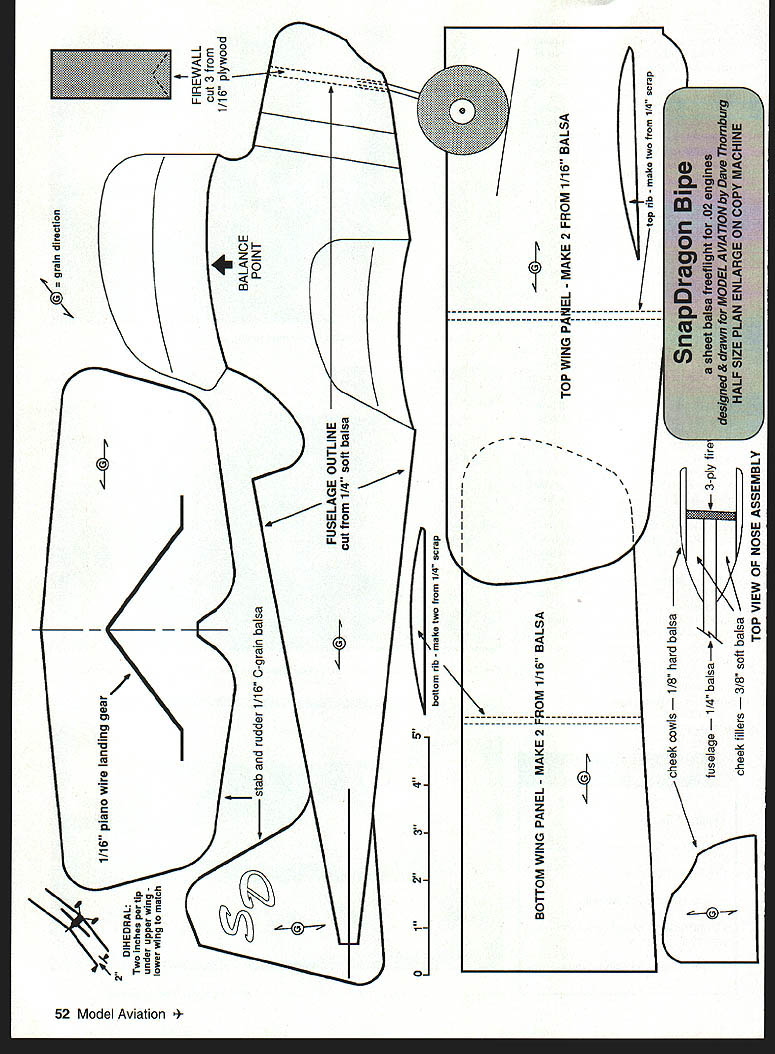
SnapDragon Bipe
designed & drawn by Dave Thornburg
- HALF-SIZE PLAN — ENLARGE ON COPY MACHINE
Parts / Materials
- Firewall — cut from 1/16" plywood (G = grain direction)
- Fuselage outline — cut from 1/4" soft balsa
- Stab and rudder — 1/16" C-grain balsa
- Landing gear — 1/16" piano wire
- Bottom wing panel — make 2 from 1/16" balsa (bottom rib — make two from 1/4" scrap)
- Top wing panel — make 2 from 1/16" balsa (top rib — make two from 1/4" scrap)
Nose / Cowling
- Cheek cowls — 1/8" hard balsa
- Fuselage cheek — 1/4" balsa
- Cheek fillers — 3/8" soft balsa
- Top view of nose assembly included on plan; scale along fuselage marked 0 1" 2" 3" 4" 5"
Right thrust is shown on the plans to keep the model from tightening up too much in the climb. By "tightening up" I mean spinning in and crashing. It happens.
Both the plan notes and the flying experience emphasize that two undercambered wings generate lots of lift—so reduce the downthrust too much and you'll have a looping fool on your hands. Looping fools are dangerous—to self and others.
Two of my three Dragons glided to the right, while the third liked a left climb and glide. Who knows why? These things are only balsa wood—nothing mil‑spec about 'em. I take half a dozen free flights to the field almost every weekend, and I always hand-glide each one before flying it, just to see where its head is before turning it loose under power.
Watch for warps, pick straight C-grain wood, make neat joints, use thin glue, and keep the flying weight down around 3.5 ounces.
Dave Thornburg 5 Monticello Drive Albuquerque, NM 87123
Transcribed from original scans by AI. Minor OCR errors may remain.

