
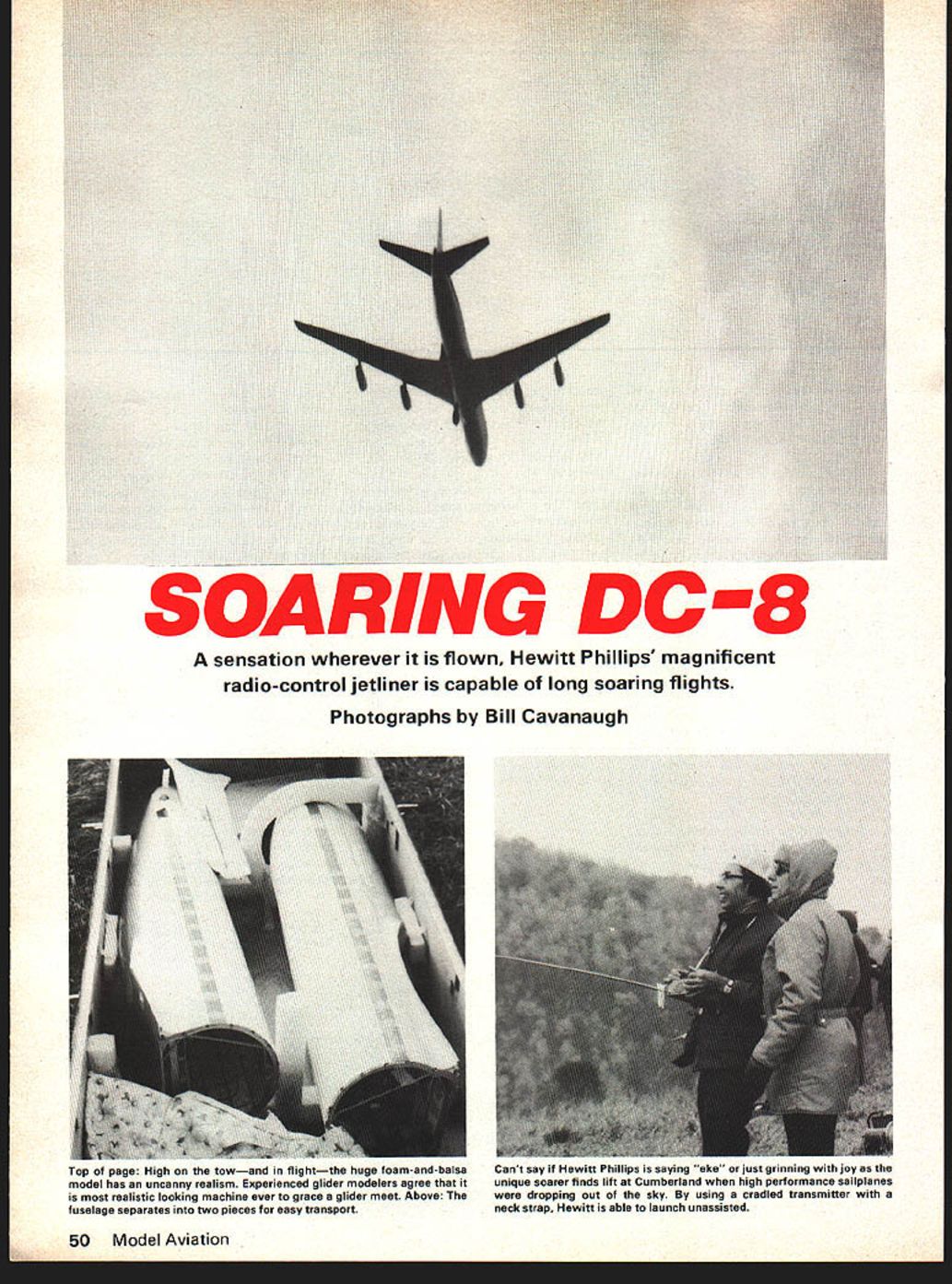
SOARING DC-8
A sensation wherever it is flown, Hewitt Phillips' magnificent radio-control jetliner is capable of long soaring flights.
Photographs by Bill Cavanaugh IT IS A RARE occasion these days when an RC is so unique—or overwhelming—that the mere sight of it stops one dead in his tracks. After all, we have seen everything—but have we? Four-engined Flying Fortresses and Liberators and things like Nosen's huge Cessna twin 310 have seemed the end of the line—until now. Besides, what can one do in Scale that has not been done bigger and better before?
Enter Hewitt Phillips and his huge DC-8 Jetliner. Hewitt, who has been with NASA for many years, goes back in modeling to the great days of Boston Indoor—in the early 1930's. An engineering type, he is noted for his unusual projects. Now people have hung engines on the nacelles of Boeing 747's and so forth but Hewitt opted for a truly magnificent sailplane. As pictures show it is certainly life-like. Witnesses of its very fine soaring flights have commented that it is, by far, the most realistic model airplane they have ever seen in flight.
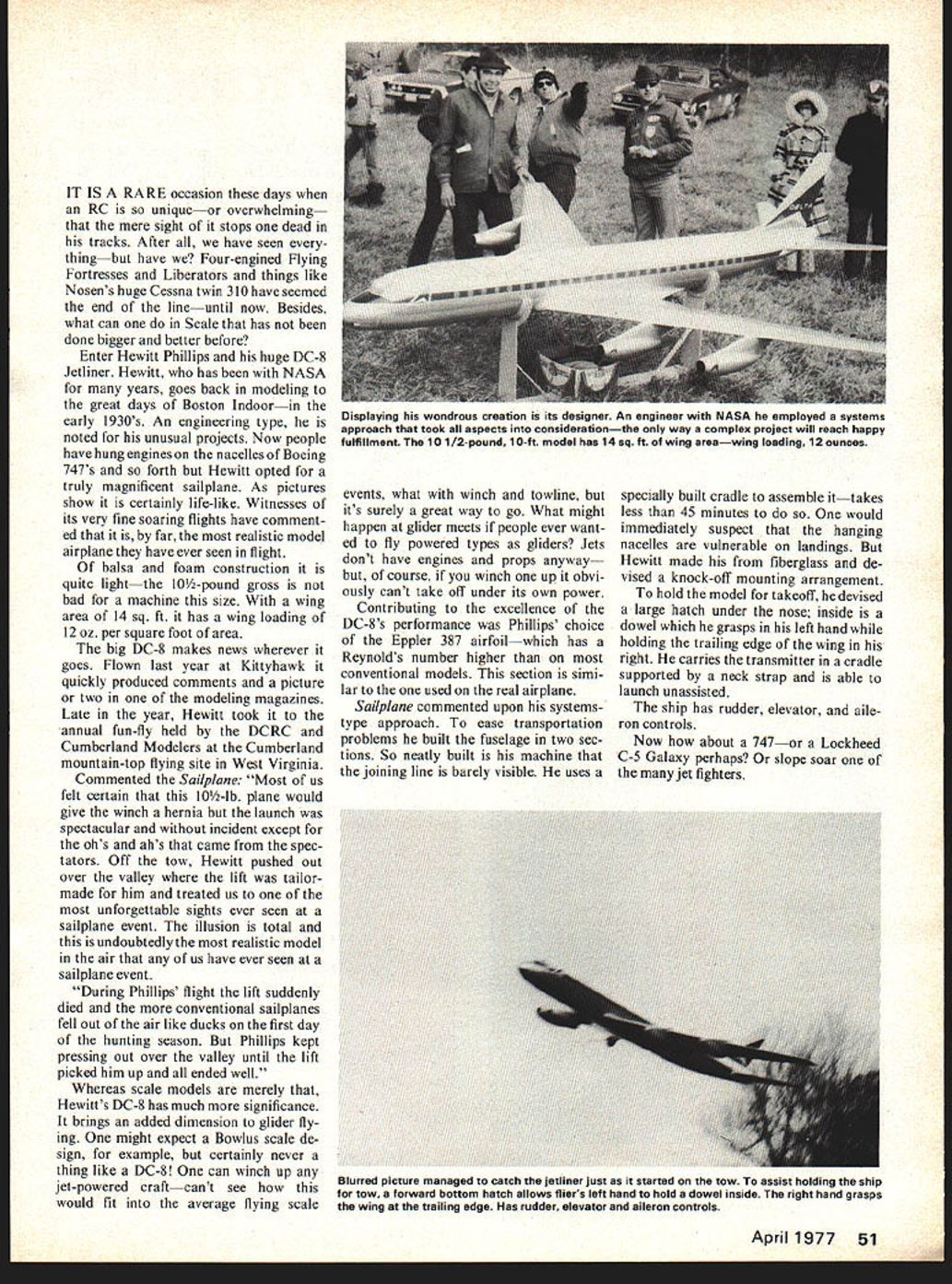
Of balsa and foam construction it is quite light—the 10-1/2-pound gross is not bad for a machine this size. With a wing area of 14 sq. ft. it has a wing loading of 12 oz. per square foot of area.
The big DC-8 makes news wherever it goes. Flown last year at Kittyhawk it quickly produced comments and a picture or two in one of the modeling magazines.
Late in the year, Hewitt took it to the annual fun-fly held by the DCRC and Cumberland Modelers at the Cumberland mountain-top flying site in West Virginia.
Commented the Sailplane: "Most of us felt certain that this 10-1/2-lb. plane would give the winch a hernia but the launch was spectacular and without incident except for the oh's and ah's that came from the spectators. Off the tow, Hewitt pushed out over the valley where the lift was tailor-made for him and treated us to one of the most unforgettable sights ever seen at a sailplane event. The illusion is total and this is undoubtedly the most realistic model in the air that any of us have ever seen at a sailplane event.
"During Phillips' flight the lift suddenly died and the more conventional sailplanes fell out of the air like ducks on the first day of the hunting season. But Phillips kept pressing out over the valley until the lift picked him up and all ended well."
Whereas scale models are merely that, Hewitt's DC-8 has much more significance. It brings an added dimension to glider flying. One might expect a Bowlus scale design, for example, but certainly never a thing like a DC-8! One can winch up any jet-powered craft—can't see how this would fit into the average flying scale events, what with winch and towline, but it's surely a great way to go. What might happen at glider meets if people ever wanted to fly powered types as gliders? Jets don't have engines and props anyway—but, of course, if you winch one up it obviously can't take off under its own power.
Contributing to the excellence of the DC-8's performance was Phillips' choice of the Eppler 387 airfoil—which has a Reynolds number higher than on most conventional models. This section is similar to the one used on the real airplane.
Sailplane commented upon his systems-type approach. To ease transportation he built the fuselage in two sections. So neatly built is his machine that the joining line is barely visible. He uses a specially built cradle to assemble it—takes less than 45 minutes to do so. One would immediately suspect that the hanging nacelles are vulnerable on landings. But Hewitt made his from fiberglass and devised a knock-off mounting arrangement.
To hold the model for takeoff, he devised a large hatch under the nose; inside is a dowel which he grasps in his left hand while holding the trailing edge of the wing in his right. He carries the transmitter in a cradle supported by a neck strap and is able to launch unassisted.
The ship has rudder, elevator, and aileron controls.
Now how about a 747—or a Lockheed C-5 Galaxy perhaps? Or slope soar one of the many jet fighters.
Transcribed from original scans by AI. Minor OCR errors may remain.

