
The Society of Automotive Engineers (SAE) Sponsors its AERO DESIGN '92
George Jenkins
Event summary
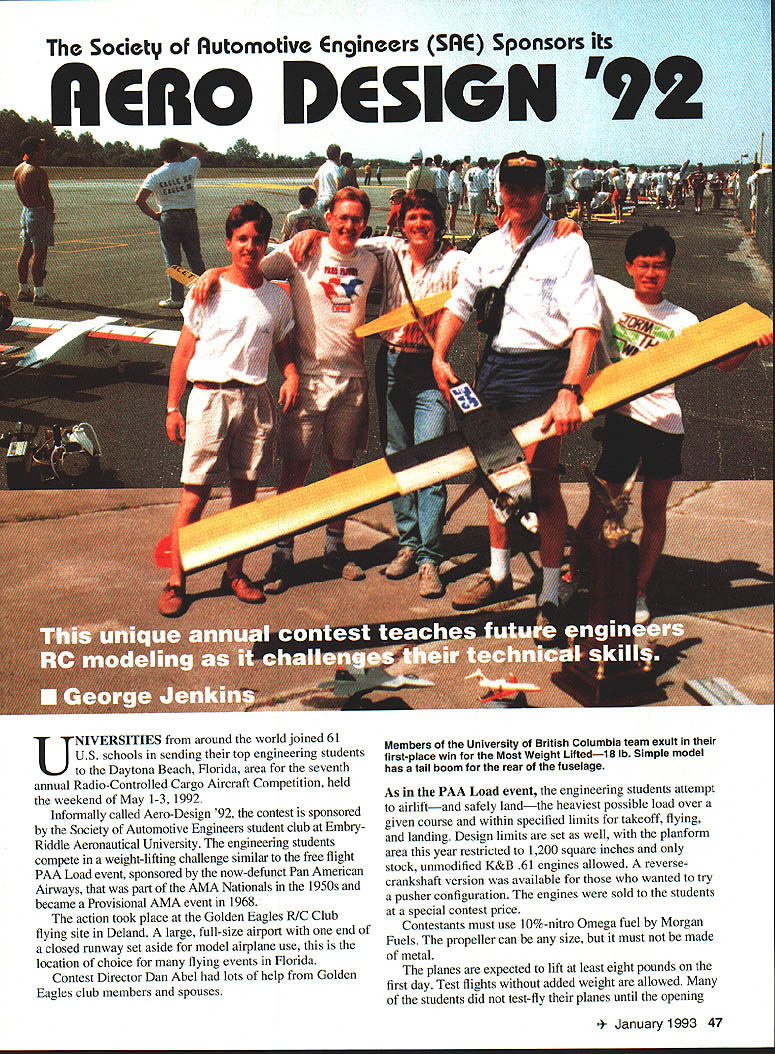
Universities from around the world joined 61 U.S. schools in sending their top engineering students to the Daytona Beach, Florida, area for the seventh annual Radio-Controlled Cargo Aircraft Competition, held the weekend of May 1–3, 1992. Informally called Aero-Design '92, the contest is sponsored by the Society of Automotive Engineers student club at Embry-Riddle Aeronautical University.
The action took place at the Golden Eagles R/C Club flying site in DeLand, a large, full-size airport with one end of a closed runway set aside for model airplane use. Contest Director Dan Abel had lots of help from Golden Eagles club members and spouses.
Rules and design limits
- The objective is to airlift—and safely land—the heaviest possible load over a given course within specified limits for takeoff, flight, and landing.
- Planform area was restricted to 1,200 square inches. All aircraft surfaces count toward this limit. For every 10 square inches over the limit, a one-pound penalty is subtracted from the final maximum weight the plane has lifted.
- Engines were limited to stock, unmodified K&B .61 engines. A reverse-crankshaft version was available for pusher configurations. Engines were sold to students at a special contest price.
- Contestants had to use 10% nitro Omega fuel by Morgan Fuels. Propellers could be any size but must not be metal.
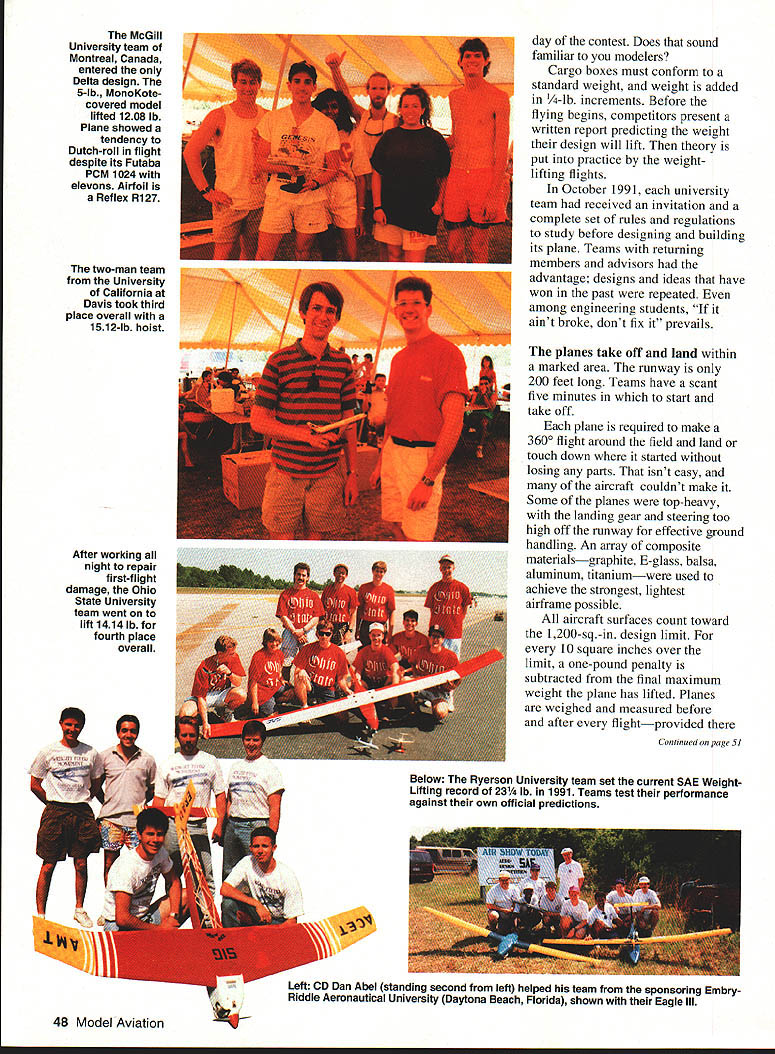
- Cargo boxes conformed to a standard weight; additional weight was added in 1/4-lb. increments. Before flying, competitors submitted a written report predicting the weight their design would lift. Test flights without added weight were allowed.
Teams received invitations and a complete set of rules in October 1991. Teams with returning members and advisors had an advantage; successful past designs were often repeated. An array of composite materials—graphite, E-glass, balsa, aluminum, titanium—were used to build the strongest, lightest airframes possible.
Flight requirements and penalties
- The runway available for models was only 200 feet long. Teams had five minutes to start and take off.
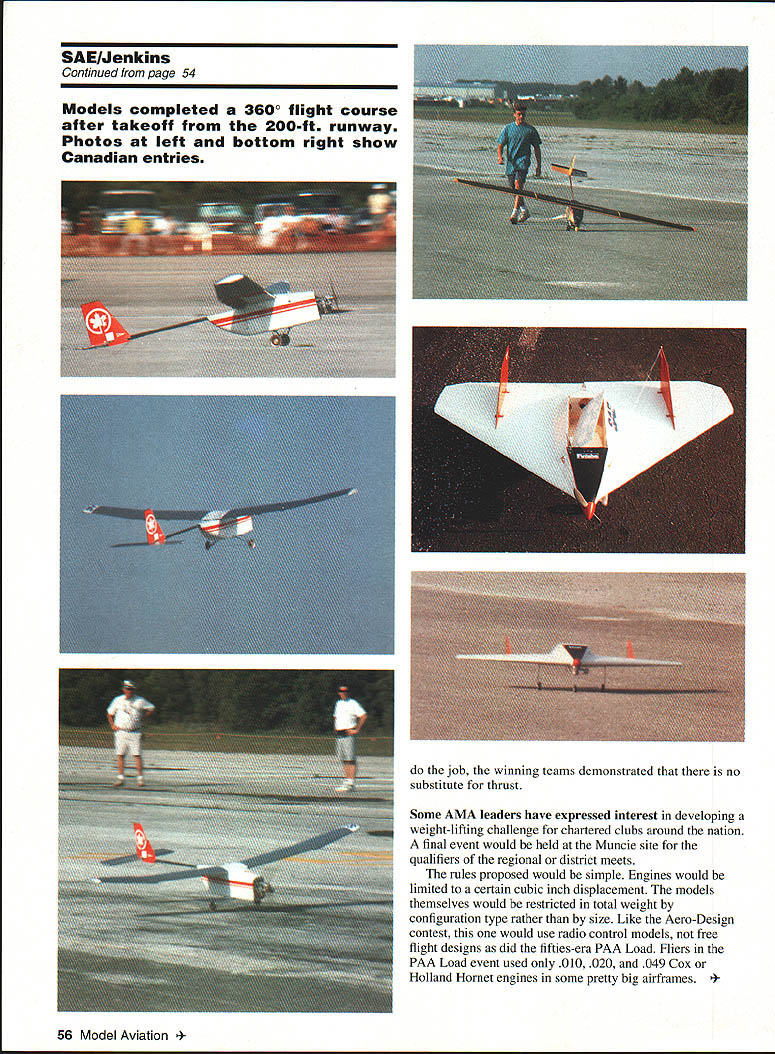
- Each plane was required to make a 360° flight around the field and land or touch down where it started without losing any parts. Planes were weighed and measured before and after every flight.
- Many aircraft were top-heavy or had landing gear/steering too high for good ground handling. Several planes suffered structural damage on landing.
Contest conduct and observations
Many entries proved too radical for successful flight; straightforward, lightweight designs worked best. Teams displayed strong spirit—cheering each other, working long into the night to repair damage and prepare for subsequent flights. On Saturday, 86 flights were made or attempted; by Sunday’s 1:00 p.m. awards program the number had been reduced to 63.
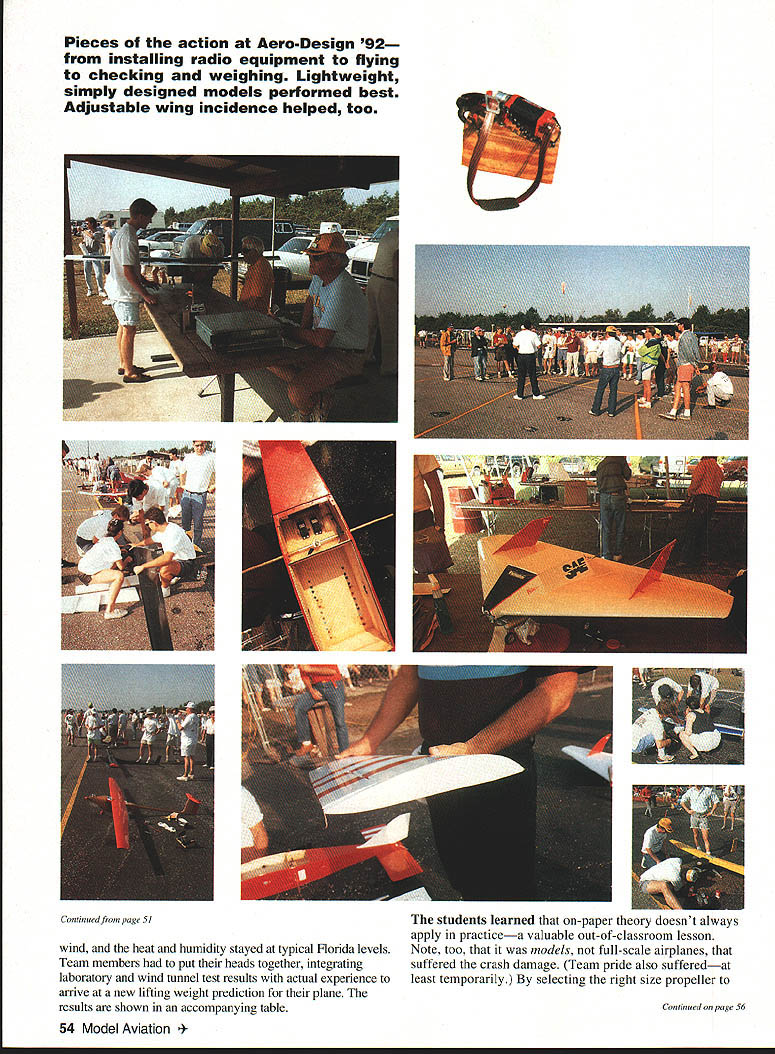
The top 15 teams in total points were further tested in a flyoff. Each team had a single attempt, starting when the helper released the plane. There was very little wind; heat and humidity were typical Florida levels. Teams integrated laboratory and wind-tunnel results with actual flight experience to arrive at a new lifting-weight prediction. The students learned that on-paper theory doesn't always apply in practice; selecting the right propeller demonstrated there is no substitute for thrust.
Some AMA leaders expressed interest in developing a weight-lifting challenge for chartered clubs nationwide, with regional qualifiers and a final event at Muncie. Proposed rules would limit engine displacement and restrict model total weight by configuration type, and—like Aero-Design—use radio control models rather than free-flight designs.
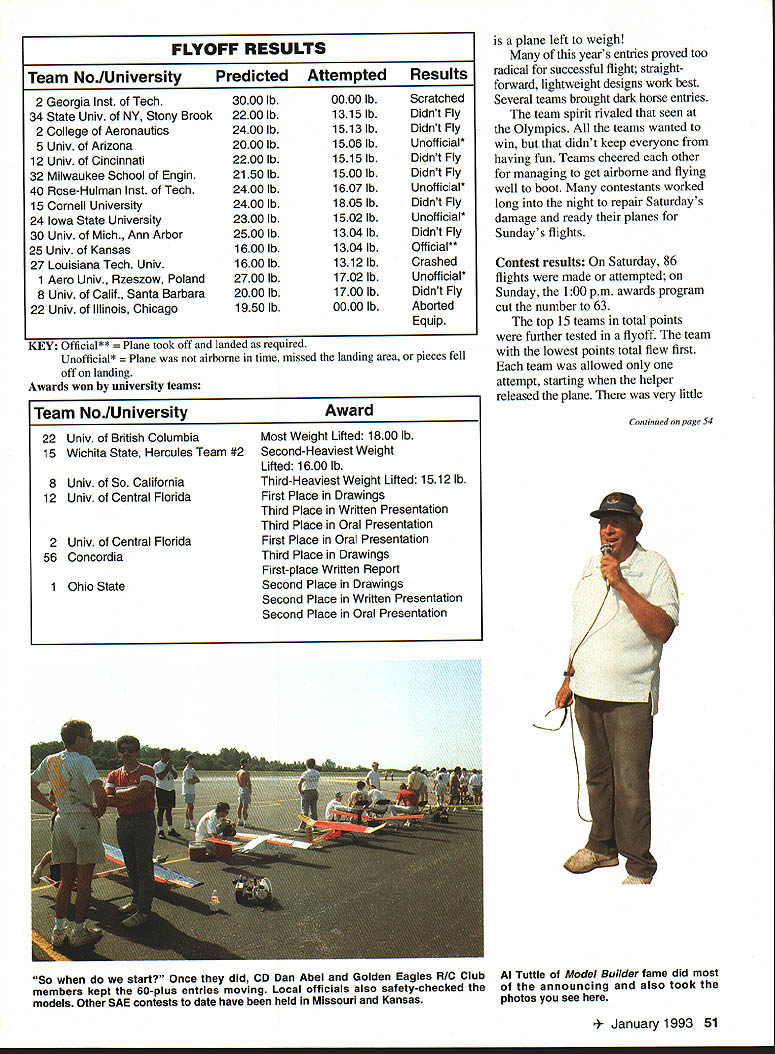
Flyoff Results
Team No. / University — Predicted — Attempted — Results
- 2 Georgia Inst. of Tech. — 30.00 lb. — 0.00 lb. — Scratched
- 34 State Univ. of NY, Stony Brook — 22.00 lb. — 13.15 lb. — Didn't Fly
- 2 College of Aeronautics — 24.00 lb. — 15.13 lb. — Didn't Fly
- 5 Univ. of Arizona — 20.00 lb. — 15.06 lb. — Unofficial*
- 12 Univ. of Cincinnati — 22.00 lb. — 15.15 lb. — Didn't Fly
- 32 Milwaukee School of Engineering — 21.50 lb. — 15.00 lb. — Didn't Fly
- 40 Rose-Hulman Institute of Technology — 24.00 lb. — 16.07 lb. — Unofficial*
- 15 Cornell University — 24.00 lb. — 18.05 lb. — Didn't Fly
- 24 Iowa State University — 23.00 lb. — 15.02 lb. — Unofficial*
- 30 Univ. of Michigan, Ann Arbor — 25.00 lb. — 13.04 lb. — Didn't Fly
- 25 Univ. of Kansas — 16.00 lb. — 13.04 lb. — Official**
- 27 Louisiana Tech University — 16.00 lb. — 13.12 lb. — Crashed
- 1 Aero Univ., Rzeszow, Poland — 27.00 lb. — 17.02 lb. — Unofficial*
- 8 Univ. of California, Santa Barbara — 20.00 lb. — 17.00 lb. — Didn't Fly
- 22 Univ. of Illinois, Chicago — 19.50 lb. — 0.00 lb. — Aborted (Equipment)
Key
- Official** — Plane took off and landed as required.
- Unofficial* — Plane was not airborne in time, missed the landing area, or pieces fell off on landing.
Awards won by university teams
- 22 Univ. of British Columbia — Most Weight Lifted: 18.00 lb.
- 15 Wichita State, Hercules Team #2 — Second-Heaviest Weight Lifted: 16.00 lb.
- 8 Univ. of Southern California — Third-Heaviest Weight Lifted: 15.12 lb.
- 12 Univ. of Central Florida — First Place in Drawings; Third Place in Written Presentation; Third Place in Oral Presentation
- 2 Univ. of Central Florida — First Place in Oral Presentation
- 56 Concordia — Third Place in Drawings; First Place in Written Report
- 1 Ohio State — Second Place in Drawings; Second Place in Written Presentation; Second Place in Oral Presentation
Many contestants learned valuable out-of-classroom lessons about the gap between theory and practice. While models—not full-scale airplanes—suffered crash damage, team pride was sometimes bruised as well.
Transcribed from original scans by AI. Minor OCR errors may remain.

