
Solar Challenger
Martyn B. Cowley
GOSSAMER DREAMS.
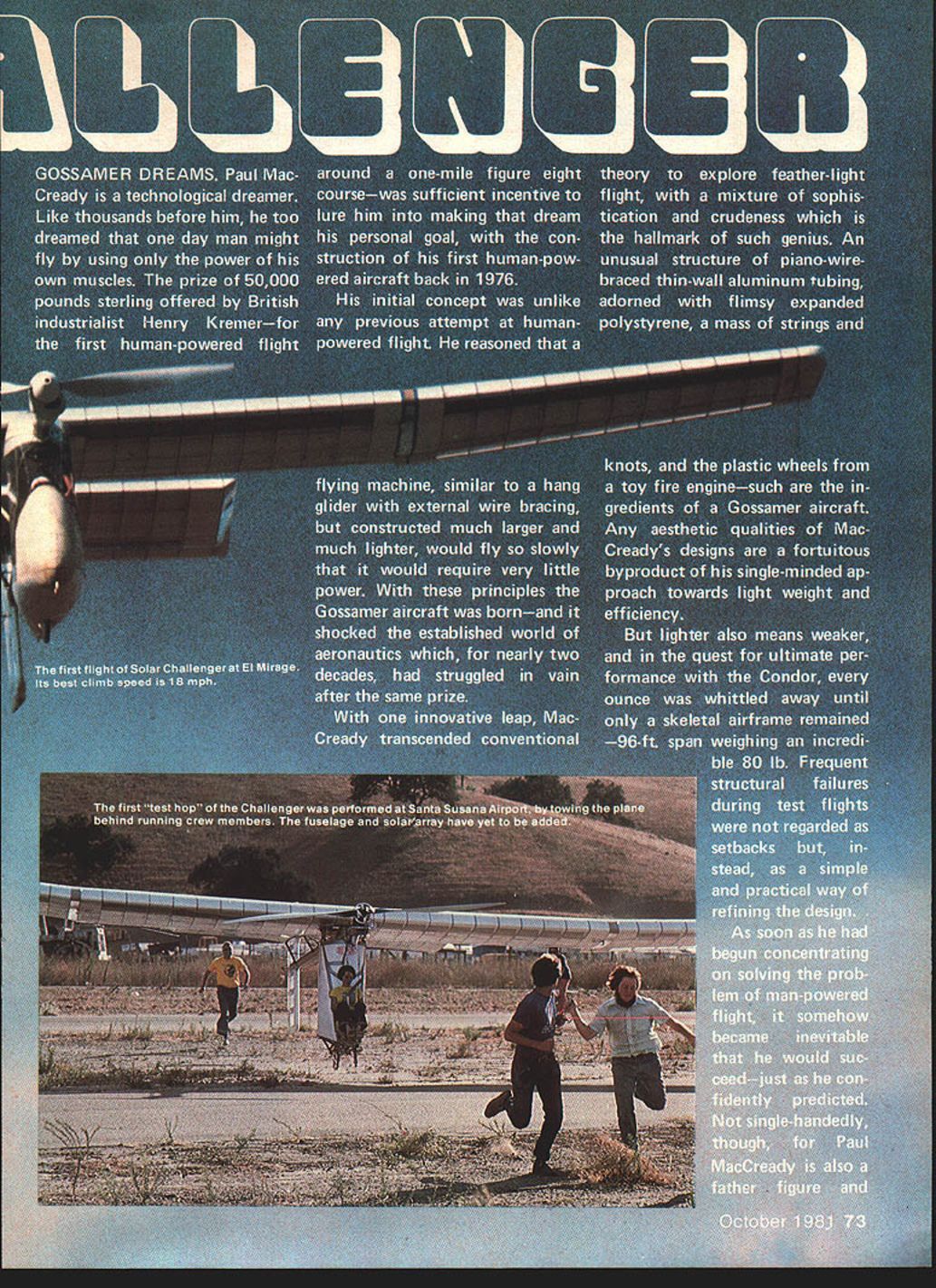
Paul MacCready is a technological dreamer. Like thousands before him, he dreamed that one day man might fly using only the power of his own muscles. The £50,000 Kremer prize offered by British industrialist Henry Kremer—for the first human-powered flight around a one-mile figure-eight course—lured MacCready into making that dream his goal and led to the construction of his first human-powered aircraft in 1976.
His concept differed from earlier attempts. He reasoned that an aircraft similar to a hang glider but much larger and much lighter would fly so slowly that it would require very little power. From this idea the Gossamer aircraft was born, and it shocked the established world of aeronautics, which for nearly two decades had struggled for the same prize.
MacCready’s designs favored feather-light structures: piano-wire-braced thin-wall aluminum tubing, expanded polystyrene shaping, a tangle of strings and knots, and even plastic toy wheels—ingredients that prioritized minimal weight and maximum efficiency over conventional aesthetics. With the Condor, every ounce was whittled away; the 96-ft span Condor weighed an incredible 80 lb. Frequent structural failures during testing were treated as practical refinements rather than setbacks.
MacCready worked with a team of talented designers, family and friends. Months after Bryan Allen pedaled the Gossamer Condor to win the Kremer prize in August 1977, MacCready announced a new design, the Gossamer Albatross, aimed at crossing the English Channel. On June 12, 1979, Bryan Allen flew 22 miles from England to France in 2 hours 50 minutes, winning the second Kremer prize of £100,000.
Solar power
Concerned about the environment and energy, MacCready turned his attention to photovoltaic solar cells. Wafer-thin silicon-crystal cells—each a couple of square inches—produce a small electric current in sunlight. After the initial investment the energy is free while the sun shines. Although solar cells were expensive then, MacCready believed mass production would reduce costs as it had for other consumer technologies.
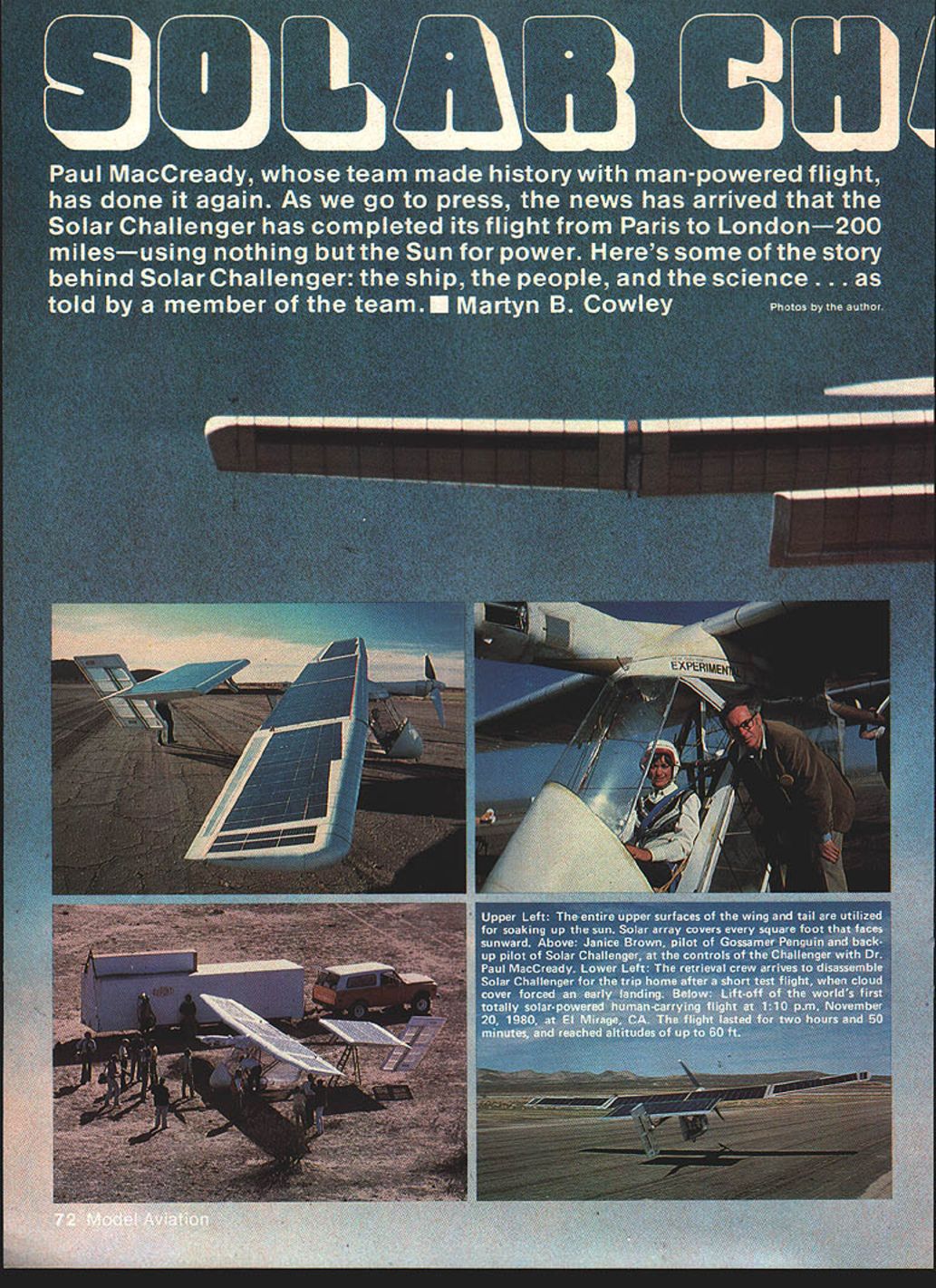
The Solar Challenger fuses current ideas and future thinking. Its aims were twofold: to demonstrate what can be achieved with a limited energy supply through high-efficiency lightweight design, and to promote photovoltaic cells. Solar-powered aircraft were unlikely to become widespread soon, but solving the hard problems of solar flight highlights earthbound applications—domestic power, remote transportation, and other niche uses.
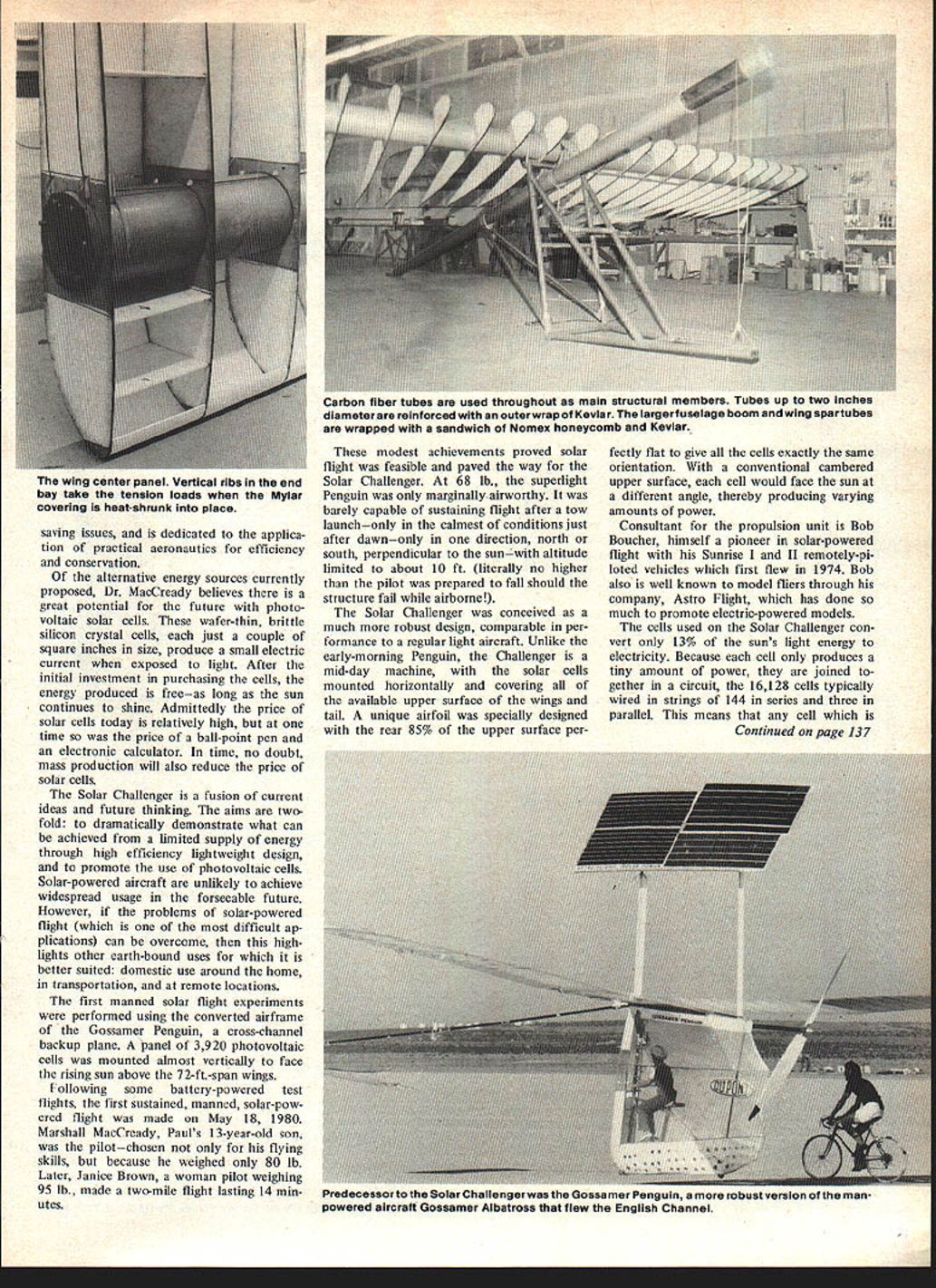
The first manned solar-flight experiments used a converted Gossamer Penguin airframe. A panel of 3,920 photovoltaic cells was mounted almost vertically above the Penguin’s 72-ft span wings. After some battery-powered tests, the first sustained manned solar-powered flight was made on May 18, 1980, with Marshall MacCready (Paul’s 13-year-old son) piloting; he weighed about 80 lb. Janice Brown later made a two-mile flight of 14 minutes. These modest achievements proved solar flight feasible and paved the way for Solar Challenger.
The Penguin (about 68 lb) was marginally airworthy—capable of sustained flight only after a tow, only in calm dawn conditions, and only at very low altitude. Solar Challenger was conceived as a much more robust, mid-day machine comparable in performance to a light aircraft. Its solar cells are mounted horizontally, covering the available upper surfaces of the wings and tail. A unique airfoil was designed with the rear 85% of the upper surface perfectly flat so all cells have the same orientation; on a conventional cambered surface each cell would face the sun at slightly different angles and produce varying power.
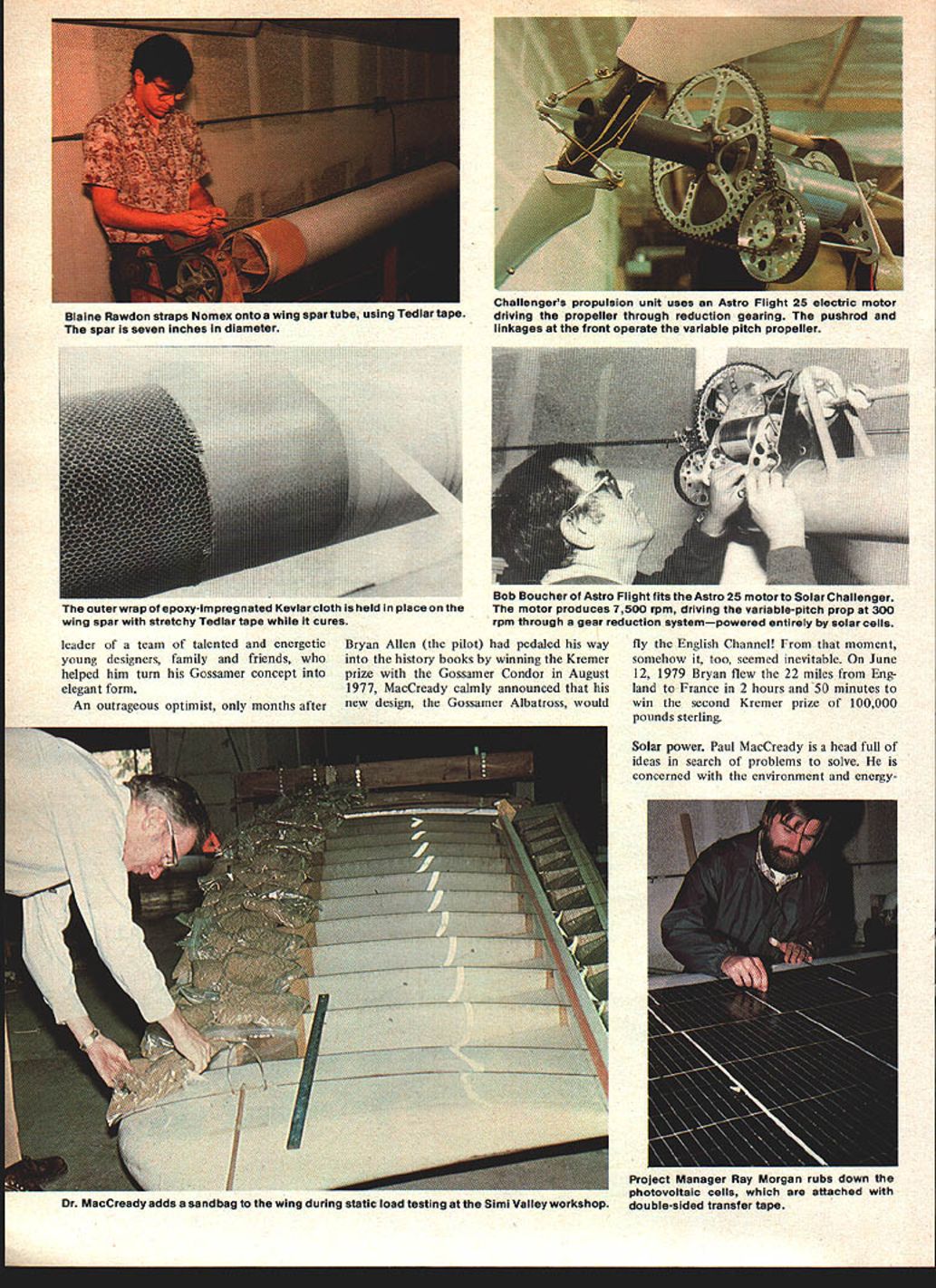
Bob Boucher of Astro Flight, a pioneer of solar-powered flight (Sunrise I and II remotely piloted vehicles first flown in 1974), was consultant on the propulsion unit. The cells used on Solar Challenger convert about 13% of incident sunlight into electricity. Because each cell produces only a tiny amount of power, 16,128 cells were joined in the circuit. The cells were typically wired in strings (144 in series and three such strings in parallel), so a damaged or shaded cell could degrade an entire string—hence the cells are mounted only on upper surfaces and away from potential shading by struts or the pilot.
Key specifications and components:
- Photovoltaic cells: 16,128 cells, ~13% conversion efficiency.
- Propulsion: Astro Flight Astro 25 electric motor driving a variable-pitch propeller through reduction gearing and pushrod linkages; motor runs ~7,500 rpm driving the prop at ~300 rpm.
- Wing: 257 sq ft area; completed wing weighed ~55 lb yet supported almost a half-ton of sandbags in static tests.
- Batteries (test use): 39 lb of Ni-Cad used for early tests; removed for pure solar flights.
Construction and materials: The wing spar was produced using a disposable aluminum former filled with honeycomb and given an outer wrap of epoxy-impregnated Kevlar cloth. After curing, the aluminum former was dissolved in acid to leave a very lightweight, strong tube. The remaining structure was filled with shaped expanded polystyrene, carved or hollowed with a hot wire and sanded to shape. The entire aircraft was covered with 0.0005-in. transparent Mylar adhered with double-sided transfer tape and shrunk drum-tight with a heat gun. Photovoltaic cells were attached with double-sided transfer tape.
Flight testing and records:
- The Solar Challenger was completed near the end of 1980 after about four months of work by a team of six led by project manager Ray Morgan (then on leave from Lockheed).
- Initial flights at Shafter Airfield near Bakersfield used rechargeable Ni-Cad batteries, allowing flights throughout the day. On November 13, Janice Brown set a believed world record for electric flight: 1 hour 32 minutes, reaching 1,600 ft.
- Batteries were removed and solar cells fitted. The first solar-powered lift-off was at El Mirage Soaring Center on November 20: a 2 min 50 sec flight reaching about 60 ft.
- Winter test flights at Marana Air Park extended performance: a flight of 1 hour 55 minutes (landing at Picacho Peak) and an altitude flight reaching about 3,500 ft.
- Further tests at Shafter in May produced new records: 8 hours 19 minutes (pilot Steve Ptacek) and an altitude of 14,300 ft (Janice Brown).
Channel challenge: Solar Challenger was prepared for a 1981 goal: a Paris-to-London flight of some 200 miles, scheduled for mid-June 1981. The ideal profile required an early-morning lift-off (6–9 a.m.), a long climb heading north over France to peak after midday at 12,000–15,000 ft over the English Channel, then descent into England. At an average groundspeed of 25–30 mph the crossing would take a grueling eight hours or more, depending on winds and weather.
(Editor’s note: this copy was being typeset on July 7; we were later informed that Solar Challenger had indeed made its crossing, flying at about 1,200 ft and landing at Manston Airport at 10:51 a.m. Eastern time. Poor weather had prevented earlier attempts, and the “window” was nearly gone.)
Conclusion: The Solar Challenger follows a long tradition of testing new ideas through challenging flights that gain public recognition. If the Age of Solar Power is a little nearer because of projects like this, the publicity and technical lessons are exactly what MacCready intended: demonstrating what high-efficiency lightweight design and photovoltaic technology can achieve and helping bring solar power closer to practical use.
Transcribed from original scans by AI. Minor OCR errors may remain.

