
The Soplata Collection
— Kenneth D. Will
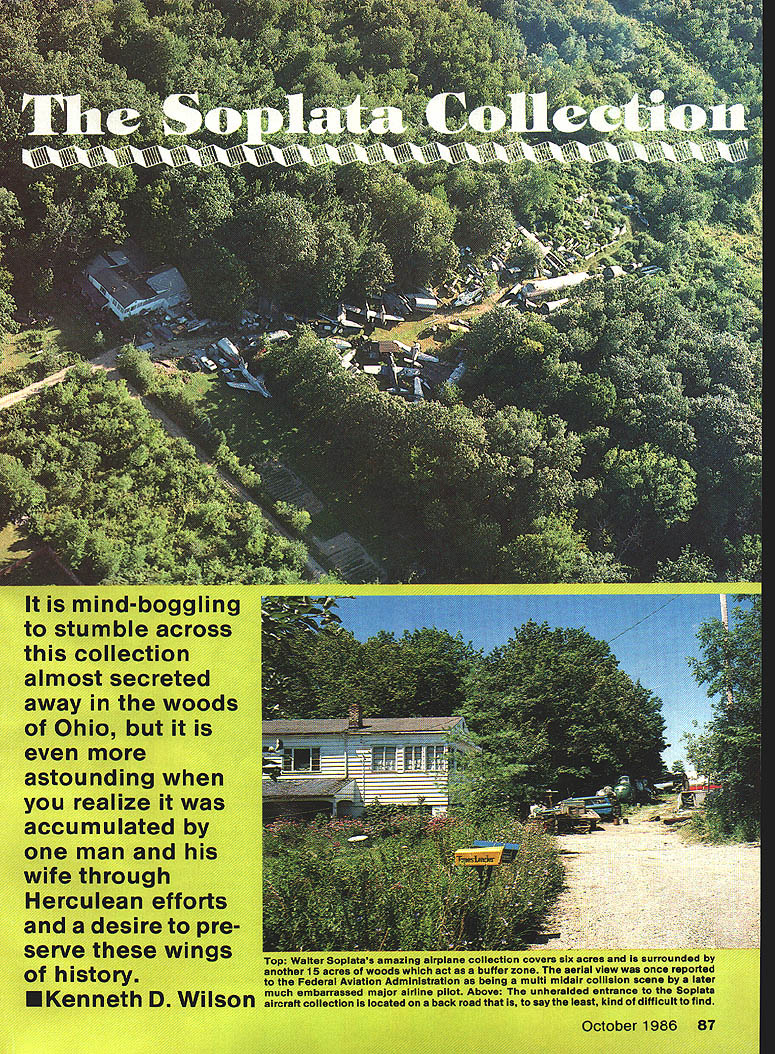
There are no billboards along the interstate highway to advertise or direct you to Walter A. Soplata's airplane collection. Yet once you have arrived you may feel like an explorer who has just stumbled onto a lost empire deep in the jungle. There are no freshly manicured grounds, no sewers, no concession stand, no plaques telling the story of each airplane, no barriers to keep the inquisitive hand from actually touching history (with permission you probably can sit in the cockpit), and no charge for admission. But when you see the collection and learn how Walter and Peggy Soplata have sacrificed to save these wings of history, you are inclined to slip them a fiver or a ten-spot, perhaps even more.
Soplata's aviation obsession blossomed in the "Mecca City of Air Racing," Cleveland, Ohio, when Walter started building model airplanes in 1933 at the tender age of ten. During World War II, Soplata served in the U.S. Air Force as an airplane mechanic. Upon his discharge in 1946, he purchased an American Eagle airplane. At his Geauga County home, Walter would fire up the engine and taxi the Eagle around the yard, but one day the Eagle spread her wings and became airborne. Although the plane never attained an altitude of more than a foot, Walter saw a nearby house zip by, missing it by mere inches.
Once Soplata got the bird back on terra firma, the brakes failed. Walter literally fell out of the cockpit and hung onto the fuselage to swing the airplane around. Shortly thereafter, Walter sold the Eagle (it would be the only airplane that he ever sold). The biplane is presently in California, one of two of its kind that is still flying.
Soplata became "plane crazy" in 1947 with the purchase of a Vultee BT-13A that had been flipped over during a windstorm. The Valiant cost him $50, which he borrowed from his girlfriend, Peggy, whom he married in 1948. Peggy jokes that she never did get her $50 back.
On weekends both can be found tracking down old airplanes around the country. Indeed, Walter did find the right "Peg o' My Heart" for his wife!
The Soplata home is located at the entrance to Walter's cluttered collection, and it also has an aviation background. The house was started in 1947 and was built by Walter (a retired union carpenter) from aircraft engine packing crates. Much of the interior is filled with aviation memorabilia—everything from bomb sights to instruments and engine parts to books and magazines—because Walter has stripped out most of the airplane interiors in his collection and placed them in his home for safekeeping.
As you enter the six-acre display area, you will be amazed that a person could possibly have collected this many airplanes almost single-handedly. But even more mind-boggling is how he moved them cross country via highway on meager means.
Among highway patrolmen in Ohio and surrounding states, Soplata's "over the road" adventures are legendary. At South Weymouth Naval Air Station, outside Boston, Massachusetts, Walter arrived in the dead of winter wheeling in a 1945 school bus which he had purchased at a junkyard for $125 to pick up a surplus Vought F7U Cutlass.
In order to load the F7U, the two Westinghouse J46-WE-8 engines had to be removed, and to pull out the powerplants the wings had to be plucked. Nearing the end of two weeks, the 5,000 base personnel were betting that Walter would never get the Cutlass off the Navy air station. With the fuselage sticking out of a slit in the roof of the bus, with windows broken out and an extended rear overhang, Walter exited Boston with the front wheels of the bus bouncing off the pavement on nearly every bump in the road.
Only 50 miles from the Pennsylvania border, a New York State highway patrolman pulled Soplata over. This was nothing new for Walter; it was the eighth time this had happened since leaving Boston. The New York motorist just wanted to see for himself what he had been alerted about; the state police had been advised: "Get him out of New York State and into Pennsylvania. He hasn't a dime!"
Walter was so broke that he did not have any money for a McDonald's and had no more room on the bus. Since it was too cold to sleep in the bus, he drove for 24 days without stopping. Each time he came to a downhill grade, Walter would switch off the engine and coast; then he would restart and continue on. Arriving home disoriented and dehydrated, Soplata went straight to bed and spent the next six weeks recovering from his easterly arctic outing.
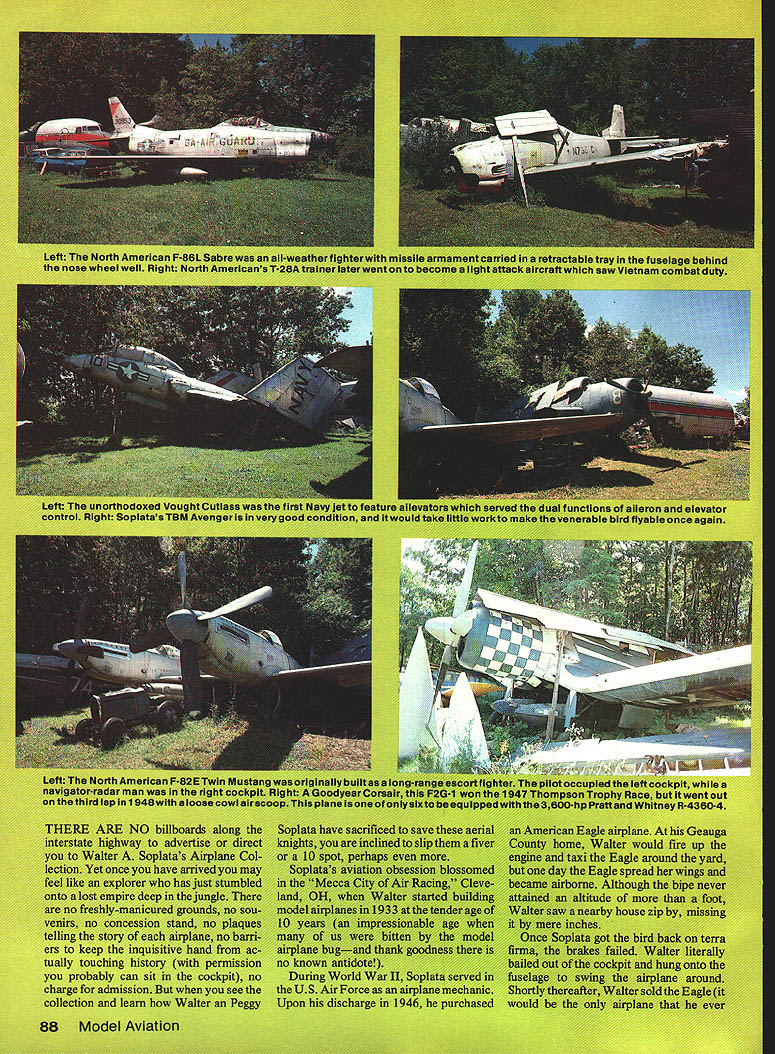
An airplane in Walter's collection that attracts attention is his light-yellow North American F-82 Twin Mustang. It was in the Twin Mustang that Lt. William Hudson, USAF, scored the first aerial kill in the Korean War on June 27, 1950. This F-82E has brought Soplata offers in excess of $200,000, all of which he has turned down.
The fuselage carries the designation NACA-133, and it is most appropriate that this Twin Mustang served the National Advisory Committee for Aeronautics' Engine Research Laboratory in Cleveland, Ohio, to assist with the scientific study of the problems of flight with a view to their practical solution. Soplata's F-82, as well as his P-51K Mustang, can trace part of their design back to earlier work on laminar-flow airfoil sections pioneered by NACA (which became the National Aeronautics and Space Administration in 1958).
NACA pioneered the development of the low-drag, high-speed airfoil section after years of research on wing characteristics. These experiments graduated into flight tests and the first application of what is often (incorrectly) referred to as a "laminar-flow" wing used on the 400+ mph North American P-51 Mustang and later applied to the F-82 Twin Mustang. This was one of NACA's contributions that assisted in winning World War II and advancing American aeronautics.
Walter's XP-82, one of two prototypes, first flew in April 1945. It is a common misconception that the Twin Mustang was simply two P-51 fuselages joined together; although similar, North American designed totally new structures for the Twin Mustang. Serial number 46-256, an F-82E, was a day escort fighter that shifted from the standard .50-caliber machine guns, and it could carry an external 4,000-lb. bomb load. (The designation system for Air Force fighter airplanes changed from "P," denoting pursuit, to "F," denoting fighter, in 1948.)
THANKS TO THE FOLLOWING FOR ASSISTANCE RENDERED ON THIS ARTICLE.
- Walter & Peggy Soplata, Newbury, Ohio
- Sidney H. Bradd, Solon, Ohio
- Donald R. Helmick, Valley City, Ohio
- Kathleen Brooks-Pazmany, National Air & Space Museum
K.D.W. — 4-86 A.M.A. 14065
Captions
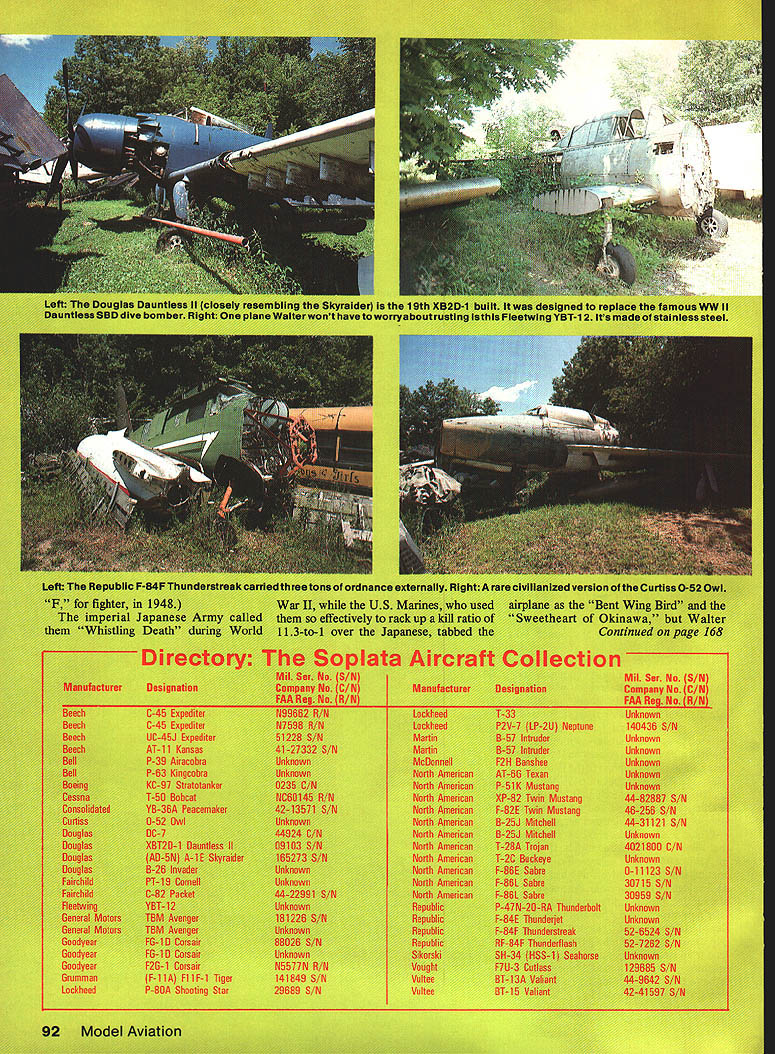
- Left: The Douglas Dauntless II (closely resembling the Skyraider) is the 19th XBD2D-1 built. It was designed to replace the famous World War II Dauntless SBD dive bomber.
- Right: One plane Walter won't have to worry about rusting is this Fleetwing YBT-12. It's made of stainless steel.
- Left: The Republic F-84F Thunderstreak carried three tons of ordnance externally.
- Right: A rare civilianized version of the Curtiss O-52 Owl.
Directory: The Soplata Aircraft Collection
- Beech — C-45 Expeditor — N99682 R/N
- Beech — C-45 Expeditor — N7598 R/N
- Beech — UC-45J Expeditor — 51228 S/N
- Beech — AT-11 Kansan — 41-27332 S/N
- Bell — P-39 Airacobra — Unknown
- Bell — P-63 Kingcobra — Unknown
- Boeing — KC-97 Stratotanker — 0235 C/N
- Cessna — T-50 Bobcat — NC20145 R/N
- Consolidated — YB-36A Peacemaker — 42-13571 S/N
- Curtiss — O-52 Owl — Unknown
- Douglas — DC-2 — 49424 C/N
- Douglas — XBD2D-1 Dauntless II — 09103 S/N
- Douglas — (AD-5N) A-1E Skyraider — 165273 S/N
- Douglas — B-26 Invader — Unknown
- Douglas — PT-19 Cornell — Unknown
- Fairchild — C-82 Packet — 44-22991 S/N
- Fleetwing — YBT-12 — Unknown
- General Motors — TBM Avenger — 181226 S/N
- General Motors — TBM Avenger — Unknown
- Goodyear — FG-1 Corsair — 80026 S/N
- Goodyear — F2G-1 Corsair — N5577 R/N
- Grumman — F-11A (F11F-1) Tiger — 714849 S/N
- Lockheed — P-80A Shooting Star — 29689 S/N
- Lockheed — T-33 — Unknown
- Lockheed — P2V-7 (LP-2U) Neptune — 140436 S/N
- Martin — B-57 Intruder — Unknown
- McDonnell — F2H Banshee — Unknown
- North American — AT-6 Texan — Unknown
- North American — AT-6 / P-51 / other types — Unknown
- North American — XP-82 Twin Mustang — 44-82887 S/N
- North American — F-82E Twin Mustang — 46-256 S/N
- North American — B-25J Mitchell — 44-31121 S/N
- North American — T-28 Trojan — 402180 C/N
- North American — F-86 Sabre — 30715 S/N
- North American — F-86E Sabre — Unknown
- Republic — P-47N-20-RA Thunderbolt — Unknown
- Republic — F-84F Thunderstreak — Unknown
- Republic — F-84E Thunderjet — 52-6524 S/N
- Sikorsky — SH-34 (HSS-1) Seashore — Unknown
- Vought — F4U-3 Corsair — 129685 S/N
- Vultee — BT-13 Valiant — 42-41597 S/N
(Note: Some serial, company, or FAA registration numbers were unreadable or labeled "Unknown" on the scanned page.)
Soplata/Wilson
Soplata knows the Corsair as his favorite airplane. All of Soplata's Corsairs rolled off the Goodyear assembly line, but his most valued one is the F2G-1. Built to counter the attacks of Japanese kamikaze planes in the Pacific, only five of the 3,600-hp Pratt & Whitney R-4360-4 powerplants were manufactured for this variant. One long-distance caller offered to pay Soplata $100,000, sight unseen, for the F2G-1, but the caller's offer came to nothing.
Trophy-race exploits: Cook Cleland, a multi-decorated World War II Navy veteran, spent every cent he had in acquiring F2G-1 airplanes. Cleland's sixth place in the 1946 Thompson Race was bettered in 1947 as he blazed past the home pylon of the 300-mile (20-lap) race with a winning speed of 396.131 mph after qualifying at 401.787 mph. In the blue-and-white racer No. 74, teammate Richard Becker placed second in Cleland's NX5590N F2G-1. Overshadowing Cleland's 1947 win, however, was the death of Tony Jannazo when the Cleland-owned NX5588N F2G-1 slammed into the ground at the No. 2 pylon.
It was disappointing for Cleland in 1948 when both of his F2G-1 entries were forced out of the Thompson Race with loose nose-cowl air scoops. However, the loss was made up for in 1949 when Cleland's F2G-1 Corsairs took first, second, and third in the Thompson Trophy Race, with Cook setting an all-time Thompson Race record of 397.071 mph. In this all-white clipped-wing Goodyear racer he became the second pilot ever to win the Thompson more than once (Col. Roscoe Turner won in 1934, 1938, and 1939).
Cleland returned to the U.S. Navy in 1951, and the three Goodyear F2G-1 Corsair racers were left exposed at Cleveland. N5590N, the airplane that won the last Thompson Race when sporting race No. 94, was destroyed by vandals. The modeler's favorite red-and-white race No. 57 lay on its belly and was finally carted away to Florida in very deteriorated condition.
Soplata rescued the 1947 Thompson-winning F2G-1 and was later approached by racing interests about purchasing the airplane to attempt prop-driven world speed records. Knowing the fate of the other Goodyear F2G-1s, he refused the offers. Due to the historical significance of these airplanes, their monetary value has increased greatly with time.
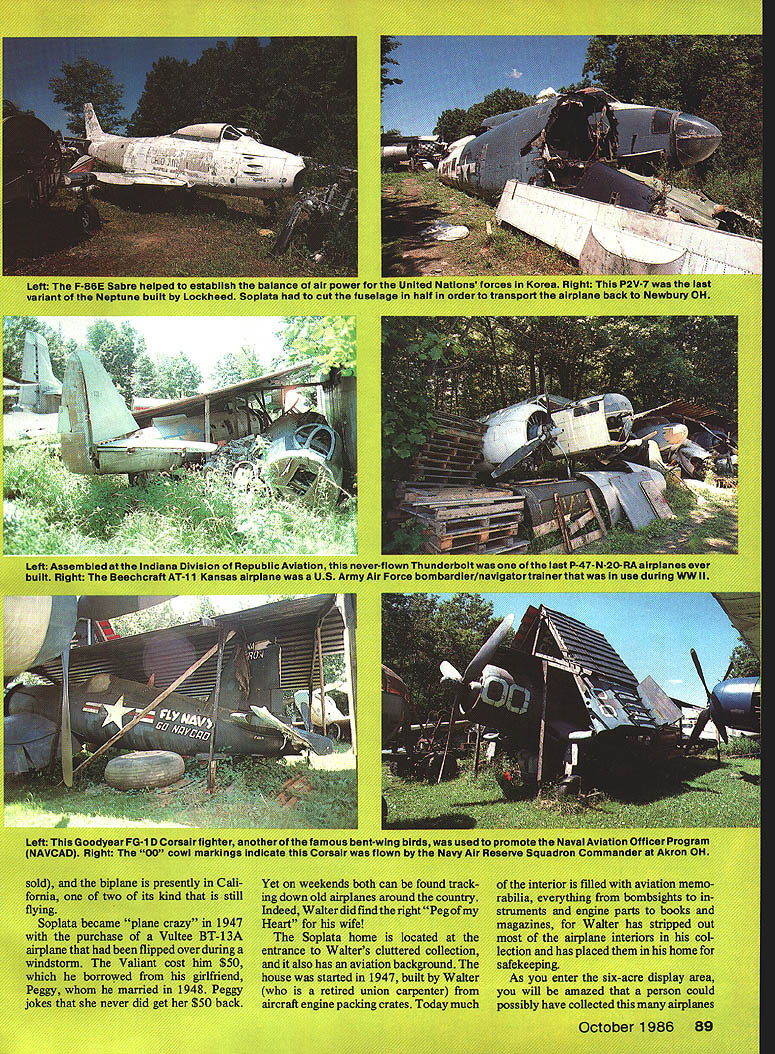
For 17 years (1945–1962), Lockheed built the famous U.S. Navy Neptune airplane in seven major variants; a total of 1,051 units were produced by them. Kawasaki Industries in Japan manufactured an additional 130 Neptunes under license.
A Neptune from NAS Alameda, CA, VX-6 (Experimental and Development Squadron No. 6), was crunched on an extra-hard landing at a deactivated Army Air Force base in Wilmington, Ohio. The main wing spar of the Neptune was extensively cracked, and after stripping the P2V of all salvageable items, the Navy abandoned the airplane.
The Alaskan springtime temperature of 40° below zero wind-chill factor did not deny Walter the rescue of his Neptune. He again relied on his old white school bus for cartage duty. (AMA control-line meets of the late 1950s and early 1960s saw several Japanese-imported Eureka and AristoCraft P2V Neptune models taking top awards in scale competitions.)
It is rare that a collector has an off-the-line production Army Air Force airplane that was never accepted by the military, yet Soplata's P-47N-20-RA Thunderbolt has never been flown. When World War II ended in August 1945, the Indiana division of Republic Aviation at Evansville had several P-47N airplanes sitting on the assembly lines. Most of these airplanes were completed and then given to local high school aviation departments and technical and vocational schools.
As the surplus Thunderbolts outlived their instructive usefulness in the late 1940s and early 1950s, Earl (Mr. P-47) Reinert went about the United States purchasing Thunderbolts and parting them out to NATO and South American nations where the P-47 was still frontline defense. Soplata obtained his P-47N-20-RA from Reinert.
What appears deceivingly as a Douglas Skyraider to the aviation fan visiting Soplata's collection is actually a Douglas XBT2D-1 Dauntless II. Taking to the air for the first time on March 18, 1945, the XBT2D-1 was designed as a replacement for the famed Douglas SBD dive bomber of World War II. The first 24 airplanes built were designated XBT2D-1 Dauntless IIs; it was redesigned as the familiar Douglas AD Skyraider in 1946. Soplata's XBT2D was one of 19 built in the attack-bomber configuration, while other XBT2D airframes were modified to serve as night-attack, photo-reconnaissance, early-warning radar stations, and all-weather airplanes.
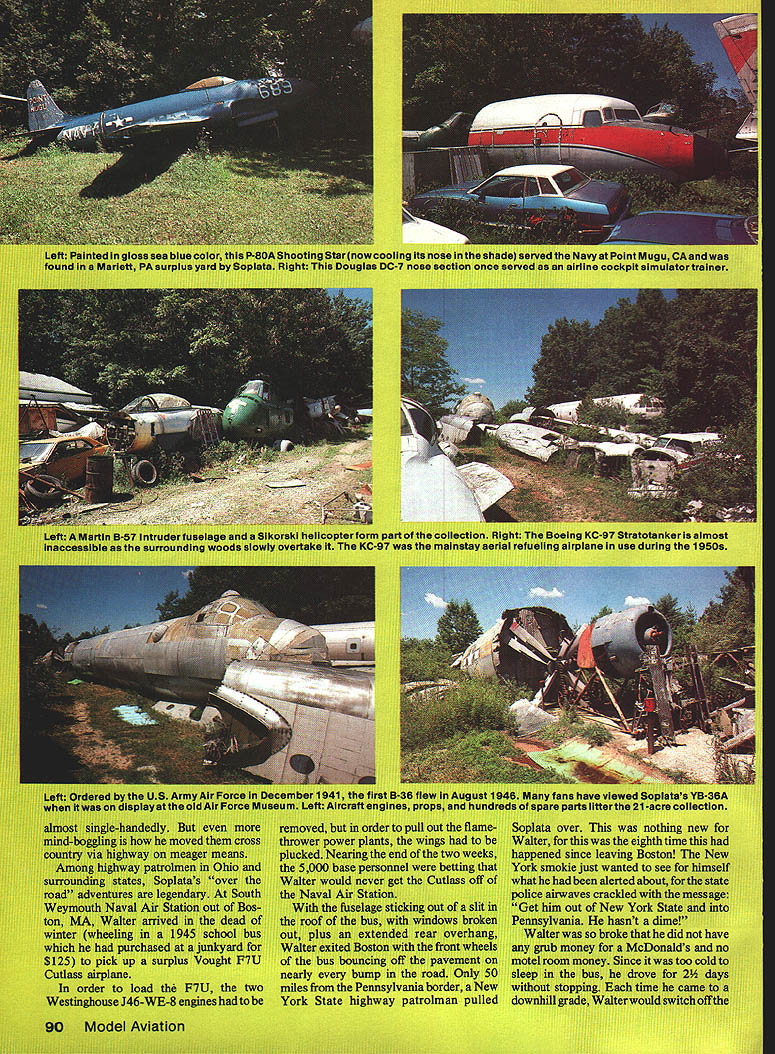
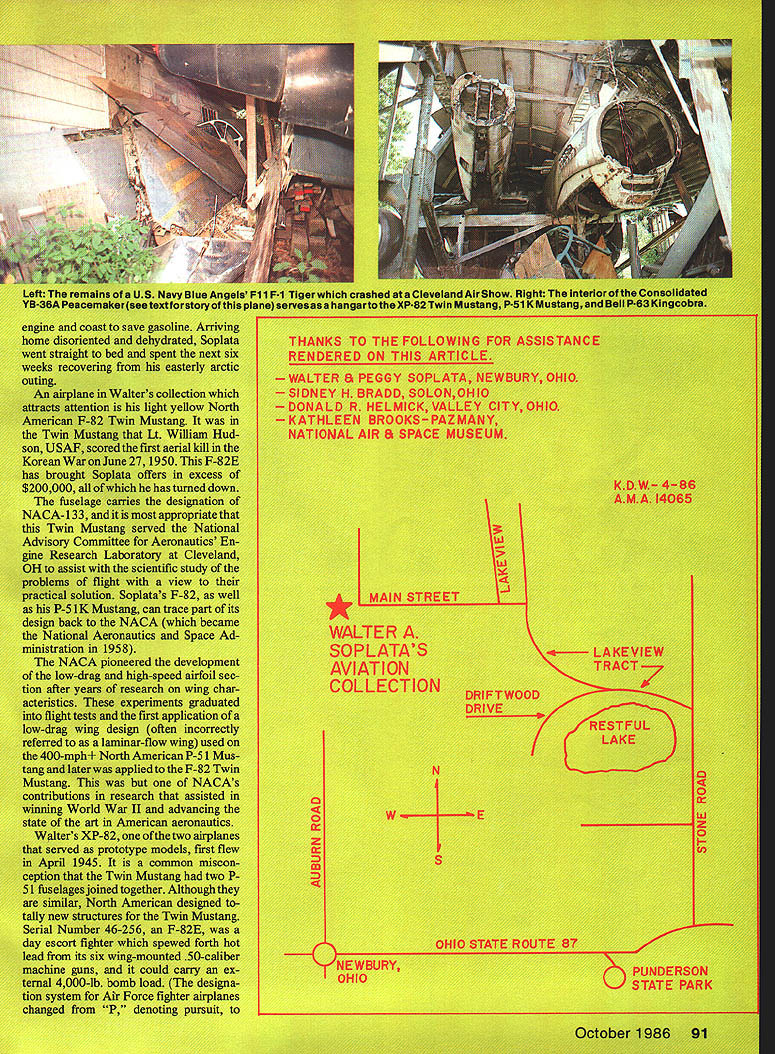
Dominating this gathering of grounded eagles is the Consolidated YB-36A Peacemaker. Many have viewed this airplane (the second Peacemaker built by Consolidated at the Fort Worth, Texas, plant) at the old U.S. Air Force Museum at Wright-Patterson AFB, Dayton, Ohio. When the Air Force Museum moved to a new location at Wright-Patterson in 1972 and placed a B-36 Peacemaker on display within the new building, the YB-36A—along with the Boeing XB-52, the first C-124 Globemaster fitted with C-74 wings, and several other large historical aircraft—was placed on sale as scrap at the museum's former site.
Originally the YB-36A was to go to another museum, but government regulations called for demilitarization first. This was accomplished by using a bulldozer to rip out the six Pratt & Whitney R-4360-25 Wasp Major engines. The YB-36A was eventually sold to Ralph Huffman and was slated for his portable smelter (as were the other surplus museum airplanes that Huffman purchased for a half-cent a pound). Soplata interceded and purchased the YB-36A remains (sans engines, propellers, and landing gear) at a price 14 times what Huffman paid.
Soplata rented a tract of farmland 18 miles out of Dayton and had the YB-36A fuselage hauled there. Walter and Peggy cut the Peacemaker into sections and lugged them home, a piece at a time, on an 8 x 14-ft. homemade wooden trailer towed by a 1966 Chevy station wagon. Walter and Peg would usually hit the interstate at 3 a.m., when the route looked the clearest. The Ohio State Police still talk about the Soplatas' trailering home the Peacemaker. On every trip the load was oversize and overweight.
In 1975, while bringing home the last of the YB-36A sections, a tire blew out on his jury-rigged trailer. A highway patrolman held the flashlight while Walter fixed the flat, but Walter managed to hide the other threadbare tire next to the flat one by keeping it obscured with his back. After two and a half years, 25 round trips, and an outlay of about $11,000, Walter had the remains of the YB-36A at his home.
One would think that after tackling such a monumental project as the YB-36 the Soplatas' thirst for mustering large airplanes would be quenched. Not so: Walter is now searching for a Boeing B-52 Stratofortress to enhance his aviation assemblage.
While some of the airplanes in the Soplata collection may be incomplete and others are disassembled, one finds many pleasant memories while roaming the weedy paths—and reflections appear of what used to be.
Transcribed from original scans by AI. Minor OCR errors may remain.

