
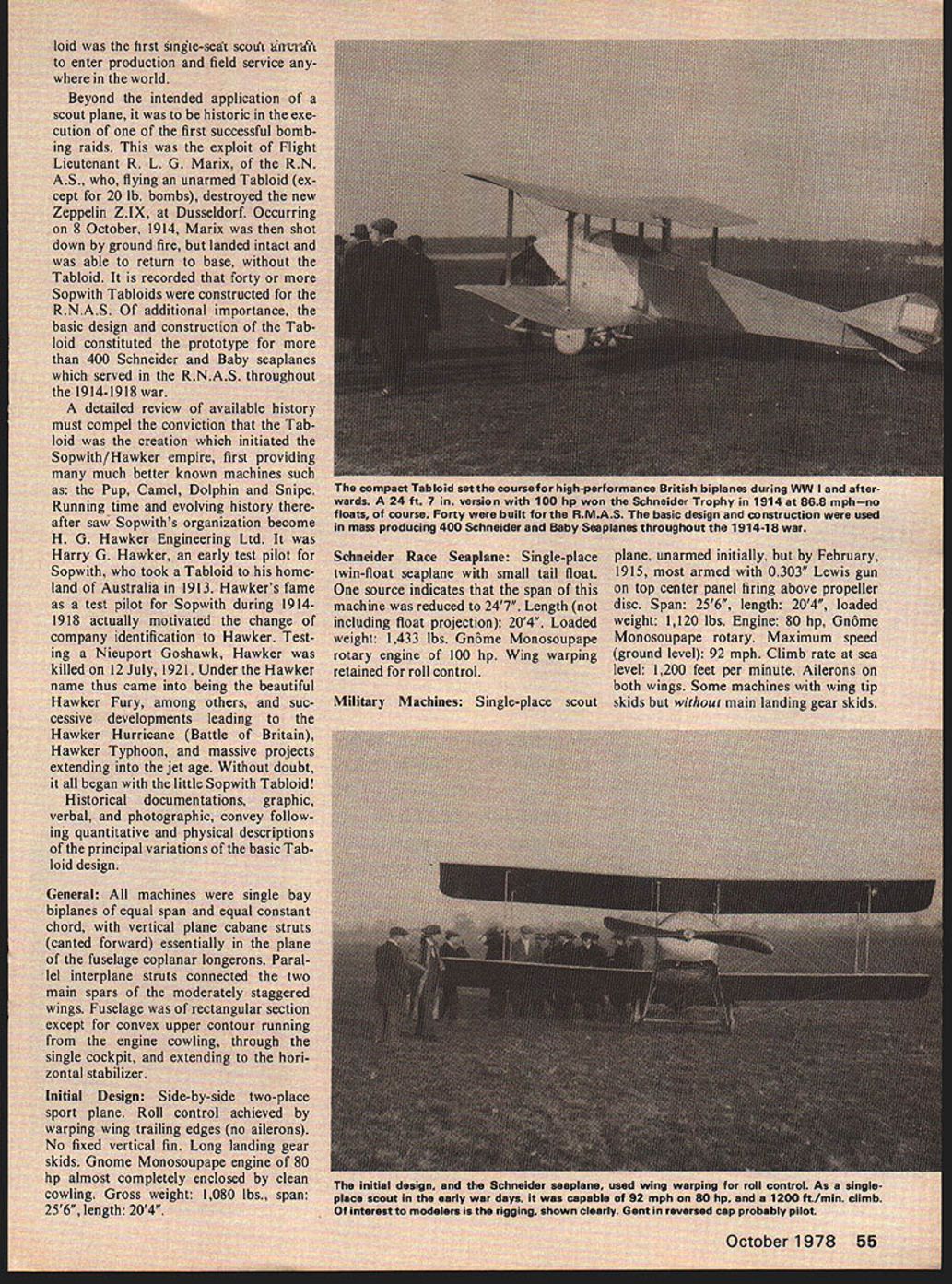
Sopwith Tabloid
Connie L. McClure
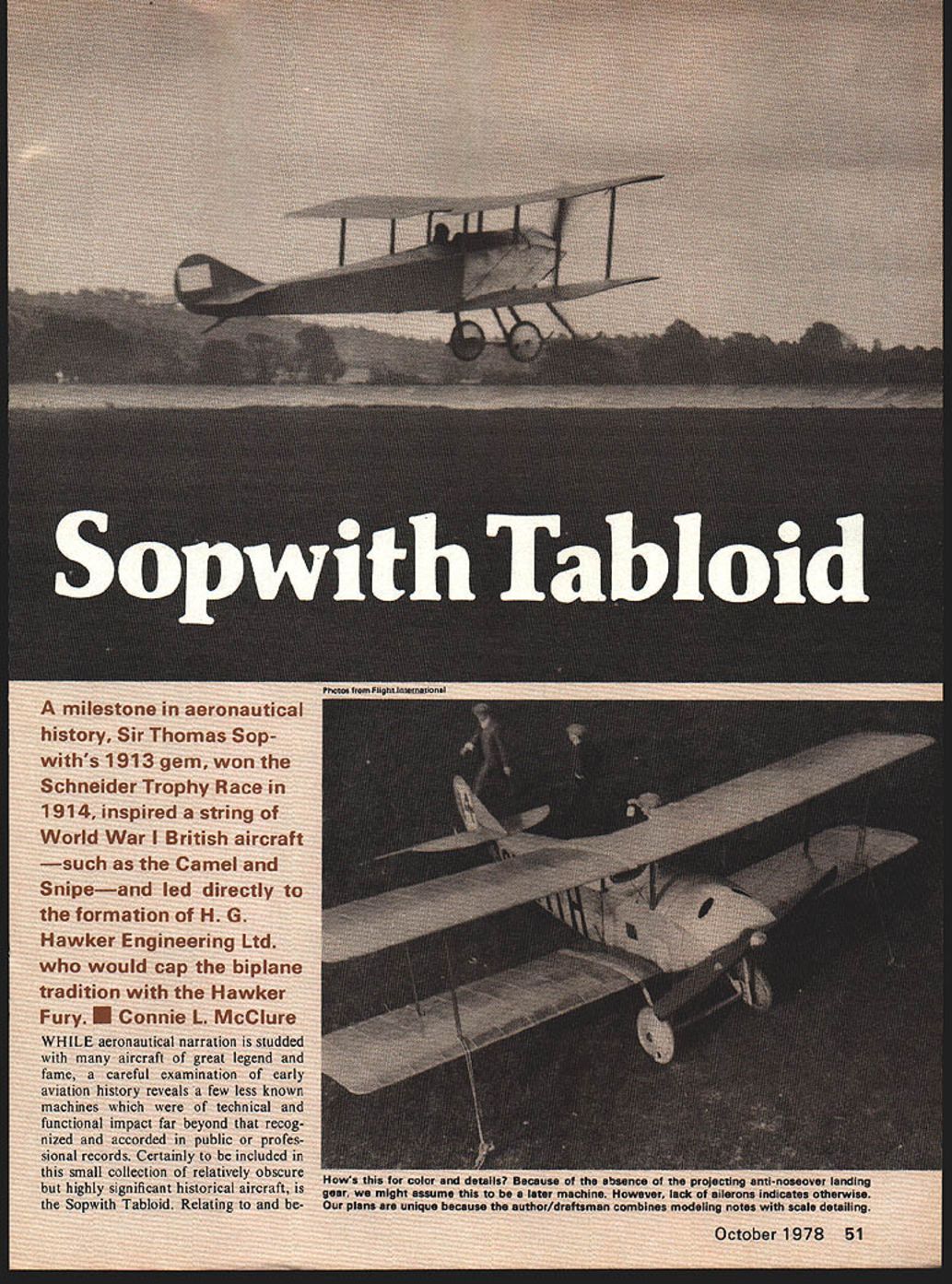
A milestone in aeronautical history, Sir Thomas Sopwith's 1913 gem won the Schneider Trophy Race in 1914, inspired a string of World War I British aircraft—such as the Camel and Snipe—and led directly to the formation of H. G. Hawker Engineering Ltd., who would cap the biplane tradition with the Hawker Fury.
While aeronautical narration is studded with many aircraft of great legend and fame, a careful examination of early aviation history reveals a few less-known machines which were of technical and functional impact far beyond that recognized in public or professional records. Certainly to be included in this small collection of relatively obscure but highly significant historical aircraft is the Sopwith Tabloid.
With the passing decades there is increasing obscurity of the even more significant creator thereof, to wit: Sir Thomas Octave Murdock Sopwith. The eventual knight, Thomas Sopwith, appeared quite early in British aviation. Apparently inadequately practiced in relation to his initial aero-endeavors, the first public attention attracted by Sopwith was an October 1910 crash at Brooklands. Undaunted, by 1911 he had learned to fly and was soon accepted as a test pilot, essentially for Martin and Handasyde, subsequently becoming known as a racing pilot.
Following this, in 1912 the progressing Thomas Sopwith established a flying school at Brooklands while increasingly entertaining an interest in aircraft design and construction. Organizing a works at Kingston, the first recorded product was the Sopwith Bat Boat, a flying-boat configuration. A three-place biplane then led, in 1913, to the little biplane which initiated the sequence of designs, productions, and events that assured Sopwith a place in history, and directly or indirectly influenced aeronautics for many years thereafter. That machine was, of course, the subject of this review—the Sopwith Tabloid.
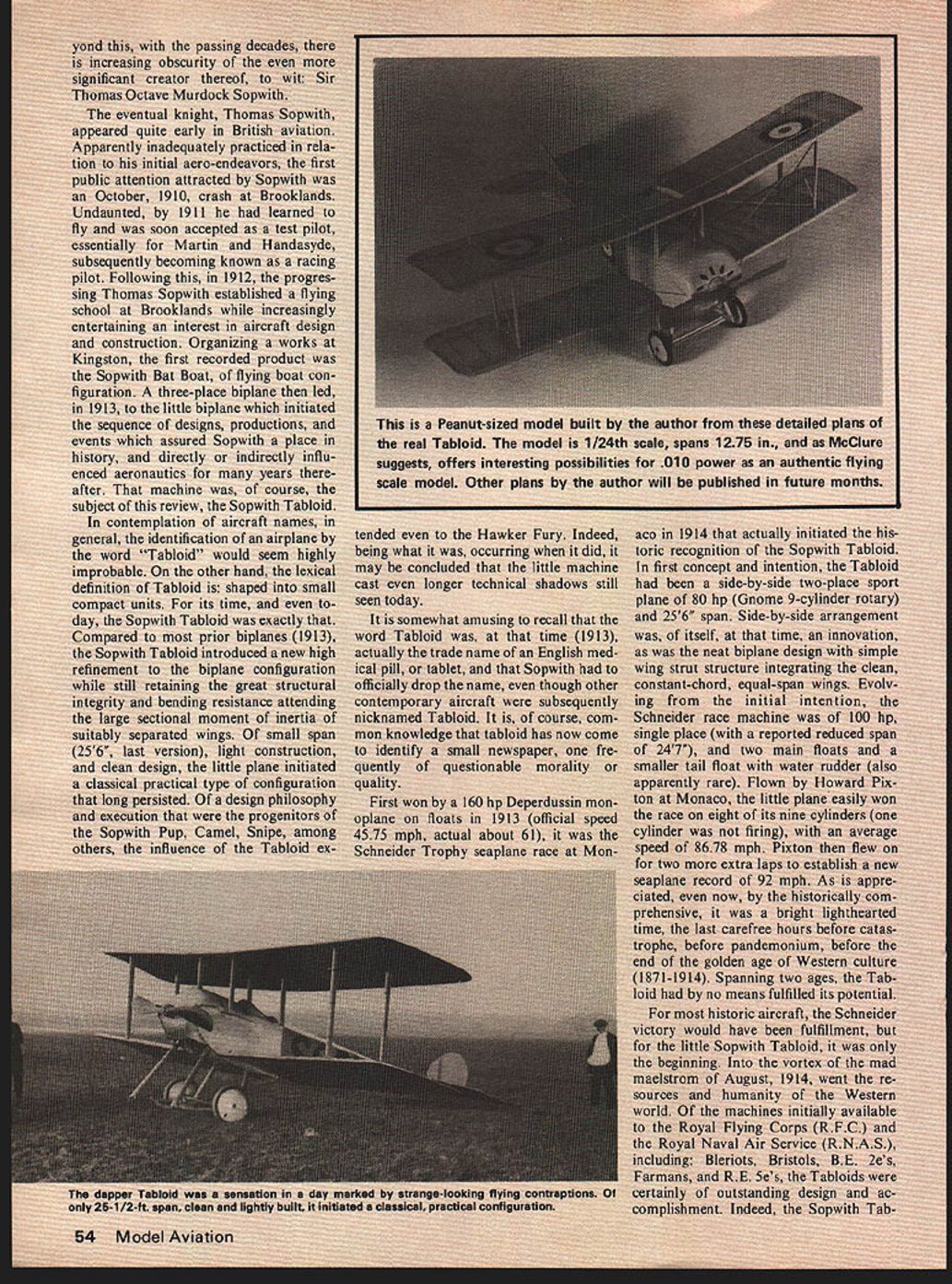
In contemplation of aircraft names, in general, the identification of an airplane by the word "Tabloid" would seem highly improbable. On the other hand, the lexical definition of tabloid is: shaped into small compact units. For its time, and even today, the Sopwith Tabloid was exactly that. Compared to most prior biplanes (1913), the Tabloid introduced a new high refinement to the biplane configuration while still retaining the great structural integrity and bending resistance attending the large sectional moment of inertia of suitably separated wings. Of small span (25' 6" in the last version), light construction, and clean design, the little plane initiated a classical practical configuration that long persisted. As a design progenitor of the Sopwith Pup, Camel, Snipe, and influencing later types including the Hawker Fury, the Tabloid cast technical shadows still seen today.
It is somewhat amusing to recall that the word Tabloid was, at that time (1913), actually the trade name of an English medical pill or tablet, and that Sopwith had to officially drop the name, even though other contemporary aircraft were subsequently nicknamed "Tabloid." It is, of course, common knowledge that tabloid has now come to identify a small newspaper, often of questionable morality or quality.
First won by a 160 hp Deperdussin monoplane on floats in 1913 (official speed 45.75 mph, actual about 61), it was the Schneider Trophy seaplane race at Monaco in 1914 that actually initiated historic recognition of the Sopwith Tabloid. In first concept and intention, the Tabloid had been a side-by-side two-place sport plane of 80 hp (Gnome 9-cylinder rotary) and 25' 6" span. Side-by-side arrangement was, of itself, at that time an innovation, as was the neat biplane design with simple wing-strut structure integrating the clean, constant-chord, equal-span wings.
Evolving from the initial intention, the Schneider race machine was a 100 hp single-place seaplane (with a reported reduced span of 24' 7"), fitted with two main floats and a smaller tail float with water rudder (apparently rare). Flown by Howard Pixton at Monaco, the little plane easily won the race on eight of its nine cylinders (one cylinder was not firing), with an average speed of 86.78 mph. Pixton then flew two more extra laps to establish a new seaplane record of 92 mph.
For most historic aircraft the Schneider victory would have been fulfillment, but for the little Sopwith Tabloid it was only the beginning. Into the vortex of August 1914 went the resources and humanity of the Western world. Of the machines initially available to the Royal Flying Corps (R.F.C.) and the Royal Naval Air Service (R.N.A.S.)—including Bleriots, Bristols, B.E.2e's, Farmans, and R.E.5e's—the Tabloids were of outstanding design and accomplishment. Indeed, the Sopwith Tabloid was the first single-seat scout aircraft to enter production and field service anywhere in the world.
Beyond the intended application of a scout plane, the Tabloid was historic for one of the first successful bombing raids. Flight Lieutenant R. L. G. Marix of the R.N.A.S., flying an unarmed Tabloid (except for 20 lb bombs), destroyed the new Zeppelin Z.IX at Düsseldorf on 8 October 1914. Marix was then shot down by ground fire but landed intact and returned to base, though without the Tabloid. It is recorded that forty or more Sopwith Tabloids were constructed for the R.N.A.S. Importantly, the basic design and construction of the Tabloid constituted the prototype for more than 400 Schneider and Baby seaplanes which served in the R.N.A.S. throughout the 1914–1918 war.
A detailed review of available history compels the conviction that the Tabloid initiated the Sopwith/Hawker empire, first providing many much better known machines such as the Pup, Camel, Dolphin, and Snipe. Running time and evolving history thereafter saw Sopwith's organization become H. G. Hawker Engineering Ltd. It was Harry G. Hawker, an early test pilot for Sopwith, who took a Tabloid to his homeland of Australia in 1913. Hawker's fame as a test pilot for Sopwith during 1914–1918 actually motivated the change of company identification to Hawker. Testing a Nieuport Goshawk, Hawker was killed on 12 July 1921. Under the Hawker name came the beautiful Hawker Fury, and successive developments leading to the Hawker Hurricane (Battle of Britain), Hawker Typhoon, and massive projects extending into the jet age. Without doubt, it all began with the little Sopwith Tabloid.
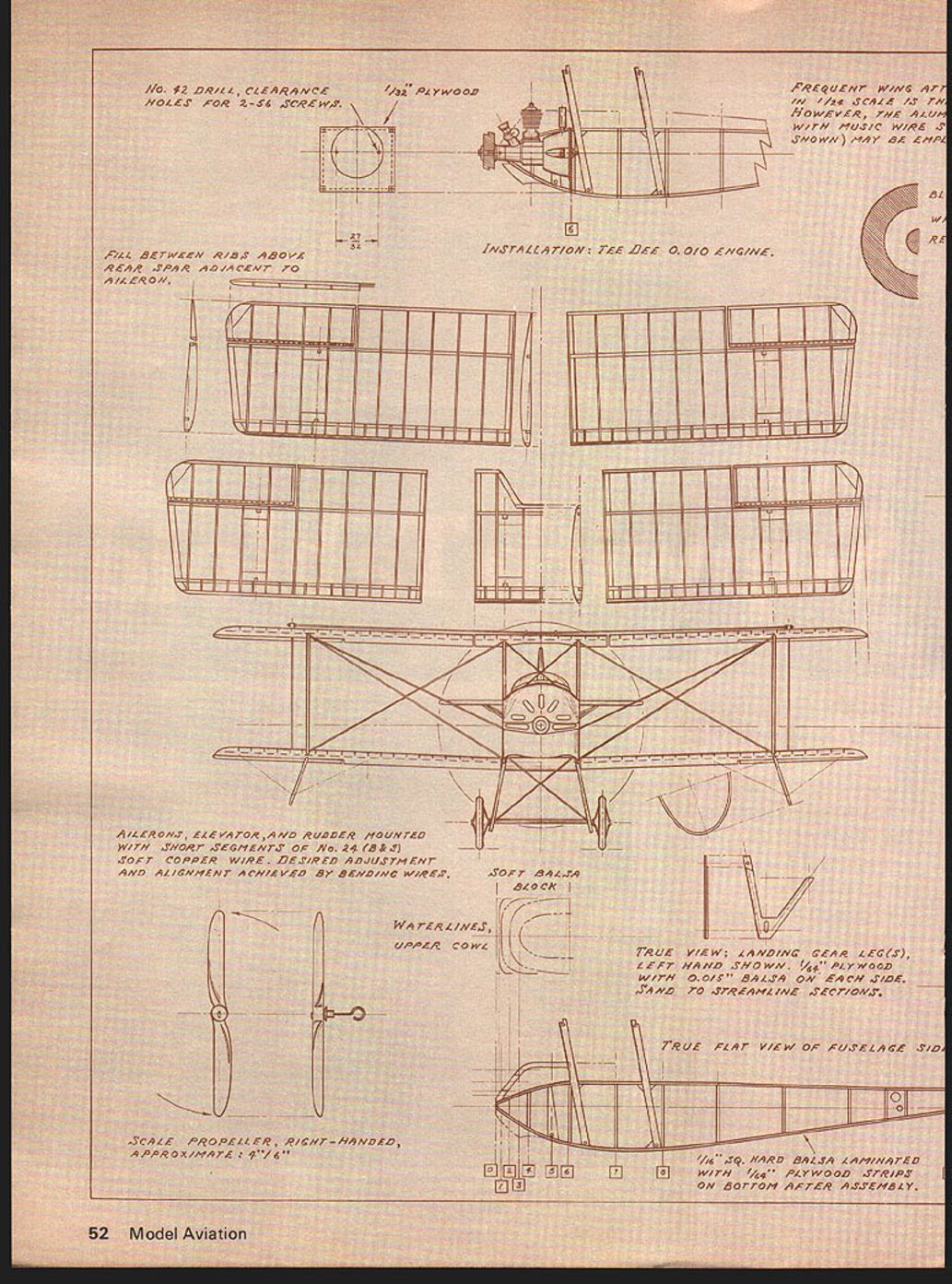
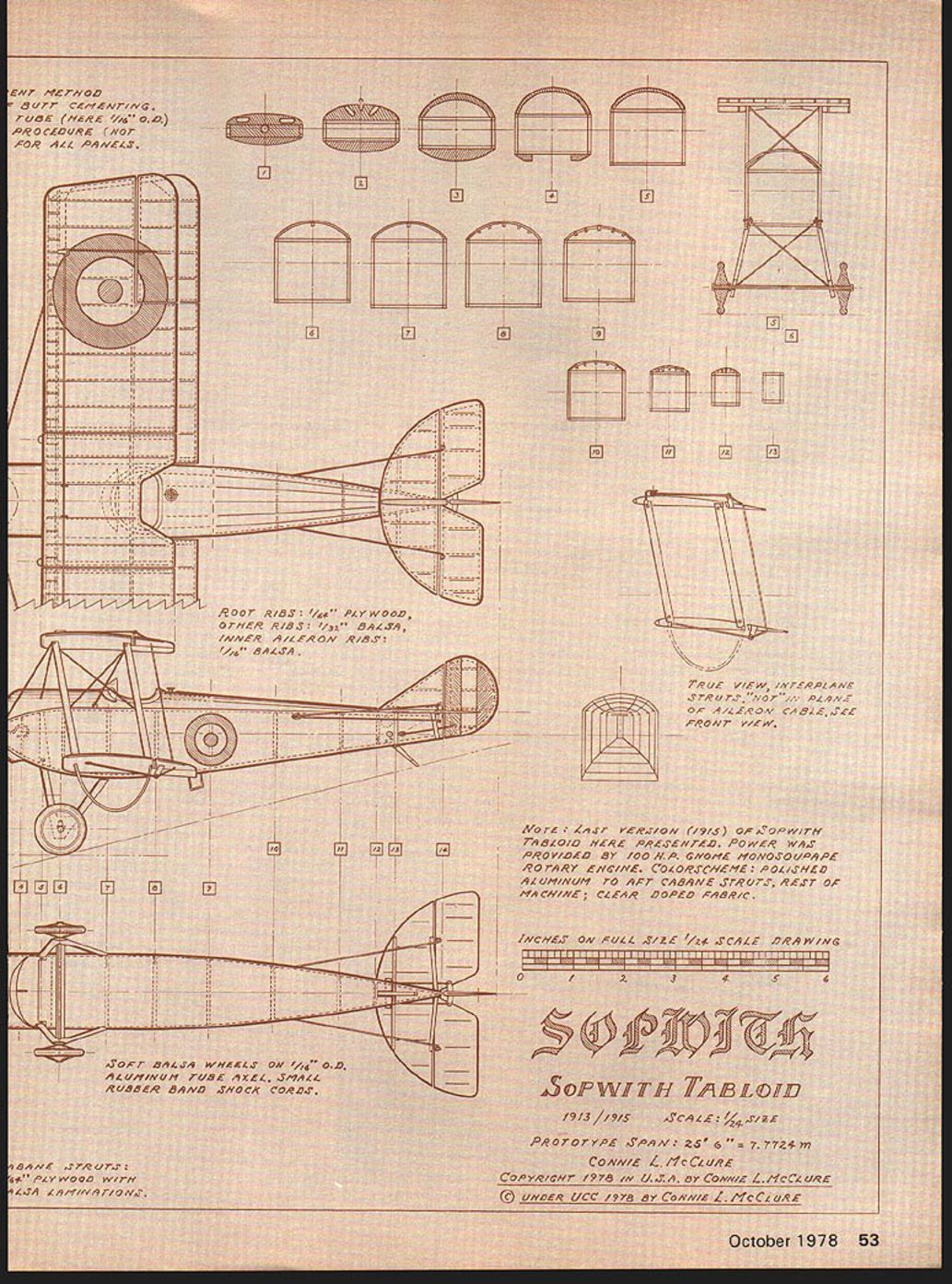
Plans and Notes
No continuous article text appears on one page of the source; that page contained only plans/diagrams and figure labels. The following are diagram and construction notes, cleaned and organized.
- Root ribs: 1/16" plywood.
- Other ribs: 1/32" balsa.
- Inner aileron ribs: 1/16" balsa.
- Soft balsa wheels on 1/16" O.D. aluminum tube axle. Small rubber-band shock cords.
- True view, interplane strut: not in plane of aileron cable (see front view).
- Note: Last version (1915) of Sopwith Tabloid here presented. Power was provided by a 100 h.p. Gnome Monosoupape rotary engine. Color scheme: polished aluminum to aft cabane struts; rest of machine: clear-doped fabric.
- Inches on full-size 1/4-scale drawing.
Sopwith Tabloid — 1913/1915 Scale: 1/4 size Prototype span: 25' 6" = 7.7724 m
Copyright 1978 in U.S.A. by Connie L. McClure (c) Under UCC 1978 by Connie L. McClure
General
All machines were single-bay biplanes of equal span and equal constant chord, with vertical-plane cabane struts (canted forward) essentially in the plane of the fuselage coplanar longerons. Parallel interplane struts connected the two main spars of the moderately staggered wings. The fuselage was of rectangular section except for a convex upper contour running from the engine cowling, through the single cockpit, and extending to the horizontal stabilizer.
Initial Design
- Side-by-side two-place sport plane.
- Roll control achieved by warping wing trailing edges (no ailerons).
- No fixed vertical fin.
- Long landing-gear skids.
- Gnome Monosoupape engine of 80 hp almost completely enclosed by a clean cowling.
- Gross weight: 1,080 lbs.
- Span: 25' 6".
- Length: 20' 4".
Schneider Race Seaplane
- Single-place plane, unarmed initially; by February 1915 most were armed with a 0.303" Lewis gun on the top center panel firing above the propeller disc.
- Span: 25' 6".
- Length: 20' 4".
- Loaded weight: 1,120 lbs.
- Engine: 80 hp Gnome Monosoupape rotary (race version reported at 100 hp in some sources).
- Maximum speed (ground level): 92 mph.
- Climb rate at sea level: 1,200 ft/min.
- Ailerons on both wings.
- Some machines had wing-tip skids but no main landing-gear skids.
Transcribed from original scans by AI. Minor OCR errors may remain.

