
SPA Contest
By Ron Van Putte
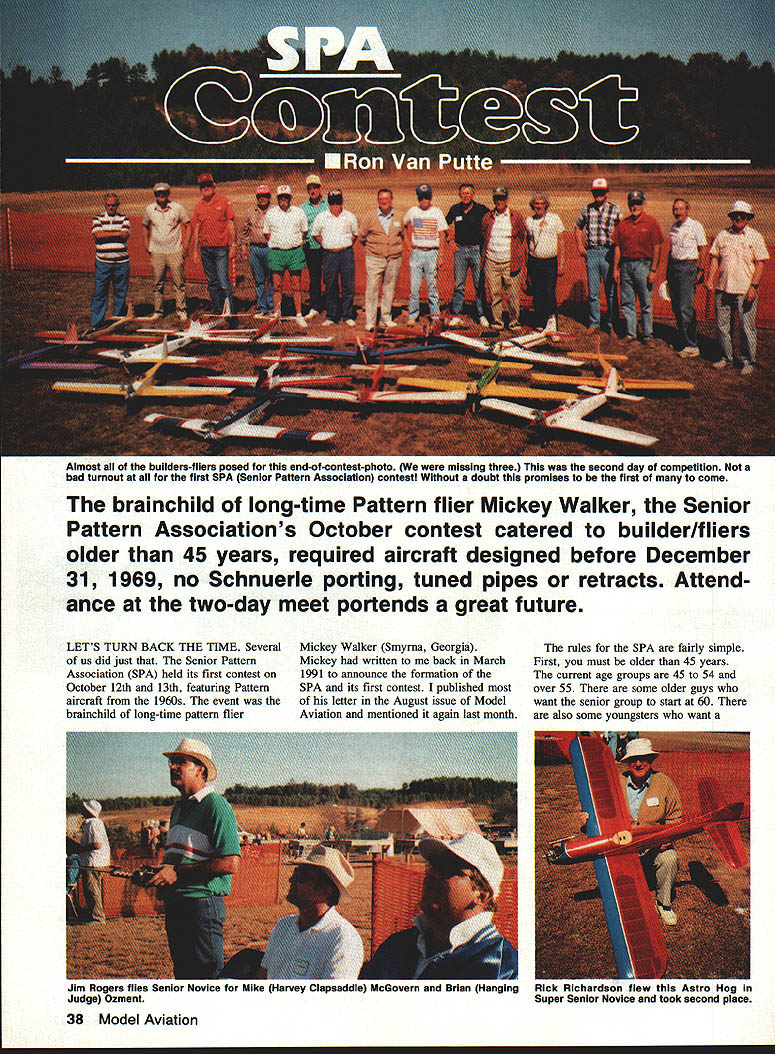
The Senior Pattern Association (SPA) was the brainchild of long-time pattern flier Mickey Walker of Smyrna, Georgia. Its first contest, held October 12–13, featured Pattern aircraft from the 1960s and catered to builder/fliers older than 45. Attendance at the two-day meet suggested a promising future for the organization.
SPA rules
- Entrant must be older than 45 years. Current age groups:
- 45–54
- 55 and over
- (Some participants suggested a senior group starting at 60 and a junior division for 35–44, but only the two groups above are used for now.)
- Aircraft must have been designed before December 31, 1969.
- No Schnuerle-ported engines.
- No tuned pipes.
- No retracts.
These rules keep the airplanes relatively simple and preserve the vintage Pattern spirit.
Representative aircraft
Some of the classic airplanes eligible and seen at the contest included:
- Kwik Fli
- Taurus
- A-6 Intruder
- Tiger Tail
- New Orleanean
- Daddy Rabbit
- Stormer / Thunderstormer
- Jester
- Triton
- Astro Hog
Building anecdote
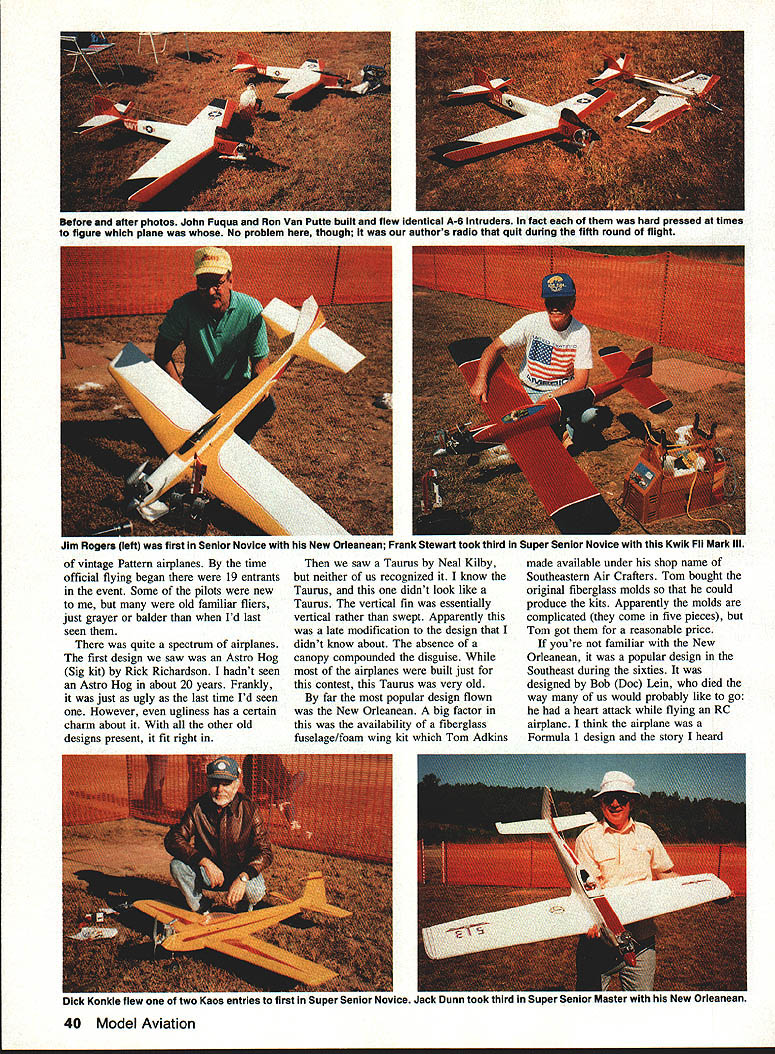
John Fuqua and I built A-6 Intruders and painted them in the same color scheme used by Jim Kirkland on his 1970 Nationals-winning airplane. They were so nearly identical that it sometimes took us a while to tell them apart — a couple of times I even started to refuel John's airplane. My radio quit during the fifth round of flights, which made identification easier after that.
The contest
We drove to Atlanta on October 11th not knowing how many people would show. Early the next morning, arriving at the flying field about 25 miles north of Atlanta, our concerns dissolved: the flight line was full of familiar faces — new ones and old ones — only grayer, balder and heavier than before. By the time official flying began there were 19 entrants.
The airplanes presented a broad spectrum of vintage designs. Examples from the day:
- Astro Hog (Sig kit) — Rick Richardson hadn't seen one in about 20 years; it's still rather ugly, but fits its era.
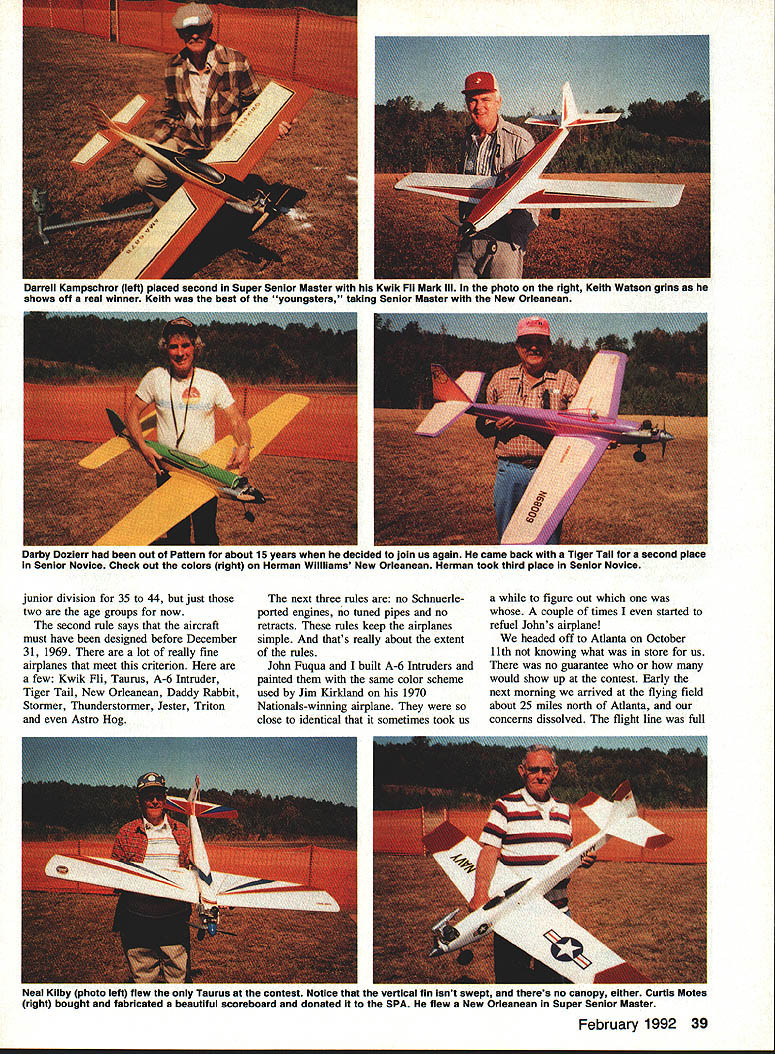
- Taurus — Neal Kilby's aircraft had a nearly vertical fin (a late modification) and lacked a canopy, making it initially unrecognizable.
- New Orleanean — by far the most popular design flown. A major factor in its availability was a fiberglass fuselage/foam wing kit produced by Tom Adkins under the shop name Southeastern Air Crafters. Tom purchased the original fiberglass molds (apparently complicated five-piece molds) and produced kits at a reasonable price.
- Jester — Len Purdy (originator of Lenair Industries) attended with a Jester. The design has been in production for more than 20 years and is a good option for those short on building time.
- There were several versions of the Kwik Fli present; memory is fuzzy on exact differences, but two or three types were seen.
We missed some hoped-for attendees: Rod Chidgey (with the original Nationals-winning Tiger Tail) and Don Lowe (with his original Phoenix III) were at the F3A World Championships in Australia and planned to participate next year. Jim (Doc) Edwards reportedly was building two airplanes (an Orion and another design) but did not attend. Jim "Daddy Rabbit" Whitley did not appear with a Daddy Rabbit this year either.
Competition and atmosphere
The most-heard comment at the event was, "This is fun!" Many of the older fliers hadn't competed in Pattern for 15–20 years but clearly hadn't lost their touch. The contest felt like Pattern used to: relatively simple aircraft, no technological edge, and a friendly social atmosphere where competition was still taken seriously. For someone who started competing in 1966, the first SPA contest was a dose of what Pattern used to be like.
Engines, props and equipment
- Engines: The overwhelming choice was the SuperTigre G.60 Bluehead. A few used Webra Blackheads and a Veco .61.
- Props: Purists used Top Flite Power Props and Rev Up Special Pro props. Some used APC props. Sound levels were high; most combinations produced ear-splitting readings. Better mufflers that don't rob power or add excessive weight are needed if these events are to be quieter and more acceptable to neighboring fields.
- Radios and controls: All radio equipment in use was modern narrow-band gear, not the 20+-year-old gear of the 1960s. Some concessions included pull-pull cable systems on rudder and single aileron servos mounted in each wing to drive ailerons directly rather than using a single servo with torque rods.
Maneuvers
John Fuqua suggested some changes in the order of maneuvers to make them flow better in an upwind–downwind sequence. One notable maneuver is the Rolling Circle. It involves a half-roll every 90° of the circle: roll from upright to near-inverted, complete 90° of the circle, half-roll back to near-upright, complete another 90° of the circle, and repeat. The third and fourth half-rolls are pretty sporty until you get used to them — I certainly wasn't used to them yet.
SPA future plans and contact
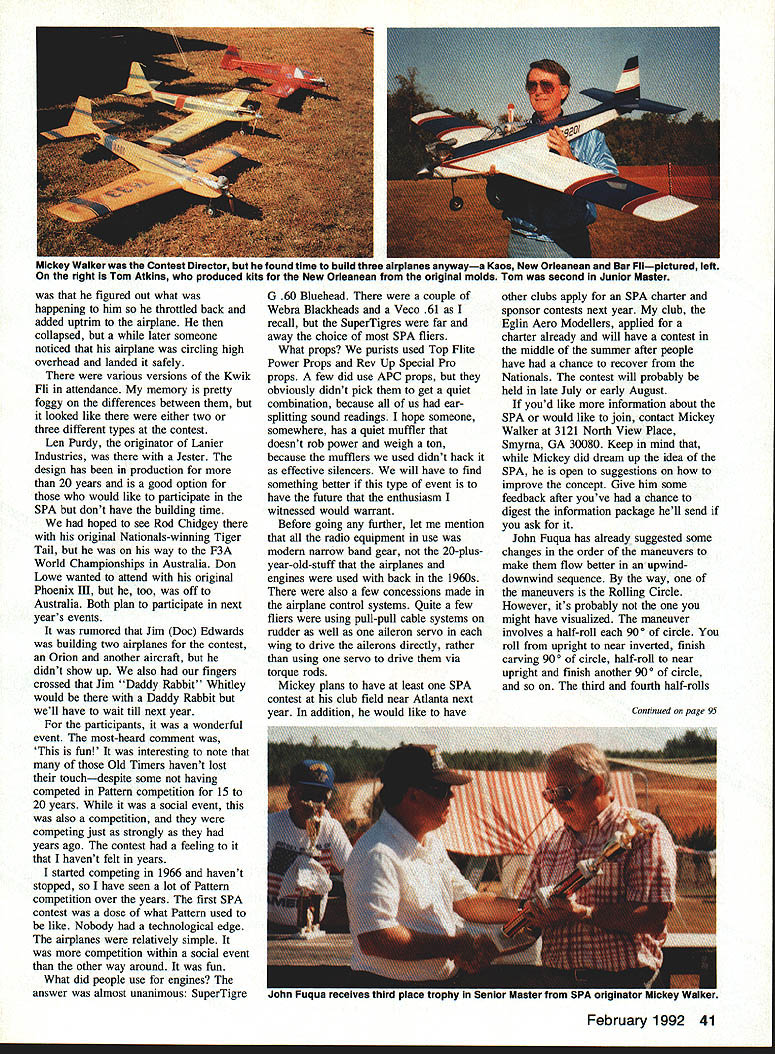
Mickey plans to hold at least one SPA contest at his club field near Atlanta next year and would like other clubs to apply for SPA charters to sponsor contests. The Eglin Aero Modelers have already applied for a charter and plan a contest in mid-summer (likely late July or early August) after people recover from the Nationals.
For more information or to join the SPA, contact: Mickey Walker 3121 Northview Place Smyrna, GA 30080
Mickey is open to suggestions on improving the concept and will send an information package on request.
Newsletter
Mickey is editor of the SPA newsletter, Mickey's S.P.A. News. He intends it to be a source of information on airplane kits and engines related to vintage Pattern airplanes and will list available kits and engines if people submit their lists. The first issue, received just before this column was finished, included:
- A report on the first contest
- The most current list of legal airplanes (as of October 1, 1991)
- Extensive input from John Fuqua describing the coincidences involved in finding and building the two A-6 Intruder kits flown at the contest
Mickey admits the newsletter's success depends on community support and input.
Closing
A few weeks before the contest, Don Lowe visited Eglin AFB while working on an RPV test program and we met a couple of times. After listening to my excitement about SPA, he finally said, "You're really excited about this, aren't you?" He was right — and the enthusiasm at the first SPA contest made it easy to be excited.
Transcribed from original scans by AI. Minor OCR errors may remain.

