
Spacemodeling World Champs
DAVID O'BRYAN
Ljubljana, Slovenia hosted the 11th World Spacemodeling Championships September 7–14, 1996 at the "Polygon," a large field outside of town nestled against the Alps along the Austrian border. More than 260 Juniors and Seniors from 23 countries competed in seven World Championship and two World Cup events.
Sunday was for practice, engine testing, certification by organizers, and opening ceremonies. The weather was beautiful; George Riebesehl had a notable 25-minute S8E (radio-controlled rocket glider) flight. Opening ceremonies were held around midday in the village near the launch site.
S8E (Radio-Controlled Glider Duration)
S8E gliders use a rocket engine limited to 40 N·s maximum (Class E). Typical characteristics:
- Wing area: 180–250 sq. in.
- Glide wing-loading: about 3.5–4.5 oz/ft² (similar to an RC hand-launch glider)
- Construction: foam-core wings with fiberglass/epoxy skins (vacuum-bagged), carbon-fiber spars; carbon-fiber fuselages; light microservos and receivers.
Performance and format:
- Models boost to about 1,000 ft in eight to nine seconds, then are piloted for duration in three rounds of increasing required durations.
- Flyoffs (up to two rounds) decide ties for first place.
- Flying is allowed anytime within a round’s open window, so timing is critical.
Notable U.S. entries included Kevin McKiou (Stingray III with Aerotech E6-PL), Herb Semmelmeyer (Badger with Aerotech E4.5-P), and George Gassaway (Stingray with Aerotech E6-PL).
Results:
- Individual: Franz Weissgerber (gold) — 16:41; Stephano Mokrin (Slovakia) — silver — 16:10; George Gassaway — bronze — 15:29.
- Other U.S.: Kevin McKiou 6th, Herb Semmelmeyer 7th.
- Team: Slovakia edged the U.S. by 12 seconds for gold; Switzerland took bronze.
S4B (Boost-Glider Duration)
Event notes:
- Gliders must have a maximum liftoff weight of 27 grams and use a maximum 5 N·s (B-class) engine for boost.
- Typical U.S. models resembled free-flight hand-launch gliders (25–40 sq. in. wing area) with an adjustable rudder for transition from a rolling boost to a thermal-seeking glide after pod ejection.
- Launches were controlled by a Range Safety Officer (RSO).
Round summaries:
- Round 1 (3-minute max): Several competitors maxed; some models thermaled away despite dethermalizers (DTs).
- Round 2 (4-minute max): Lift diminished as the sun lowered; only 10 of 54 competitors maxed. The RSO became overwhelmed by launch requests.
- Round 3 (5-minute max): Lift was failing; five competitors maxed and three advanced to the deciding flyoff.
Results:
- Individual: Vladimir Menchkov (Russia) — gold; Jan Pukl (Czech Republic) — silver; Sascha Steinbeck (Germany) — bronze.
- U.S./author: David O'Bryan placed 4th; Phil Barnes placed 26th; Ben Roberto 53rd.
- Team: Spain gold; Slovakia silver; Czech Republic bronze.
S3A (Parachute Duration)
Event rules and equipment:
- Models must carry parachute recovery devices; A-class engines (maximum ~2.5 N·s) are used.
- Minimum body diameter: 30 mm for at least 50% of the minimum 350 mm total model length.
- Many modelers avoided DTs because DTs can foul parachute deployment; without DTs it's important to fly into lift that will allow a max but not thermal away.
Round summaries:
- Round 1 (4-minute max): 37 of 65 Seniors maxed, including Phil Barnes, George Riebesehl, and the author.
- Round 2 (5-minute max): Several maxes continued.
- Round 3: More maxes; 13 competitors advanced to the unlimited-duration final flyoff.
- Final flyoff (unlimited): Conditions were ideal — light, variable winds and consistent lift. Seven competitors vied for the title; models were still aloft after 45 minutes.
Results:
- Individual: Takashi Suzuki (Japan) — gold — 1:11:10; Uwe Brewka (Germany) — silver; Igor Shmatov (Russia) — bronze.
- Team: Romania gold; Poland silver; Macedonia bronze.
S6A (Streamer Duration)
Event notes:
- Same engine class as S3A (A-class); recovery is by streamer rather than parachute.
- Extremely light models (4–5 grams) are critical; materials include vellum, Kapton, fiberglass, etc.
- Engines used were specially constructed competition A engines (e.g., A3-6, A2-5 variants).
- The event was the largest at the competition with 62 Seniors, making desired launch timing difficult.
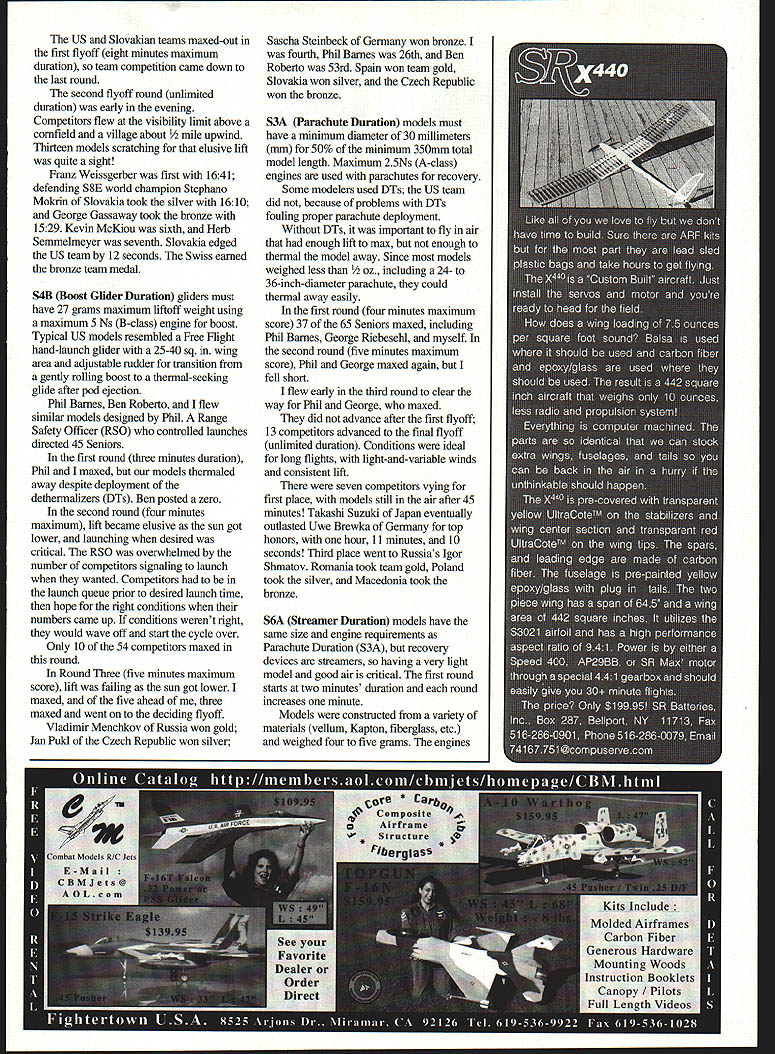
U.S. team: George Riebesehl, Jay Marsh, Nick Rivieccio; Ross Hironaka flew as defending world champion (not counting toward team standings).
Round summaries:
- Round 1 (2-minute start): George posted 1:35; Jay, Nick, and Ross maxed.
- Round 2 (3-minute max): Nick maxed with one second to spare; George posted 2:25. Ross was reportedly caught in a thermal and was tracked for an extended time (Phil Barnes timed it at 33 minutes).
- Final rounds: Lift deteriorated as the sun lowered; only one competitor maxed in the final round.
Results:
- Individual: Neus Misse (Spain) — gold; Jaromir Chalupa (Czech Republic) — silver; Oleg Voronov (Russia) — bronze.
- Team: Czech Republic gold; Russia silver; Slovakia bronze.
S1B (Altitude)
Event format and issues:
- S1B (5.0 N·s altitude) was scheduled for three 90-minute morning rounds.
- There were 55 competitors — far more than organizers had planned for — creating major tracking and timing problems. Each flight’s data recording by trackers took significant time, so rounds would have taken far longer than expected.
Model notes:
- Criteria are similar to S3A and S6A; two-stage models are most competitive.
- Expected competitive altitudes were around 1,000 meters.
Competition notes:
- Some excellent flights were recorded, but tracker/data-reduction problems limited fully tracked flights. Only 28 of 55 competitors received tracked flights.
Results:
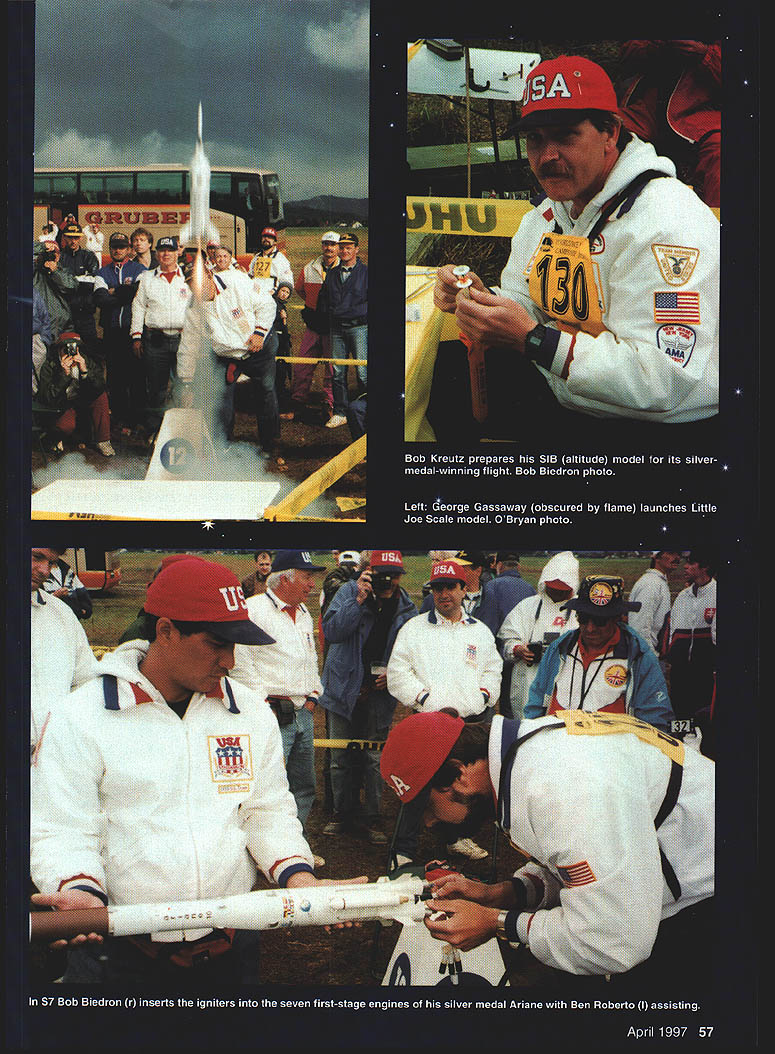
- Individual: Oleg Voronov (Russia) — gold — 1,209 m; Bob Kreutz (USA) — silver — 943 m; Alexei Koriapin (Russia) — bronze — 925 m.
- Team: Netherlands gold; Slovakia silver; Latvia bronze.
S5C (Scale Altitude)
Event notes:
- Models must be replicas of full-scale rockets; two-stage sounding-rocket types are typically most competitive.
- Engines limited to 10 N·s total impulse. Models are judged for Scale craftsmanship and altitude; total score determines placing.
- 31 entries.
Static judging after day one:
- Jan Kotuba (Slovakia) led static judging with 715 points (Bumper-WAC); Bob Kreutz (USA) 702 (Sergeant-Hydac); Bob Biedron (USA) 693 (Nike-Apache).
Flight results highlights:
- Bob Kreutz’s incredible 890 m flight vaulted him into first place with a composite score of 1,592 points.
- Some competitors suffered recovery or staging failures; Jan Kotuba had a first-stage recovery failure that led to disqualification on that flight but was allowed to fly again.
- Strong Russian flights included Vladimir Minakov (852 m) and Sergei Ilyin (788 m).
Results:
- Individual: Bob Kreutz (USA) — gold; Vladimir Minakov (Russia) — silver; Sergei Ilyin (Russia) — bronze.
- Team: Slovakia first; Russia second; USA third (two-man US S5C team).
S7 (Scale)
Event format:
- Scheduled for two four-hour rounds; 20 Seniors entered.
- Weather delays moved flights to the afternoon.
- Organizers adopted a "one qualified flight" policy: if your first flight qualified, you were not allowed a normally permitted second flight; if your first flight did not qualify, you received a second opportunity.
Notable models:
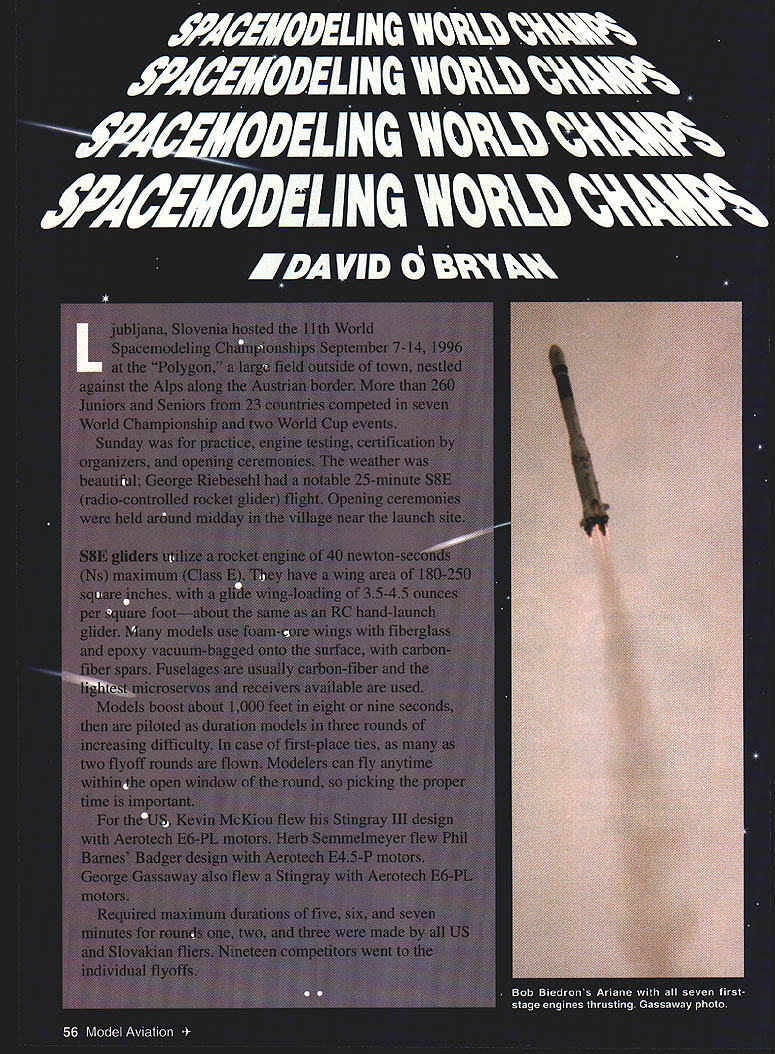
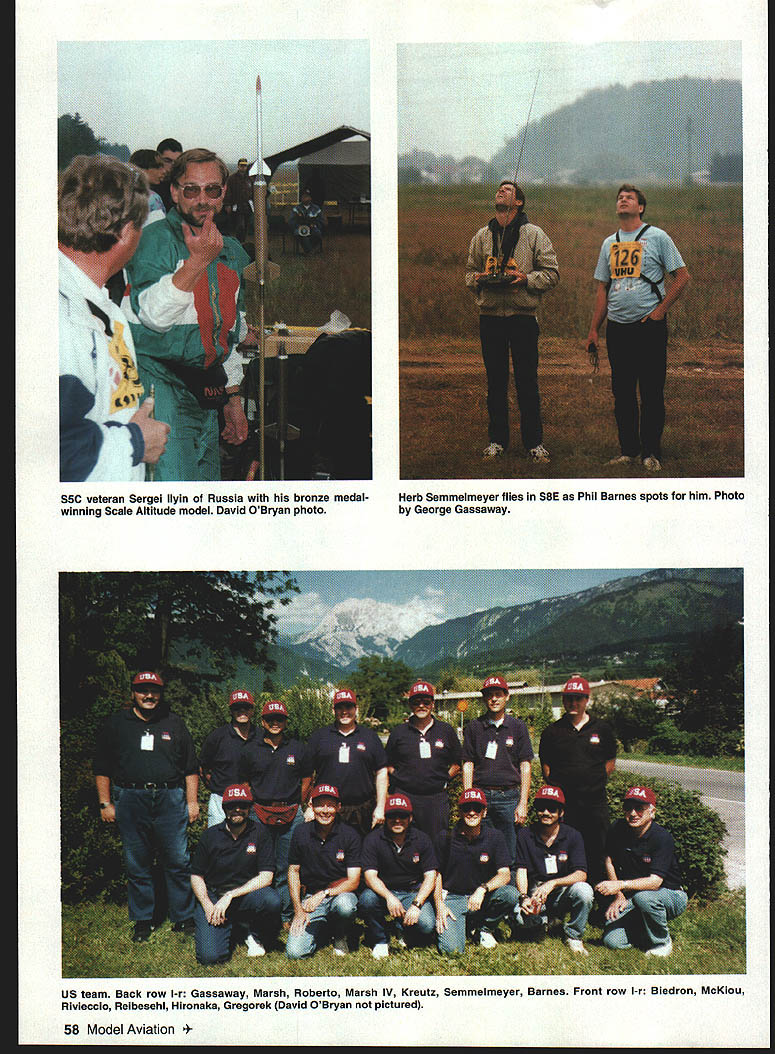
- Ariane 5s were most popular, followed by Saturn IBs and Soyuz TM replicas.
- Radio control yields extra points; Bob Biedron’s RC model earned high flight points.
Competition incidents:
- Jay Marsh suffered model damage in a fall from a wet pavement; several colleagues assisted repairs.
- Several Soyuz models experienced recovery failures on multi-part separations.
Results:
- Individual: Jan Kotuba (Slovakia) — gold — 1,026 points; Bob Biedron (USA) — silver — 1,009 points; Arnis Bacha (Latvia) — bronze — 931 points.
- Notes: George Gassaway placed 13th; Jay Marsh received no flight points.
Overall team note:
- The U.S. team was second in the individual medal count behind Russia, placing in the top five in seven of the nine events.
If you are interested in team practice (every spring in Muncie) and team selection flyoffs (late summer in Muncie), or would like more FAI Spacemodeling competition information, please write or e‑mail:
David O'Bryan 1312 Gresham Road Silver Spring, MD 20904 E-mail: david_obryan@sgi.com
Transcribed from original scans by AI. Minor OCR errors may remain.

