
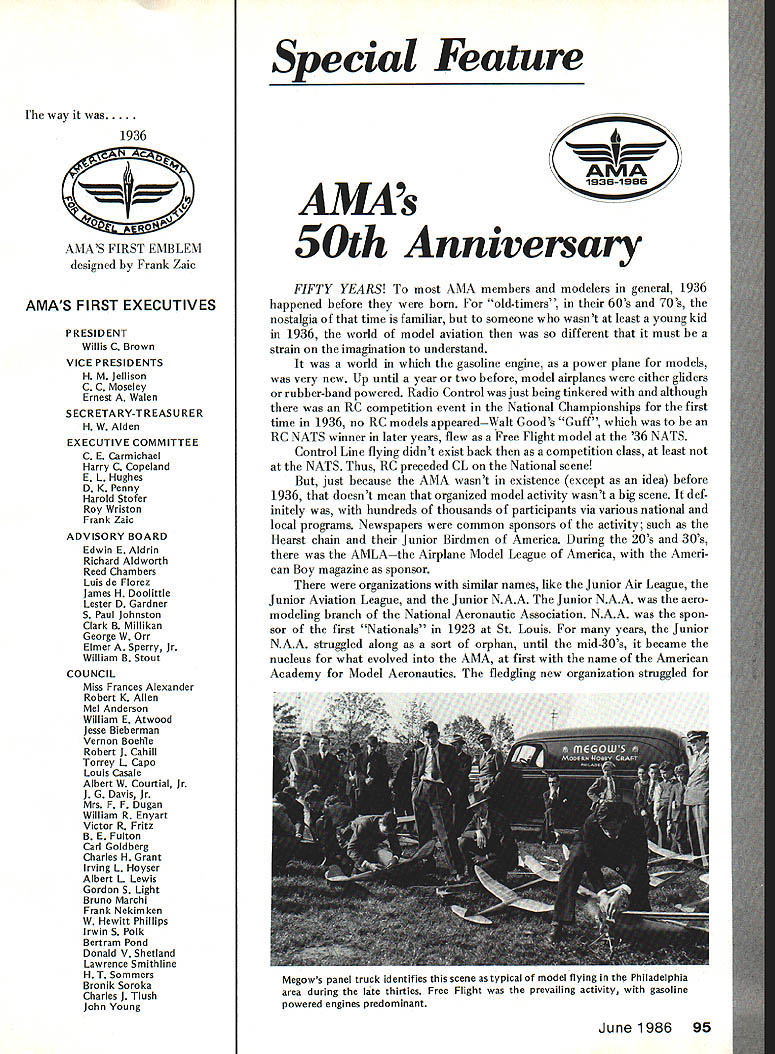
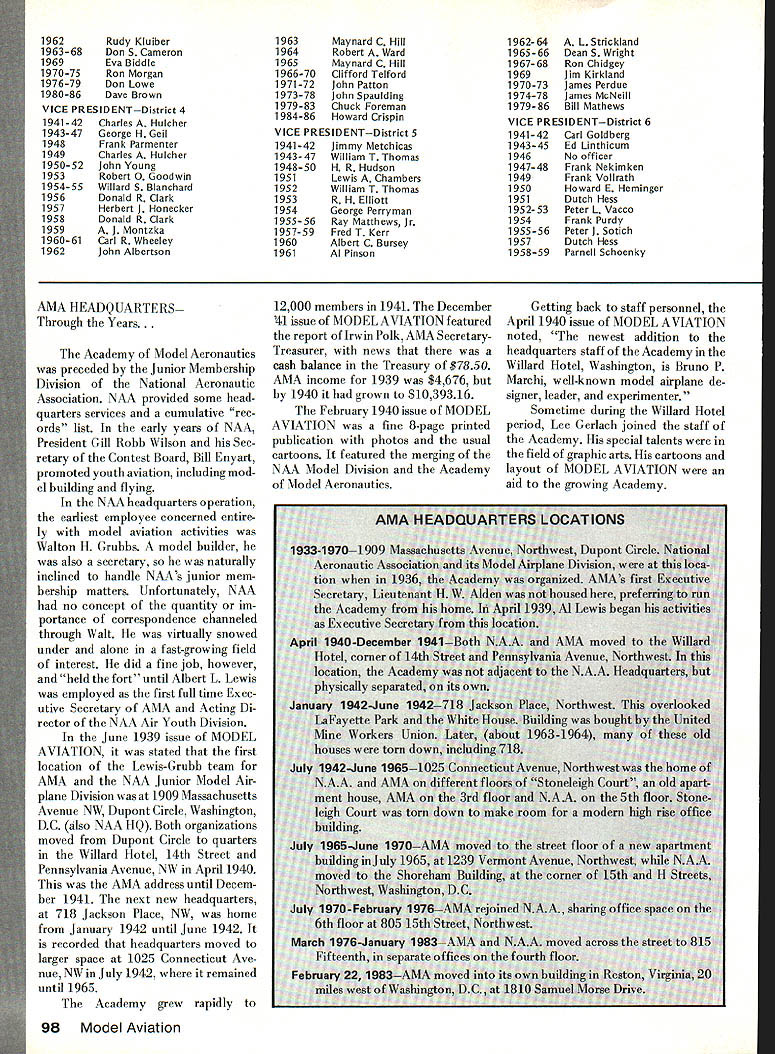
Special Feature
AMA's 50th Anniversary
FIFTY YEARS! To most AMA members and modelers in general, 1936 happened before they were born. For "old-timers" in their 60s and 70s, the nostalgia of that time is familiar, but to someone who wasn't at least a young kid in 1936, the world of model aviation then was so different that it must be a strain on the imagination to understand.
It was a world in which the gasoline engine, as a power plant for models, was very new. Up until a year or two before, model airplanes were either gliders or rubber-band powered. Radio control was just being tinkered with and although there was an RC competition event in the National Championships for the first time in 1936, no RC models appeared—Walt Good's "Guff", which was to be an RC NATS winner in later years, flew as a Free Flight model at the '36 NATS.
Control-line flying didn't exist back then as a competition class, at least not at the NATS. Thus, RC preceded CL on the national scene!
But just because the AMA wasn't in existence (except as an idea) before 1936, that doesn't mean that organized model activity wasn't a big scene. It definitely was, with hundreds to thousands of participants via various national and local programs. Newspapers were common sponsors of the activity, such as the Hearst chain and their Junior Birdmen of America. During the 1920s and 1930s there was the A.M.L.A.—the Airplane Model League of America, with American Boy magazine as sponsor.
There were organizations with similar names, like the Junior Air League, the Junior Aviation League, and the Junior N.A.A. The Junior N.A.A. was the aeromodeling branch of the National Aeronautic Association. N.A.A. was the sponsor of the first "Nationals" in 1923 at St. Louis. For many years, the Junior N.A.A. struggled along as a sort of orphan until the mid-1930s, when it became the nucleus for what evolved into the AMA, at first with the name of the American Academy for Model Aeronautics. The fledgling new organization struggled for about a year, but by 1938 was growing rapidly and developing on its own.
After World War II, AMA became, in the late 1940s and early 1950s, an almost independent division of the N.A.A. Finally, in 1966, AMA became incorporated on its own and ever since has been a franchised division of the N.A.A., operating under a contractual agreement with N.A.A. to be the U.S.A.'s aeromodeling representative to the Federation Aeronautique Internationale (F.A.I.).
But well before 1966, AMA had functioned on its own, with its own budget, officers, and headquarters operation. The N.A.A., however, has always been regarded as the parent organization which spawned AMA, largely under the leadership of N.A.A.'s Secretary during the 1930s, Bill Enyart.
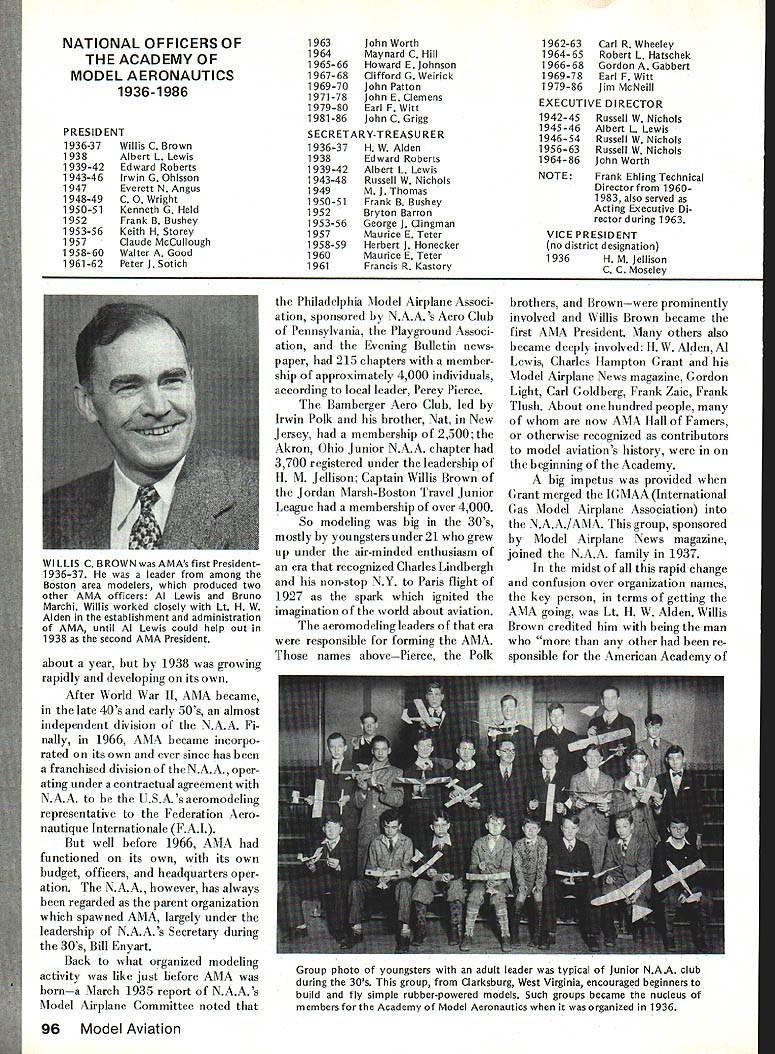
Back to what organized modeling activity was like just before AMA was born — a March 1935 report of N.A.A.'s Model Airplane Committee noted that the Philadelphia Model Airplane Association, sponsored by N.A.A.'s Aero Club of Pennsylvania, the Playground Association, and the Evening Bulletin newspaper, had 215 chapters with a membership of approximately 4,000 individuals, according to local leader Percy Pierce.
The Bamberger Aero Club, led by Irwin Polk and his brother Nat in New Jersey, had a membership of 2,500; the Akron, Ohio Junior N.A.A. chapter had 3,700 registered under the leadership of H. M. Jellison; Captain Willis Brown of the Jordan Marsh–Boston Travel Junior League had a membership of over 4,000.
So modeling was big in the 1930s, mostly by youngsters under 21 who grew up under the air-minded enthusiasm of an era that recognized Charles Lindbergh and his nonstop N.Y. to Paris flight of 1927 as the spark that ignited the imagination of the world about aviation.
The aeromodeling leaders of that era were responsible for forming the AMA. Those names above—Pierce, the Polk brothers, and Brown—were prominently involved, and Willis Brown became the first AMA President. Many others also became deeply involved: H. W. Alden, Al Lewis, Charles Hampton Grant and his Model Airplane News magazine, Gordon Light, Carl Goldberg, Frank Zaic, Frank Tlush. About one hundred people, many of whom are now AMA Hall of Famers or otherwise recognized as contributors to model aviation's history, were on the beginning of the Academy.
A big impetus was provided when Grant merged the IGMA (International Gas Model Airplane Association) into the N.A.A./AMA. This group, sponsored by Model Airplane News magazine, joined the N.A.A. family in 1937.
In the midst of all this rapid change and confusion over organization names, the key person in terms of getting the AMA going was Lt. H. W. Alden. Willis Brown credited him with being the man who "more than any other had been responsible for the American Academy of Model Aeronautics." Alden worked for years with the Junior N.A.A., then helped develop the organization which became the A.A.M.A., then the AMA, as part of the N.A.A. Alden left the scene in mid-1937 when he became very ill. It was left to Brown, Al Lewis, and Frank Zaic then to carry on, with N.A.A.'s help, until others could pick it up. N.A.A.'s big contribution (in addition to its support for model aviation in general during the earlier years) was to provide the basis for a headquarters operation which could handle paperwork for membership processing, competition rules development, and programs to promote model aviation.
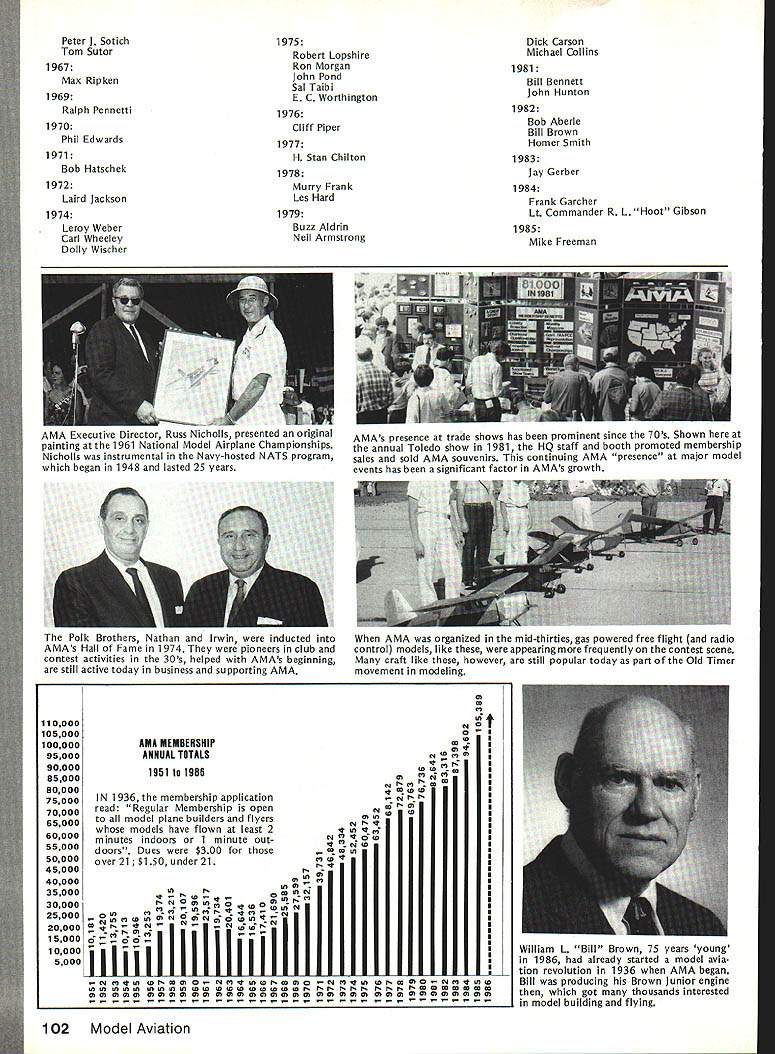
Over the next few years until World War II, AMA membership grew as the competitive aspects of model flying got organized on a national basis. The War effectively froze model activity until it revived again in 1946. It then grew quickly through the 1950s and 1960s to about the 20,000-member level. A decline to about 17,000 in the mid-1960s was reversed and there began a strong and steady climb that has continued until today.
Control-line activity came along strongly after World War II to help boost growth, but the big and continuing surge since the mid-1960s has been almost entirely from Radio Control activity.
AMA now has over 100,000 members and over 1,800 chartered clubs. It is the largest, by far, of the many N.A.A. sport aviation divisions. Besides its own building in Reston, Va., near Washington with a full-time staff of 45 people, AMA has over 200 volunteer officers on committees and contest boards.
In these anniversary pages of MODEL AVIATION are lists of the many people who have served the AMA and model aviation in general. Many of the names are now legends in the 50-year history and many continue to serve. AMA's good fortune, these many years, has been due to such people who have given of themselves on behalf of others. The dedication has been and continues to be awesome. It's no wonder, with such a past, that the future looks so bright.
Having reached a membership of over 100,000 in fifty years, the goal for the next fifty is one million. That could be a conservative outlook—there is a feeling that we are only scratching the surface of the potential. We have doubled the membership in the past eleven years. If we keep going at that rate, we would be at one quarter of a million members by the year 2000, a half million by 2010, and well over two million in the year 2036.
It's all possible, looking at a total U.S. population of over 200 million and a growing trend toward increased leisure time activities. Whatever the future holds, it's reassuring to know that AMA is in a good position to get ready for the 21st century.
AMA HEADQUARTERS — Through the Years
The Academy of Model Aeronautics was preceded by the Junior Membership Division of the National Aeronautic Association. N.A.A. provided some headquarters services and a cumulative records list. In the early years of N.A.A., President Gil Robb Wilson and his Secretary of the Contest Board, Bill Enyart, promoted youth aviation, including model building and flying.
In the N.A.A. headquarters operation, the earliest employee concerned entirely with model aviation activities was Walton H. Grubbs. A model builder, he was also a secretary, so he was naturally inclined to handle N.A.A.'s junior membership matters. Unfortunately, N.A.A. had no concept of the quantity or importance of correspondence channeled through Walt. He was virtually snowed under and alone in a fast-growing field of interest. He did a fine job, however, and "held the fort" until Albert L. Lewis was employed as the first full-time Executive Secretary of AMA and Acting Director of the N.A.A. Air Youth Division.
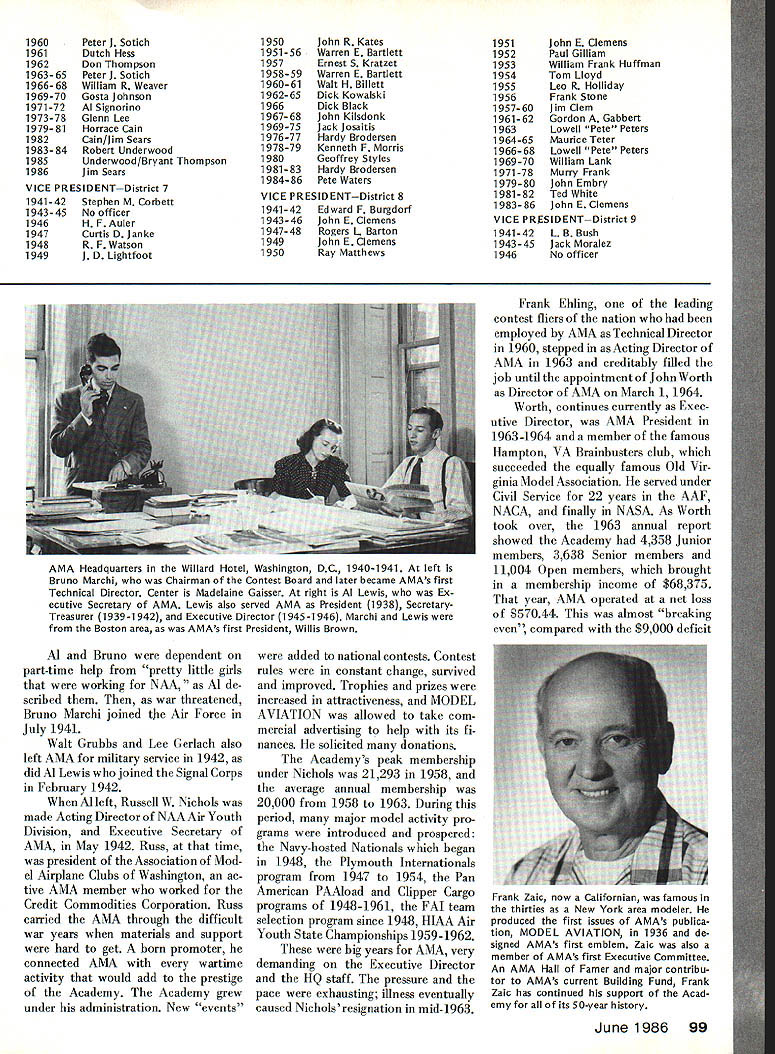
In the June 1939 issue of MODEL AVIATION, it was stated that the first location of the Lewis–Grubbs team for AMA and the N.A.A. Junior Model Airplane Division was at 1909 Massachusetts Avenue NW, Dupont Circle, Washington, D.C. (also N.A.A. HQ). Both organizations moved from Dupont Circle to quarters in the Willard Hotel, 14th Street and Pennsylvania Avenue NW in April 1940. This was the AMA address until December 1941. The next new headquarters, at 718 Jackson Place NW, was home from January 1942 until June 1942. It is recorded that headquarters moved to larger space at 1025 Connecticut Avenue NW in July 1942, where it remained until 1965.
The Academy grew rapidly to 12,000 members in 1941. The December 1941 issue of MODEL AVIATION featured the report of Irwin Polk, AMA Secretary-Treasurer, with news that there was a cash balance in the Treasury of $78.50. AMA income for 1939 was $4,676, but by 1940 it had grown to $10,393.16.
The February 1940 issue of MODEL AVIATION was a fine 8-page printed publication with photos and the usual cartoons. It featured the merging of the N.A.A. Model Division and the Academy of Model Aeronautics.
Getting back to staff personnel, the April 1940 issue of MODEL AVIATION noted, "The newest addition to the headquarters staff of the Academy in the Willard Hotel, Washington, is Bruno P. Marchi, well-known model airplane designer, leader, and experimenter."
Sometime during the Willard Hotel period, Lee Gerlach joined the staff of the Academy. His special talents were in the field of graphics. His cartoons and layout of MODEL AVIATION were an aid to the growing Academy.
AMA HEADQUARTERS LOCATIONS
- 1933–1939 — 1909 Massachusetts Avenue NW, Dupont Circle, Washington, D.C. National Aeronautic Association and its Model Airplane Division were at this location when in 1936 the Academy was organized. AMA's first Executive Secretary, Lieutenant H. W. Alden, was not housed here, preferring to run the Academy from his home. In April 1939, Al Lewis began his activities as Executive Secretary from this location.
- April 1940–December 1941 — The Willard Hotel, corner of 14th Street and Pennsylvania Avenue NW. In this location, the Academy was not adjacent to N.A.A. Headquarters but physically separated, on its own.
- January 1942–June 1942 — 718 Jackson Place NW. This overlooked Lafayette Park and the White House. The building was later bought by the United Mine Workers Union.
- July 1942–June 1965 — 1025 Connecticut Avenue NW ("Stoneleigh Court"), home of N.A.A. and AMA on different floors—AMA on the 3rd floor and N.A.A. on the 5th floor. "Stoneleigh Court" was torn down to make room for a modern high-rise office building.
- July 1965–June 1970 — AMA moved to the street floor of a new apartment building at 1239 Vermont Avenue NW, while N.A.A. moved to the Shoreham Building at the corner of 15th and H Streets NW, Washington, D.C.
- July 1970–February 1976 — AMA rejoined N.A.A., sharing office space on the 6th floor at 805 15th Street NW.
- March 1976–January 1983 — AMA and N.A.A. moved across the street to 815 Fifteenth Street, in separate offices on the fourth floor.
- February 22, 1983 — AMA moved into its own building in Reston, Virginia, at 1810 Samuel Morse Drive.
Al and Bruno were dependent on part-time help from "pretty little girls that were working for N.A.A.," as Al described them. Then, as war threatened, Bruno Marchi joined the Air Force in July 1941.
Walt Grubbs and Lee Gerlach also left AMA for military service in 1942, as did Al Lewis who joined the Signal Corps in February 1942.
When Al left, Russell W. Nichols was made Acting Director of N.A.A. Air Youth Division and Executive Secretary of AMA in May 1942. Russ, at that time, was president of the Association of Model Airplane Clubs of Washington, an active AMA member who worked for the Credit Commodities Corporation. Russ carried the AMA through the difficult war years when materials and support were hard to get. A born promoter, he connected AMA with every wartime activity that would add to the prestige and strength of the Academy. The Academy grew under his administration. New events were added to national contests. Contest rules were in constant change, survived and improved. Trophies and prizes were increased in attractiveness, and MODEL AVIATION was allowed to take commercial advertising to help with its finances. He solicited many donations.
The Academy's peak membership under Nichols was 21,293 in 1958, and the average annual membership was 20,000 from 1958 to 1963. During this period, many major model activity programs were introduced and prospered: the Navy-hosted Nationals which began in 1948, the Plymouth Internationals program from 1947 to 1954, the Pan American R/C and Outdoor Clipper Cargo programs of 1948–1961, the FAI team selection program since 1948, and the N.A.A. Air Youth State Championships 1959–1962.
These were big years for AMA, very demanding on the Executive Director and the HQ staff. The pressure and the pace were exhausting; illness eventually caused Nichols' resignation in mid-1963.
Frank Ehling, one of the leading contest fliers of the nation who had been employed by AMA as Technical Director in 1960, stepped in as Acting Director of AMA in 1963 and creditably filled the job until the appointment of John Worth as Director of AMA on March 1, 1964.
Worth, who continues as Executive Director, was AMA President in 1963–1964 and a member of the famous Hampton, VA Brainbusters club, which succeeded the equally famous Old Virginia Model Association. He served under Civil Service for 22 years in the AAF, NACA, and finally in NASA. As Worth took over, the 1963 annual report showed the Academy had 4,358 Junior members, 3,638 Senior members, and 11,004 Open members, which brought in membership income of $68,375. That year, AMA operated at a net loss of $570.44. This was almost "breaking even" compared with the $9,000 deficit incurred in 1962 and the deficits of 1960 and 1961. Worth's first year in office brought management controls and needed changes that resulted in a net gain for the year 1964 of $2,406.50, according to the annual balance sheet.
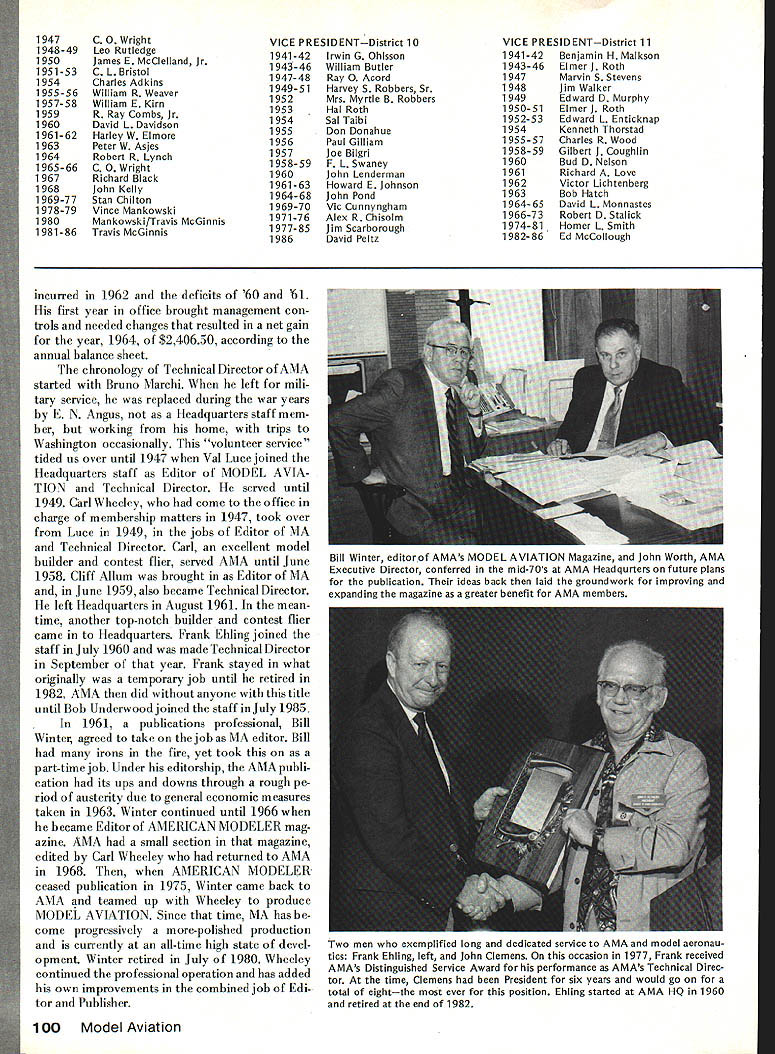
The chronology of Technical Director of AMA started with Bruno Marchi. When he left for military service, he was replaced during the war years by E. N. Angus, not as a Headquarters staff member, but working from his home with trips to Washington occasionally. This volunteer service tided AMA over until 1947 when Val Luce joined the Headquarters staff as Editor of MODEL AVIATION and Technical Director. He served until 1949. Carl Wheeler, who had come to the office in charge of membership matters in 1947, took over from Luce in 1949 in the jobs of Editor of MODEL AVIATION and Technical Director. Carl, an excellent model builder and contest flier, served AMA until June 1958. Cliff Almun was brought in as Editor of MODEL AVIATION and, in June 1959, also became Technical Director. He left Headquarters in August 1961. In the meantime, another top-notch builder and contest flier came into Headquarters. Frank Ehling joined the staff in July 1960 and was made Technical Director in September of that year. Frank stayed in what originally was a temporary job until he retired in 1982. AMA then did without anyone with this title until Bob Underwood joined the staff in July 1985.
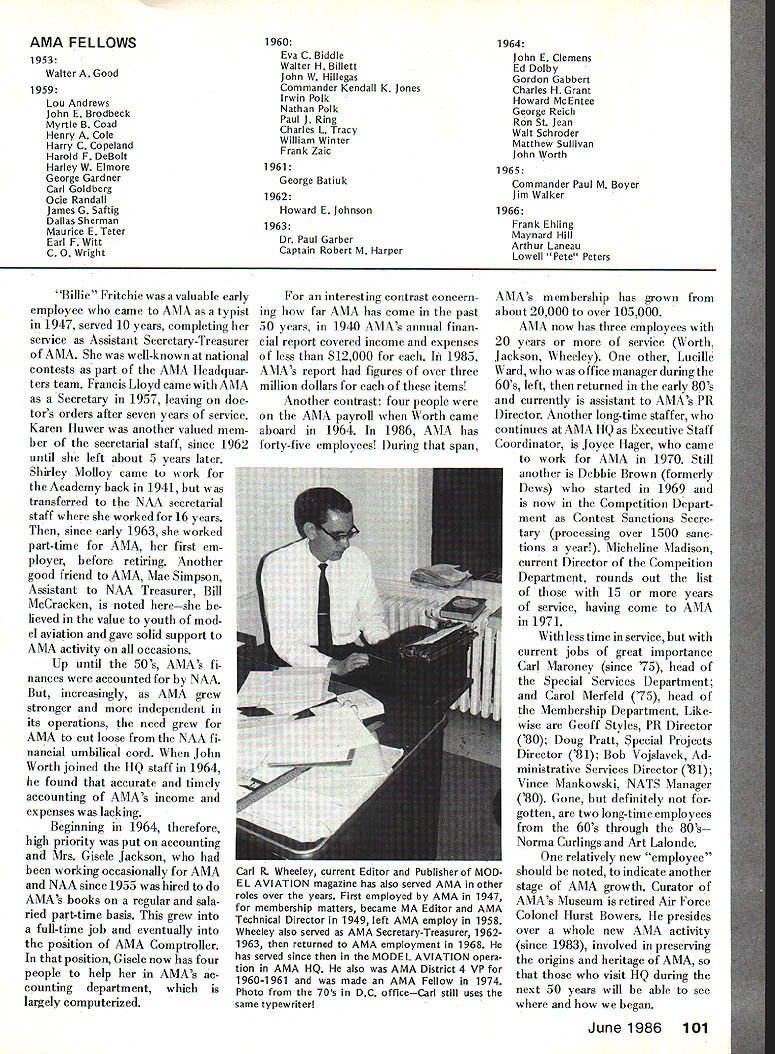
In 1961, a publications professional, Bill Winter, agreed to take on the job as MODEL AVIATION editor. Bill had many irons in the fire, yet took this on as a part-time job. Under his editorship, the AMA publication had its ups and downs through a rough period of austerity due to general economic measures taken in 1963. Winter continued until 1966 when he became Editor of AMERICAN MODELER magazine. AMA had a small section in that magazine, edited by Carl Wheeler who had returned to AMA in 1968. Then, when AMERICAN MODELER ceased publication in 1975, Winter came back to AMA and teamed up with Wheeler to produce MODEL AVIATION. Since that time, MODEL AVIATION has become progressively more polished and is currently at an all-time high state of development. Winter retired in July 1980. Wheeler continued the professional operation and has added his own improvements in the combined job of Editor and Publisher.
"Billie" Fritchie was a valuable early employee who came to AMA as a typist in 1947, served 10 years, completing her service as Assistant Secretary-Treasurer of AMA. She was well-known at national contests as part of the AMA Headquarters team. Francis Lloyd came with AMA as a Secretary in 1957, leaving on doctor's orders after seven years of service. Karen Huxer was another valued member of the secretarial staff from 1962 until she left about five years later. Shirley Molloy came to work for the Academy back in 1941, but was transferred to the N.A.A. secretarial staff where she worked for 16 years. Then, since early 1963, she worked part-time for AMA, her first employer, before retiring. Another friend to AMA, Mae Simpson, Assistant to N.A.A. Treasurer Bill McCracken, is noted here—she believed in the value to youth of model aviation and gave solid support to AMA activity on all occasions.
Up until the 1950s, AMA's finances were accounted for by N.A.A. But, increasingly, as AMA grew stronger and more independent in its operations, the need grew for AMA to cut loose from the N.A.A. financial umbilical cord. When John Worth joined the HQ staff in 1964, he found that accurate and timely accounting of AMA's income and expenses was lacking.
Beginning in 1964, therefore, high priority was put on accounting and Mrs. Gisele Jackson, who had been working occasionally for AMA and N.A.A. since 1953, was hired to do AMA's books on a regular and salaried part-time basis. This grew into a full-time job and eventually into the position of AMA Comptroller. In that position, Gisele now has four people to help her in AMA's accounting department, which is largely computerized.
For an interesting contrast concerning how far AMA has come in the past 50 years, in 1940 AMA's annual financial report covered income and expenses of less than $12,000 each. In 1985, AMA's report had figures of over three million dollars for each of these items.
Another contrast: four people were on the AMA payroll when Worth came aboard in 1964. In 1986, AMA has forty-five employees! During that span, AMA's membership has grown from about 20,000 to over 105,000.
AMA now has three employees with 20 years or more of service (Worth, Jackson, Wheeler). One other, Lucille Ward, who was office manager during the 1960s, left, then returned in the early 1980s and currently is assistant to AMA's PR Director. Another longtime staffer who continues at AMA HQ as Executive Staff Coordinator is Joyce Hager, who came to work for AMA in 1970. Still another is Debbie Brown (formerly Dews) who started in 1969 and is now in the Competition Department as Contest Sanctions Secretary (processing over 1,500 sanctions a year). Micheline Madison, current Director of the Competition Department, rounds out the list of those with 15 or more years of service, having come to AMA in 1971.
With less time in service, but with current jobs of great importance are Carol Maroney (since 1975), head of the Special Services Department; and Carol Merfeld (1975), head of the Membership Department. Likewise are Geoff Styles, PR Director (1980); Doug Pratt, Special Projects Director (1981); Bob Vojslavick, Administrative Services Director (1981); Vince Manakowski, NATS Manager (1980). Gone, but definitely not forgotten, are two long-time employees from the 1960s through the 1980s—Norma Curlings and Art Lalonde.
One relatively new "employee" should be noted to indicate another stage of AMA growth. Curator of AMA's Museum is retired Air Force Colonel Hurst Bowers. He presides over a whole new AMA activity (since 1983), involved in preserving the origins and heritage of AMA so that those who visit HQ during the next 50 years will be able to see where and how we began.
National Officers of the Academy of Model Aeronautics 1936–1986
PRESIDENT
- 1936–37 Willis C. Brown
- 1938 Albert L. Lewis
- 1939–42 Edward Roberts
- 1943–46 Irwin G. Ohisson
- 1947 Everett N. Angus
- 1948–49 C. O. Wright
- 1950–51 Kenneth G. Held
- 1952 Frank B. Bushey
- 1953–56 Keith H. Storey
- 1957 Claude McCullough
- 1958–60 Walter Good
- 1961–62 Peter J. Sotich
- 1963 John Worth
- 1964 Maynard C. Hill
- 1965–66 Howard E. Johnson
- 1967–68 Clifford G. Weirick
- 1969–70 John Patton
- 1971–78 John E. Clemens
- 1979–80 Earl F. Witt
- 1981–86 John C. Grigg
SECRETARY-TREASURER
- 1936–37 H. W. Alden
- 1938 Edward Roberts
- 1939–42 Albert L. Lewis
- 1943–48 Russell W. Nichols
- 1949 M. J. Thomas
- 1950–51 Frank B. Bushey
- 1952 Bryton Barron
- 1953–56 George Clingman
- 1957 Maurice E. Teter
- 1958–59 Herbert Honecker
- 1960 Maurice E. Teter
- 1961 Francis R. Kastory
- 1962–63 Carl R. Wheeler
- 1964–65 Robert L. Hatschek
- 1966–68 Gordon Gabbert
- 1969–78 Earl F. Witt
- 1979–86 Jim McNeill
EXECUTIVE DIRECTOR
- 1942–45 Russell W. Nichols
- 1945–46 Albert L. Lewis
- 1946–54 Russell W. Nichols
- 1956–63 Russell W. Nichols
- 1964–86 John Worth
NOTE: Frank Ehling, Technical Director (1960–1983), also served as Acting Executive Director during 1963.
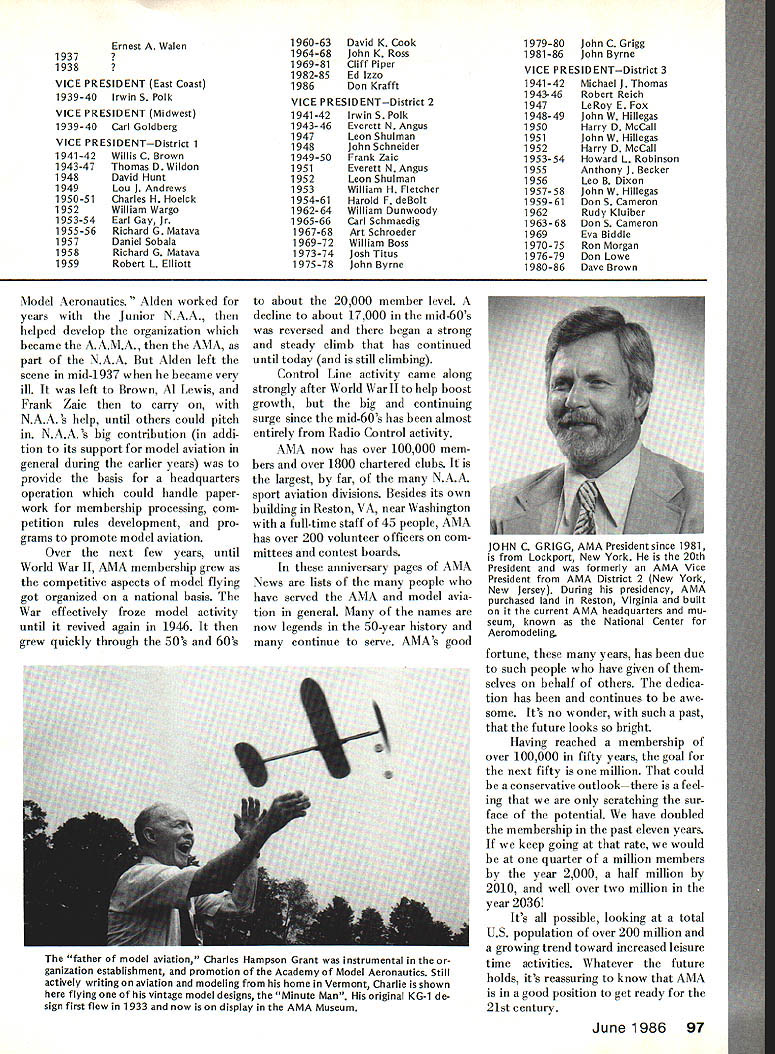
WILLIS C. BROWN, AMA's first President (1936–37), was a leader among Boston-area modelers and produced two other AMA officers, Al Lewis and Bruno Marchi. Willis worked closely with Lt. H. W. Alden in the establishment and administration of AMA until Al Lewis could help out. In 1938 Al Lewis became the second AMA President.
Transcribed from original scans by AI. Minor OCR errors may remain.

