
Special Flight: Rocketry
Dennis Kryway 1440 Millikens Bend Rd. Herndon, VA 22070
THIS COLUMN represents another first for the Academy of Model Aeronautics. In order to continue to bring you the best in modeling, the column will cover all aspects of model rocketry — beginning with FAI world-class competition and continuing through just plain flying for the fun of it. I will emphasize FAI flying, simply because it is the toughest form of model rocket competition anywhere. Anything learned from competition can easily be applied and adapted to any other type of model rocket flying — hobby or otherwise. In addition, some of the lightweight building techniques to be discussed in this column can be applied to other forms of aeromodeling.
The wonderful thing about hobbyists who are involved in aerosports is their willingness to show how they do what they do. Believe me, a lot of talented modelers are out there, and most of them are willing to share knowledge for the benefit of the hobby as well as the sport.
Events and models (eighth World Championship, Kiev, Ukraine)
The events are as follows:
- S1a — Altitude
- S3a — Parachute Duration
- S4b — Rocket-Boosted Glider
- S5c — Scale Model Altitude
- S6a — Streamer Duration
- S7a — Scale Model
- S8c — Rocket-Boosted Glider (radio control allowed)
The models built to compete in S1a, S3a, and S6a are largely made of fiberglass cloth impregnated with epoxy or polyester resins. Fins are made of balsa wood reinforced with epoxy and fiberglass. Under current rules the model must be no less than 350 mm (13.78 in.) long, with at least 50 percent of the total length measuring 30 mm (1.181 in.) in diameter. These measurements apply to the airframe and nose cone.
Fins do not count toward overall length or width. They are generally tacked in place with CYA (cyanoacrylate glue) after careful positioning, and a thin bead of epoxy is used to anchor them.
Although there are no minimum or maximum weight restrictions for the model itself, the weight of a parachute model (S3a) is usually between 38 and 55 grams. The spread in weight occurs because some modelers like to use a longer 30 mm section so that a larger parachute can be stuffed into the airframe.
The weight of an S6a Streamer model generally runs between 36 and 42 grams. The spread found here is caused primarily by the differences between materials available worldwide.
S1a two-stage Altitude models vary greatly in weight because of the nose cone weight used in the upper stage to keep the center of gravity ahead of the center of pressure, thereby ensuring model stability.
Recovery devices and tracking aids
The weights quoted for S3a and S6a do not include the recovery devices — a parachute in the case of S3a, and a streamer for S6a — nor do they include the weight of the motor.
Several different materials are used for parachutes. In Eastern Europe, the most popular material is called Lavsan. Lavsan acts, looks, and feels like Mylar; however, it is aluminized for higher visibility. Here in the United States, polyethylene plastic and aluminized Mylar are the most popular choices. Thicknesses differ, but 0.00025 in. (0.25 mil) is the most popular because of availability. Parachute diameters will vary based upon weather conditions; 28 to 32 in. seems to be the European standard. Shroud lines for parachutes are made from fine "00" or "A" nylon or silk thread, and occasionally from fine Kevlar thread.
Streamers, with a mandatory length-to-width ratio of 10:1, are usually made from a plastic film. The average size used is about 5 x 50 inches; however, some competitors favor a 6 x 60 in. length. The thickness of these plastic films ranges from 0.0005 in. for the really long, wide streamers to 0.001 in. for the shorter and narrower ones. The streamer is folded to produce as much drag as possible in order to slow the descent but still react well to thermals to gain altitude. The streamer attachment line, like the shock line, is usually made from thin Kevlar cord.
S1a Altitude specifics
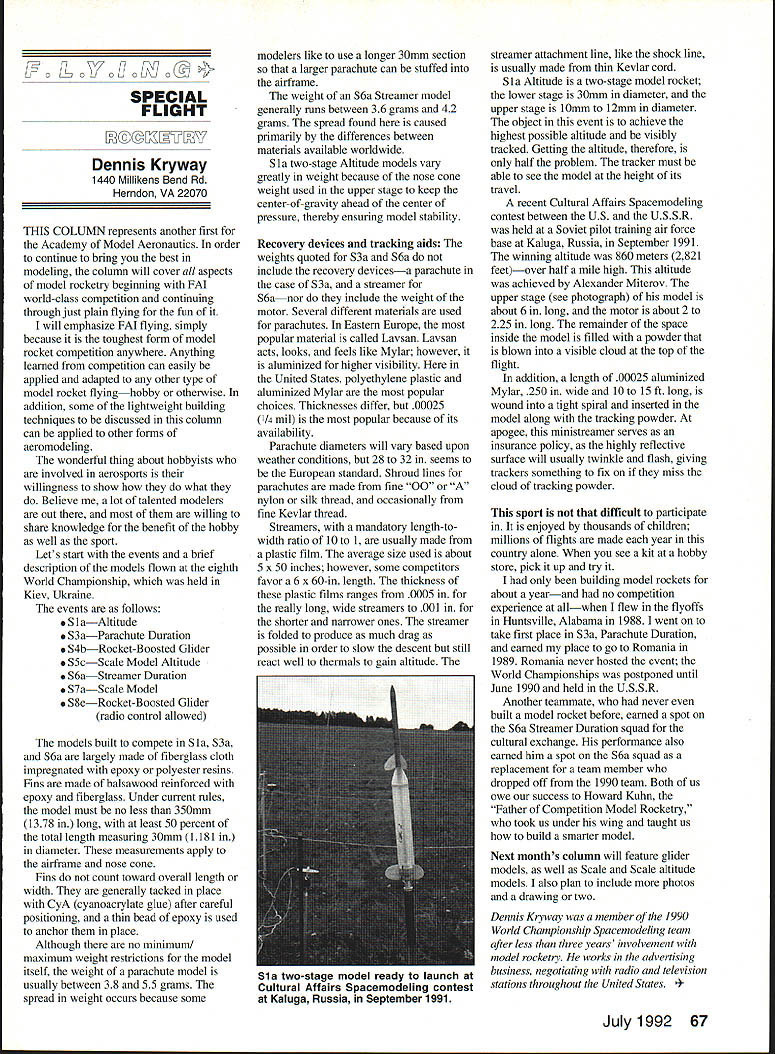
S1a Altitude is a two-stage model rocket; the lower stage is 30 mm in diameter, and the upper stage is 10 mm to 12 mm in diameter. The object in this event is to achieve the highest possible altitude and be visibly tracked. Getting the altitude, therefore, is only half the problem. The tracker must be able to see the model at the height of its travel.
A recent Cultural Affairs Spacemodeling contest between the U.S. and the U.S.S.R. was held at a Soviet pilot training air force base at Kaluga, Russia, in September 1991. The winning altitude was 860 meters (2,821 feet) — over half a mile high. This altitude was achieved by Alexander Miterov. The upper stage of his model is about 6 in. long, and the motor is about 2 to 2.25 in. long. The remainder of the space inside the model is filled with a powder that is blown into a visible cloud at the top of the flight.
In addition, a length of 0.00025 in. aluminized Mylar, 0.250 in. wide and 10 to 15 ft. long, is wound into a tight spiral and inserted in the model along with the tracking powder. At apogee, this ministreamer serves as an insurance policy, as a highly reflective surface will usually twinkle and flash, giving trackers something to fix on if they miss the cloud of tracking powder.
Getting started and personal experience
This sport is not that difficult to participate in. It is enjoyed by thousands of children; millions of flights are made each year in this country alone. When you see a kit at a hobby store, pick it up and try it.
I had only been building model rockets for about a year — and had no competition experience at all — when I flew at Huntsville, Alabama in 1988. I went on to take first place in S3a, Parachute Duration, and earned my place to go to Romania in 1989. Romania never hosted the event; the World Championships were postponed until June 1990 and held in the U.S.S.R.
Another teammate, who had never even built a model rocket before, earned a spot on the S6a Streamer Duration squad for the cultural exchange. His performance also earned him a spot on the S6a squad as a replacement for a team member who had dropped off from the 1990 team. Both of us owe our success to Howard Kuhn, the "Father of Competition Model Rocketry," who took us under his wing and taught us how to build a smarter model.
Looking ahead
Next month's column will feature glider models, as well as Scale and Scale altitude models. I also plan to include more photos and a drawing or two.
Dennis Kryway was a member of the 1990 World Championship Spacemodeling team after less than three years' involvement with model rocketry. He works in the advertising business, negotiating with radio and television stations throughout the United States.
Transcribed from original scans by AI. Minor OCR errors may remain.

