
SPECIAL FLIGHT ROCKETRY
Dennis Kryway 1440 Millikens Bend Rd., Herndon, VA 22070
Background
It's now official—AMA has formally assumed the responsibility for running the Fédération Aéronautique Internationale (FAI) spacemodeling (model rocket) program in the United States.
A little background. FAI is the world-governing organization for aviation. Each country belonging to the FAI has a designated national aero club. The United States is a member of the FAI, and our national aero club is the National Aeronautic Association (NAA). The NAA oversees the activities of eight organizations participating in the FAI program. The AMA is a member and, as such, is charged by the NAA and the FAI with representing all aeromodelers who belong to the FAI program in the U.S.
Spacemodeling (as model rocketry is called today) was never officially represented by the AMA. By default, the National Association of Rocketry (NAR) became involved with the FAI program, even though it is not one of the eight dues-paying organizations affiliated with the NAA.
In the past, the NAR formed a spacemodeling team to represent the United States in competition at the Space Modeling World Championships approximately every two years. The NAR, however, supported no other FAI event other than team-selection flyoffs.
The president of the NAR, J. Patrick Miller, announced at the ninth World Space Modeling Championships, held in Florida last September, that the FAI international program would be dropped immediately after the contest was over. The reason cited for this measure was the lack of benefit to the majority of its membership.
The effect of this totally unexpected announcement was a shock to the members of the U.S. team as well as the rest of the NAR. The NAR currently has a membership base of a little more than 3,200 members, of which about 50% are adults. At the team-selection flyoffs I have observed, about 20–30 participants vied for 12 slots on the U.S. team.
Rather than ignore this major aspect of aeromodeling, the AMA has come to the rescue of these hobbyists. The AMA is now developing a spacemodeling program for the United States. It will include a training program for those interested in international competition as well as a spacemodeling program directed toward the younger members of our hobby—the children.
Rocketry / Kryway
Events and Participation
The current plan calls for:
- A seminar and how-to session on May 15–16, 1993.
- U.S. team-selection flyoffs on August 21–22, 1993, scheduled at the Muncie flight facility.
If you are interested in participating in either event, contact your district vice president immediately.
What this Means to AMA Members
What does this mean to you—the AMA member? It opens the door to a new facet of aeromodeling. If you have been thinking about getting into competition but are afraid of the cost or of being embarrassed in public, don't worry. This is a sport where the secrets are few and the competition can be very close.
If you don't want to be a competitor, that's fine, too. Sport flying of model rockets in the United States accounts for the use of between eight and nine million rocket engines a year.
More important, it is something that kids love to be a part of, and it really doesn't take much skill on the fun level. Estes Industries has catered to the young modeler by making the building of a model more of an assembly job. Estes also provides more difficult kits for experienced modelers. The exact rules, descriptions, and modifiers for FAI competition can be found in the FAI Sporting Code, which is available from the AMA.
S8e: Radio-Controlled Rocket Gliders
This is the second part of an article that appeared in the July 1992 issue of Model Aviation. The article discusses S8e: radio-controlled rocket gliders.
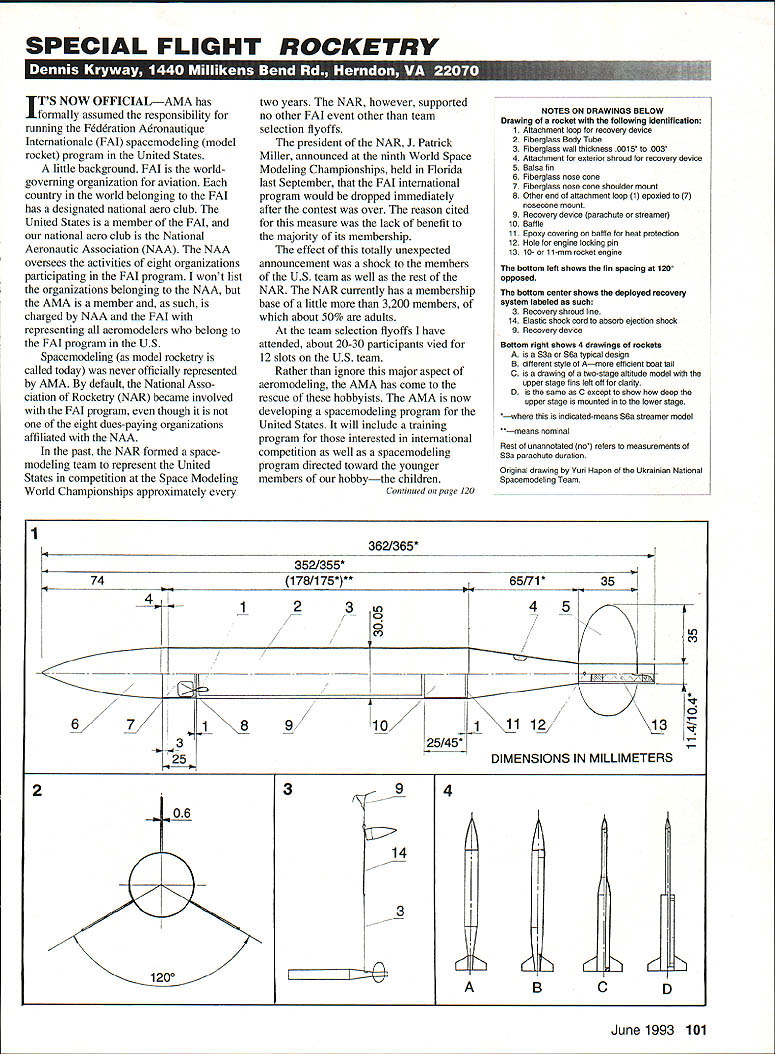
Radio-controlled rocket gliders are designed to be propelled through the air by a rocket motor in as nearly vertical an attitude as possible (within a 60° cone). At the end of the burn (boost stage), the model should go into a glide and stay aloft for a specified time. It cannot drop the motor or the pod that holds the motor. It must be flown accounting for the shift in center of gravity caused by the loss of propellant during the boost portion of the flight.
The motor impulse class limit is 0.0–40.00 newton-seconds. A rules change was submitted by Bulgaria during the 1990 Space Modeling Championships in Kiev, Ukraine, to allow motors smaller than the 40 newton-seconds limit. The motor specification now reads 0.0–40.00 newton-seconds. It was approved by the FAI for a number of reasons:
- Safety: Because the models would reach approximately 300 meters (about 1,000 feet), there was concern about losing control of the model if the rechargeable batteries went dead prematurely and the model subsequently crashed—perhaps many miles away from the launch site. European modelers who compete in this event sometimes open rechargeable nine-volt batteries, take apart the stacked cells found inside, and put their own voltage combinations together as needed. It seems that the European version of the nine-volt rechargeable has a higher amp capacity than is commonly available in domestic rechargeable batteries.
- Cost and manufacturing risk: The motors used in competition are special (about a nine-second burn at an average thrust of a little more than four newtons). During production, part of the process is to press the propellant under pressures in excess of 8,000 psi. Because of the high pressures, explosions can occur fairly frequently during manufacturing. In eastern European countries, rocket motors generally are not available at local hobby shops—hobby shops as we know them do not exist there. In those countries, a current or former member of the national team often makes the motors for team use, or the team manager is responsible for obtaining them.
Commercial Kits and Motors
RC rocket glider kits are now available commercially.
- Estes Industries is marketing a rocket-propelled glider called the Astro-Blaster. It is expressly designed to be radio controlled and will use a motor as small as 20 newton-seconds (D-powered). The kit is available directly from Estes or at any hobby shop that normally stocks Estes products in the United States and Canada.
- North Coast Rocketry sells a radio-controlled rocket glider called the Avatar. While the Avatar can be D-powered, North Coast recommends the use of an E motor.
Because the motor cannot be dropped or jettisoned, a special motor without an ejection charge must be used. Estes Industries sells a special version of its 20 newton-seconds line called the D-11P. It contains no ejection charge and has a plug in the front of the motor, preventing hot gas from escaping and damaging the motor pod.
Transcribed from original scans by AI. Minor OCR errors may remain.

