
The Spirit
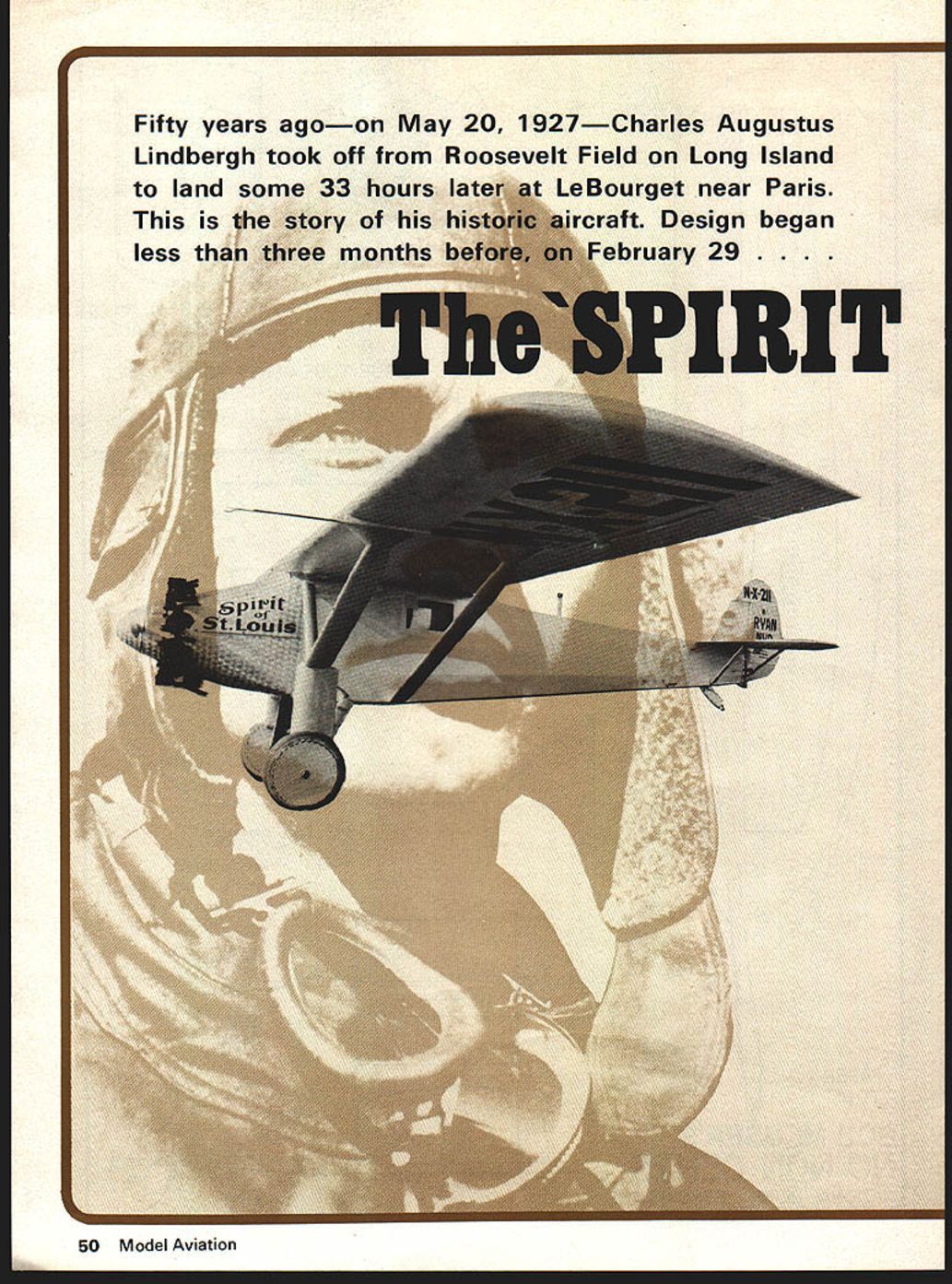
Fifty years ago—on May 20, 1927—Charles Augustus Lindbergh took off from Roosevelt Field on Long Island to land some 33 hours later at LeBourget near Paris. This is the story of his historic aircraft. Design began less than three months before, on February 29... A YEAR AND two days to fly from Dutch Flats to Bolling Field. Less than 500 flying hours from first test hop to retirement. And yet it hangs proudly alongside the Wright Flyer and the command module of the Apollo 11 Moon mission in the "Milestones of Flight" hall of the National Air & Space Museum.
Its year and two days of active life, and its 489½ hours in the air on 174 flights were about as momentous as any in the long and explosive history of man-in-the-air. The brief year of flying encompassed 19 countries and all 48 American states. Several of the flights were of considerably more than passing significance.
Don Berliner
The Ryan NYP "Spirit of St. Louis" wasn't the first choice of Charles Lindbergh for his ambitious project. In fact, it wasn't even second choice. First on his list was a Wright-Bellanca flying engine testbed which both the pilot and his financial backers wanted, but which had too many strings attached. Two weeks after Lindbergh's history-making New York-Paris flight, the Bellanca beat his non-stop distance record by 700 miles with a flight from New York to Germany, piloted by Clarence Chamberlin. But as non-flying owner Charles Levine was also on board, the flight was technically not solo.
The second choice was a Travel Air monoplane, but the manufacturer cut that short, refusing to sell it for a solo trip across the Atlantic. All during the search for an airplane, Lindbergh encountered opposition to his plan to use a single-engined airplane. A lot of people felt that, with only one engine, he would have far less chance of success than with three engines, like most of the other contenders were using. Time after time Lindbergh explained that if one of a tri-motor's three engines failed far from land, it would go down into the ocean just as sure as a single-engined airplane. But still the conservative element pressed for the "obvious" safety of extra engines.
With the OK from his group of eager financial friends in St. Louis, Lindbergh telegraphed Ryan Airlines, Inc. (as it was then called) in early February of 1927, inquiring about the possibility of buying a specially designed airplane for his long flight. A few days later, Bellanca indicated it would go along with the idea, but then the new owner of the Wright-Bellanca insisted he be allowed to pick his own crew, which of course held absolutely no interest for Lindbergh.
On February 25, 1927, the deal was completed with Ryan, and the project was begun two days later. It went ahead at full speed, as well it might, for the schedule called for takeoff in about three months. All that remained to be done was to design, build and test an airplane to the point where it could be counted on to fly farther than any previous airplane had ever flown. In three months! And all that the group of money men from St. Louis had to spend was $15,000! Today, you'd be lucky to get a two-seat Cessna 150 with a couple of radios for that kind of cash.
To stand much of a chance of completing a record-distance flight that would be almost entirely over water, the airplane would have to offer unheard-of dependability. If its sole engine were to quit, there would be no place to land—at least, no place where the pilot would stand a chance of surviving. So, this pointed toward a proven airplane, or at least as many proven components as possible. And it meant that there would have to be a great deal of built-in margin. More than enough fuel to get it to Europe even if the winds turned sour, more than enough wing to get it off the ground with an overload.
Then, as now, weight is the great evil monster that haunts all airplane designers. If they put in all the equipment they really need, the airplane will have trouble lifting its own weight off the ground. But if they cut down on the weight so the thing will fly right, they'll have to compromise with something important, like safety or utility. The Wright Brothers had this problem and so did the designers of the Concorde and the Space Shuttle. It may be the one absolute rule in aviation.
With so little time in which to build an airplane, there could be no serious thought of designing a completely new one. That's the way it should have been done, but doing it the right way could have left Lindbergh on the drawing board when his competition was somewhere out over the Atlantic. And with all the competition assembling its plans and its planes on both sides of the pond to try for the $25,000 Orteig prize and immeasurable fame, time had to be very important.
Bellanca and Travel Air were out of the question, and so it was up to T. Claude Ryan and his little factory in San Diego. They had built a pretty solid reputation
THE SPIRIT OF ST. LOUIS
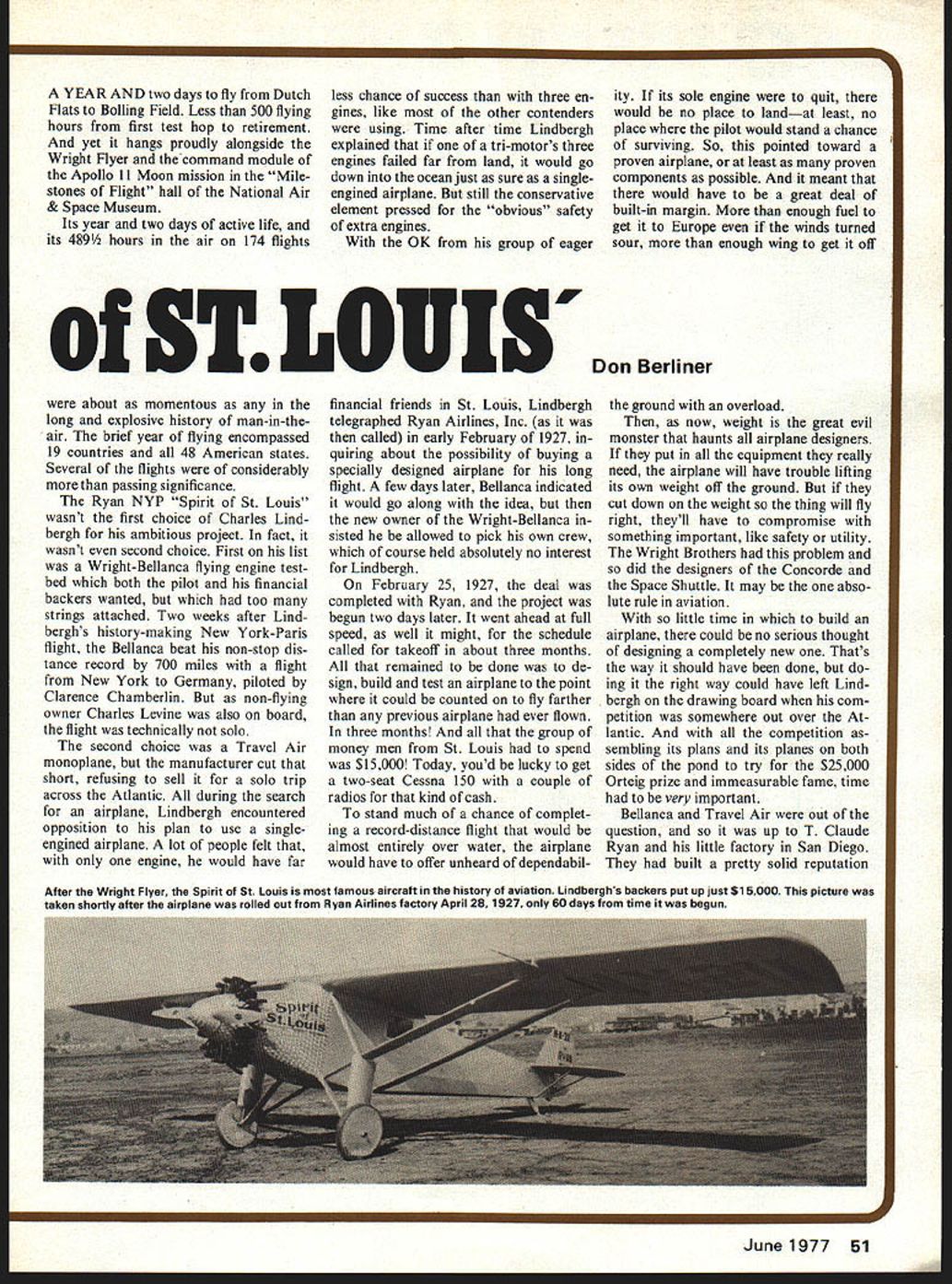
After the Wright Flyer, the Spirit of St. Louis is the most famous aircraft in the history of aviation. Lindbergh's backers put up just $15,000.
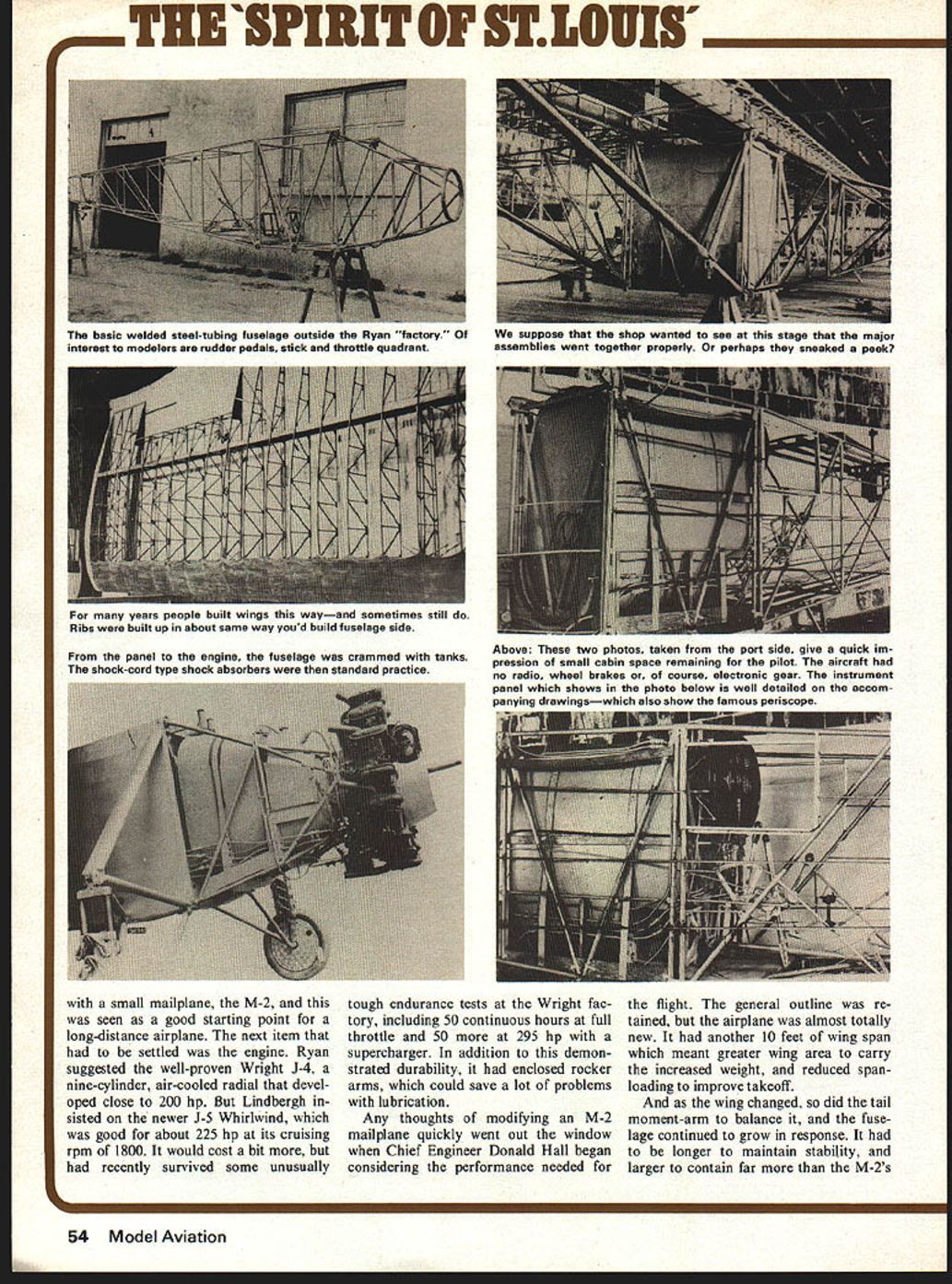
Small mailplane M-2 seemed a good starting point for a long-distance airplane. The next item settled was the engine. Ryan suggested the well-proven Wright J-4 nine-cylinder air-cooled radial developed to close to 200 hp. Lindbergh insisted on the newer J-5 Whirlwind, good for about 225 hp; its cruising reliability was well known. With a small mailplane, the M-2, this was seen as a good starting point for a long-distance airplane. The next item that had to be settled was the engine. Ryan suggested the well-proven Wright J-4, a nine-cylinder, air-cooled radial that developed close to 200 hp. But Lindbergh insisted on the newer J-5 Whirlwind, which was good for about 225 hp at its cruising rpm of 1800. It would cost a bit more, but had recently survived some unusually tough endurance tests at the Wright factory, including 50 continuous hours at full throttle and 50 more at 295 hp with a supercharger. In addition to this demonstrated durability, it had enclosed rocker arms, which could save a lot of problems with lubrication.
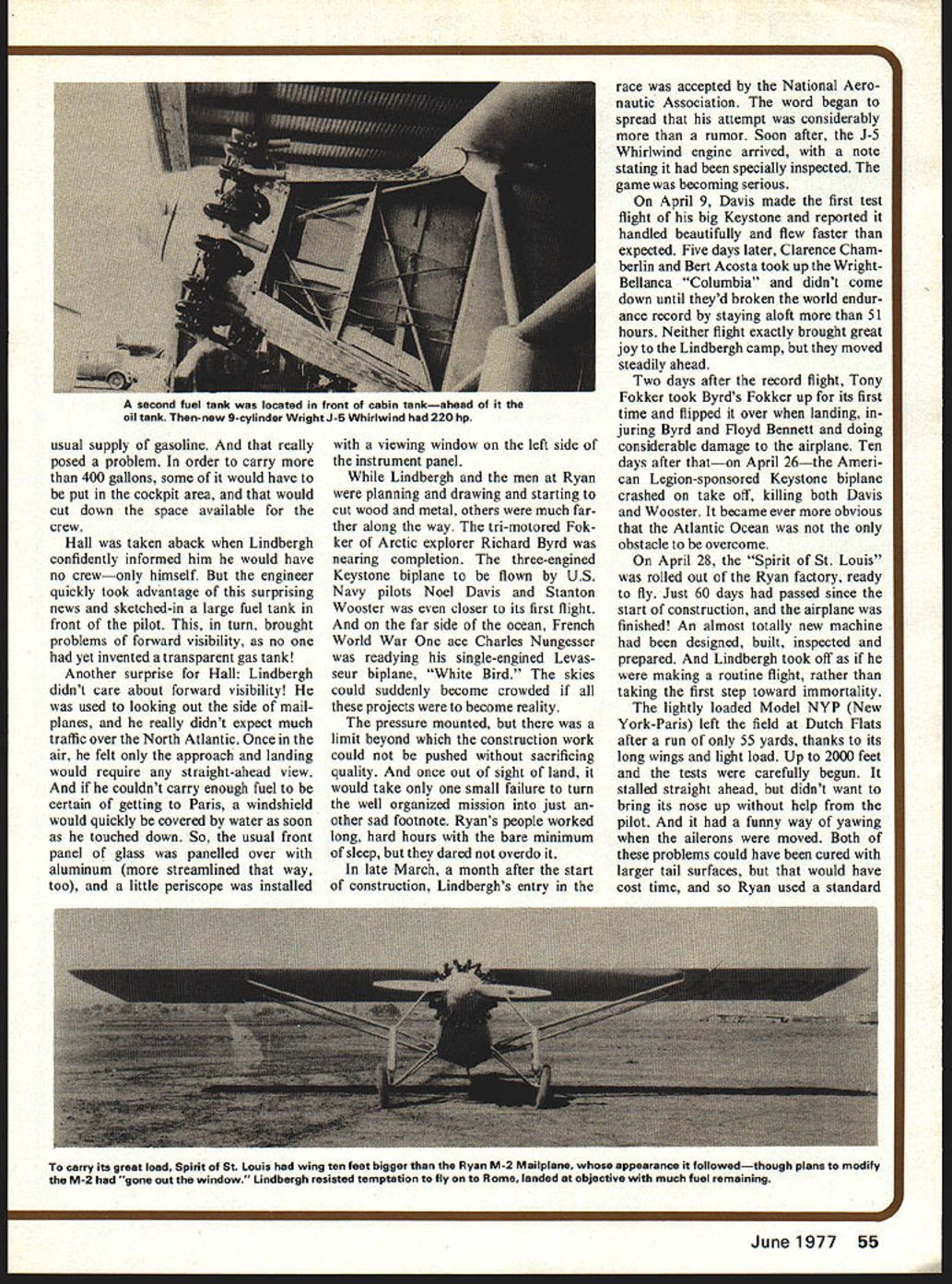
Any thoughts of modifying an M-2 mailplane quickly went out the window when Chief Engineer Donald Hall began considering the performance needed for the flight. The general outline was retained, but the airplane was almost totally new. It had another 10 feet of wing span which meant greater wing area to carry the increased weight, and reduced span-loading to improve takeoff.
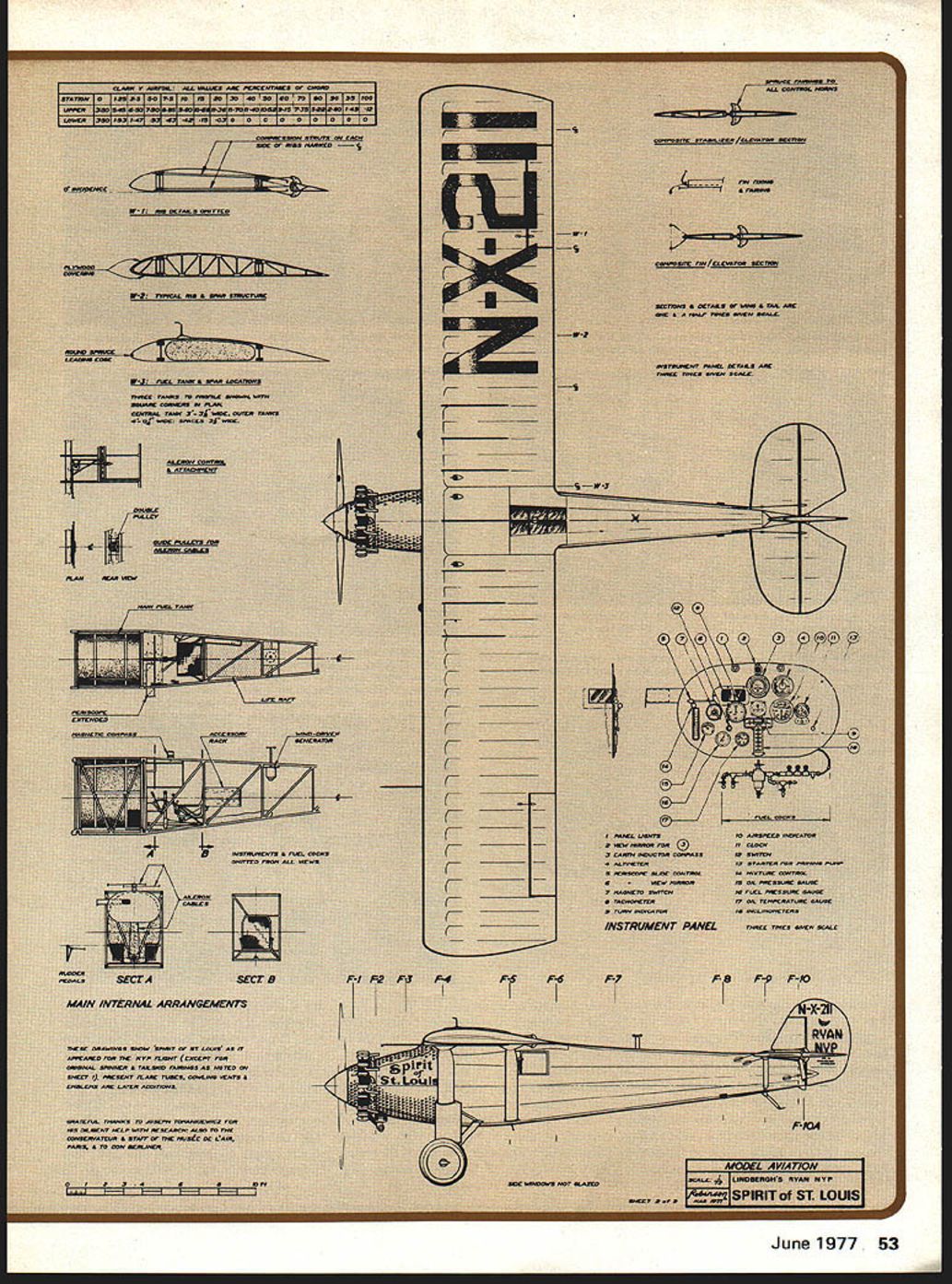
And as the wing changed, so did the tail moment-arm to balance it, and the fuselage continued to grow in response. It had to be longer to maintain stability, and larger to contain far more than the M-2's usual supply of gasoline. And that really posed a problem. In order to carry more than 400 gallons, some of it would have to be put in the cockpit area, and that would cut down on the space available for the crew.
Hall was taken aback when Lindbergh confidently informed him he would have no crew—only himself. But the engineer quickly took advantage of this surprising news and sketched-in a large fuel tank in front of the pilot. This, in turn, brought problems of forward visibility, as no one had yet invented a transparent gas tank!
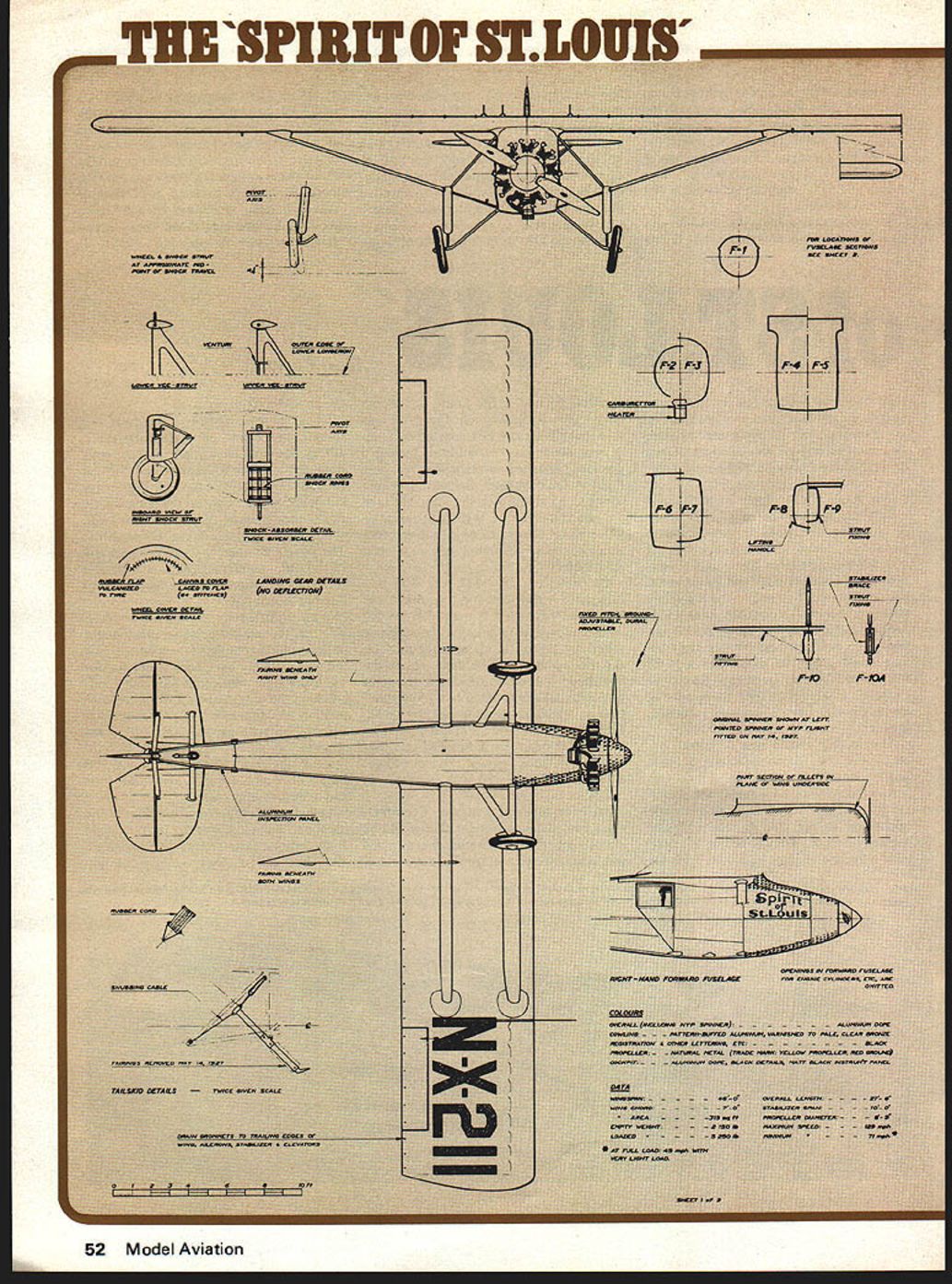
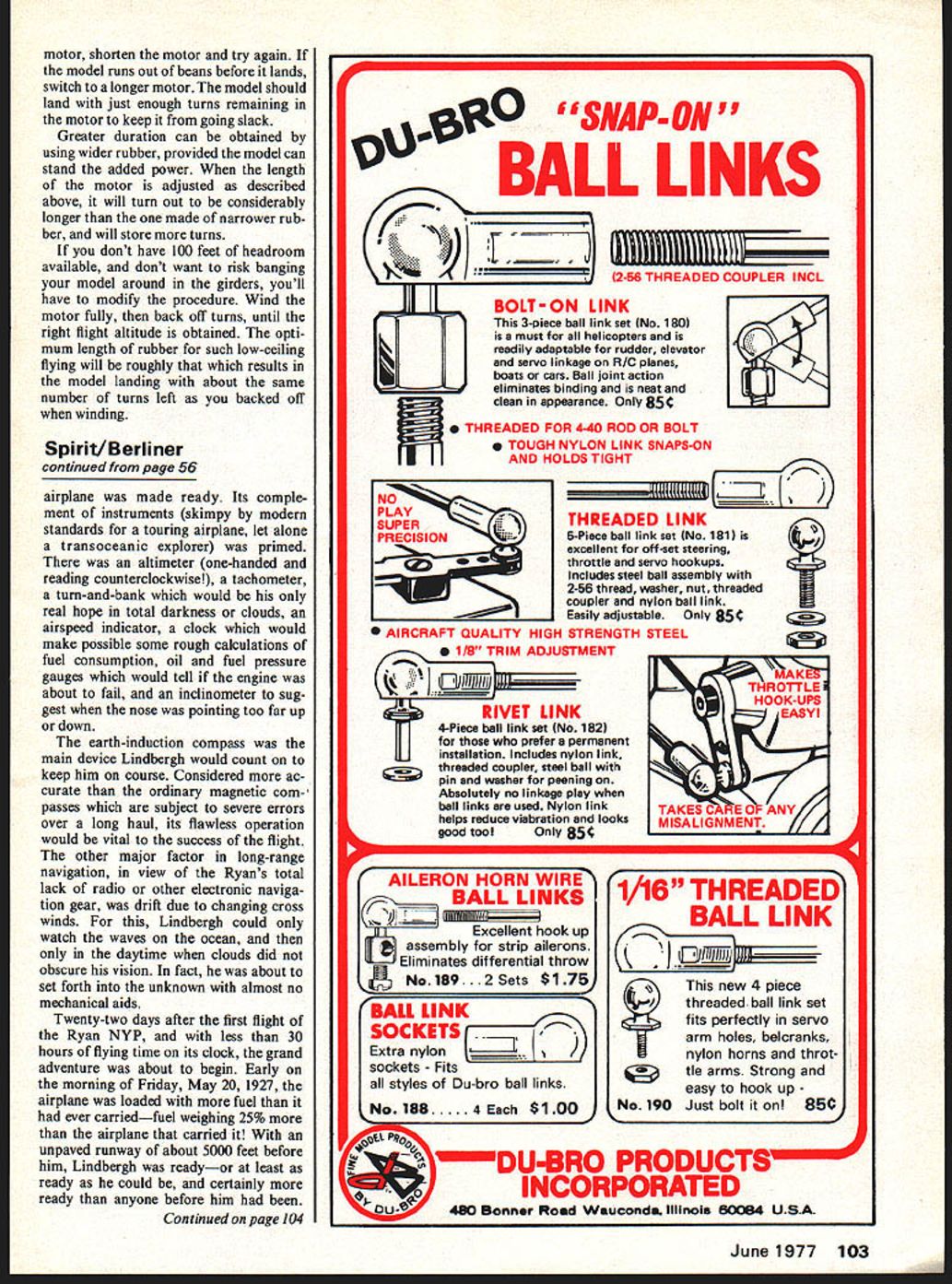
Another surprise for Hall: Lindbergh didn't care about forward visibility! He was used to looking out the side of mailplanes, and he really didn't expect much traffic over the North Atlantic. Once in the air, he felt only the approach and landing would require any straight-ahead view. And if he couldn't carry enough fuel to be certain of getting to Paris, a windshield would quickly be covered by water as soon as he touched down. So, the usual front panel of glass was panelled over with aluminum (more streamlined that way, too), and a little periscope was installed with a viewing window on the left side of the instrument panel.
While Lindbergh and the men at Ryan were planning and drawing and starting to cut wood and metal, others were much farther along the way. The tri-motored Fokker of Arctic explorer Richard Byrd was nearing completion. The three-engined Keystone biplane to be flown by U.S. Navy pilots Noel Davis and Stanton Wooster was even closer to its first flight. And on the far side of the ocean, French World War One ace Charles Nungesser was readying his single-engined Levasseur biplane, "White Bird." The skies could suddenly become crowded if all these projects were to become reality.
The pressure mounted, but there was a limit beyond which the construction work could not be pushed without sacrificing quality. And once out of sight of land, it would take only one small failure to turn the well organized mission into just another sad footnote. Ryan's people worked long, hard hours with the bare minimum of sleep, but they dared not overdo it.
In late March, a month after the start of construction, Lindbergh's entry in the race was accepted by the National Aeronautic Association. The word began to spread that his attempt was considerably more than a rumor. Soon after, the J-5 Whirlwind engine arrived, with a note stating it had been specially inspected. The game was becoming serious.
On April 9, Davis made the first test flight of his big Keystone and reported it handled beautifully and flew faster than expected. Five days later, Clarence Chamberlin and Bert Acosta took up the Wright-Bellanca "Columbia" and didn't come down until they'd broken the world endurance record by staying aloft more than 51 hours. Neither flight exactly brought great joy to the Lindbergh camp, but they moved steadily ahead.
Two days after the record flight, Tony Fokker took Byrd's Fokker up for its first time and flipped it over when landing, injuring Byrd and Floyd Bennett and doing considerable damage to the airplane. Ten days after that—on April 26—the American Legion-sponsored Keystone biplane crashed on take off, killing both Davis and Wooster. It became ever more obvious that the Atlantic Ocean was not the only obstacle to be overcome.
On April 28, the "Spirit of St. Louis" was rolled out of the Ryan factory, ready to fly. Just 60 days had passed since the start of construction, and the airplane was finished! An almost totally new machine had been designed, built, inspected and prepared. And Lindbergh took off as if he were making a routine flight, rather than taking the first step toward immortality.
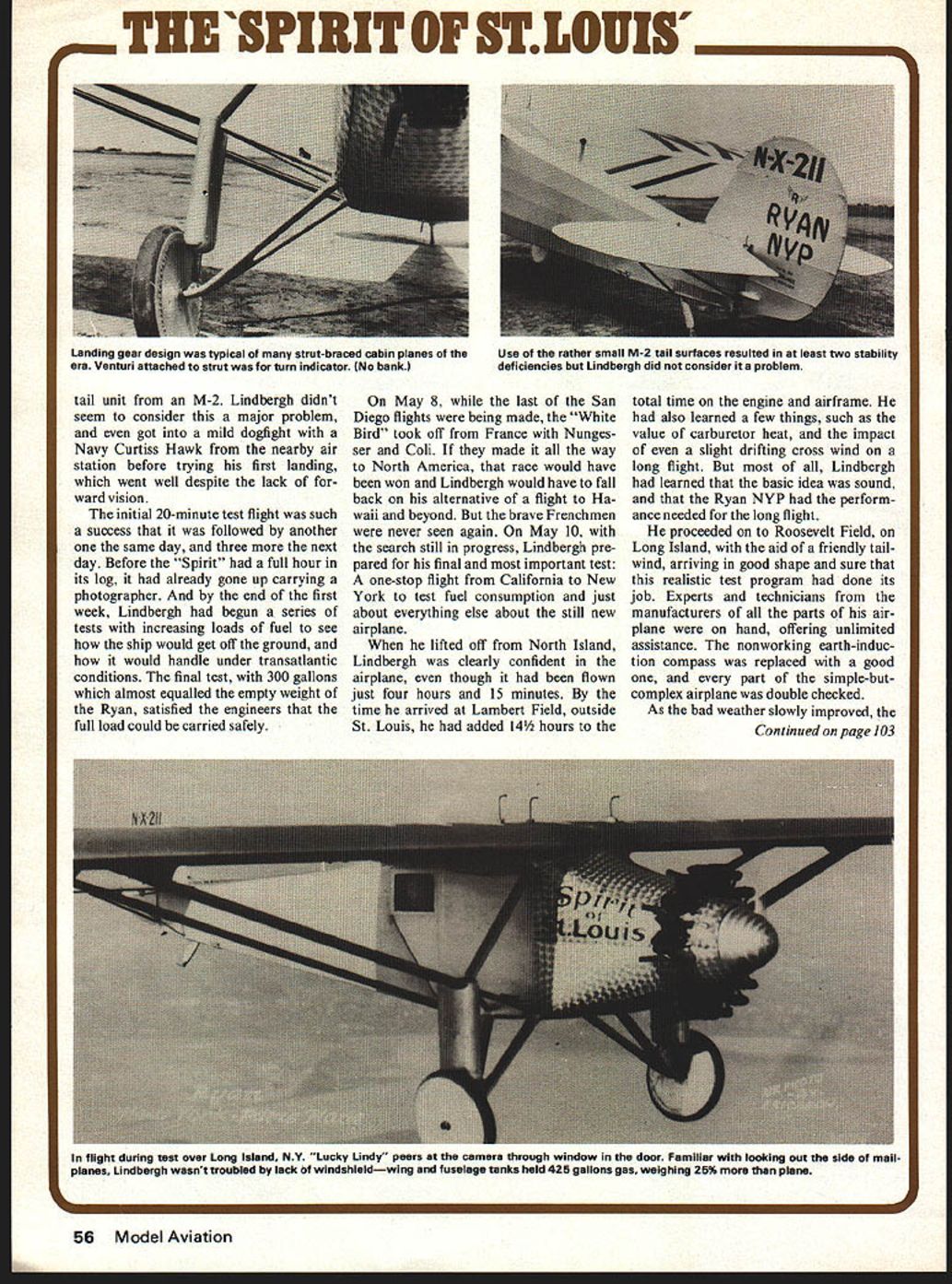
The lightly loaded Model NYP (New York-Paris) left the field at Dutch Flats after a run of only 55 yards, thanks to its long wings and light load. Up to 2000 feet the tests were carefully begun. It stalled straight ahead, but didn't want to bring its nose up without help from the pilot. And it had a funny way of yawing when the ailerons were moved. Both of these problems could have been cured with larger tail surfaces, but that would have cost time, and so Ryan used a standard tail unit from an M-2. Lindbergh didn't seem to consider this a major problem, and even got into a mild dogfight with a Navy Curtiss Hawk from the nearby air station before trying his first landing, which went well despite the lack of forward vision.
The initial 20-minute test flight was such a success that it was followed by another one the same day, and three more the next day. Before the "Spirit" had a full hour in its log, it had already gone up carrying a photographer. And by the end of the first week, Lindbergh had begun a series of tests with increasing loads of fuel to see how the ship would get off the ground, and how it would handle under transatlantic conditions. The final test, with 300 gallons which almost equalled the empty weight of the Ryan, satisfied the engineers that the full load could be carried safely.
On May 8, while the last of the San Diego flights were being made, the "White Bird" took off from France with Nungesser and Coli. If they made it all the way to North America, that race would have been won and Lindbergh would have to fall back on his alternative of a flight to Hawaii and beyond. But the brave Frenchmen were never seen again. On May 10, with the search still in progress, Lindbergh prepared for his final and most important test: a one-stop flight from California to New York to test fuel consumption and just about everything else about the still new airplane.
When he lifted off from North Island, Lindbergh was clearly confident in the airplane, even though it had been flown just four hours and 15 minutes. By the time he arrived at Lambert Field, outside St. Louis, he had added 14½ hours to the total time on the engine and airframe. He had also learned a few things, such as the value of carburetor heat, and the impact of even a slight drifting cross wind on a long flight. But most of all, Lindbergh had learned that the basic idea was sound, and that the Ryan NYP had the performance needed for the long flight.
He proceeded on to Roosevelt Field, on Long Island, with the aid of a friendly tailwind, arriving in good shape and sure that this realistic test program had done its job. Experts and technicians from the manufacturers of all the parts of his airplane were on hand, offering unlimited assistance. The nonworking earth-induction compass was replaced with a good one, and every part of the simple-but-complex airplane was double checked.
As the bad weather slowly improved, the airplane was made ready. Its complement of instruments (skimpy by modern standards for a touring airplane, let alone a transoceanic explorer) was primed. There was an altimeter (one-handed and reading counterclockwise!), a tachometer, a turn-and-bank which would be his only real hope in total darkness or clouds, an airspeed indicator, a clock which would make possible some rough calculations of fuel consumption, oil and fuel pressure gauges which would tell if the engine was about to fail, and an inclinometer to suggest when the nose was pointing too far up or down.
The earth-induction compass was the main device Lindbergh would count on to keep him on course. Considered more accurate than the ordinary magnetic compasses which are subject to severe errors over a long haul, its flawless operation would be vital to the success of the flight. The other major factor in long-range navigation, in view of the Ryan's total lack of radio or other electronic navigation gear, was drift due to changing cross winds. For this, Lindbergh could only watch the waves on the ocean, and then only in the daytime when clouds did not obscure his vision. In fact, he was about to set forth into the unknown with almost no mechanical aids.
Twenty-two days after the first flight of the Ryan NYP, and with less than 30 hours of flying time on its clock, the grand adventure was about to begin. Early on the morning of Friday, May 20, 1927, the airplane was loaded with more fuel than it had ever carried—fuel weighing 25% more than the airplane that carried it! With an unpaved runway of about 5000 feet before him, Lindbergh was ready—or at least as ready as he could be, and certainly more ready than anyone before him had been. Once the throttle had been pushed all the way forward and the airplane had gathered too much speed to safely be stopped, all the planning and checking would be put to the test. The engine would have to run almost perfectly for something like 35 hours (more than twice as long as it had ever done in the air). The airframe would have to hold together through whatever violent winds it might encounter (despite a broken longeron near the tail which would not be discovered until Paris).
And, as important as anything else, the flight would have to be made in the correct direction, for a trip of record distance which terminated in the South Atlantic would hardly be seen as a rousing success. To make it along a planned route, the navigation would not only have to be near-perfect, but the almost unknown factor of drift would have to push Lindbergh and the Ryan not very far off course. Unknown to the pilot, and even to the ill-equipped weather experts, was that a high pressure area to the north of his course and a low to the south were ideally situated to create a strong and steady tailwind, and almost no lateral drift.
But as Lindbergh sat at the end of the runway at Roosevelt Field and completed his final checks, he was unaware of the conditions he would meet over the vast, menacing body of water. He only knew that his plans had been developed with the greatest of care, and his plane had been built and tested in the same way. Beyond that, it would be up to him.
Transcribed from original scans by AI. Minor OCR errors may remain.

