

SPIRIT OF FENTRESS
For those who don't get a chance to make it to the AMA Nationals, we've arranged this account from a second-time attendee that will give an indication of what you've been missing. — Fred Berman
The site and the heat
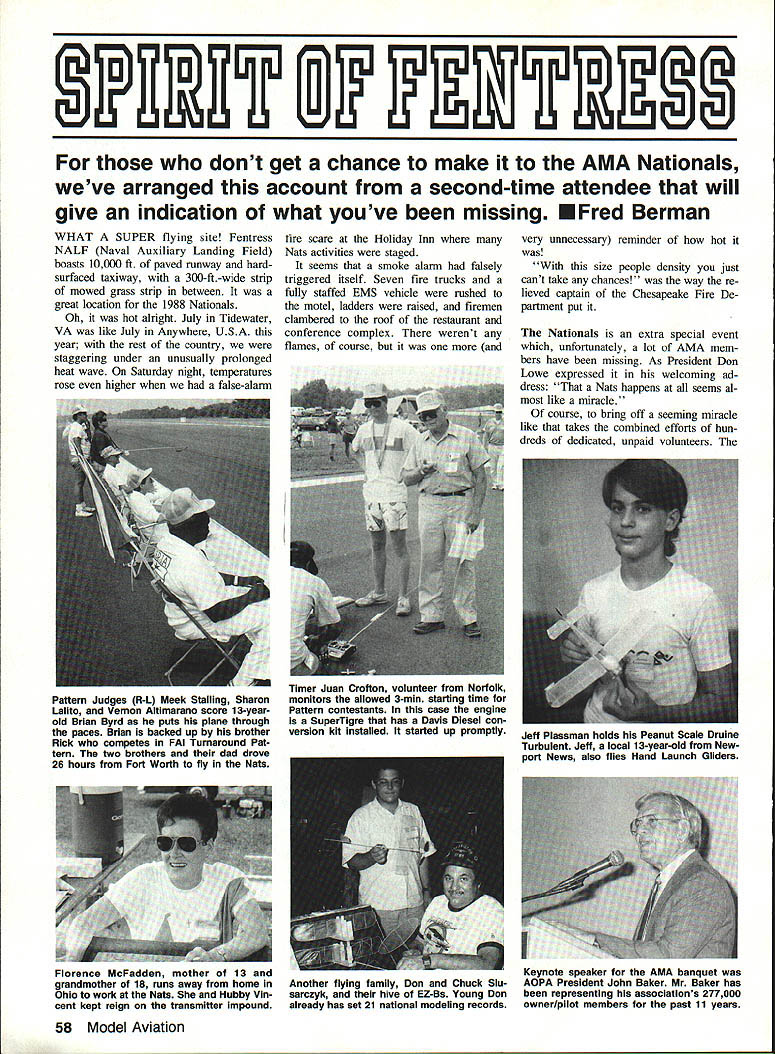
What a super flying site! Fentress NALF (Naval Auxiliary Landing Field) boasts 10,000 ft. of paved runway and hard-surfaced taxiway, with a 300-ft-wide strip of mowed grass in between. It was a great location for the 1988 Nationals.
Oh, it was hot, alright. July in Tidewater, Va., was like July in Anywhere, U.S.A. this year; with the rest of the country, we were staggering under an unusually prolonged heat wave. On Saturday night, temperatures rose even higher when we had a false-alarm fire scare at the Holiday Inn where many Nats activities were staged.
It seems that a smoke alarm had falsely triggered itself. Seven fire trucks and a fully staffed EMS vehicle were rushed to the motel, ladders were raised, and firemen clambered to the roof of the restaurant and conference complex. There weren't any flames, of course, but it was one more (and very unnecessary) reminder of how hot it was!
"With this size people density, you just can't take any chances!" was the way the relieved captain of the Chesapeake Fire Department put it.
Organizational challenges and the volunteers
The Nationals is an extra special event which, unfortunately, a lot of AMA members have been missing. As President Don Lowe expressed it in his welcoming address: "That a Nats happens at all seems almost like a miracle."
Of course, to bring off a seeming miracle like that takes the combined efforts of hundreds of dedicated, unpaid volunteers. The best-laid plans in the world, though, can't prevent the occasional glitch. This year Mother Nature had a hand in the major one. Due to the drought in the Midwest, the prearranged South Field Free Flight and RC Soaring site was converted to suddenly high-profit soybean acreage shortly before the Nats starting date and declared off-limits for us.
With a never-say-die spirit, the Tidewater Model Soaring Society (TMSS) found a partial solution to our dilemma. A full-scale glider field at the Garner Airport was ceded to us at the last minute for use as the Soaring site. Soaring requires less ground space than Free Flight; the RC gliders can be winched off and landed on the single runway between rows of corn and soybeans. But the Free Flight competitors, some of whom had not received notice of the cancellation and traveled all the way from Belgium and Guatemala, were out of luck.
Sampling the diversity of the hobby
The Nationals offers a unique opportunity to observe the vast diversity of the hobby up close. Most of us belong to a specialty club, be it RC sport flying, Control Line, or Electrics. At Chesapeake we were able to sample the developments in other branches of the hobby, and we had a ball.
Indoor modeling (Scope arena)
Watching the Indoor modelers, who held forth in a domed arena called Scope, was a real eye-opener. The diversity of events was fascinating. Tiny rubber-powered Scale models flew in stately circles above the arena floor, first climbing gradually and later gently descending. By carefully counting the number of turns they cranked into the rubber motors, many of the pilots were able to fly their models in the 30–90 second range.
Weighing only a few ounces and with incredible attention to detail, these Indoor models looked as though they'd been built under a jeweler's magnifier. Their covering material is said to be condenser paper. Some of the models are classified as Peanut Scale, while others are termed Pistachios — the most precious nuts a-flying you ever saw!
Scoring is the sum of the static judging score plus the flight score. The rule in Peanut that the flight score may not exceed the Scale score provides strong incentive to build a quality model. There were antique pusher-type models as well as World War I and World War II designs. In a totally different category were the microweight Pennyplanes and microfilm-covered models.
Indoor planes themselves are inexpensive, but the support equipment is another matter. Flimsy airplane structures weighing less than a copper penny have handmade propellers that rotate as slowly as the blades of a Dutch windmill. When we wondered how a rubberband-driven prop could turn that slowly, we were told it was due to low windup torque, relatively large prop diameter, and high blade pitch.
An unusual device was available for retrieving planes trapped on chandeliers, roof trusses, or other high structural members: a helium-filled balloon tied to the line of a fishing rod. In case of need, line is paid out from the reel and the balloon is maneuvered close to the errant plane. A bit of adept snagging nearly always succeeds in dislodging the fragile craft. Hmmm... Could a similar device be used to snare those planes caught in trees? Certainly food for thought.
The covering for wings, control surfaces, and prop blades is a special material which is lighter than plastic wrap. The builders of these superlightweight models seem to possess unlimited skills. Some of them have built models that flap their wings like butterflies, called Ornithopters.
The Scope arena was a bit stuffy in the oppressive heat, but doubtless this was due to purposely shutting down the air conditioning system to prevent unwanted drafts on the tiny craft.
RC helicopters and communications
RC Helicopters had the flying site closest to the Holiday Inn at an as-yet unoccupied industrial park. Like all the other sites, this one didn't escape the relentless gaze of that imprecise celestial heat lamp, but it was a beautiful location. It even included an on-site computer and printer to process and tabulate the contestants' scores.
Those wonderful, uncomplaining volunteers showed unmatchable resourcefulness. The communications crew even erected a husky 60-ft. antenna for transmitting to and from the AMA base station at Fentress.
Control Line Combat
Control Line Combat is, from the spectator's point of view, probably the most exciting event at the Nats. Not only is the action up close, but the word "action" doesn't quite convey the full pitch of the excitement.
Contestants would appear to carry a minimum of 10 spare planes, plus engines, props, and as complete a portable repair shop as can be crammed into a van. The goal of the event is for one plane's prop or wing to chop the other's trailing streamer as often as possible, while trying to keep its own streamer away from the enemy. Megasonic is not too grand a word to describe the Combat pilots' reflexes.
Midairs are common, as are soil-sampling maneuvers. Bouts last four minutes, and "up" flying time is rewarded with a point a second. We saw planes still flying on just half a wing and a prayer following a collision. One would almost think that many of these fliers brew their own fuel, as that high-nitro stuff (as much as 50%) can get very expensive indeed. Due to the high casualty rate, Combat planes are all-function and no-frills affairs.
Control Line Scale
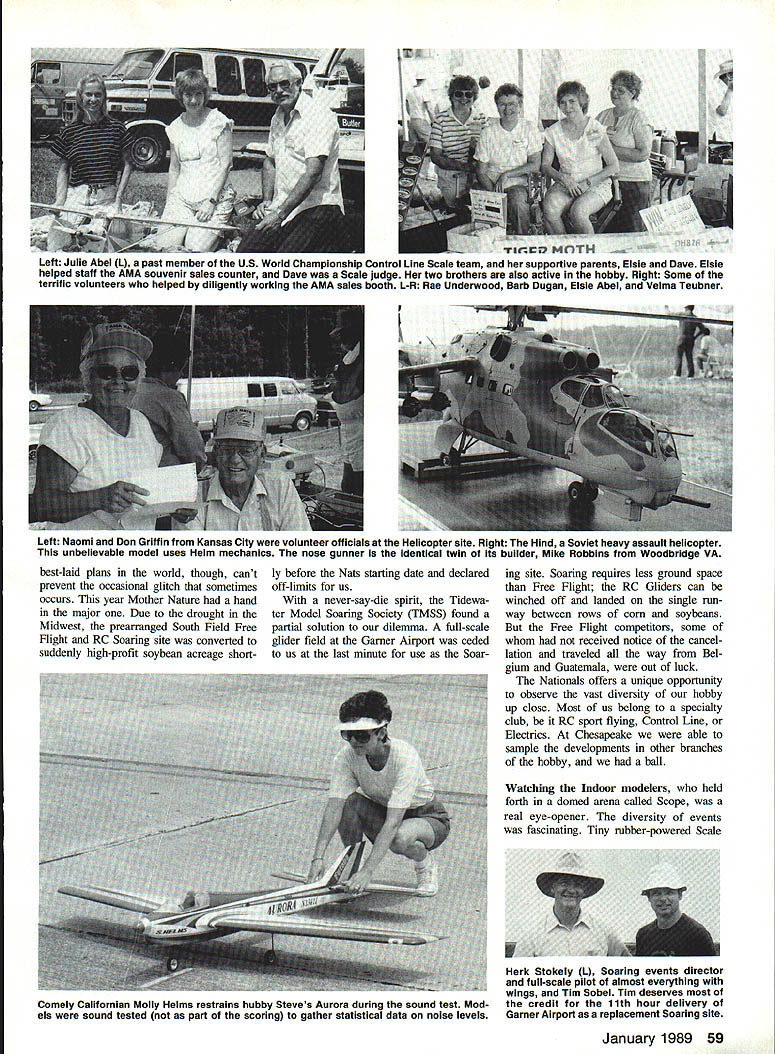
Other Control Line contests are of the one-flier-at-a-time variety. We were lucky to catch up with Julie Abel, world-class Control Line Scale competitor, who told us that she just missed the cut as a U.S.A. team member in the 1988 World Championships held in Russia. Judging from the spirit she displayed, we're convinced Julie will be on top again at the next competition. Interestingly, an FAI Control Line Scale competitor must sign a declaration that he or she is the sole builder of the model entered. So there, you male chauvinists! Go eat some humble pie! Julie not only flies with the best, she also builds world-class!
RC Pylon Racing
RC Pylon Racing stirs memories of the Cleveland Air Races during the Thirties. Flying racetrack patterns at low altitude around the pylons at nothing less than max throttle has to be a full-flow adrenaline experience. For safety's sake spectators are kept at a distance, which tempers the immediacy of that trackside sensation a bit. But with four screaming hornets in hot pursuit of one another, there certainly is a thrill a minute.
Fliers of each heat subsequently compete against other entrants. The champion is the one with the most points when all the heats have been completed. Tuned pipes notwithstanding, we doubt that any of these engines sounded off at less than 100 decibels, which explains why the mechanics all wear earplugs. With guided "missiles" such as these on the loose, scoring officials are fenced in for their own protection.
RC Soaring
Less spine-tingling, but no less absorbing, is the RC Soaring competition. A Soaring competitor chooses not only the size of his plane, but whether or not his bird is to be a replica of a full-size, man-carrying glider. Four competition classes cover wingspans from less than 4 1/2 ft. to — well, as long as a chap can bring to the flying field.
We watched them fly a seven-minute precision-duration task. In this aptly named contest, neither less nor more is better. The highest-scoring flight will have the glider's nose kissing the ground just as the timer's countdown hits zero. The clock starts ticking when the winch line is released from the airborne plane. The pilot starts sniffing for a nibble — a thermal or updraft — which will sustain his plane until the proper time has elapsed for initiating the landing maneuver.
Landing must be not only on time but on target. The pilot selects his touchdown point, the center of a 50-ft. circle. The closer to the center he lands, the more points he earns. To the Nats crowd's credit, there was many a flier who bulls-eyed the landing circle the day we watched.
A competition site far removed from any sort of gastronomic facility may have its disadvantages, but the Ladies Auxiliary of the local Volunteer Fire Brigade came to the rescue at Garner Airport. Twice a day they paid a mess call with a truckload of edibles — and sold out every time. Nobody went hungry, and a beautiful people-bridge formed the gap between local residents and visiting high-soarers.
Banquet, speakers, and advocacy
The Monday night AMA banquet was attended by about 140 persons, a somewhat smaller number than in previous years. Among the guests were officers from the Oceana Naval Air Station, who were accorded warm thanks by AMA President Don Lowe for the Academy's use of their Fentress facility. It is hoped that the 1989 World Aerobatic Championships may be hosted by AMA at Fentress.
John Baker, the eleven-year-veteran AOPA president, addressed the gathering. (AOPA is the Aircraft Owners and Pilots Association, the national organization representing general aviation.) Steeped in practically all phases of aviation including modeling, Baker once walked 320 miles back to civilization after having been shot down as a military pilot.
He drew an interesting parallel between general aviation and model flying. Both groups are doing an inadequate job of public and political relations, Baker warned, especially in contrast to such organizations as the National Rifle Association and the Right to Life advocates. Full-scale and model aviation groups confront similar problems — beleaguered airports and flying sites — and face a similar apathy on the part of their enthusiasts. The available figures for U.S. general aviation planes, persons carried, mileage flown, and airports utilized exceed similar figures for commercial aviation by a factor of at least 10. Not so, unfortunately, the force of our aggressive thrust for our rightful place under the sun.
Don Lowe later added that of the estimated five million modelers in the U.S., only a little more than 135,000 are AMA members. Politicians, better described as representatives of the people, do behave in accordance with the squeaky-wheel axiom — and certainly wouldn't ignore a tuned chorus of five million squeaks. There is strength in numbers, surely. If AOPA and AMA were able to speak with authority for all their potential members, both organizations could provide leadership with far more impressive clout.
Volunteers, families, and recognition
Enthusiasm and support are never lacking from all those who come to the Nats. Especially memorable are the families. Equally humbling to this observer is the unselfish service rendered, usually under physically trying circumstances, by all those wonderful, gracious volunteers:
- contest and event directors
- judges
- scorekeepers
- impound officials
- go-fers
- grounds police
- and the many others who perform away from the limelight during their finest hour
May we be allowed to recognize the combined, magnificent achievement of these volunteers in this most inadequate fashion. We're confident that the entire AMA membership joins us in honoring them. Associations with this fine group of people far outweigh all other Academy benefits. Where else could one acquire such a large circle of friends one hasn't even tried to cultivate? This old head is bowed in silent admiration. Life certainly is worth living!
Fentress/Berman
RC Pattern competition
Purposely saved till last is our RC Pattern competition commentary. Yes, as threatened in our article, "I Premiered the Nats" (Model Aviation, January 1988), we built two Auroras. No, we did not purchase two kits. Due to an "I don't have it" radio glitch with a brand-new set, we simply built the original kit twice — and the second time around was just a month before the Nats!
No, the Aurora did not help our competitive standing. That's because the majority of those other self-styled Sportsman contestants should more properly have registered for Advanced class. For another alibi, we were apprised of our failure to build differential into the aileron throws — more up than down. Symmetrical throw, these fliers said, produces a yaw, or turning moment, into the down-side aileron, and makes an attempted straight-line roll behave like a spiral. Oh, well...!
Starting timer Juan Crofton, a volunteer from nearby Norfolk, motivated those engines so well that every single one came to life well within the allowed three-minute window — even one luckless engine which exhibited a defunct glow plug after the clock had started ticking. Sound engineer Rick Schott, a recruit from Virginia Beach, measured and recorded the full-throttle sound of every engine solely to accumulate data for possible future restrictions. He informed us that of the 64 Sportsman category planes, none — zilch — passed the aimed-for 90-dB-at-9-ft guideline noise threshold! Hear, hear, you muffler makers!
Most of the planes flown were true Pattern aircraft. There was one Super Kaos .40, one Aeromaster Too, and a shoulder-wing plane resembling a Wolf-Pak Shrike. The latter suffered in-flight structural fatigue and crashed. Crashes, by the way, included at least one midair with a ship from the upstream (or was it downstream?) flightline. The plucky young crash-ee finished the contest with a borrowed plane. One neighbor on our flight line, a member of the Air Force, competed with a Davis Diesel conversion of his Super Tigre engine. His plane seemed to perform well enough with no unusual starting or running problems.
Of course, Pattern flying remains an amateur pursuit because nobody gets paid. Still, our top guys are so much better than the rest of us that we can't help dubbing them "pros." It's fun to watch their crisply orchestrated performances; we almost become Pattern judges ourselves. We eyeball their ships and equipment, wondering whether ownership of the like could boost our performance to their stratum. Naturally, there's always that nagging doubt in our own, inferior talent tugging us back to reality.
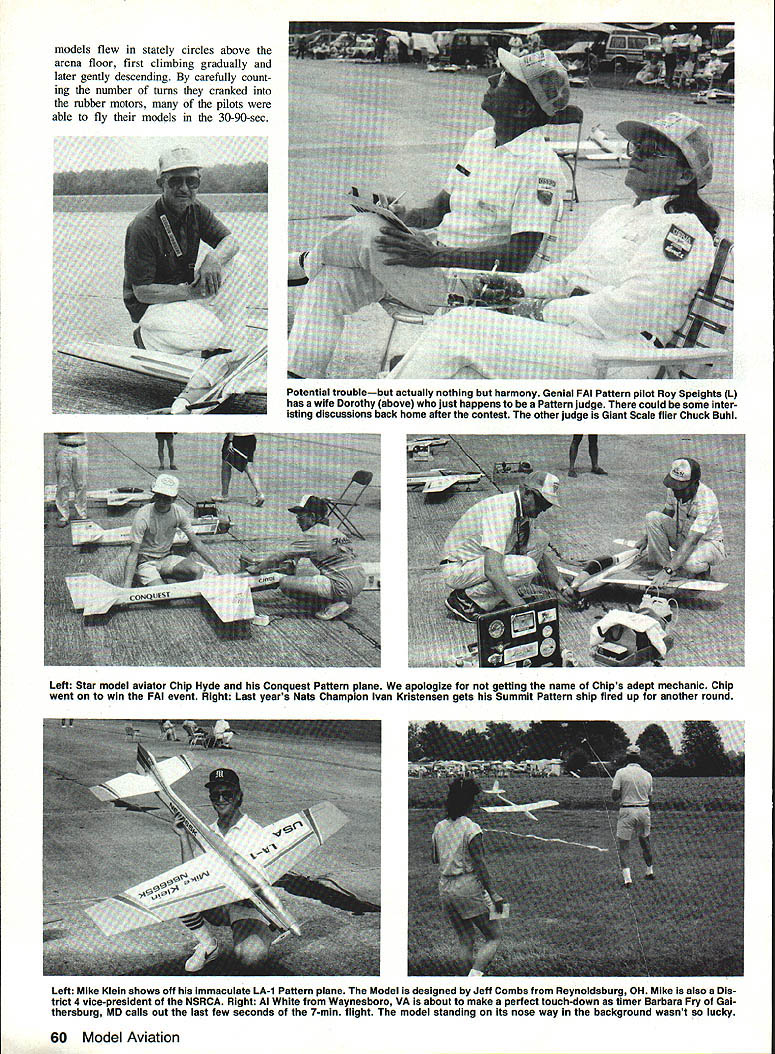
One young man's talents demand to be singled out. Gordon "Chip" Hyde (Yuma, AZ) is a very personable, wide-awake, 16-year-old who has been in the hobby only two years. He has allowed his obvious enthusiasm to go to his head. The fact that Time magazine reporters had arrived purposely to interview him didn't prevent Chip from crewing for other youngsters at the Nats.
Of course, Chip crossed us up by flying a new Conquest plane instead of last year's Aurora. We hear, too, that he uses a secret, so-called quiet motor mount which in some manner sports a piece of motorcycle inner tube, although we're not free to divulge further particulars for fear of being sued for patent infringement. We can report, however, that Chip's father, Merle, not only won top honors in the Advanced Pattern category, but also was awarded the Quiet Machine trophy, presumably for having flown with an engine mount similar to that of his illustrious son.
Sportsman and Advanced trophies were awarded promptly to the top 11 finishers. And you-know-who was spared the transportation hassle of one of those coveted hunks of walnut. Next year, maybe? Guess that will depend on how many next years are left.
The RC Pattern awards ceremony was held at the headquarters Holiday Inn where the NSRCA (National Society for Radio-Controlled Aerobatics) treated all comers to a fine buffet supper. Each segment of our hobby maintains its separate activity group under the AMA umbrella. Chiefly, these groups organize area contests, issue a newsletter, take part in rules making, and serve their particular modeling activity in every manner possible. Dynamic, affable NSRCA President Craig Millett explained how his local members assisted AMA in running the Nats. Amazingly, 41 volunteers were required just to staff the Sportsman competition with its 64 entrants. The Nats certainly is labor intensive!
No question about it, competition doesn't appeal to everyone. On the other hand, the experience of attending a Nats seems to be a strong catalyst for energizing and teaming up families. We saw scores of examples, of which our photos inadequately depict but a few.
Competition is pulse quickening, even for the spectator. Why else would the likes of Jack Nicklaus, Al Unser, Peggy Thomas, Mike Tyson, Darryl Strawberry, and Mario Lemieux have so many loyal followers? We modelers have our own champions: Kristensen, Hyde, Helms, Abel, Richmond, and so many others. And we needn't buy a ticket to watch their superior efforts. Our superstars have climbed to the peak of the achievement ladder, a summit which we ourselves are unlikely ever to reach. But wouldn't it be grand if we, at the bottom, could manage just one step higher? I'll not give up trying for a toehold on the next rung up. Won't you join me? At the '89 Nats, maybe?
Transcribed from original scans by AI. Minor OCR errors may remain.

