

Spirit of Lorain
Mohsen A. Mabrouk
Inspiration and goal
Having lived in the Cleveland area since 1970, I have done a lot of boating on Lake Erie. One day, sailing far offshore in pursuit of better fishing, the lake seemed endless; it occurred to me that, to a model airplane, the lake would be equivalent to an ocean. I wondered if a model could cross from the American side to the Canadian side some 40–50 miles away. This had never been done before (to my knowledge), although some of the local RC club members had thought of it.
As time passed, the idea turned into a project. I set out to build and fly an RC model that would take off from Lorain, OH, on the southern coast of Lake Erie, and continue to fly nonstop to Point Pelee, Ontario, on the northern coast of Lake Erie about 40 miles away. I decided to name the plane The Spirit of Lorain after the city from which I would begin the flight.
Design and construction
I started looking for a suitable model. It had to be large and lightweight to carry a lot of fuel without the need for a very large engine. It had to be rugged to withstand rigorous testing and stable to track straight. The Balsa U.S.A. 1/4-scale J-3 Cub filled the bill perfectly.
The other very important element was the engine. It had to have good fuel economy, great reliability, and high torque to swing a propeller large enough for the 20-lb. plane. I talked with Mr. John P. Maloney of World Engines about the project, and he suggested the O.S. Max .90 four-cycle. It turned out to be an excellent choice.
Construction started in May 1984 and proceeded slowly due to a busy schedule and the need for some modifications to the kit design. Construction was completed by February 1985.
Testing and first attempt
Testing started in March 1985 and continued until August. By then the craft (equipped with an 80-oz. fuel tank and 1,200 mAh battery pack) could fly for 2½ hours nonstop at full throttle — and some fuel was left in the tank. Since that was more time than needed to fly across Lake Erie, I decided to try as soon as we had a calm day.
West Erie Avenue, near the lake, was the takeoff site, as there were no other open areas closer to the boat docks. Nearby power lines and trees were worrisome, but on August 17 at 8 a.m., the Spirit of Lorain took off as planned and circled a couple of times while gaining altitude. I got into the hatchback of the chase car and was taken to the waiting boat about a mile away.
Rick Schramm, the copilot, was waiting in the boat prepared to take over the controls until I could get in, but that wasn't necessary. I jumped in the boat, and we were on our way.
At one point I glanced at the trims on the transmitter, not realizing that the boat had changed direction. In that brief instant I lost sight of the plane. I looked back to where it was supposed to be, but it wasn't there! A moment of panic passed while I scanned the sky. I finally found the plane 1,500 feet off our starboard bow moving steadily toward the north. After that, my eyes were glued to the airplane; unlike flying while standing on the ground, boats can change direction!
The boat was cruising at 25 mph, and because of a light tailwind, the plane was getting too high and too far ahead. I slowed the engine to an idle and let the plane go into a shallow descent. It took the boat about 10 minutes to catch up. I advanced the throttle to resume level flight, but nothing happened — the engine had stopped. I yelled to the skipper to stop the boat, turned the plane around, and ditched it about 30 feet off our port side.
Disappointed, but not discouraged, I fished the plane out of the water and checked for damage. There was none. We disassembled the wet plane and headed back to the dock. The trial was not a total failure. I found that I could take off from the less-than-best runway with a full load of fuel, and that was my greatest worry. It did not take much work to dry out the fuselage and check all the components. Everything seemed to be in order, but nonetheless I replaced the receiver, which got soaked when the plane went down. I made a couple of test flights of about two hours' length with no problems.
The Spirit of Lorain was ready again.
The next day I received a phone call from Mr. Karl Witt of the Copper Kettle Marina. He said that he had read about the unsuccessful attempt in the newspaper and that the Copper Kettle Marina would be glad to let us use a Wellcraft Nova 23 as a chase boat. That was a great help.
Second attempt and successful crossing
I tried again on August 22. The model made a smooth takeoff, and in a few minutes I was in the chase boat guiding the Spirit of Lorain north to Canada. This time it flew against a headwind of about 10 mph, which slowed down the plane's ground speed by that much. Even though the throttle of the O.S. engine was wide open, the chase boat had to go only 35 mph, which the Nova 23 delivered with ease.
The first few minutes were tense, but my nerves settled down as the model cruised steadily on course at an altitude of about 100 ft. We held it about the wind axis for the most part; the heading was close to where we wanted to be.
We had been in the chase boat for about 45 minutes when suddenly it seemed that the plane had stalled. It was going down fast, so I put in full throttle and gave up some elevator to get it back. It recovered nicely. About five minutes later I noticed that it seemed to be hanging there as if it were stalled but still flying. Then I saw a small object fall from the plane. I banked to the left to check and saw that a piece of the cowling had come off. I called to the skipper to slow the boat, but the wind and waves were making control difficult. By the time we had slowed, the plane had dipped dangerously. I pushed the nose down to increase airspeed and recovered.
We were now over shallow water, and the plane was flying with no visible problems. Forty minutes had elapsed. No land was in sight. We were holding a 340° heading. I handed the controls to Rick and said, "Keep it there; I'm going forward to watch." A ship appeared off the starboard bow about two miles away. As we passed it, I could read the name on the sand dredger, John Emry-Lorain. We waved to the crew, and they waved back as we continued on our way.
An hour had passed, and we were in Canadian waters. A white structure appeared some five miles away. As we got closer, we could see it was an electronic lighthouse which produced some kind of navigation beacon. I feared radio interference from its power signal at close range but was relieved when we passed it without any problem.
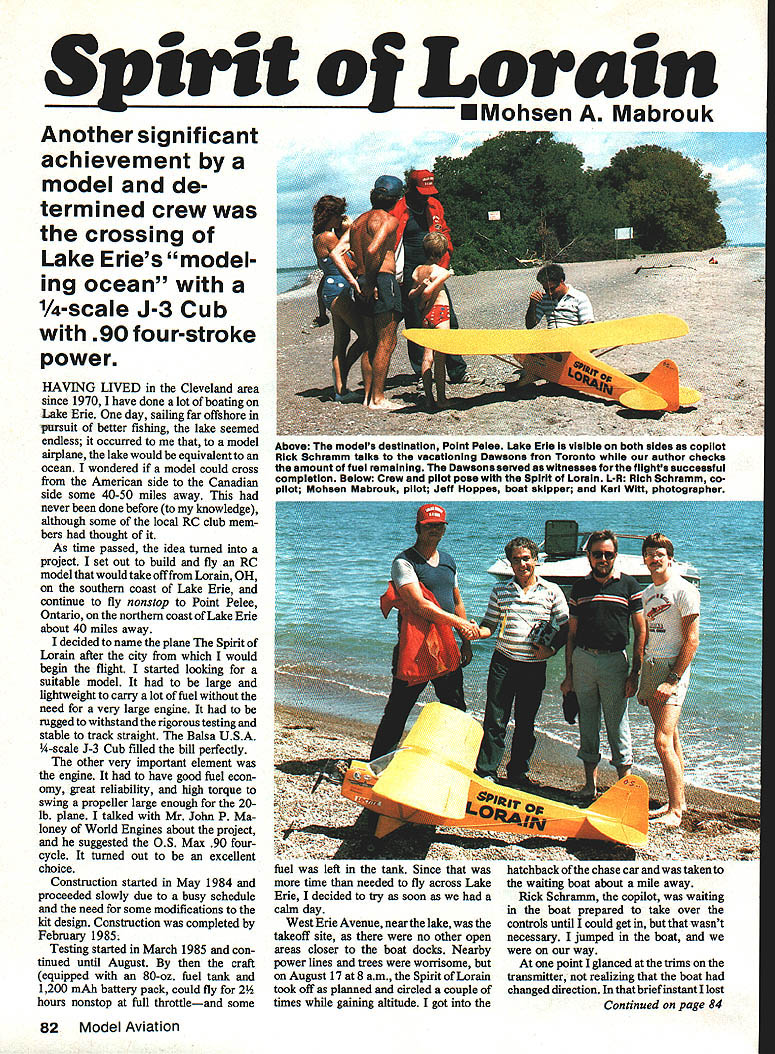
Once we passed the lighthouse, we could see land dead ahead about 10 miles away. If that was Point Pelee, it would mean that Jeff Hoopes, the boat skipper, had navigated perfectly on course. It was actually Point Pelee; we could see it 15 minutes later, and beaches large enough for landing also came into sight. Soon the Spirit of Lorain was flying over dry land. Jeff Hoopes beached the boat, and I jumped onto the beach, transmitter in hand. I circled a couple of times while reducing altitude. The final approach was from the south, slowly descending toward the sandy beach. As soon as the wheels touched the loose, bumpy sand, the Spirit of Lorain came to a sudden stop and flipped over with its tail up in the air. No matter. To me this was a pretty sight. We had made it.
The crowd of vacationers that gathered—to see what they thought at first was a full-size aircraft—was our witness that Lake Erie was conquered by the Spirit of Lorain.
Transcribed from original scans by AI. Minor OCR errors may remain.

