
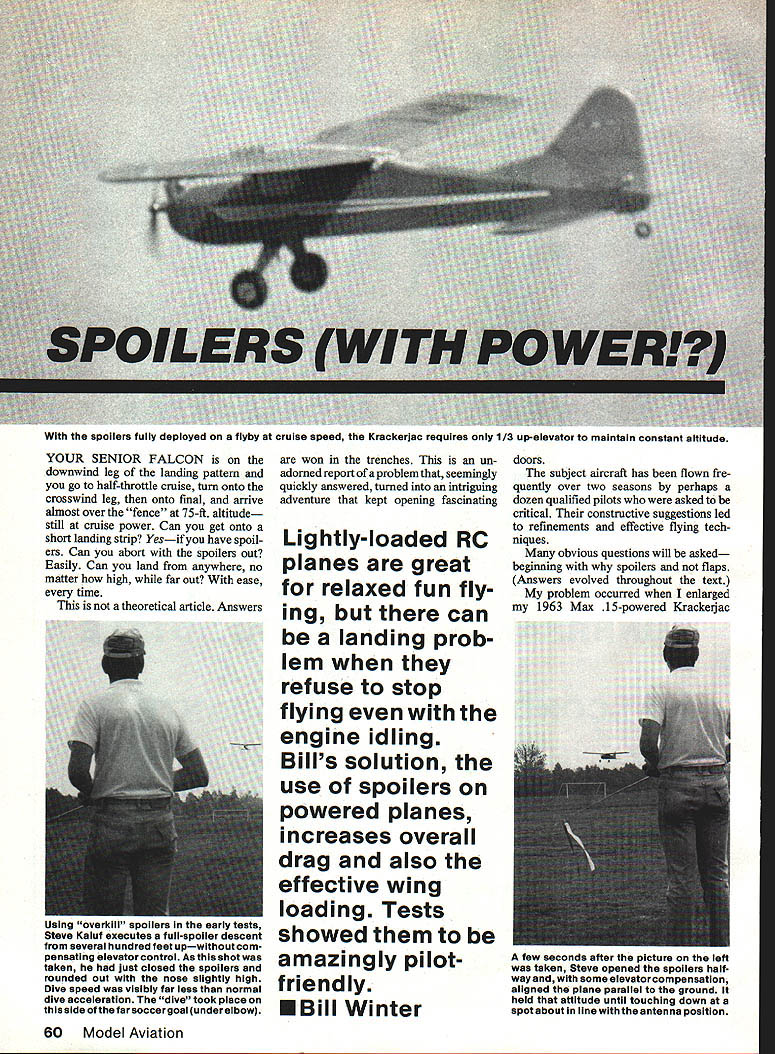

SPOILERS (WITH POWER!?)
Your Senior Falcon (or similar lightly loaded R/C ship) is on the downwind leg of the landing pattern. You go to half‑throttle cruise, turn onto the crosswind leg, then onto final — and arrive almost over the fence at about 75 ft. altitude, still at cruise power. Can you get onto a short landing strip? Yes — if you have spoilers. Can you abort with the spoilers out? Easily. Can you land from anywhere, no matter how high, while far out? With ease, every time.
This is not a theoretical article. These answers were won in the trenches. The following is an unadorned report of a problem that, seemingly quickly answered, became an intriguing adventure and led to several useful, practical refinements.
— Bill Winter
Problem background
Lightly loaded R/C planes are great for relaxed flying, but there can be a landing problem when they refuse to stop flying even with the engine idling. I encountered this after enlarging a 1963 Max .15‑powered Krackerjac. A few seconds after an in‑flight photo was taken, my pilot (Steve) opened the spoilers halfway; with some elevator compensation the plane aligned parallel to the ground and held that attitude until touching down almost exactly in line with the antenna.
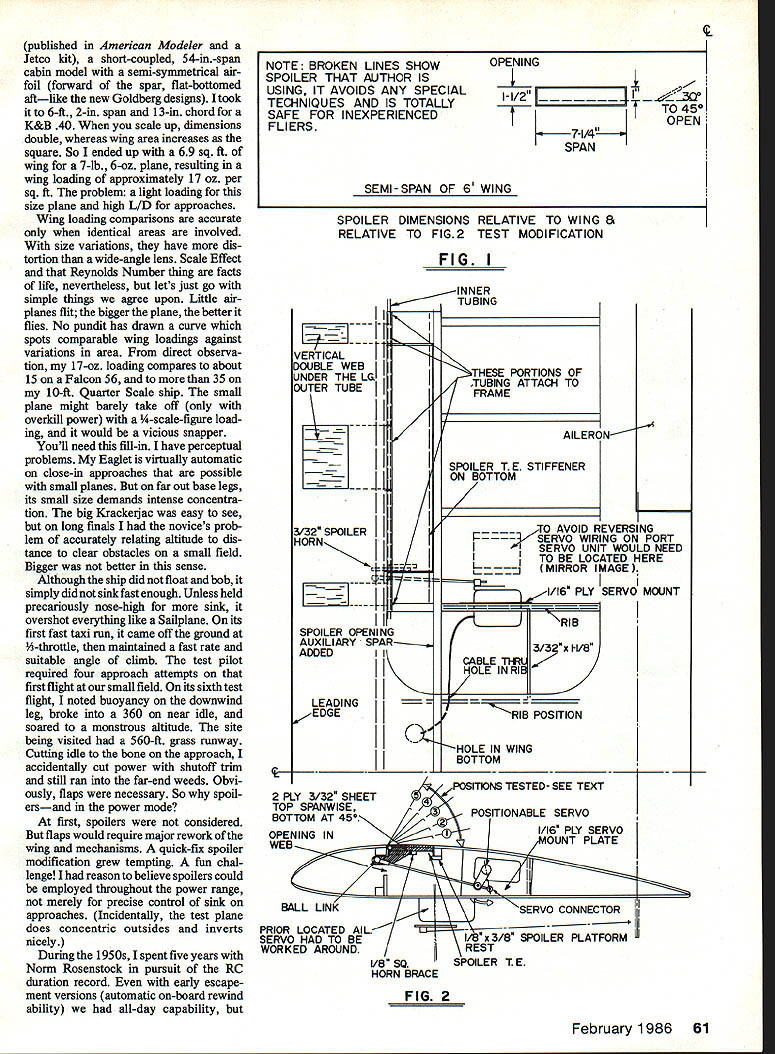
The model was scaled up to about 6 ft 2 in. span with a 13‑in. chord. That produced nearly 1,000 square inches of wing area on a 7 lb 6 oz airplane, yielding a wing loading near 17 oz per sq. ft. The problem: the light loading and large wing area produced very high L/D approaches — the ship simply would not sink fast enough. Unless held nose‑high, it sailed past everything like a sailplane.
On initial test flights the model floated, bobbed and required repeated approaches; on one downwind it climbed to a huge altitude near idle and later, after a power failure on approach with trim still set, ran into the far‑end weeds. It was clear: some way to increase sink and braking was needed. Flaps were considered, but would have required major wing rework. So a quick‑fix spoiler modification was attempted — and it worked very well.
Why spoilers (not flaps)?
- Flaps can generate additional lift at intermediate positions (and change pitching moment unpredictably with power), so they may require significant mechanical changes and trim work.
- Spoilers never add lift — they kill lift over a portion of the wing, increasing effective wing loading and adding drag. That lower L/D and added drag produce steep, predictable sink rates without large speed build‑up.
- Spoilers are simpler to retrofit and can be made to work throughout the power range, permitting precise control of sink approaches and safe aborts.
Historical note: spoilers in early R/C
In the 1950s, while working on duration attempts with Norm Rosenstock, we used spoilers for altitude control when throttle control was limited. A 1 x 4 in. spoiler hinged at its leading edge produced a steady, mid‑flap‑like descent with no tip‑stall tendency. A single strand of 1/4‑in. rubber to an SN escapement operated the spoiler easily; the "vacuum" sucked the spoiler up and drag slammed it shut. The technique translated well to powered ships in later tests.
Spoiler design and installation
- Initial test spoiler: large chords (early overkill spoilers were 7/16 x 1 in. in one test, later reduced).
- Final effective configuration (as refined by field tests): a small chord (about 3/8 in.) and only two positions: open (about 30°) and shut. This proved sufficient for most sport fliers.
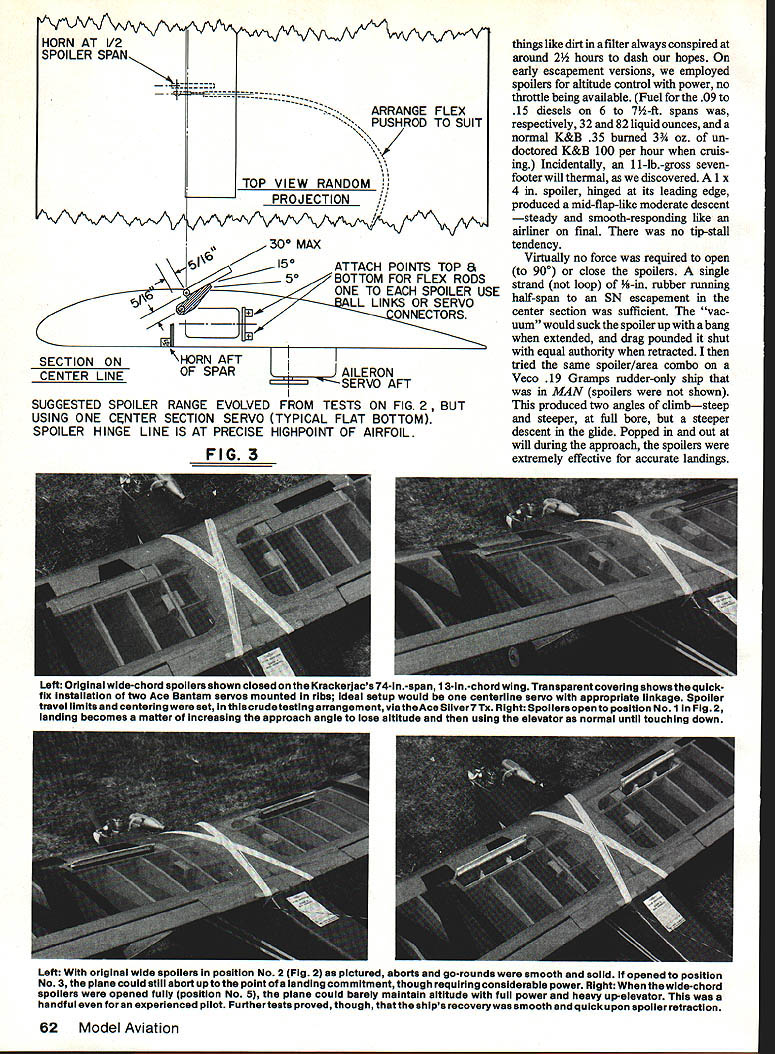
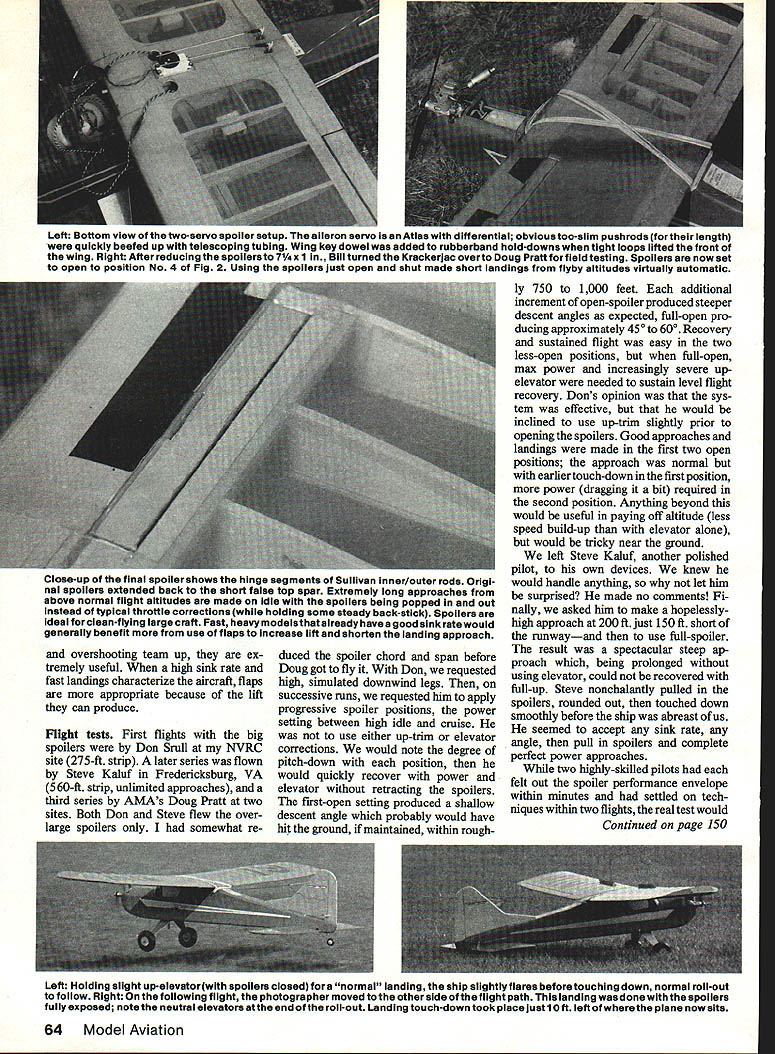
- Mounting: hinge the spoiler at its leading edge in the center section. One standard servo on the centerline is preferred during construction. Any reasonable mechanism (cables, torque rods, pushrods, bellcranks) will work.
- Control options: early experiments used the flap channel with several discrete positions. Practical field use favors a simple open/shut arrangement operated by the retract channel or a dedicated switch.
- Trim: provided spoilers are not too large, all degrees of exposure are readily trim‑compensated with appropriate back‑stick. Slight up‑trim before opening can help, but heavy pre‑trim combined with large spoiler openings can produce odd behavior (the model appearing to hang and sink simultaneously).
Note: Fig. 1, Fig. 2 and Fig. 3 were used in the original tests to show spoiler size, positions and a two‑servo fix on the Krackerjac. In practice, the two‑position (open/shut) small spoiler proved simplest and safest.
Flight tests and pilot experiences
Flight tests were conducted over two seasons, by a dozen or so pilots. Their feedback produced progressive refinements.
- Don Srull (NVRC site, 275‑ft strip) flew with the large initial spoilers. Progressive openings (no elevator correction requested in tests) showed predictable increases in pitch‑down and sink angle: the first‑open setting produced a shallow descent, additional openings steepened the descent, and full‑open produced approximately 45°–60° dive angles. Recovery from the two less‑open positions was easy with power and elevator; the full‑open position required large power and up‑elevator and was tricky near the ground.
- Steve Kaluf (560‑ft strip) demonstrated spectacular steep approaches. In one test he made a hopelessly high approach (about 200 ft), 150 ft short of the runway, used full spoilers, then closed them and rounded out to a smooth touchdown just before reaching the pilots. Dive speed during full‑spoiler attacks was noticeably less than expected.
- My own experience: I could safely use the first‑open and second‑open positions throughout the pattern, but changing positions late on final (e.g., from No. 2 to No. 3) was risky. For sport pilots, the two small positions (open/shut or two slight openings) are adequate. Using the retract switch for open/shut is an easy and reliable technique.
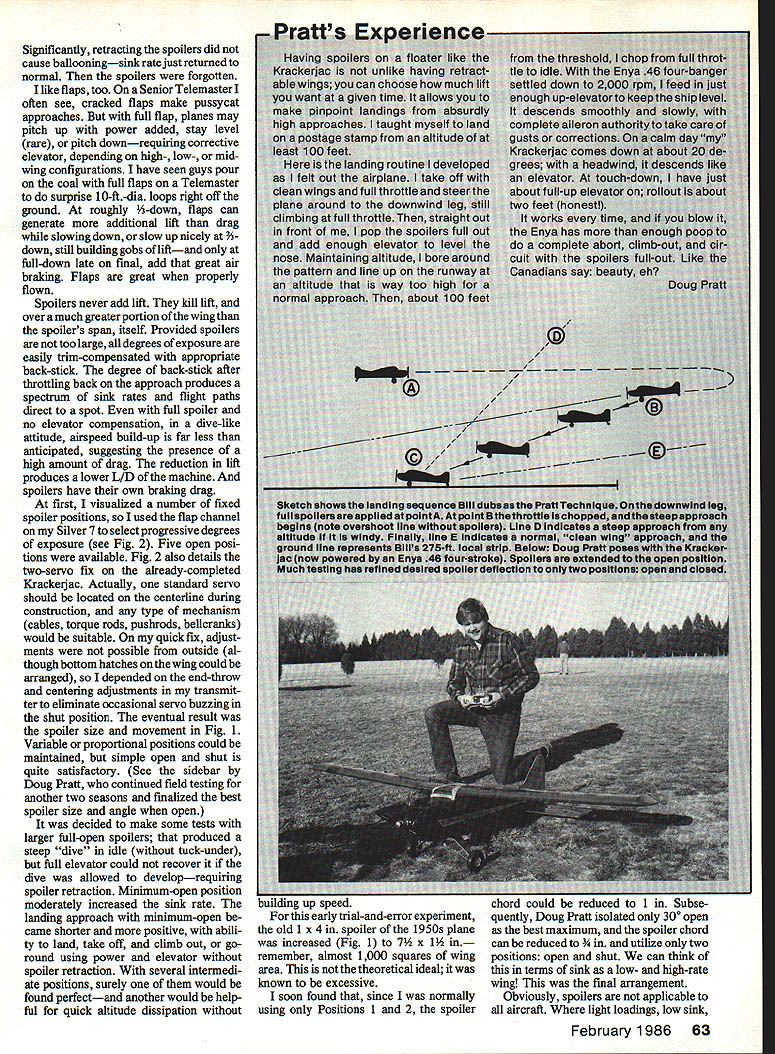
Practical routine developed (see Pratt’s section below): use clean wings and full throttle for takeoff, establish pattern, pop spoilers full out to choose the desired lift, line up high, then chop throttle to idle about 100 ft from threshold and use elevator to control descent. If you blow it, full power with spoilers still out will permit a safe go‑around with normal elevator control on these configurations.
Pratt’s Experience
Having spoilers on a floater like the Krackerjac is like having retractable wings — you can choose how much lift you want. Doug Pratt taught himself to land on a postage‑stamp target from at least 100 ft using spoilers. His routine:
- Take off with clean wings and full throttle; climb in the pattern.
- Ahead of the pattern, pop the spoilers fully out and level the nose with elevator.
- Line up on the runway high; about 100 ft from the threshold, cut from full throttle to idle.
- With the engine settled, use just enough up‑elevator to keep the ship level; it will descend smoothly with full aileron authority.
- Touchdown is extremely short; aborts are simple — apply power, climb out with spoilers still out if needed.
Pratt refined the spoiler size: he found 30° open as the best maximum and reduced the spoiler chord to about 3/8 in., using only two positions (open and shut). This gave a practical low‑ and high‑rate wing behavior that is simple and repeatable.
Conclusions and recommendations
- Spoilers are an effective retrofit for lightly loaded, large‑area R/C aircraft that float excessively on approach. They increase sink rate and add drag without the lift/Q‑moment complications of flaps.
- For sport pilots, install small spoilers with two positions (open/shut) and operate them on a simple switch or the retract channel.
- Establish the desired spoiler position well back on the downwind leg; avoid changing to a much larger opening late on final unless you are highly practiced.
- Use slight up‑trim or be ready with back‑stick to compensate for the pitch‑down when spoilers open.
- For aircraft with very high sink rates or when additional lift is needed during short/rough‑field operations, flaps may still be preferable.
- Field‑test any spoiler installation in a safe, ample area before regular operation.
Disclaimers and tips
- Spoiler effectiveness varies with wing section, aspect ratio and planform. On thin airfoils or at very low Reynolds numbers they may be less effective.
- On very big models spoilers can produce great drag and predictable behavior; on small, heavy or high‑power models the required spoiler size and behavior will differ.
- Do not rely on spoilers alone without practicing recovery procedures: simultaneous retraction, application of power, and correct elevator response can be demanding at low altitude.
- Flight‑test progressively, start with conservative, small openings and pilot practice in calm conditions.
Flight tests by several pilots over multiple sites confirmed that the correct spoiler size and a simple open/shut control offer a practical STOL tool — enabling precise short landings from high approaches and easy aborts when needed.
(Original field figures indicated initial oversized spoilers, a multi‑position control scheme, and later refinement to a small 30° open spoiler with two positions. If you build or modify spoilers, reference your airframe plans and test progressively.)
Transcribed from original scans by AI. Minor OCR errors may remain.

