
Sportster
Harold deBolt
LOOKING BACK over the years, have you asked yourself which airplanes you enjoyed the most? I have and, strangely enough, all the contest winners seem to play second fiddle to a few of what I call my "play" airplanes. These were not intended to win anything, yet their ease of flight and versatility gave me much enjoyment. So it was that I decided to design a new play airplane. What form should it take? The result is the "Sportster," a fine Sunday flier for sure, but a versatile airplane with much added potential!
By designing around the popular .40 engines I have a multi-purpose design which can be used for a variety of purposes besides Sunday fun. A newcomer should be happy with it for general flying, yet it does have the potential to be competitive in several events, at least at the local level.
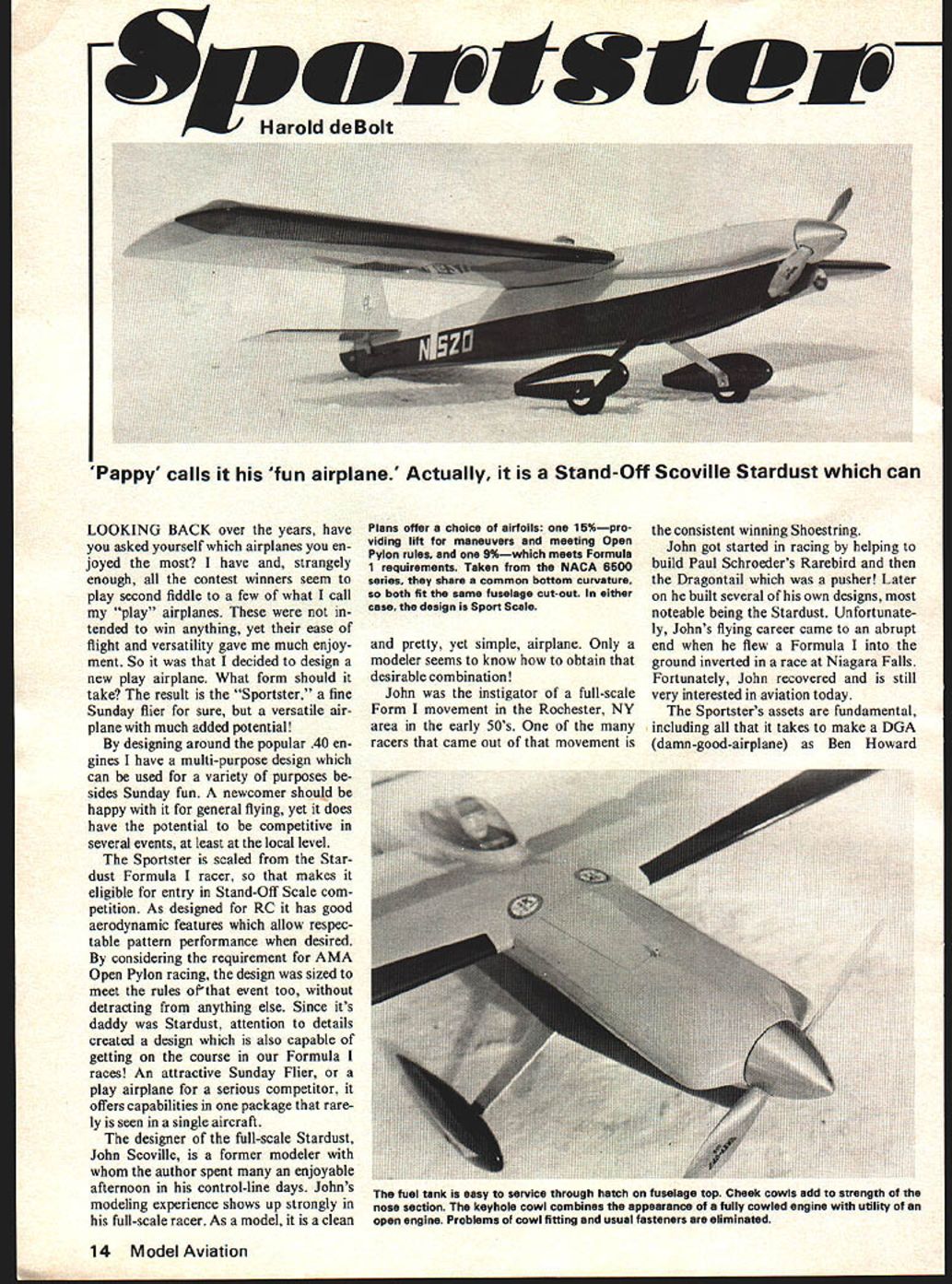
The Sportster is scaled from the Stardust Formula I racer, so that makes it eligible for entry in Stand-Off Scale competition. As designed for RC it has good aerodynamic features which allow respectable pattern performance when desired. By considering the requirement for AMA Open Pylon racing, the design was sized to meet the rules of that event too, without detracting from anything else. Since its daddy was Stardust, attention to details created a design which is also capable of getting on the course in our Formula I races! An attractive Sunday Flier, or a play airplane for a serious competitor, it offers capabilities in one package that rarely is seen in a single aircraft.
The designer of the full-scale Stardust, John Scoville, is a former modeler with whom the author spent many an enjoyable afternoon in his control-line days. John's modeling experience shows up strongly in his full-scale racer. As a model, it is a clean and pretty, yet simple, airplane. Only a modeler seems to know how to obtain that desirable combination!
John was the instigator of a full-scale Formula I movement in the Rochester, NY area in the early 50's. One of the many racers that came out of that movement is the consistent winning Shoestring.
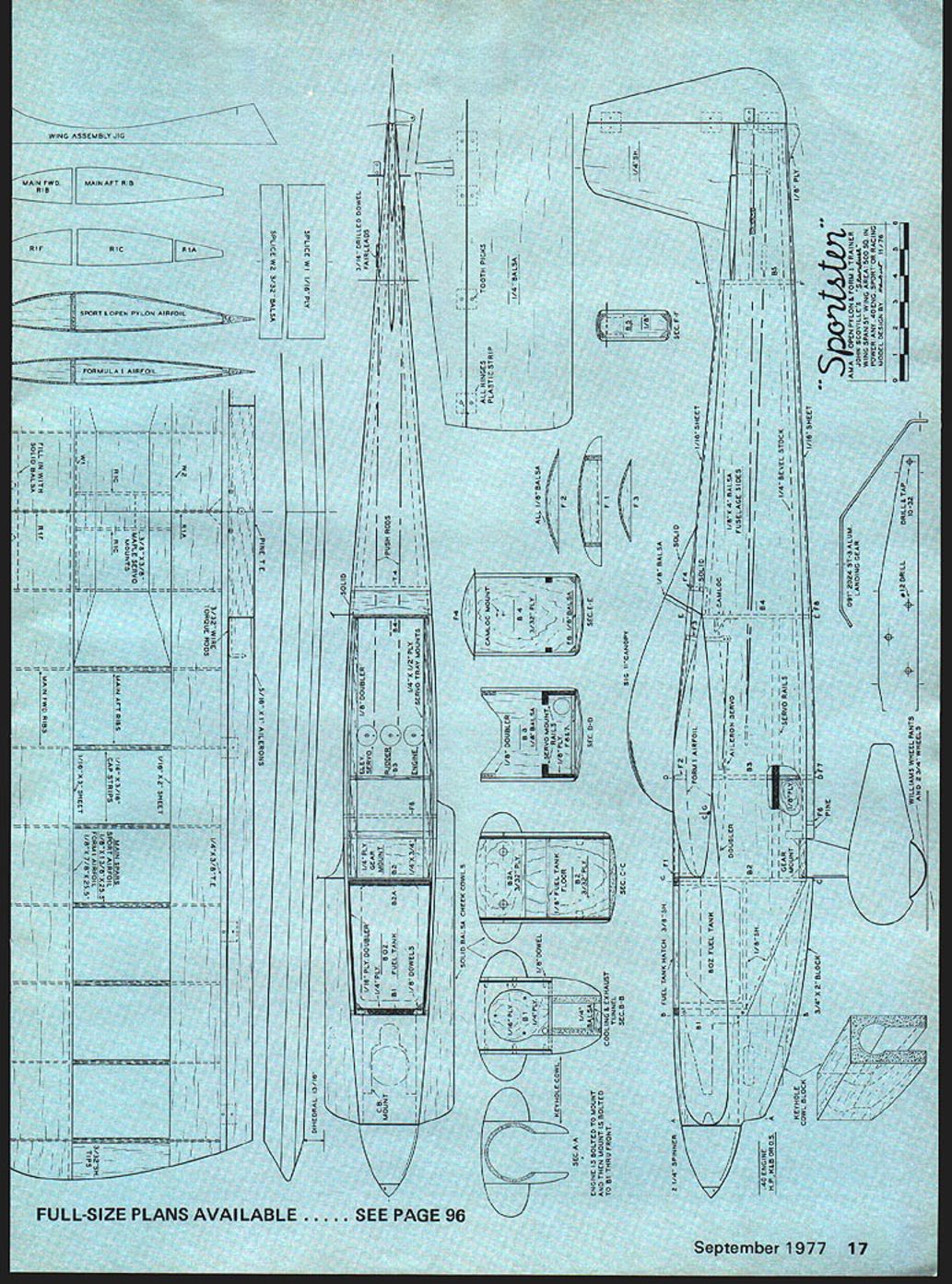
Plans offer a choice of airfoils: one 15% — providing lift for maneuvers and meeting Open Pylon rules, and one 9% — which meets Formula 1 requirements. Taken from the NACA 6500 series, they share a common bottom curvature, so both fit the same fuselage cut-out. In either case, the design is Sport Scale.
John got started in racing by helping to build Paul Schroeder's Rarebird and then the Dragontail which was a pusher! Later on he built several of his own designs, most notable being the Stardust. Unfortunately, John's flying career came to an abrupt end when he flew a Formula I into the ground inverted in a race at Niagara Falls. Fortunately, John recovered and is still very interested in aviation today.
The Sportster's assets are fundamental, including all that it takes to make a DGA (damn-good-airplane) as Ben Howard would have said. For sure, a pretty Sunday airplane should be scaleish. With today's know-how and fine equipment it is just as easy to go that route as any other—the effort is really no greater. Sound basic aerodynamics have been used and, with Scoville's help, that was no chore either. The force set-up is taken directly from pattern and racing experience, which makes for a very docile flying airplane. The airfoils used are from the well-proven NACA 6500 series, which are excellent for modeling.
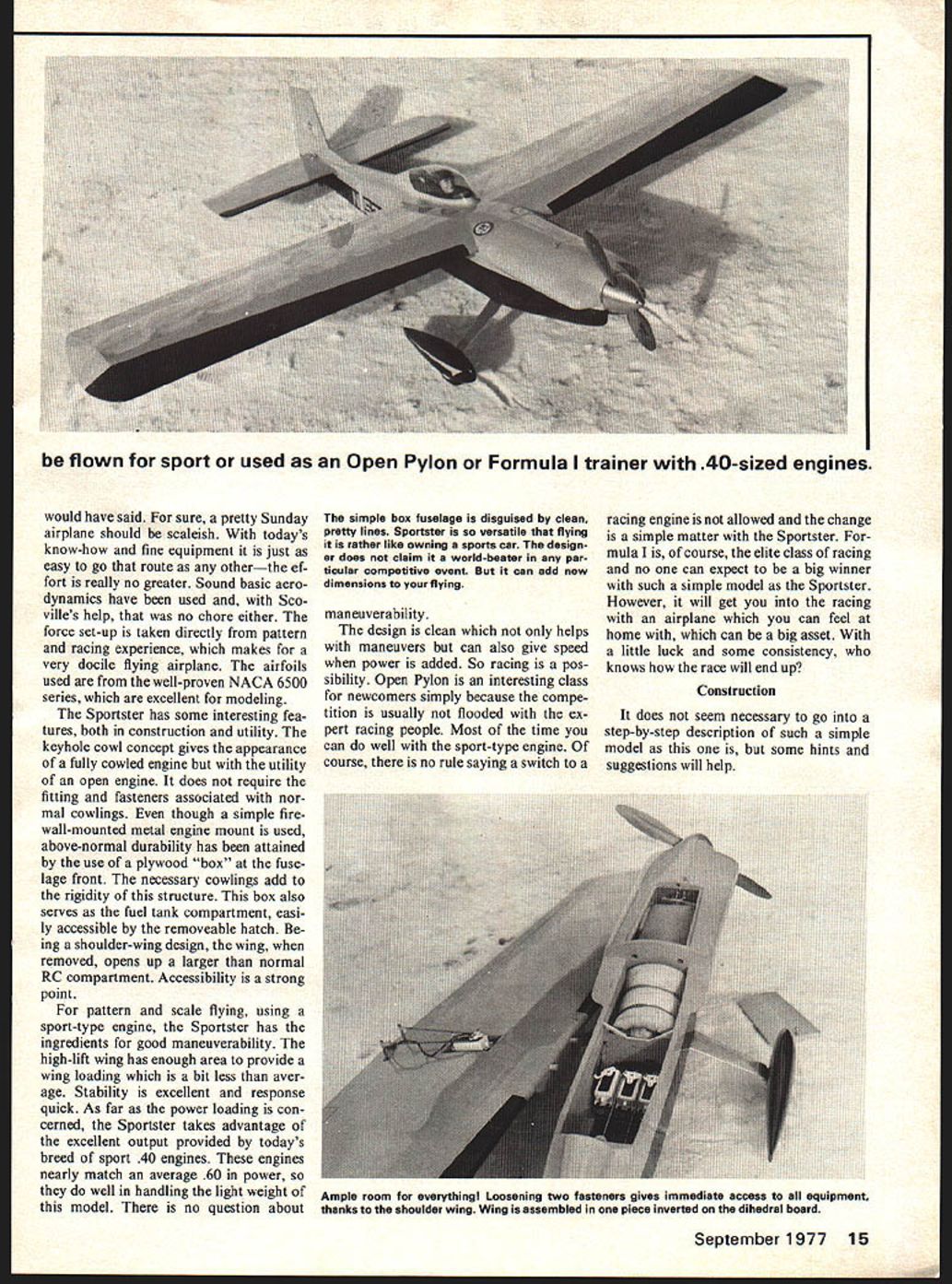
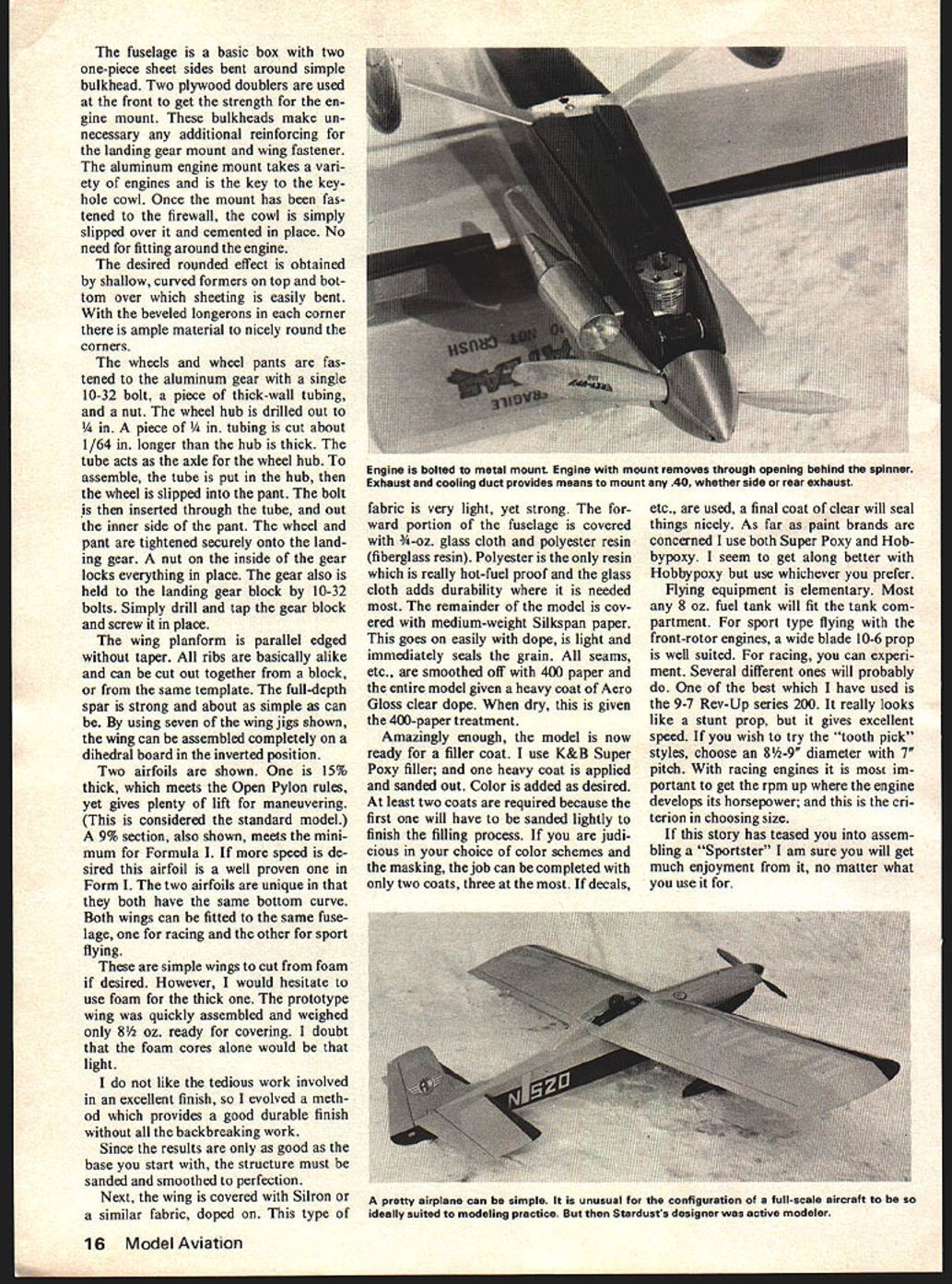
The Sportster has some interesting features, both in construction and utility. The keyhole cowl concept gives the appearance of a fully cowled engine but with the utility of an open engine. It does not require the fitting and fasteners associated with normal cowlings. Even though a simple firewall-mounted metal engine mount is used, above-normal durability has been attained by the use of a plywood "box" at the fuselage front. The necessary cowlings add to the rigidity of this structure. This box also serves as the fuel tank compartment, easily accessible by the removable hatch. Being a shoulder-wing design, the wing, when removed, opens up a larger than normal RC compartment. Accessibility is a strong point.
For pattern and scale flying, using a sport-type engine, the Sportster has the ingredients for good maneuverability. The high-lift wing has enough area to provide a wing loading which is a bit less than average. Stability is excellent and response quick. As far as the power loading is concerned, the Sportster takes advantage of the excellent output provided by today's breed of sport .40 engines. These engines nearly match an average .60 in power, so they do well in handling the light weight of this model. There is no question about
The simple box fuselage is disguised by clean, pretty lines. Sportster is so versatile that flying it is rather like owning a sports car. The designer does not claim it a world-beater in any particular competitive event. But it can add new dimensions to your flying.
Maneuverability
The design is clean which not only helps with maneuvers but can also give speed when power is added. So racing is a possibility. Open Pylon is an interesting class for newcomers simply because the competition is usually not flooded with the expert racing people. Most of the time you can do well with the sport-type engine. Of course, there is no rule saying a switch to a racing engine is not allowed and the change is a simple matter with the Sportster. Formula I is, of course, the elite class of racing and no one can expect to be a big winner with such a simple model as the Sportster. However, it will get you into the racing with an airplane which you can feel at home with, which can be a big asset. With a little luck and some consistency, who knows how the race will end up?
Construction
It does not seem necessary to go into a step-by-step description of such a simple model as this one is, but some hints and suggestions will help. The fuselage is a basic box with two one-piece sheet sides bent around a simple bulkhead. Two plywood doublers are used at the front to get the strength for the engine mount. These bulkheads make unnecessary any additional reinforcing for the landing gear mount and wing fastener. The aluminum engine mount takes a variety of engines and is the key to the keyhole cowl. Once the mount has been fastened to the firewall, the cowl is simply slipped over it and cemented in place. No need for fitting around the engine.
The desired rounded effect is obtained by shallow, curved formers on top and bottom over which sheeting is easily bent. With the beveled longerons in each corner there is ample material to nicely round the corners.
The wheels and wheel pants are fastened to the aluminum gear with a single 10-32 bolt, a piece of thick-wall tubing, and a nut. The wheel hub is drilled out to 1/4 in. A piece of 1/4 in. tubing is cut about 1/64 in. longer than the hub is thick. The tube acts as the axle for the wheel hub. To assemble, the tube is put in the hub, then the wheel is slipped into the pant. The bolt is then inserted through the tube, and out the inner side of the pant. The wheel and pant are tightened securely onto the landing gear. A nut on the inside of the gear locks everything in place. The gear also is held to the landing gear block by 10-32 bolts. Simply drill and tap the gear block and screw it in place.
The wing planform is parallel edged without taper. All ribs are basically alike and can be cut out together from a block, or from the same template. The full-depth spar is strong and about as simple as can be. By using seven of the wing jigs shown, the wing can be assembled completely on a dihedral board in the inverted position.
Two airfoils are shown. One is 15% thick, which meets the Open Pylon rules, yet gives plenty of lift for maneuvering. (This is considered the standard model.) A 9% section, also shown, meets the minimum for Formula I. If more speed is desired this airfoil is a well proven one in Formula I. The two airfoils are unique in that they both have the same bottom curve. Both wings can be fitted to the same fuselage, one for racing and the other for sport flying.
These are simple wings to cut from foam if desired. However, I would hesitate to use foam for the thick one. The prototype wing was quickly assembled and weighed only 8-1/2 oz. ready for covering. I doubt that the foam cores alone would be that light.
I do not like the tedious work involved in an excellent finish, so I evolved a method which provides a good durable finish without all the backbreaking work.
Since the results are only as good as the base you start with, the structure must be sanded and smoothed to perfection.
Next, the wing is covered with Silron or a similar fabric, doped on. This type of fabric is very light, yet strong. The forward portion of the fuselage is covered with 3/4-oz. glass cloth and polyester resin (fiberglass resin). Polyester is the only resin which is really hot-fuel proof and the glass cloth adds durability where it is needed most. The remainder of the model is covered with medium-weight Silkspan paper. This goes on easily with dope, is light and immediately seals the grain. All seams, etc., are smoothed off with 400 paper and the entire model given a heavy coat of Acro Gloss clear dope. When dry, this is given the 400-paper treatment.
Amazingly enough, the model is now ready for a filler coat. I use K&B Super Poxy filler; and one heavy coat is applied and sanded out. Color is added as desired. At least two coats are required because the first one will have to be sanded lightly to finish the filling process. If you are judicious in your choice of color schemes and in the masking, the job can be completed with only two coats, three at the most. If decals, etc., are used, a final coat of clear will seal things nicely. As far as paint brands are concerned I use both Super Poxy and Hobbypoxy. I seem to get along better with Hobbypoxy but use whichever you prefer.
Flying equipment is elementary. Most any 8 oz. fuel tank will fit the tank compartment. For sport-type flying with the front-rotor engines, a wide blade 10-6 prop is well suited. For racing, you can experiment. Several different ones will probably do. One of the best which I have used is the 9-7 Rev-Up series 200. It really looks like a stunt prop, but it gives excellent speed. If you wish to try the "tooth pick" styles, choose an 8-1/2-9" diameter with 7" pitch. With racing engines it is most important to get the rpm up where the engine develops its horsepower; and this is the criterion in choosing size.
If this story has teased you into assembling a "Sportster" I am sure you will get much enjoyment from it, no matter what you use it for. FULL-SIZE PLANS AVAILABLE . . . . SEE PAGE 96
Transcribed from original scans by AI. Minor OCR errors may remain.

