
Spruce Goose Jr.
Howard Hughes' Spruce Goose has been around for a long time, but until recently it rarely was modeled. Then one with eight OS .25s appeared at the 1980 Kitchener-Waterloo Scale Rally, and on December 6 the Meyer brothers' Spruce Goose, with eight K&B .61s, repeated history in miniature. ● Dale Willoughby
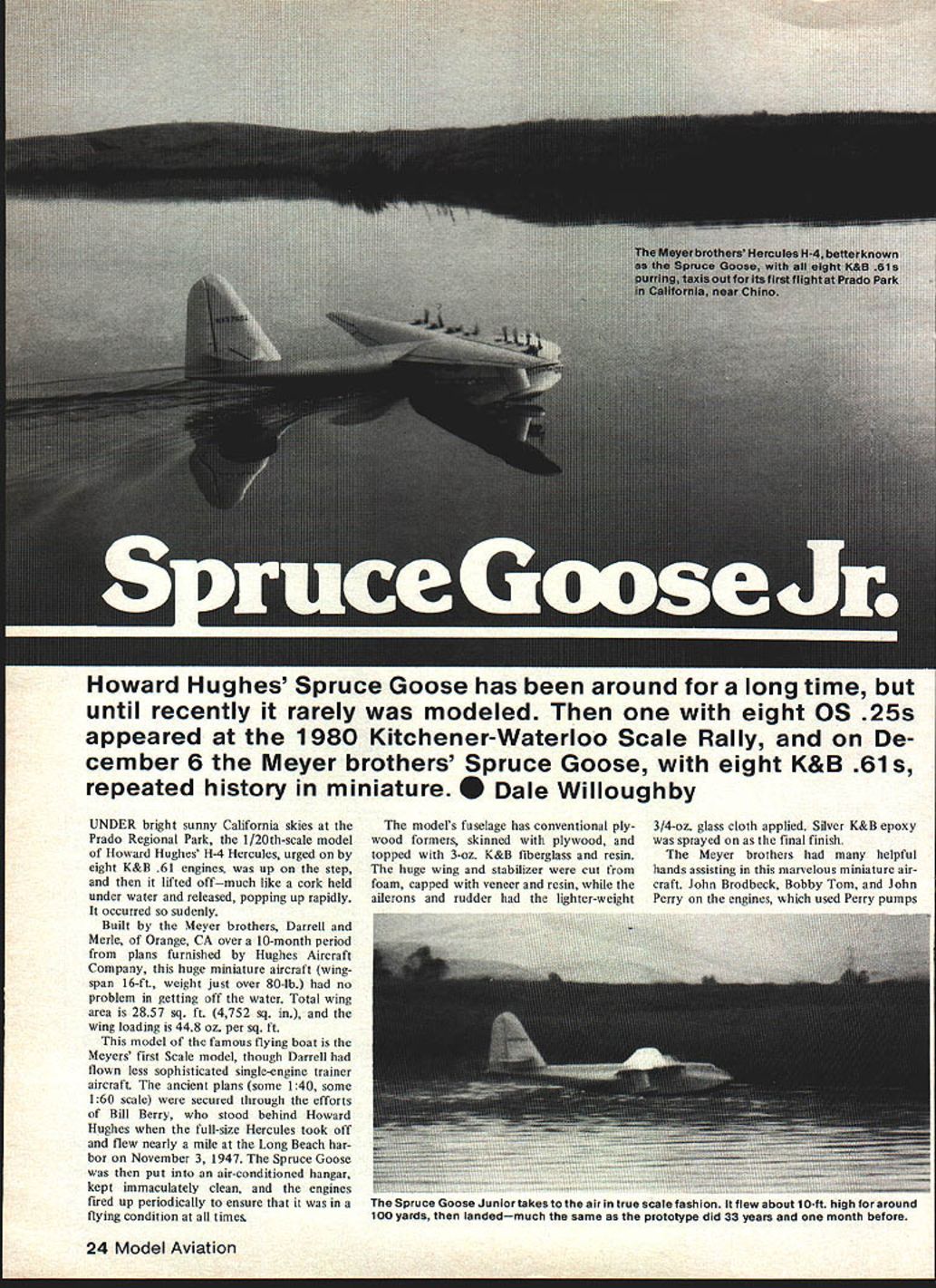
UNDER bright sunny California skies at the Prado Regional Park, the 1/20th-scale model of Howard Hughes' H-4 Hercules, urged on by eight K&B .61 engines, was up on the step, and then it lifted off—much like a cork held under water and released, popping up rapidly. It occurred so suddenly.
Built by the Meyer brothers, Darrell and Merle, of Orange, CA over a 10-month period from plans furnished by Hughes Aircraft Company, this huge miniature aircraft (wingspan 16-ft, weight just over 80-lb) had no problem getting off the water. Total wing area is 28.57 sq. ft. (4,752 sq. in.), and the wing loading is 44.8 oz. per sq. ft.
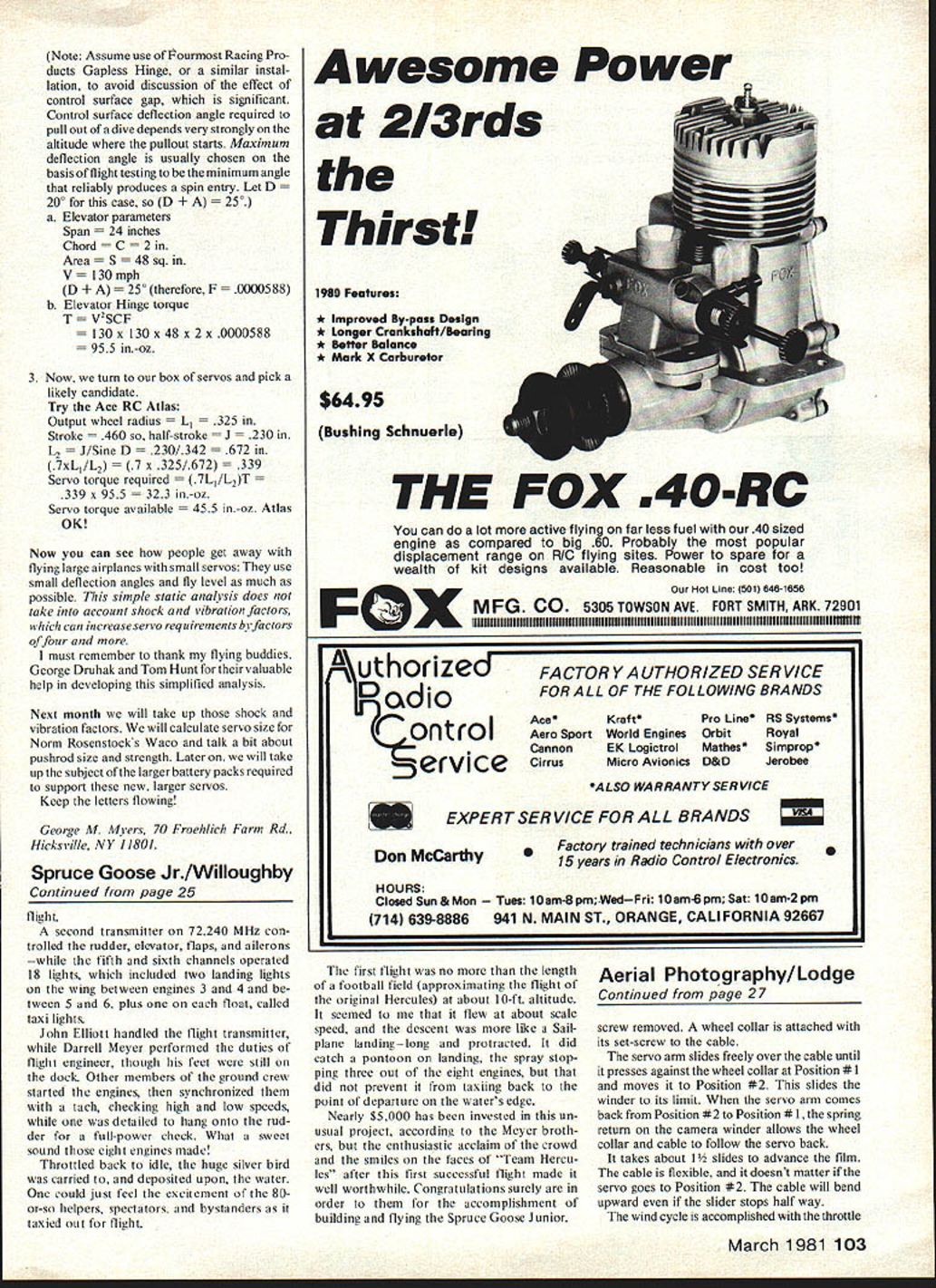
This model of the famous flying boat is the Meyers' first scale model, though Darrell had flown less sophisticated single-engine trainer aircraft. The ancient plans (some 1:40, some 1:60 scale) were secured through the efforts of Bill Berry, who stood behind Howard Hughes when the full-size Hercules took off and flew nearly a mile at the Long Beach harbor on November 3, 1947. The Spruce Goose was then put into an air-conditioned hangar, kept immaculately clean, and the engines fired up periodically to ensure that it was in flying condition at all times.
The model's fuselage has conventional plywood formers, skinned with plywood, and topped with 3-oz. K&B fiberglass and resin. The huge wing and stabilizer were cut from foam, capped with veneer and resin, while the ailerons and rudder had the lighter-weight 3/4-oz. glass cloth applied. Silver K&B epoxy was sprayed on as the final finish.
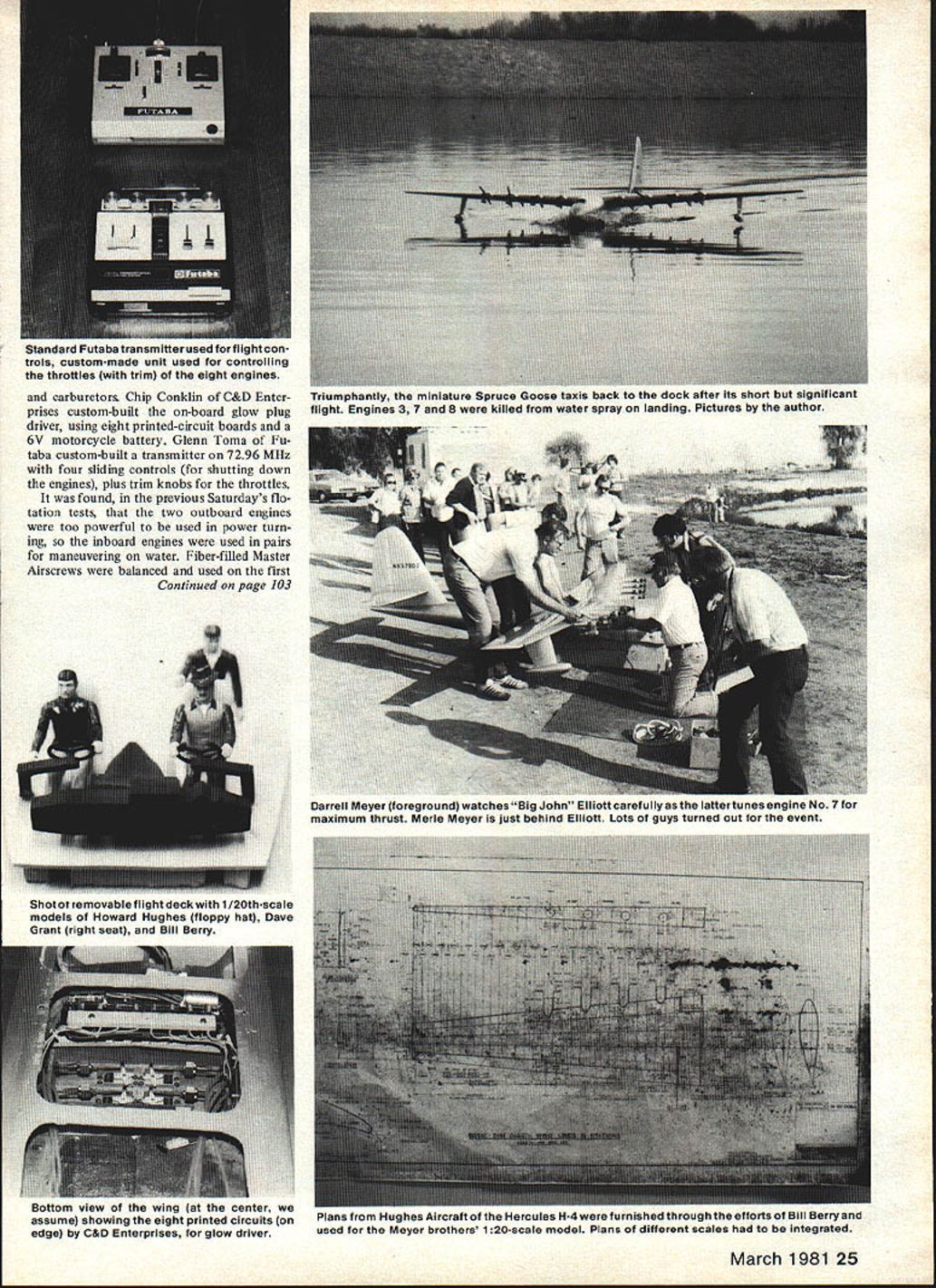
The Meyer brothers had many helpful hands assisting in this marvelous miniature aircraft. John Brodbeck, Bobby Tom, and John Perry on the engines, which used Perry pumps. and carburetors. Chip Conklin of C&D Enterprises custom-built the on-board glow plug driver, using eight printed-circuit boards and a 6V motorcycle battery. Glenn Toma of Futaba custom-built a transmitter on 72.96 MHz with four sliding controls (for shutting down the engines), plus trim knobs for the throttles.
It was found, in the previous Saturday's flotation tests, that the two outboard engines were too powerful to be used in power turning, so the inboard engines were used in pairs for maneuvering on water. Fiber-filled Master Airscrews were balanced and used on the first. flight.
A second transmitter on 72.240 MHz controlled the rudder, elevator, flaps, and ailerons — while the fifth and sixth channels operated 18 lights, which included two landing lights on the wing between engines 3 and 4 and between 5 and 6, plus one on each float, called taxi lights.
John Elliott handled the flight transmitter, while Darrell Meyer performed the duties of flight engineer, though his feet were still on the dock. Other members of the ground crew started the engines, then synchronized them with a tach, checking high and low speeds, while one was detailed to hang onto the rudder for a full-power check. What a sweet sound those eight engines made!
Throttle back to idle, the huge silver bird was carried to, and deposited upon, the water. One could just feel the excitement of the 80-or-so helpers, spectators, and bystanders as it taxied out for flight.
The first flight was no more than the length of a football field (approximating the flight of the original Hercules) at about 10-ft. altitude. It seemed to me that it flew at about scale speed, and the descent was more like a sailplane landing — long and protracted. It did catch a pontoon on landing, the spray stopping the aircraft short of the eight engines, but that did not prevent it from taxiing back to the point of departure on the water's edge.
Nearly $5,000 has been invested in this unusual project, according to the Meyer brothers, but the enthusiastic acclaim of the crowds and the smiles on the faces of "Team Hercules" after this first successful flight made it well worthwhile. Congratulations surely are in order to them for the accomplishment of building and flying the Spruce Goose Junior.
Transcribed from original scans by AI. Minor OCR errors may remain.

