
Square 1
Overview
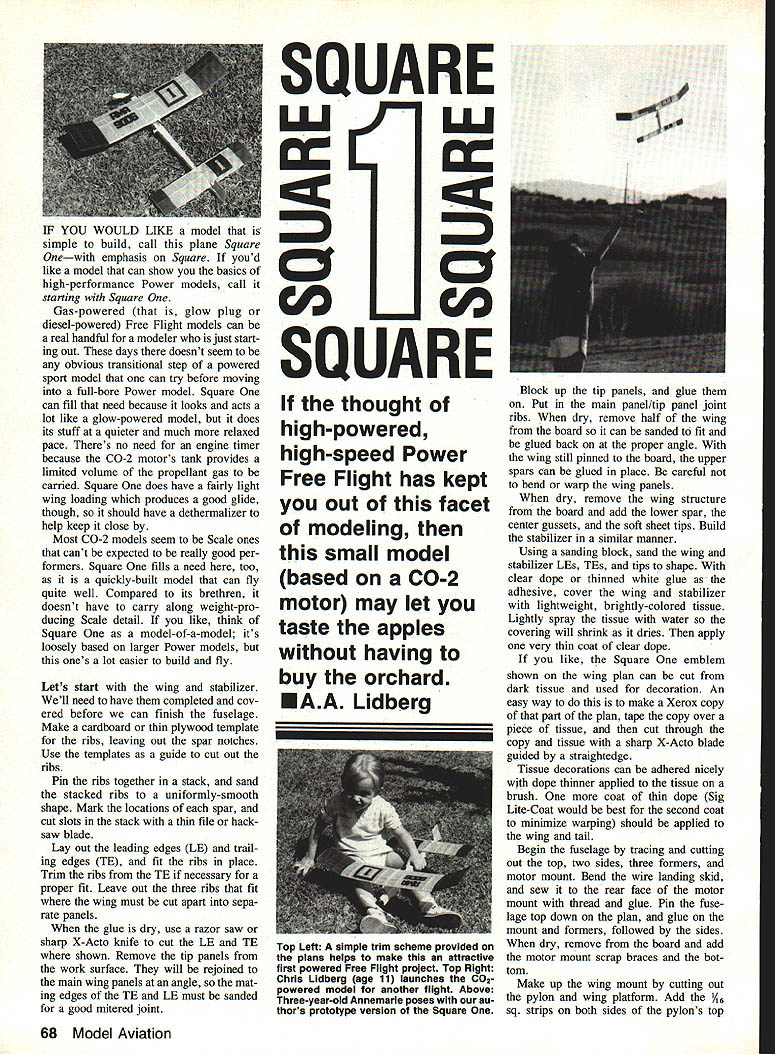
If you would like a model that is simple to build, call this plane Square One — with emphasis on Square. If you'd like a model that can show you the basics of high-performance power models, call it Square One as a starting point.
Gas-powered (that is, glow-plug or diesel-powered) Free Flight models can be a real handful for a modeler who is just starting out. These days there doesn't seem to be any obvious transitional step of a powered sport model that one can try before moving into a full-bore power model. Square One fills that need because it looks and acts a lot like a glow-powered model, but it does its stuff at a quieter and much more relaxed pace. There's no need for an engine timer, because the CO2 motor's tank provides a limited volume of propellant gas to be carried. Square One does have a fairly light wing loading which produces a good glide, though, so it should have a de-thermalizer (DT) to help keep it close by.
Most CO2 models seem to be scale ones that can't be expected to be really good performers. Square One fills a need here, too, as it is a quickly-built model that can fly quite well. Compared to its brethren, it doesn't have to carry along weight-producing scale detail. If you like, think of Square One as a model-of-a-model; it's loosely based on larger power models, but this one's a lot easier to build and fly.
Wing and stabilizer construction
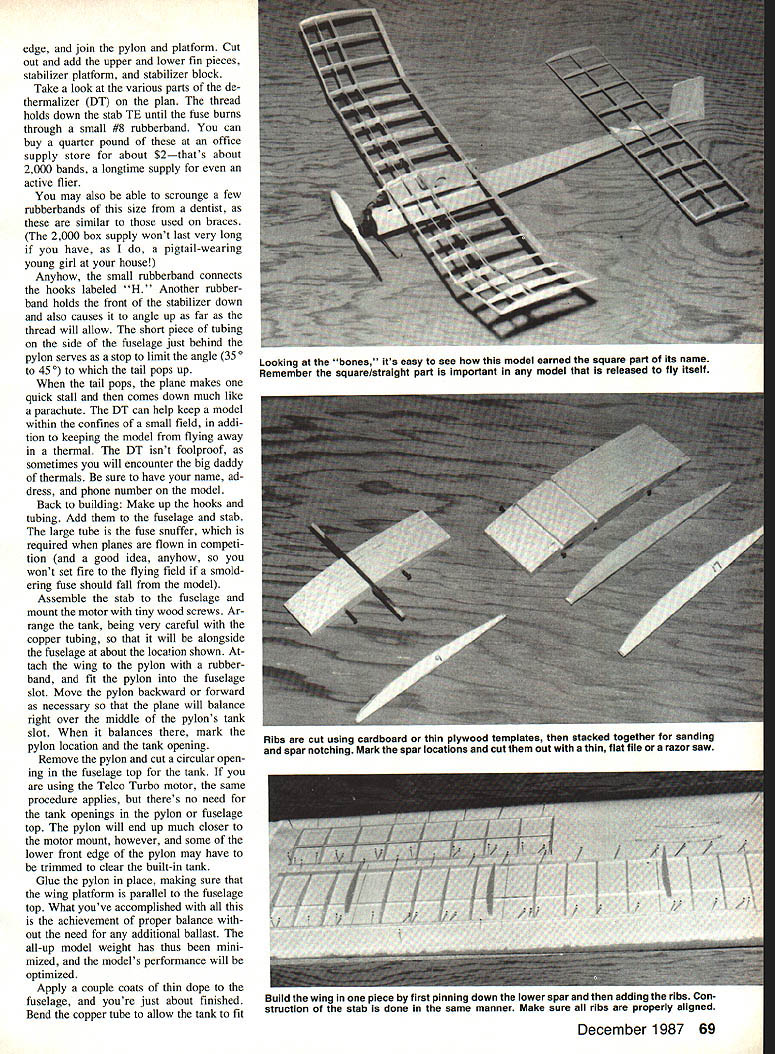
We need the wing and stabilizer completed and covered before finishing the fuselage.
- Make a cardboard or thin-plywood template for the ribs, leaving out the spar notches. Use the templates as a guide to cut out the ribs.
- Pin the ribs together in a stack, and sand the stacked ribs to a uniformly smooth shape.
- Mark the locations of each spar, and cut slots in the stack with a thin file or hacksaw blade.
- Lay out the leading edges (LE) and trailing edges (TE), and fit the ribs in place. Trim the ribs from the TE if necessary for a proper fit. Leave out the three ribs that fit where the wing must be cut apart into separate panels.
- When the glue is dry, use a razor saw or sharp X-Acto knife to cut the LE and TE where shown. Remove the tip panels from the work surface. They will be rejoined to the main wing panels at an angle, so the mating edges of the TE and LE must be sanded for a good mitered joint.
- Block up the tip panels, and glue them on. Put in the main panel / tip panel joint ribs.
- When dry, remove half of the wing from the board so it can be sanded to fit and be glued back on at the proper angle. With the wing still pinned to the board, glue the upper spars in place. Be careful not to bend or warp the wing panels.
- When dry, remove the wing structure from the board and add the lower spar, the center gussets, and the soft sheet tips.
- Build the stabilizer in a similar manner.
Using a sanding block, shape the wing and stabilizer LEs, TEs, and tips.
Covering the wing and stabilizer
- With clear dope or thinned white glue as the adhesive, cover the wing and stabilizer with lightweight, brightly colored tissue.
- Lightly spray the tissue with water; the covering will shrink as it dries.
- Apply one very thin coat of clear dope.
If you like, the Square One emblem shown on the wing plan can be cut from dark tissue and used for decoration. An easy way to do this is to make a Xerox copy of that part of the plan, tape the copy over a piece of tissue, and then cut the copy and tissue with a sharp X-Acto blade guided by a straightedge.
Tissue decorations can be adhered nicely with dope thinner applied to the tissue with a brush. Apply one more coat of thin dope (Sig Lite-Coat is recommended for the second coat to minimize warping) to the wing and tail.
Fuselage and pylon
- Begin the fuselage by tracing and cutting out the top, two sides, three formers, and motor mount.
- Bend the wire landing skid, and sew it to the rear face of the motor mount with thread and glue.
- Pin the fuselage top down on the plan, and glue on the formers, followed by the sides.
- When dry, remove from the board and add the motor mount, scrap braces, and bottom.
- Make up the wing mount by cutting out the pylon and wing platform. Add the 1/8" square strips on both sides of the pylon's top.
- Cut out and add upper and lower fin pieces, stabilizer platform, and stabilizer block.
De-thermalizer (DT)
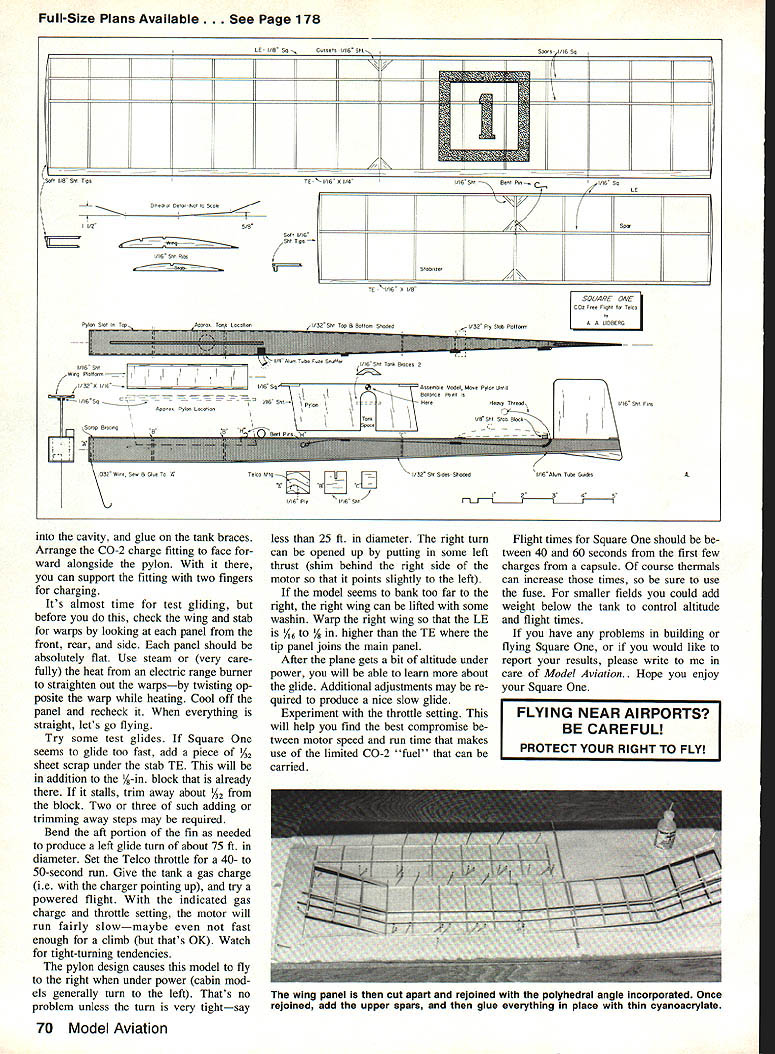
Take a look at the de-thermalizer plan. The thread holds down the stab TE until the fuse burns through. A small #8 rubber band can be bought at the quarter-pound office supply store for about $2 — that's about 2,000 bands, a longtime supply. An active flier may also be able to scrounge a few rubber bands the size a dentist uses for braces. A 2,000-box supply won't last very long if you have a pigtail-wearing young girl in the house, so plan accordingly.
- A small rubber band connects the hooks labeled H.
- Another rubber band holds the front stabilizer down and also causes a bit of nose-up angle.
- A short piece of tubing on the side of the fuselage will allow the DT to work properly.
When the tail pops, the plane makes one quick stall and then comes down much like a parachute. The DT can help keep a model within the confines of a small field, in addition to keeping the model from flying away in a thermal. The DT isn't foolproof, as sometimes you will encounter the big daddy of thermals. Be sure to have your name, address, and phone number on the model.
Make up the hooks and tubing. Add them to the fuselage and stab. The large tube is the fuse snuffer, which is required when planes are flown in competition (and a good idea, anyhow, so you won't set fire to the flying field if a smoldering fuse should fall from the model).
Final assembly
- Assemble the stab to the fuselage and mount the motor with tiny wood screws.
- Arrange the tank, being very careful with the copper tubing, so that it will be alongside the fuselage at about the location shown on the plan.
- Attach the wing to the pylon with a rubber band, and fit the pylon into the fuselage slot.
- Move the pylon backward or forward as necessary so that the plane will balance right over the middle of the pylon's tank slot. When it balances there, mark the pylon location and the tank opening.
- Remove the pylon and cut a circular opening in the fuselage top for the tank.
If you are using the Telco Turbo motor, the same procedure applies, but there's no need for the tank openings in the pylon or fuselage top. The pylon will end up much closer to the motor mount, however, and some of the lower front edge of the pylon may have to be trimmed to clear the built-in tank.
Glue the pylon in place, making sure that the wing platform is parallel to the fuselage top. What you've accomplished with all this is proper balance without the need for any additional ballast. The all-up model weight has thus been minimized, and the model's performance will be optimized.
Apply a couple coats of thin dope to the fuselage. Bend the copper tube to allow the tank to fit into the cavity, and glue on the tank braces. Arrange the CO2 charge fitting to face forward alongside the pylon. With it there, you can support the fitting with two fingers for charging.
Preflight checks and straightening warps
Before test gliding, check the wing and stab for warps by looking at each panel from the front, rear, and side. Each panel should be absolutely flat. Use steam or (very carefully) the heat from an electric range burner to straighten out warps — twist opposite the warp while heating. Cool off the panel and recheck it.
Test glides and trimming
Try some test glides.
- If Square One seems to glide too fast, add a piece of 1/32" sheet scrap under the stab TE. This will be in addition to the 1/16" block that is already there.
- If it stalls, turn away about 1/2° from the block. Two or three such adding or trimming steps may be required.
- Bend the aft portion of the fin as needed to produce a left glide turn of about 75 ft in diameter.
- Set the Telco throttle for a 40- to 50-second run. Give the tank a gas charge (i.e., with the charger pointing up), and try a powered flight. With the indicated gas charge and throttle setting, the motor will run fairly slow—maybe even not fast enough for a climb (but that's OK). Watch for right-turning tendencies.
The pylon design causes this model to fly to the right when under power (cabin models generally turn to the left). That's no problem unless the turn is very tight—say less than 25 ft in diameter. The right turn can be opened up by putting in some left thrust (shim behind the right side of the motor so that it points slightly to the left).
If the model seems to bank too far to the right, the right wing can be lifted with some wash-in. Warp the right wing so that the LE is 1/16" to 1/8" higher than the TE where the tip panel joins the main panel.
After the plane gets a bit of altitude under power, you will be able to learn more about the glide. Additional adjustments may be required to produce a nice slow glide. Experiment with the throttle setting to find the best compromise between motor speed and run time that makes use of the limited CO2 "fuel" that can be carried.
Flight times and tips
- Flight times for Square One should be between 40 and 60 seconds from the first few charges from a capsule.
- Thermals can increase those times, so be sure to use the fuse (DT).
- For smaller fields you could add weight below the tank to control altitude and flight times.
If you have any problems in building or flying Square One, or if you would like to report your results, please write to me in care of Model Aviation. Hope you enjoy your Square One.
A.A. Lidberg
Transcribed from original scans by AI. Minor OCR errors may remain.

