
Stanzel Museum
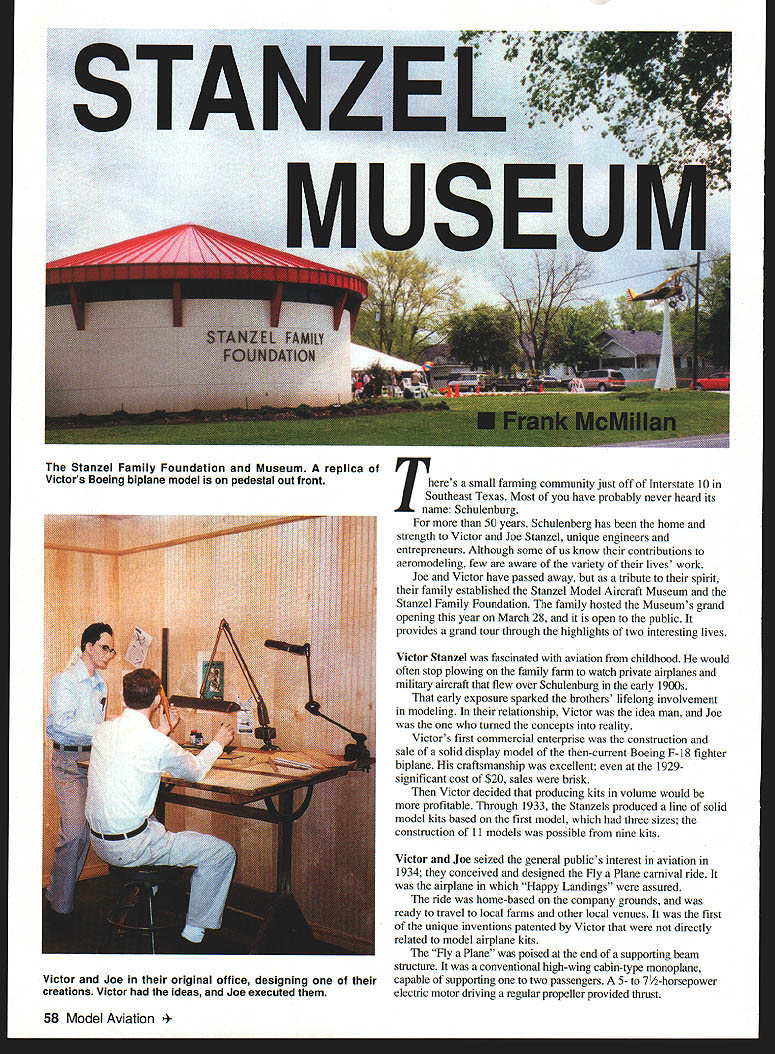
There's a small farming community just off Interstate 10 in Southeast Texas: Schulenburg. For more than 50 years, Schulenburg was home to Victor and Joe Stanzel — unique engineers and entrepreneurs known in aeromodeling and beyond.
Their family established the Stanzel Model Aircraft Museum and the Stanzel Family Foundation as a tribute to their spirit. The family hosted the museum's grand opening on March 28 (year not specified), and it is open to the public. The museum provides a grand tour through the highlights of two interesting lives.
The Stanzel Brothers: background and partnership
Victor Stanzel was fascinated with aviation from childhood. He would often stop plowing on the family farm to watch private and military aircraft fly over Schulenburg in the early 1900s. That early exposure sparked the brothers' lifelong involvement in modeling.
In their partnership, Victor was the idea man; Joe turned concepts into reality. Both served during World War II at Duncan Field, San Antonio, using their talents as draftsmen and welders.
Innovations and enterprises
Early commercial models and kits
- Victor's first commercial enterprise was the construction and sale of a solid display model of the then-current Boeing F-18 fighter biplane. His craftsmanship was excellent; even at the 1929 cost of $20, sales were brisk.
- By 1933 the Stanzels produced a line of solid model kits based on that first model, offering three sizes and a system where construction of 11 models was possible from nine kits.
- In 1939 they introduced their first Control Line (CL) model airplane kit, the Tiger Shark, which afforded gentle up-and-down control and typified flowing Stanzel designs (red-and-yellow color scheme). Over the next few years they produced a dazzling array of new airplanes and control systems, including Free Flight designs such as the Texas Ranger and Interceptor.
Carnival rides and amusement devices
- 1934: Fly-a-Plane carnival ride — a high-wing cabin-type monoplane capable of carrying one to two passengers. A 5- to 7-horsepower electric motor drove a regular propeller. The ride was poised at the end of a supporting beam with a variable-ballast water tank partly counterbalancing passenger weight. Inside the cabin passengers could zoom and dip up to 25 feet at about 20 miles per hour. The ride cost 25 cents and was very successful. It was ready to travel to local fairs and farms.
- 1935: 20th Century Strato-Ship carnival ride — a design that strongly resembled the ships used in the Flash Gordon comic strips and was immensely popular at the State Fair of Texas in Dallas in 1936.
Mechanical and electronic devices
- The Stanzels developed an electronic pinball machine of unique design. The principal control used an arc so one-inch steel balls fell onto a bowed flexible steel sheet; the point of impact on the sheet determined where the ball landed and scored. An original unit is on display in the museum.
- 1943: Big Tiger Shark — conceived as a target airplane for gunnery training. This 5-foot model weighed 20 pounds.
Line-control innovations and Mono-Line
- From roughly 1939 to 1941 the brothers experimented with unusual wire-loop systems attached to elevators and rudder; loop arcs intersected and were used to trim models for stable flight.
- After the war they continued development of Shark designs — Super G, twin-tail and C-5 control systems.
- 1955: The Stanzels decided to market products based on the Mono-Line control system. Its principal feature was applying torsion to the flying wire via a handle, translating torsion to elevator movement through a worm gear. The system maintained positive control even when the line was slack and had the advantage of drag from only one line.
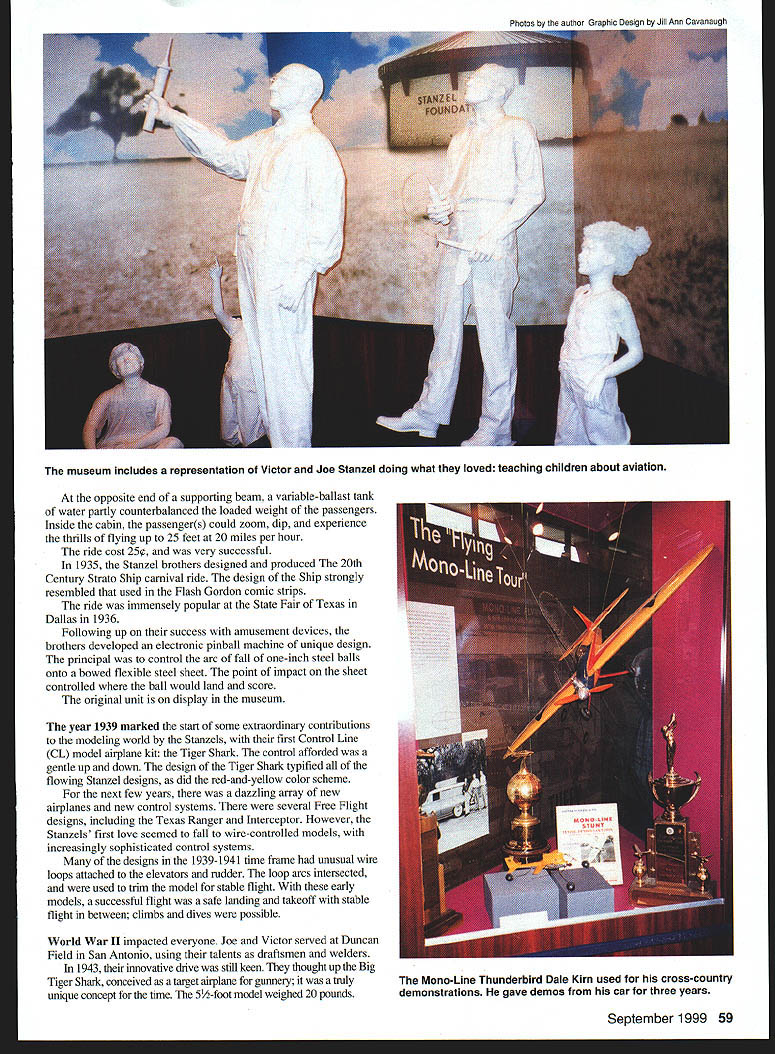
- Mono-Line found immediate success in Speed and Aerobatics. Speed flier Dale Kim promoted Mono-Line by giving demonstrations across the U.S. from 1955 to 1958, traveling in a new Chevrolet and demonstrating Speed and Aerobatics capabilities. For a short period, cash prizes were offered to Nationals winners in Stunt who used Mono-Line systems.
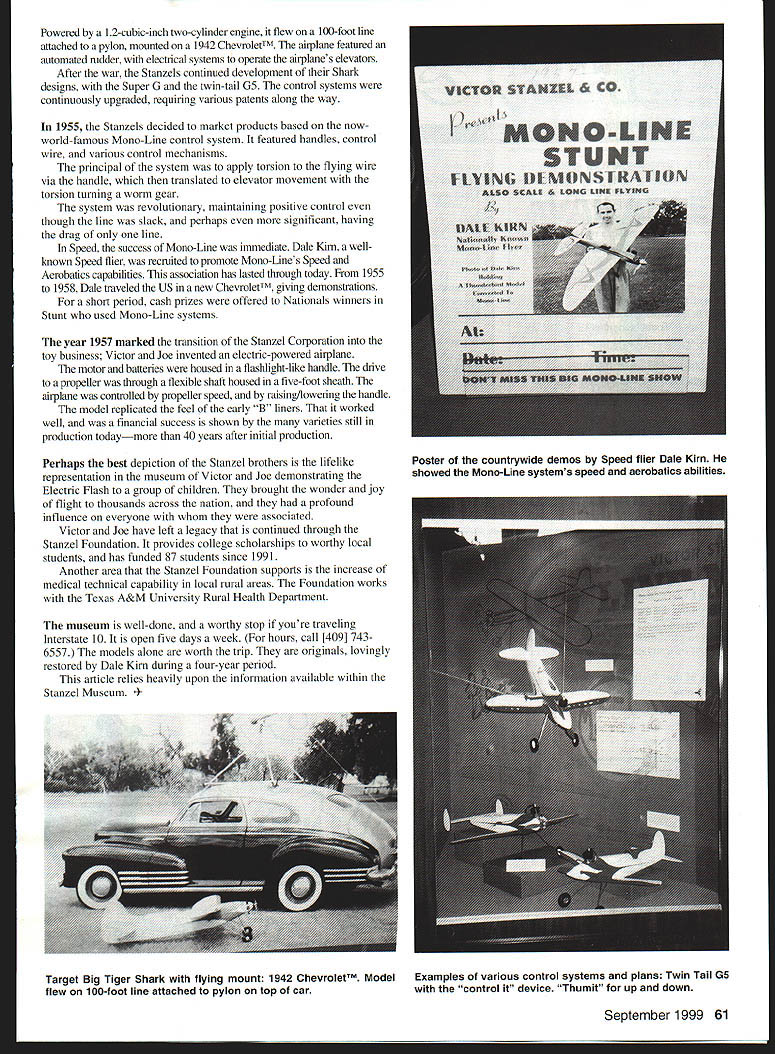
- Mono-Line Thunderbird and other demonstrations: Dale Kim used cross-country demonstrations, giving demos from a car for three years. The Mono-Line Thunderbird was powered by a 12-cubic-inch two-cylinder engine and flew on a 100-foot line attached to a pylon mounted to a 1942 Chevrolet. It featured an automated rudder and electrical systems to operate the elevators.
Electric-powered airplane and later products
- 1957: The Stanzel Corporation transitioned into the toy business with an electric-powered airplane. The motor and batteries were housed in a flashlight-like handle, with drive to the propeller through a flexible shaft in a five-foot sheath. The airplane was controlled by propeller speed and by raising/lowering the handle, replicating the feel of the early "B" liners. The product was a financial success, with many varieties still in production decades later.
- The museum includes lifelike representations of Victor and Joe demonstrating the Electric Flash to groups of children — reflecting the joy they brought to thousands across the nation.
The Stanzel Family Foundation
The Stanzel Foundation continues the brothers' legacy through:
- College scholarships to local students — the foundation has funded 87 students since 1991.
- Supporting increased medical technical capability in rural areas through work with the Texas A&M University Rural Health Department.
The museum today
The museum is well done and a worthy stop if you're traveling Interstate 10. It is open five days a week (for hours, call (409) 743-6557). The models — originals lovingly restored by Dale Kim over a four-year period — are significant attractions, and several original devices (including the electronic pinball machine) are on display.
This article relies heavily upon information available within the Stanzel Museum.
Transcribed from original scans by AI. Minor OCR errors may remain.

