
Stilomag
Yves Fernandez
This CL Precision Aerobatics model for a .40 comes to us from Strasbourg, France and is the state-of-the-art in central Europe. It appears to have all of the qualities to perform fully to the pilot's ability.
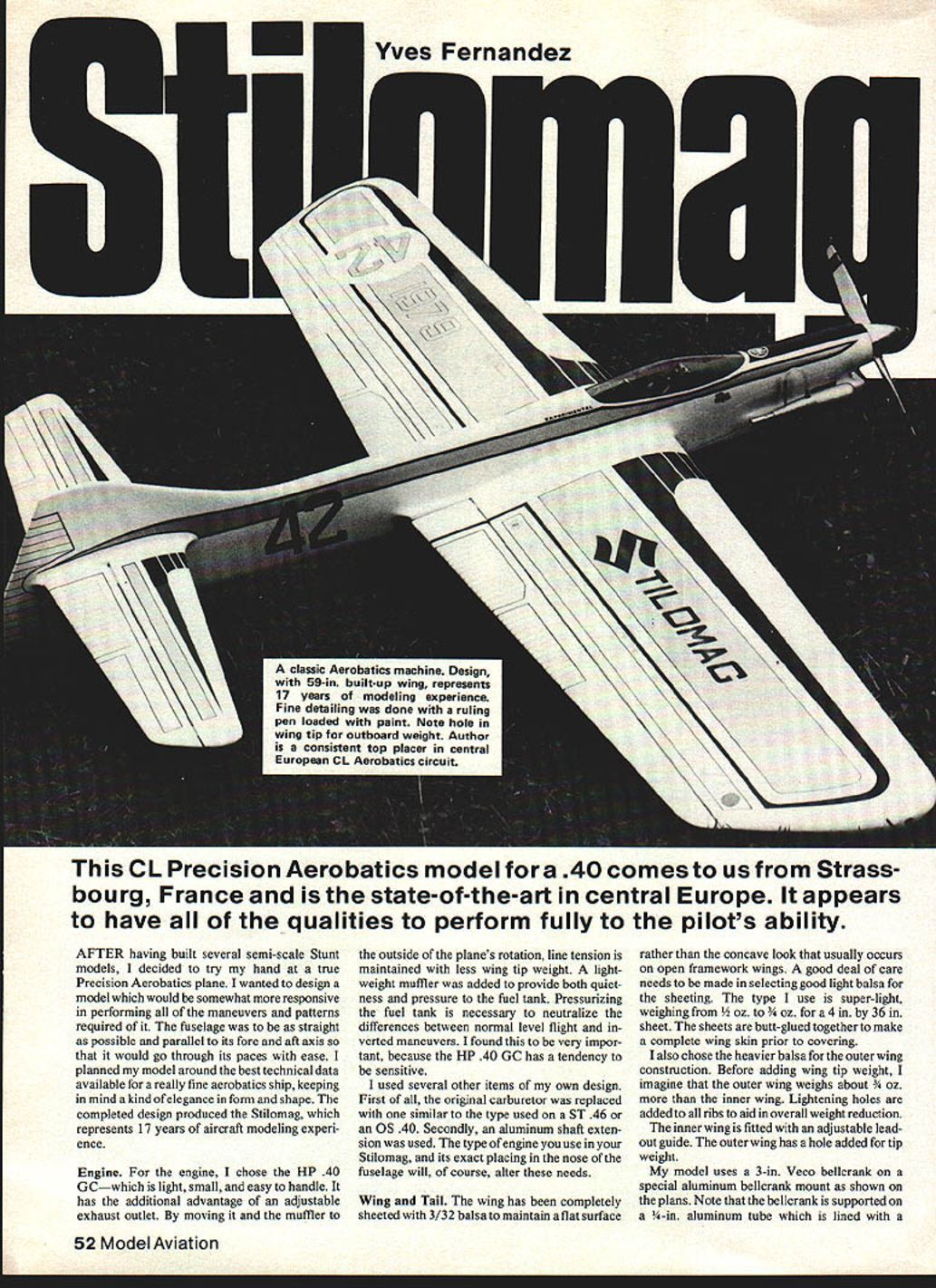
After having built several semi-scale stunt models, I decided to try my hand at a true Precision Aerobatics plane. I wanted to design a model that would be more responsive in performing all of the maneuvers and patterns required of it. The fuselage was to be as straight as possible and parallel to its fore-and-aft axis so that it would go through its paces with ease. I planned my model around the best technical data available for a really fine aerobatics ship, keeping in mind a certain elegance in form and shape. The completed design produced the Stilomag, which represents 17 years of aircraft modeling experience.
Engine
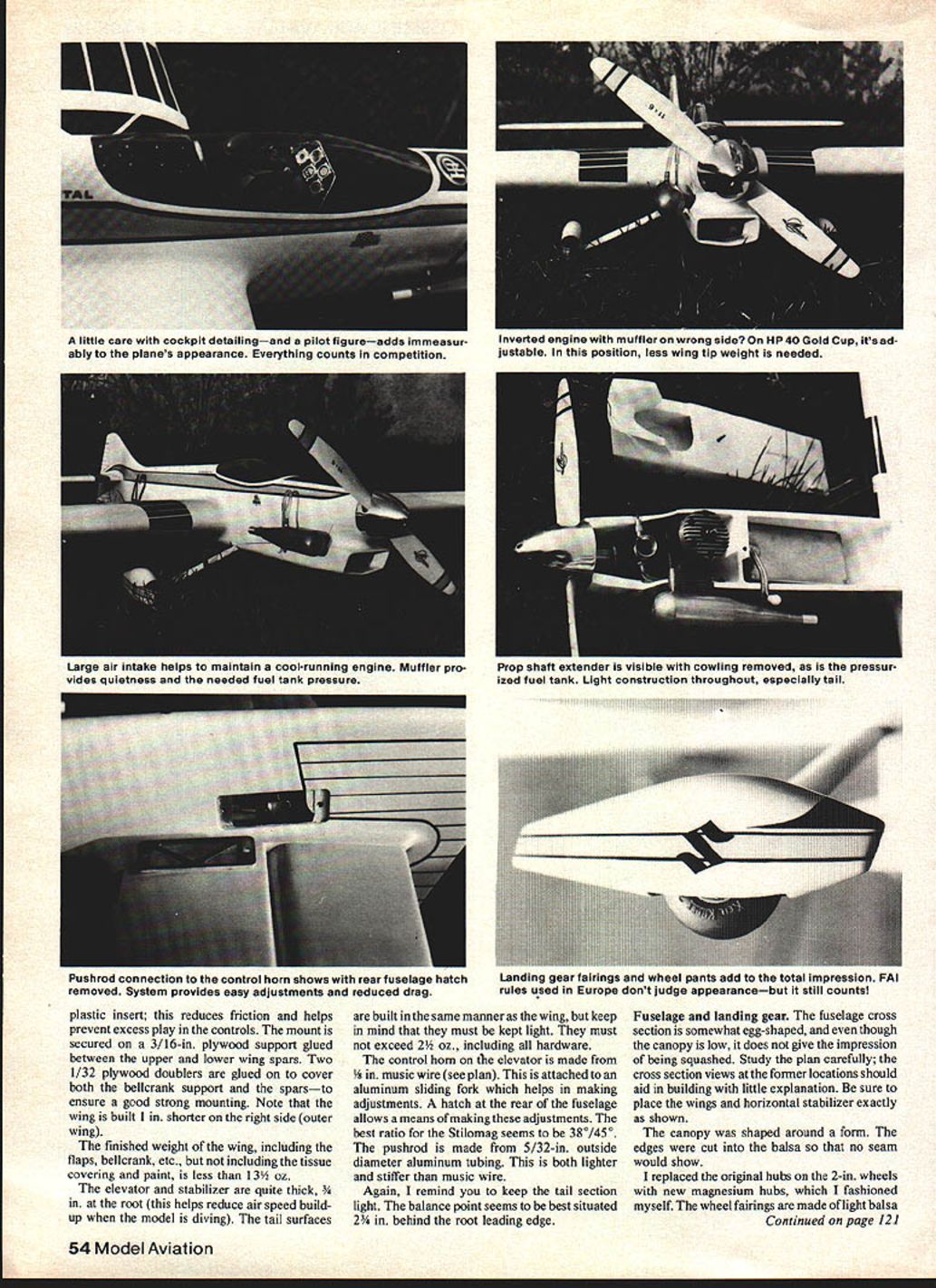
For the engine I chose the HP .40 GC — which is light, small, and easy to handle. It has the additional advantage of an adjustable exhaust outlet. By moving it and the muffler to the outside of the plane's rotation, line tension is maintained with less wing-tip weight. A light-weight muffler was added to provide both quietness and pressure to the fuel tank. Pressurizing the fuel tank is necessary to neutralize the differences between normal level flight and inverted maneuvers. I found this to be very important, because the HP .40 GC has a tendency to be sensitive.
Modifications and items I used:
- Replaced the original carburetor with one similar to the type used on a .46 or an OS .40.
- Used an aluminum shaft extension.
- Moved the exhaust/muffler externally to reduce line tension and wing-tip weight.
- Added a lightweight muffler to aid tank pressurization and quiet operation.
The type of engine you use in your Stilomag, and its exact placing in the nose of the fuselage, will of course alter these needs.
Wing and Tail
The wing has been completely sheeted with 3/32-in. balsa to maintain a flat surface rather than the concave look that usually occurs on open-framework wings. A good deal of care is needed in selecting light balsa for the sheeting. The type I use is super-light, weighing from 5/8 oz. to 3/4 oz. for a 4 in. by 36 in. sheet. The sheets are butt-glued together to make a complete wing skin prior to covering.
I chose heavier balsa for the outer wing construction. I estimate the outer wing weighs about 4½ oz. more than the inner wing before adding wing-tip weight. Lightening holes are added to all ribs to aid overall weight reduction. The inner wing is fitted with an adjustable lead-out guide. The outer wing has a hole added for tip weight.
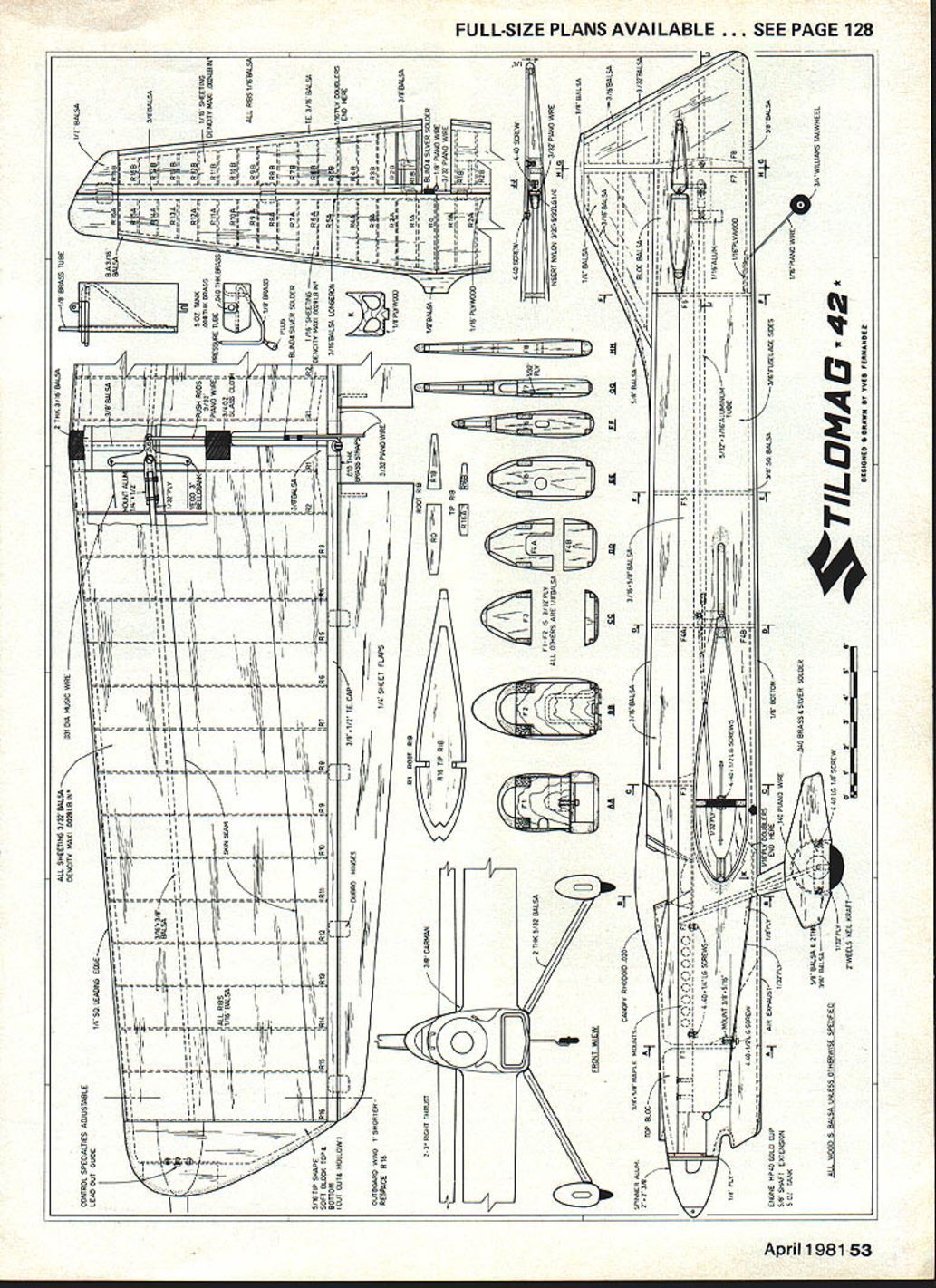
My model uses a 3-in. Veco bellcrank on a special aluminum bellcrank mount as shown on the plans. The bellcrank is supported on a 1/4-in. aluminum tube which is lined with a plastic insert that reduces friction and helps prevent excess play. The control mount is secured to a 3/16-in. plywood support glued between the upper and lower wing spars. Two 1/32-in. plywood doublers are glued to cover both bellcrank support spars to ensure a good, strong mounting.
Note that the wing was built slightly shorter on the right side. The outer wing finished weight (wing including flaps, bellcrank, etc., including tissue covering and paint) was less than 13 oz. The elevator and stabilizer are quite thick at the root. The tail surfaces are built in the same manner as the wing, but keep in mind that they must be kept light. They must not exceed 2 1/2 oz., including all hardware.
The control horn on the elevator is made from 1/8-in. music wire (see plan). This is attached to an aluminum sliding fork which helps in making adjustments. A hatch at the rear of the fuselage allows a means of making these adjustments. The best control throw ratio for the Stilomag seems to be 38°/45°.
The pushrod is made from 5/32-in. outside-diameter aluminum tubing. This is both lighter and stiffer than music wire.
Again, keep the tail section light. The balance point seems to be best situated 2 1/4 in. behind the root leading edge.
Fuselage and Landing Gear
The fuselage cross section is somewhat egg-shaped, and even though the canopy is low, it does not give the impression of being squashed. Study the plan carefully; the cross-section views at the former locations should aid in building with little explanation. Be sure to place the wing and horizontal stabilizer exactly as shown.
The canopy was shaped around a form. The edges were cut into the balsa so that no seam would show.
I replaced the original hubs on the 2-in. wheels with new magnesium hubs, which I fashioned myself. The wheel fairings are made of light balsa and stiffened with 1/32-in. plywood sheet on the inside; both weigh 1/2 oz.
After all filling and sanding was completed, the entire model was covered with Japanese tissue. The model was then primed and spray-painted with several coats of paint and varnish. This was followed by paste-waxing.
The finished model weighs between 53 and 54 ounces.
The paint scheme that I used was designed to give me good reference points for the maneuvers.
The engine, with its modified exhaust, is practically noiseless—yet strong enough to give a fine account of itself. My props are homemade 11 x 6s with large blades.
I have noticed that more than one flier has had problems with engine runs in competition. According to my tests, the fuel content has a big effect on how long the engine runs per tank. If oil or nitro is added to the fuel mixture, the running time is proportionately shortened. Conversely, if 2% benzene or unleaded gasoline is added, the running time is lengthened by approximately 5%.
The Stilomag's first flight went very well. The lead-out adjustment was in the center of its range, and 1/2 oz. of outboard wing-tip weight had been added. The model's control and response was quite good as it went through its paces. I usually fly with .015-in. braided lines, 65 ft. long, but my future flights will be on .018-in., which I feel will slightly improve control response.
Yves Fernandez
Transcribed from original scans by AI. Minor OCR errors may remain.

