
With so many fuels on the market, all with their "secret" ingredients it's difficult for the consumer to make heads and tails out of the picture. Here is some useful data.
Straight Talk On Fuels And Lubricants
John F. Kilsdonk
THIS IS NOT a product report nor is it an endorsement of any product, manufacturer, or supplier of model engine fuels or lubricants. It is intended solely to present facts based on experimental data obtained through standard test procedures. The inspiration for this article has come from all the talk, opinions, hearsay, claims, and whatever that have existed concerning model engine lubricants, primarily synthetic oils.
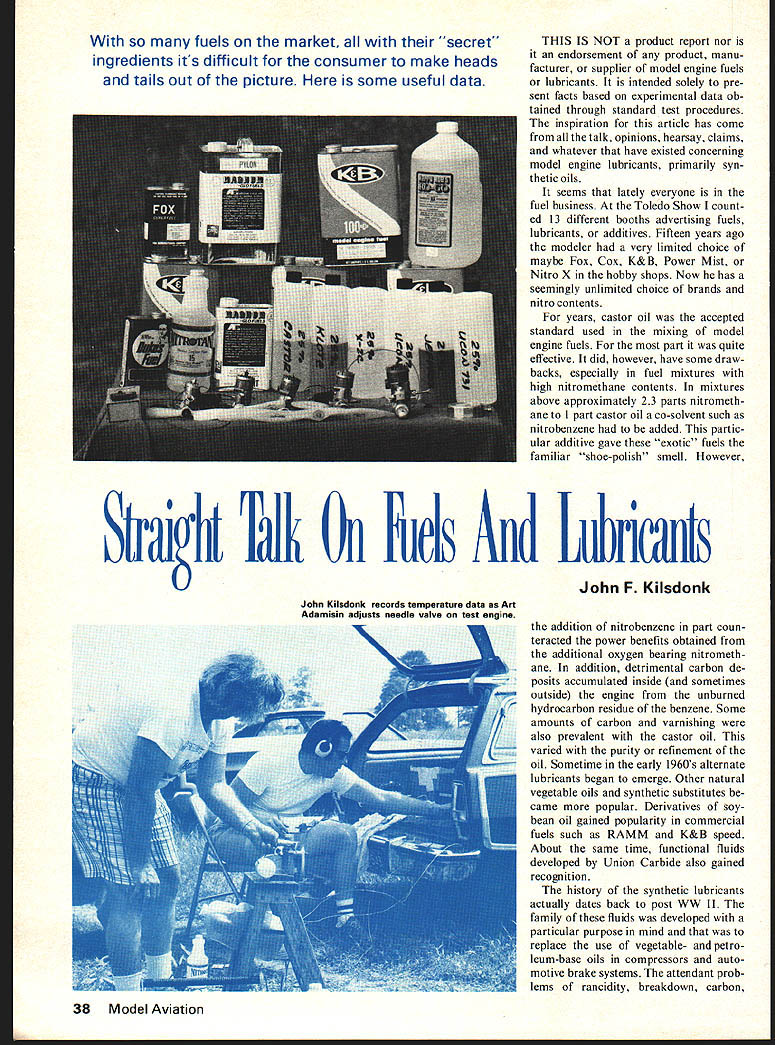
It seems that lately everyone is in the fuel business. At the Toledo Show I counted 13 different booths advertising fuels, lubricants, or additives. Fifteen years ago the modeler had a very limited choice of maybe Fox, Cox, K&B, Power Mist, or Nitro X in the hobby shops. Now he has a seemingly unlimited choice of brands and nitro contents.
For years, castor oil was the accepted standard used in the mixing of model engine fuels. For the most part it was quite effective. It did, however, have some drawbacks, especially in fuel mixtures with high nitromethane contents. In mixtures above approximately 2.3 parts nitromethane to 1 part castor oil a co-solvent such as nitrobenzene had to be added. This particular additive gave these "exotic" fuels the familiar "shoe-polish" smell. However, the addition of nitrobenzene in part counteracted the power benefits obtained from the additional oxygen-bearing nitromethane. In addition, detrimental carbon deposits accumulated inside (and sometimes outside) the engine from the unburned hydrocarbon residue of the benzene. Some amounts of carbon and varnishing were also prevalent with the castor oil. This varied with the purity or refinement of the oil.
Sometime in the early 1960's alternate lubricants began to emerge. Other natural vegetable oils and synthetic substitutes became more popular. Derivatives of soybean oil gained popularity in commercial fuels such as RAMM and K&B speed. About the same time, functional fluids developed by Union Carbide also gained recognition.
The history of the synthetic lubricants actually dates back to post WW II. The family of these fluids was developed with a particular purpose in mind and that was to replace the use of vegetable- and petroleum-base oils in compressors and automotive brake systems. The attendant problems of rancidity, breakdown, carbon, sludge and varnish formation under extended use and higher temperature requirements with time led Union Carbide to develop a better lubricant — a brake-fluid base, namely polyalkylene glycols. Success was immediate due to apparent advantages: longer life, greater stability, better lubrication, improved viscosity characteristics and lack of sludge and carbon formation. Simply stated, Union Carbide hit the bell ringer.
Additional research into additives resulted in a desirable series of fluids. Due to favorable solubility ranges, special Ucon fluids could be readily modified with various stabilizers, antioxidants and wetting agents and further enhanced for broad use as oils or modifications thereof. An outgrowth, of course, was the use of these fluids in some model engine fuels. The first introduced synthetic oils were about 1963 by my very good friend Harry Roe. Like others, I have found success with these oils ever since initial contact. Ucon LB-625 functioned very well and in fact was the primary oil used until 1974 when I switched to the new Ucon MA-731. The only problem ever incurred with LB-625 was after running an engine on a humid day. If the engine was oiled and then a couple of drops of 3-in-1 oil or something similar were applied to prevent rusting of the internal iron surfaces, rusting and oxidation problems occurred. Early Ucon fluids — and the new Ucon oils MA-731 and MA-2270, in addition to Klotz and others — now contain anti-oxidant additives, so the oil-after-running routine isn't necessary although still a good safeguard.
Meanwhile, chemical manufacturers eventually picked up the ball and now also produce similar fluids. Others, at the same time, began to purchase base oils, add their own "mystery" additives and re-market products under different names. This situation has led to a lot of claims concerning what an oil does. Most claims, at least among modelers, are based on hearsay. Most claims, at least among modelers, are not based on any scientific proof. Rather, they go something like this: "X oil runs cooler than Y oil." When queried on how this was determined, they usually respond by saying that they felt the muffler with their fingers, or something similar. No account was made for changes in weather conditions, fuel mixture, time, or skin sensitivity. Additional claims may also involve performance increases. These usually also can be discredited when the test technique is examined.
I personally have used most of the other brands of oils at one time or another and even tried some of the magic additives and could see no firm proof that any of these were any better than the UCON oil I was using, so I really never changed. The data presented in this article represents an attempt to confirm or reject, at least somewhat scientifically, my suspicions as to the similarities of some of the more popular lubricants and fuel mixes.
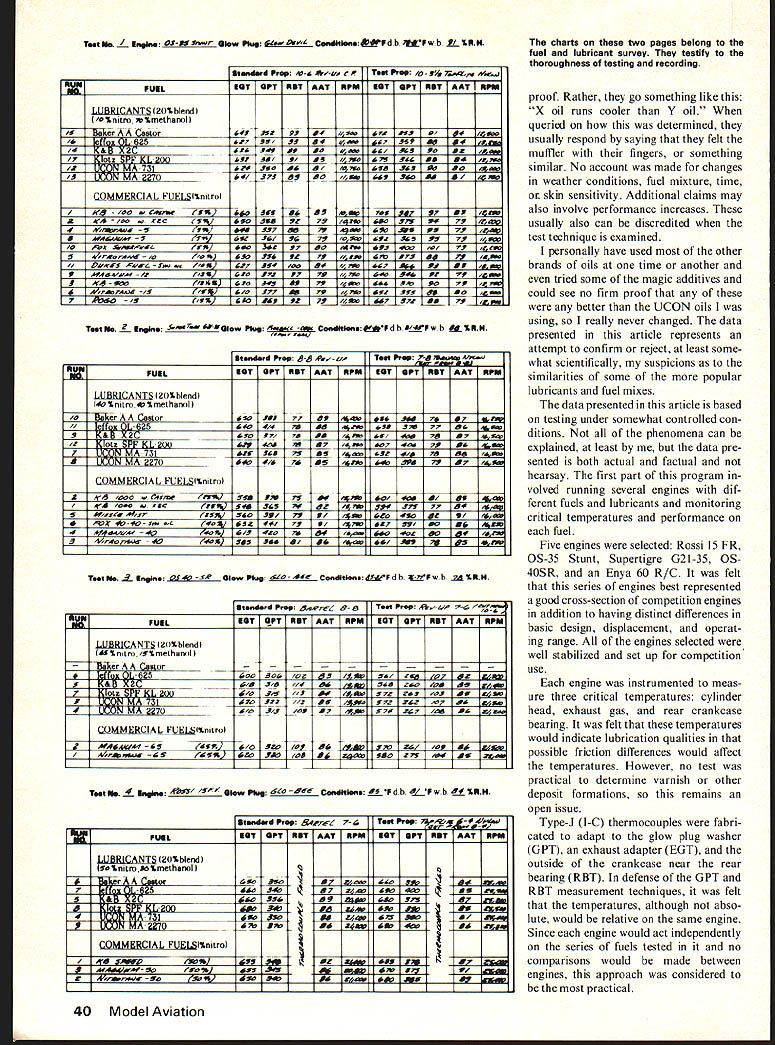
The data presented in this article is based on testing under somewhat controlled conditions. Not all of the phenomena can be explained, at least by me, but the data presented is both actual and factual and not hearsay. The first part of this program involved running several engines with different fuels and lubricants and monitoring critical temperatures and performance on each fuel.
Five engines were selected: Rossi 15 FR, OS-35 Stunt, Super Tigre G21-35, OS-35R, and an Enya 60 R/C. It was felt that this series of engines best represented a good cross-section of competition engines in addition to having distinct differences in basic design, displacement, and operating range. All of the engines selected were well stabilized and set up for competition use.
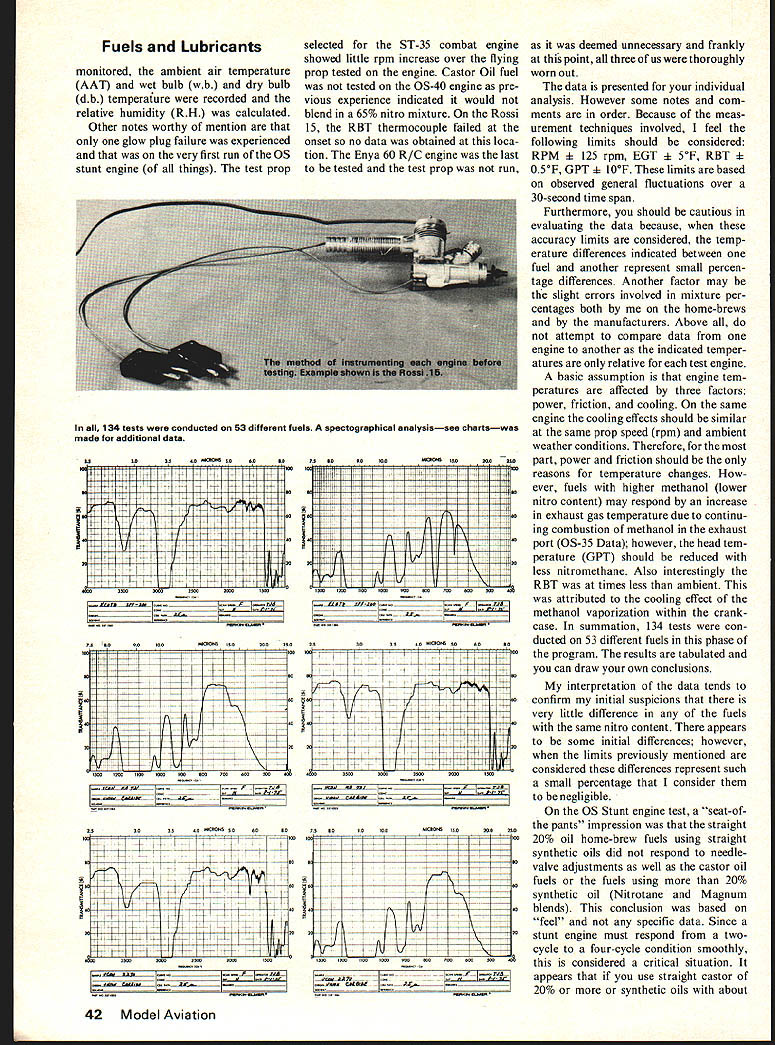
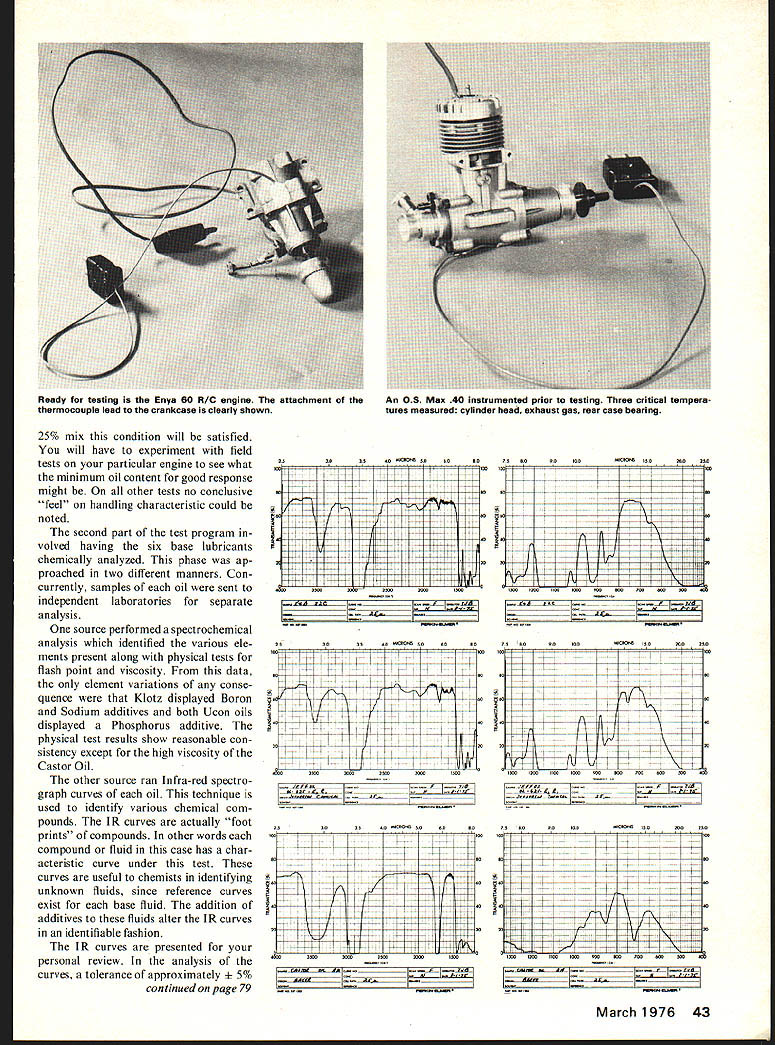
Each engine was instrumented to measure three critical temperatures: cylinder head, exhaust gas, and rear crankcase bearing. It was felt that these temperatures would indicate lubrication qualities in that possible friction differences would affect the temperatures. However, no test was practical to determine varnish or other deposit formations, so this remains an open issue.
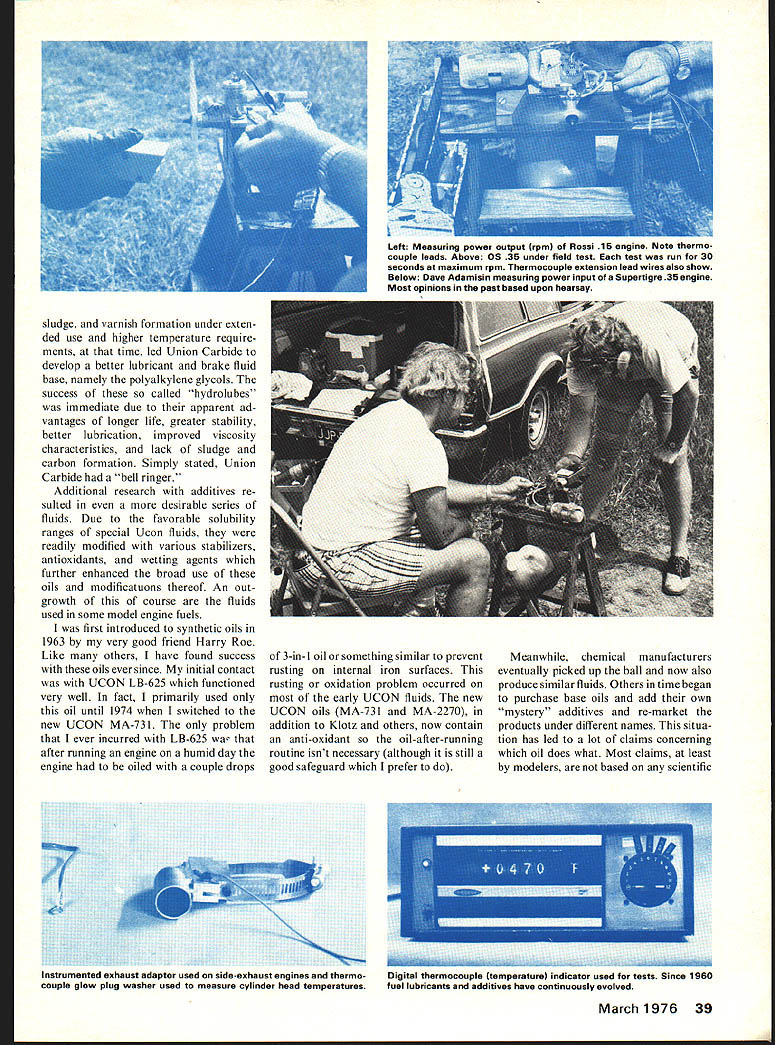
Type-J (1-C) thermocouples were fabricated to adapt to the glow plug washer (GPT), an exhaust adapter (EGT), and the outside of the crankcase near the rear bearing (RBT). In defense of the GPT and RBT measurement techniques, it was felt that the temperatures, although not absolute, would be relative on the same engine. Since each engine would act independently on the series of fuels tested in it and no comparisons would be made between engines, this approach was considered to be the most practical. As a performance indicator, each engine was to be tested on two propellers: a standard flying prop and a test prop to simulate in-flight rpm. It was felt that this phase of the test would best represent any performance increases obtained through any fuel under test. A series of different fuels both commercially mixed and home-brews using various lubricants would be tested. The engine running test sequence would be accomplished in the shortest possible time to reduce atmospheric effects. Inquiries were sent to all major lubricant and fuel suppliers outlining the intended test procedures and asking for any additional advice or help that they might have to offer. Some responded with fuel or oil samples, others did not respond. The balance of the products were provided off the hobby shop shelf.
Six different lubricants were selected to be "home-brewed" with various amounts of nitromethane. The oils selected were Klotz KL-200, K&B X2C, Jeffox OL-625, Ucon MA-731, Ucon MA-2270, and good old Baker's AA Castor oil. These oils were selected as they represent the basic cross section of current usage. All home-brew fuels were carefully blended using 20% (by volume) of each oil. The nitro content of each fuel was selected to be representative of the fuel normally used in the respective test engine. The OS stunt engine fuel contained 10% nitro, the Enya 60 R/C mix was 25% nitro, the ST-35 combat mix was 40% nitro, the Rossi 15 goodyear mix was 50% nitro, and the OS 40 rat race/pylon mix was 65% nitro. The balance of the fuel was made up entirely of methanol. So each fuel contained only three ingredients: test oil, nitromethane, and methanol, all percentages measured by volume.
To digress for just a minute, you will note that I continually state the fuels were mixed by volume. This is not the ideal technique. Most all chemical densities vary with temperature, some more than others. Therefore, when using the volume mixing technique, the temperature must always be considered. The only real safe method to ensure consistency is to mix fuels by weight of each ingredient. To do this, you must know the exact specific gravity of each ingredient to maintain accurate volume mixing ratios.
Many an unsuspecting fuel-brewer has been amazed to find out that, let's say, 50 ounces of nitro, 30 ounces of methanol and 20 ounces of oil when blended together did not give him 100 ounces of fuel, but something less. This is caused by chemical reactions between the ingredients which change the composition and resultant density. However the volume mixing method is generally used for the sake of convenience. In addition, commercially available pre-mixed fuels were selected based on similar nitro contents. Some variations in nitro content of commercial fuels were also selected solely for comparison purposes.
To conduct the test, I solicited the help of Art and Dave Adamisin. On a bright clear calm Saturday morning in June, the three of us loaded a car and a pick-up truck full of test equipment, fuel, and other supplies and headed out into the middle of an 80-acre field to conduct the testing. We set up the test equipment including a digital thermocouple (temperature) indicator powered by the car battery via a DC-AC inverter, and began running engines, recording data, verifying thermocouple calibrations, re-checking data, etc. All testing was done in a somewhat sheltered area to minimize the effects of wind direction and velocity. Ten hours later we called it quits confident that the data was accurate but not sure what it meant.
The typical test went something like this: the fuel tank was flushed and rinsed with pure methanol and allowed to dry. The test fuel was then added and the engine started and run up to, and held at, peak rpm. Immediately the EGT and the RBT temperatures stabilized; however, the GPT took approximately 30 seconds to stabilize as it was being monitored outside of the combustion chamber and the heat transfer through the cylinder head took about 30 seconds to stabilize the glow plug washer temperature. When all readings were stabilized they were recorded and the engine stopped.
At this point, the second propeller was installed on the engine and the test sequence repeated. The fuel tank was then again rinsed and the sequence repeated with another fuel. The fuels were selected in somewhat random fashion to eliminate any possible residual effects of the previous run. Also, periodic re-runs of fuels were made to ensure test consistency. Along with the engine temperatures that were monitored, the ambient air temperature (AAT) and wet bulb (w.b.) and dry bulb (d.b.) temperature were recorded and the relative humidity (R.H.) was calculated.
Other notes worthy of mention are that only one glow plug failure was experienced and that was on the very first run of the OS stunt engine (of all things). The test prop selected for the ST-35 combat engine showed little rpm increase over the flying prop tested on the engine. Castor Oil fuel was not tested on the OS-40 engine as previous experience indicated it would not be used in a 65% nitro mixture. On the Rossi 15, the RBT thermocouple failed at the onset so no data was obtained at this location. The Enya 60 R/C engine was the last to be tested and the test prop was not run, as it was deemed unnecessary and frankly at this point, all three of us were thoroughly worn out.
The data is presented for your individual analysis. However some notes and comments are in order. Because of the measurement techniques involved, I feel the following limits should be considered: RPM ± 125 rpm, EGT ± 5°F, RBT ± 0.5°F, GPT ± 10°F. These limits are based on observed general fluctuations over a 30-second time span.
Furthermore, you should be cautious in evaluating the data because, when these accuracy limits are considered, the temperature differences indicated between one fuel and another represent small percentage differences. Another factor may be the slight errors involved in mixture percentages both by me on the home-brews and by the manufacturers. Above all, do not attempt to compare data from one engine to another as the indicated temperatures are only relative for each test engine.
A basic assumption is that engine temperatures are affected by three factors: power, friction, and cooling. On the same engine the cooling effects should be similar at the same prop speed (rpm) and ambient weather conditions. Therefore, for the most part, power and friction should be the only reasons for temperature changes. However, fuels with higher methanol (lower nitro content) may respond by an increase in exhaust gas temperature due to continuing combustion of methanol in the exhaust port (OS-35 Data); however, the head temperature (GPT) should be reduced with less nitromethane. Also interestingly the RBT was at times less than ambient. This was attributed to the cooling effect of the methanol vaporization within the crankcase. In summation, 134 tests were conducted on 53 different fuels in this phase of the program. The results are tabulated and you can draw your own conclusions.
My interpretation of the data tends to confirm my initial suspicions that there is very little difference in any of the fuels with the same nitro content. There appears to be some initial differences; however, when the limits previously mentioned are considered these differences represent such a small percentage that I consider them to be negligible.
On the OS Stunt engine test, a "seat-of-the-pants" impression was that the straight 20% oil home-brew fuels using straight synthetic oils did not respond to needle-valve adjustments as well as the castor oil fuels or the fuels using more than 20% synthetic oil (Nitrocane and Magnum blends). This conclusion was based on "feel" and not any specific data. Since a stunt engine must respond from a two-cycle to a four-cycle condition smoothly, this is considered a critical situation. It appears that if you use straight castor of 20% or more or synthetic oils with about 30% oil content, then the engine will have a much broader needle valve range with less need for needle readjustment under load changes. 25% mix this condition will be satisfied.
You will have to experiment with field tests on your particular engine to see what the minimum oil content for good response might be. On all other tests no conclusive "feel" on handling characteristic could be noted.
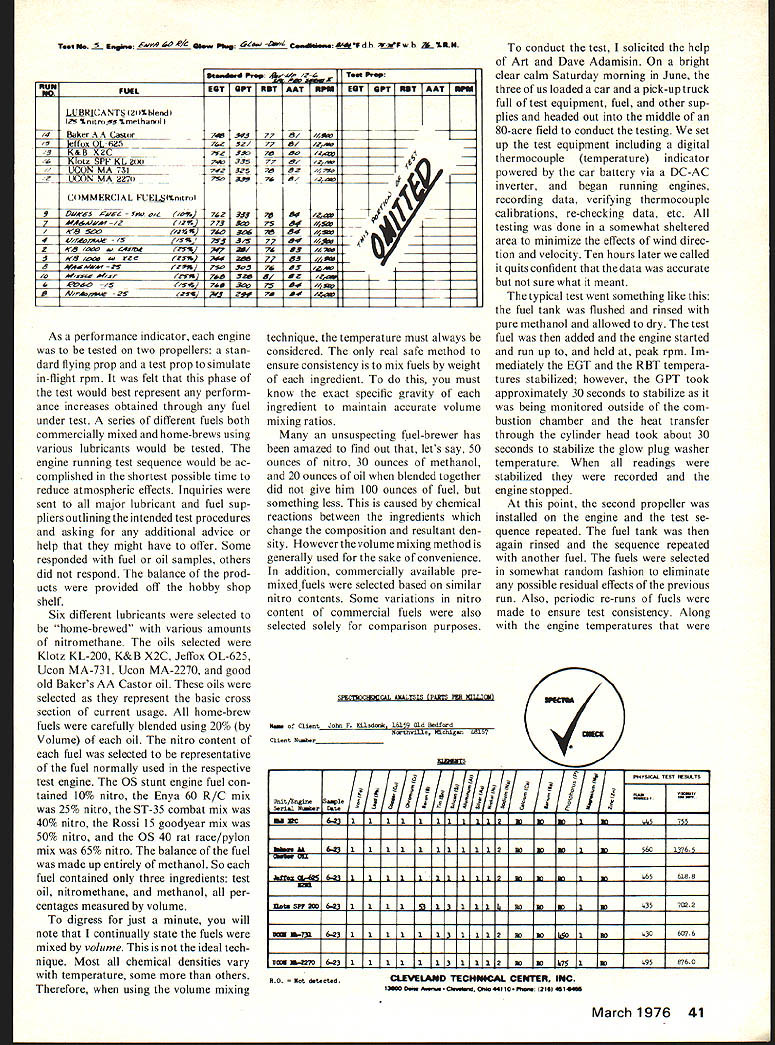
The second part of the test program involved having the six base lubricants chemically analyzed. This phase was approached in two different manners. Concurrently, samples of each oil were sent to independent laboratories for separate analysis.
One source performed a spectrochemical analysis which identified the various elements present along with physical tests for flash point and viscosity. From this data, the only element variations of any consequence were that Klotz displayed Boron and Sodium additives and both Ucon oils displayed a Phosphorus additive. The physical test results show reasonable consistency except for the high viscosity of the Castor Oil.
The other source ran infra‑red spectrograph curves of each oil. This technique is used to identify various chemical compounds. The IR curves are actually "footprints" of compounds. In other words each compound or fluid in this case has a characteristic curve under this test. These curves are useful to chemists in identifying unknown fluids, since reference curves exist for each base fluid. The addition of additives to these fluids alter the IR curves in an identifiable fashion.
The IR curves are presented for your personal review. In the analysis of the curves, a tolerance of approximately ±5%
Straight Talk On Fuels and Lubricants
is allowable at any point due to equipment calibration limitations. Each oil has two IR curves. This was done to encompass the complete spectra of each fluid.
You will note that for the five synthetic oils the curves are basically the same except for minor variations at certain wavelengths or frequencies. These are all characteristic of polyalkylene glycol curves. Disregard variations at the extreme left and right on maximum and minimum frequency of each chart. These variations are due to linearity and other calibration differences near frequency extremes on each chart. The only fundamental variation or basic difference occurs with the castor oil. I am told that this curve is similar to other vegetable oils (soybean, coconut, peanut, etc.)
The differences noted in the synthetic oils at certain wave lengths are generated by the presence of inorganic compounds added to the oils by the manufacturers or oil vendors. These additives may result as the basis for claims by the various sources as to why their oil is better than another oil. In the case of Klotz, their additive may well be a Sodium Borate compound, a common motor oil additive for over 20 years. Ucon Oils indicated a phosphate additive which may well be "TCP" (Tris‑(p‑cresyl) phosphate). Specific examination of the curves show inorganic blocking of light transmission at specific wavelengths depicting respective trace elements of sodium, boron, and phosphorus. These are confirmed in the spectrochemical analysis also. The chemical analysis of the synthetic lubricants tends to further strengthen my initial suspicions that there is little difference in the synthetic oils.
I feel that certain fundamental conclusions can be drawn from this exercise. First of all, all of the base lubricants tested appeared to be similar in effectiveness. This includes the age‑old standard castor oil. Although all five synthetic oils again displayed no consistent trend as to their respective effectiveness, there are some subtle chemical differences as noted on the IR curves.
Secondly, the pre‑mixed commercial fuels, despite variations in oil type and percentage mix, all responded similar. Admittedly, the results of these short duration tests conducted in this survey may not be representative of what could be expected under continual use. However the intent of this test was to determine possible friction and/or performance differences, both of which appeared to be negligible using the techniques noted. Perhaps some detrimental problems can be experienced under continual use with certain lubricants. This appears to be the only basis for any claims resulting from additives or magic substitutes. This open issue remains up to the user to determine. You are invited to review not only the data presented but also the test techniques. You then can draw your own conclusions.
So there you have it. I sincerely hope that certain misconceptions or false claims have been somewhat clarified. Perhaps there was more that could have been tested. Undoubtedly, other mixture percentages could have been tested along with combinations of the various oils mixed together. Additionally, other engine combinations could also have been tested along with idle characteristics, but in the interest of being practical, the information presented was what I thought to be the best approach. I do not intend to imply that I am a self‑proclaimed expert on this matter, so if there are any second‑guessers or Monday morning quarterbacks reading this, to them I say, be my guest and add your two cents worth also. Hopefully, it will be based on facts and not on hearsay.
I would like to acknowledge the help of the following: the various manufacturers who cooperated by supplying various products and information; Dave and Art Adamisin for their help in the field testing, Joe's Hobby Center for their cooperation in obtaining certain products, and lastly Harry Roe for his mechanical interpretations and advice.
Transcribed from original scans by AI. Minor OCR errors may remain.

