
Sukhoi Su-26M
Don Berliner
Introduction
With national pride on the line—and major money to back up their ambitions—Soviet designers unveiled their newest aerobatic mount for the national team, and by all accounts it was a winner.
The star of the 1986 World Aerobatics Championships, held August 1–17 at South Cerney, England, was not a pilot but an airplane: the Sukhoi Su-26M from the Soviet Union. For the first time in the long and colorful history of competition aerobatics, here was an airplane not only capable of the most difficult maneuvers, but which may actually have offered too much performance.
The speed, vertical penetration, and roll rate of the Su-26M were spectacular—and significantly superior to all its rivals. To achieve this performance, however, the sponsor spent an unprecedented sum of money, and the designer required pilots to pull record numbers of Gs. Pilots had to be exceptionally sharp in order to stop maneuvers at the precise points required—sort of like the tail wagging the dog—and this proved to be a serious problem.
Pulling 10 to 11 Gs—both positive and negative—in maneuver after maneuver may have been within the Su-26M’s design limitations, but one could still wonder about the effects on the men and women in the cockpits. Rarely is anything this impressive achieved without some sacrifice.
Background: Early Soviet Aerobatics
While the Su-26M itself was still a young airplane, its antecedents go back to the severely disappointing Yak-50. That, in turn, had its roots in the beginnings of contest aerobatics in the postwar U.S.S.R. It is a story of callousness, stubbornness, sacrifice, and eventual triumph.
In the early 1960s, when the first biennial World Aerobatics Championships were held, the Soviet team was equipped with mildly modified World War II Yak-18 trainers. Since the demands of the sport were far less than they are today, airplanes of limited performance like these were acceptable. In fact, in the 1964 championships the great British pilot Neil Williams flew a Cosmic Wind Formula One racer even though it lacked inverted fuel and oil systems.
Relatively easygoing though the championships may have been in those days, competing is nothing if you don't try to win. The Soviets went to work on the Yak-18 and created the Yak-18P version, with more power, better wings, and increased strength. With this upgraded model they won the team title in 1964 and established themselves as a major contender in international aerobatics.
For the 1966 championships near Moscow, the Soviets fielded an improved version called the Yak-18PM. It was the result of watching others fly and figuring out what was needed to excel in the increasingly difficult sequences of maneuvers. They completely dominated that year's competition, though their ability to manipulate the rules played an important role in the victory.
Soon the faithful and dependable Yak became a tail-dragger—the Yak-18PS—resulting in weight reduction. This lighter plane carried Igor Egorov to a narrow victory in the 1970 championships in England. But the U.S. team carried off the team trophy with its tiny, nimble Pitts Special; most other pilots flew Czech-built Zlins.
It was even worse for the Soviets in France in 1972, when the Americans and their Pitts biplanes swept everything and threatened to create a dynasty. Clearly, the Yak-18 series had reached the limit of its development, and something new was needed if the Red Star was to have any chance against the Stars and Stripes.
There wasn't a world championships in 1974; so when 1976 rolled around and everyone gathered near Kiev, U.S.S.R., four years had elapsed since the last championships. Most of the world champion U.S. pilots had retired, and the field was decorated with new airplanes.
The Yak-50, Yak-55, and the Rise of Sukhoi
Among the aircraft receiving heavy attention was the new Yak-50. At first glance it appeared to be no more than a cleaned-up Yak-18PS. But it was actually a new design: smaller, yet retaining the same strong, powerful radial engine. It had been designed to carry the Soviet team to victory.
The Yak-50 might have secured a Soviet triumph in a completely fair contest. But the 1976 championships on Soviet soil had been given an ideological gloss by the hosts, who dared not risk their team losing; both fair and foul means were employed to trump opponents. This corruption led directly to drastic reforms in the sport and ultimately to fairer competition.
While the Yak-50 was a fine airplane, it had a serious shortcoming: the center section of the wing was weak, leading to several failures during practice. Two weeks before the 1978 championships in Czechoslovakia, reigning World Champion Victor Letsko lost his life in such an accident. Because of this and other weaknesses, the airframe was assigned a useful life of just 200 hours; after that it had to be retired.
In the West, it would have been unthinkable to operate airplanes with such a problem. Even in the U.S.S.R., the record of four known wing failures (and possibly more) was enough to set the Yak-50 aside, at least temporarily.
First to appear in its place was the Yak-55, which combined parts from other successful aerobatic designs. But it was substandard from the start, and not even a completely new wing in 1984 could save it. After two years of effort it was allowed to die.
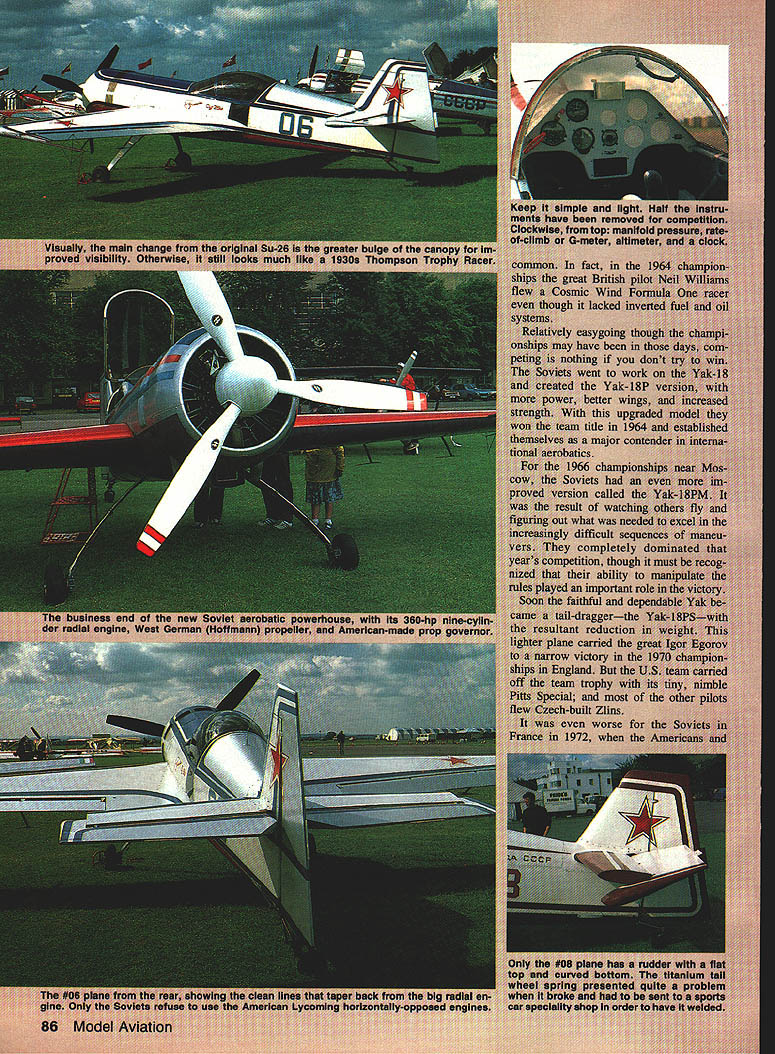
Even before the final Yak-55 flew, a completely new airplane made its debut: the Sukhoi Su-26. First seen in Hungary at the 1984 world championships, it attracted attention as much for its puzzling design features as for its flying qualities. With a low-drag canopy and small wings, it looked more like a late-1930s Thompson Trophy racer than a 1980s aerobatic airplane.
The choice of such small wings for the Sukhoi was baffling. Scaled-down wings were incongruous on a plane which, because the Soviets insisted on using their own M-14P radial engine—much heavier than the horizontally opposed Lycomings chosen by other builders—had wing loading 50% higher than anything else around. The undersized wings were the key to all the airplane's problems, leading predictably to high-speed stalling when the pilot pushed or pulled hard on the elevator to turn.
The Sukhoi design bureau was known for high-performance jet fighters and had not, as far as Westerners were aware, designed anything like an aerobatic airplane. Why it got involved remains unexplained. In any case, the results showed how far the bureau had ventured outside its expertise: the airplane simply wasn't competitive.
1986 World Aerobatics Championships (South Cerney)
As the 1986 world championships approached, questions swirled: Would the Soviets bring two Yak-55s and two Su-26s as announced? Would they revert to fragile Yak-50s, as at previous Socialist championships? Or would they bring some completely new airplanes, as they had with the Sukhoi in 1984?
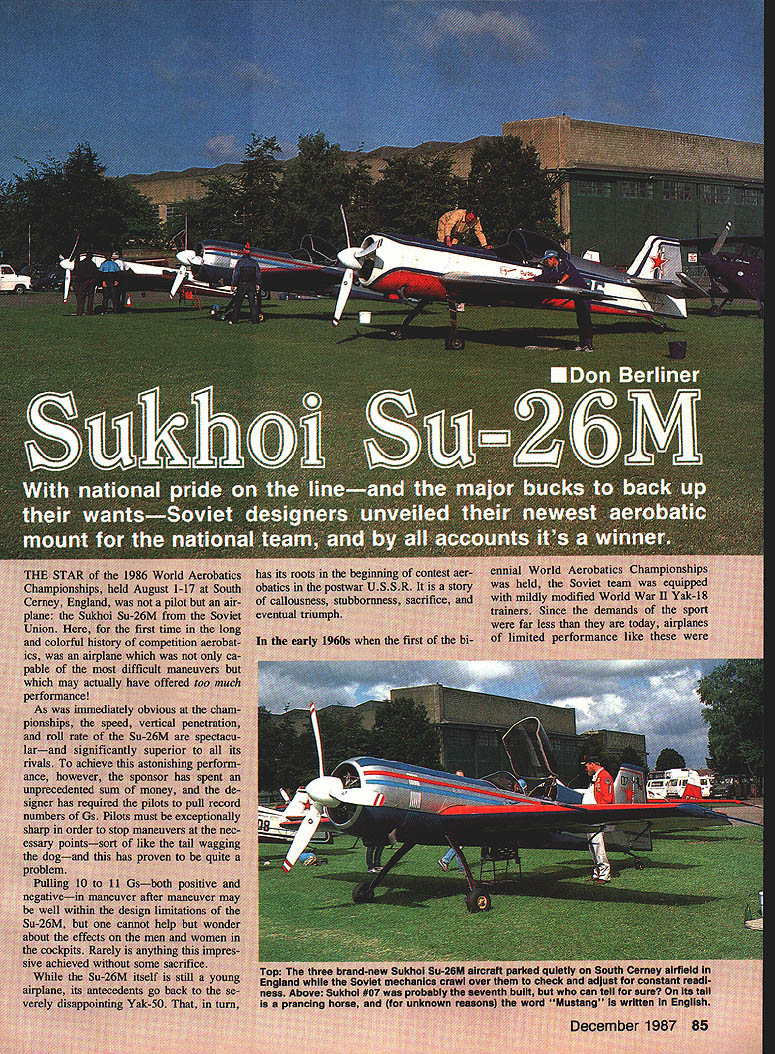
When three new Sukhois roared in formation across the field at South Cerney, the crowd had its answer. While at first glance not strikingly different from the earlier Sukhoi, the Su-26M aircraft unloaded from an Ilyushin Il-76 cargo plane at Bristol and then flown to South Cerney were a totally revamped design.
The three planes landed, taxied up, and were immediately surrounded by the curious. The new Su-26Ms were certainly better built than the 1984 prototypes. Their wings were covered not with plywood but with an as-yet unidentified composite material, and—astonishingly—each had its own completely different color scheme. Was something changing in the homeland of sameness?
What really counts, though, is how the airplanes fly, and that would be revealed during on-site practice. Each of the nine Soviet pilots (five men and four women) was to fly for 20 minutes in the 1,000-meter aerobatics box above the airfield.
Rumors often contain hyperbole, but in this case the excited reports preceding the Su-26M were borne out in practice. The new Sukhoi was a vastly improved airplane. It climbed like a much lighter, more powerful airplane. It rolled like an airplane with far more effective (though not much larger) ailerons. In fact, the Su-26M climbed so high that strong winds could blow it right out of the box unless the pilot applied extreme G-loads during pull-up and push-over maneuvers.
Unquestionably, the Su-26M differed far more from the prototype Sukhoi than its external appearance suggested. It had performance to spare. Pilots from other teams, who had never seen an aerobatic airplane blast through maneuvers with such ease, were awestruck. Assuming its pilots were up to the challenge of controlling so much performance, the chances of outflying it were slim.
Flying, Training, and Judging
In competition aerobatics, it's the pilots more than the airplanes who determine outcomes. As long as an airplane can perform the maneuvers, it is up to the pilot to win. There is no such thing as "buying a winner"—an aerobatic airplane will only do what its pilot makes it do; so even as agile and potent as the Sukhoi is, it must be flown precisely, every second.
If a pilot is to win, expert training is essential. If teaching is lacking in one or more elements, it can be a big handicap. Soviet past performances suggested remissness in training regarding FAI judging standards, which require specific flying practices: lines, angles, turn radii, etc. Some of these are so frequently ignored by Soviets that their training must be faulty.
For example, Soviets have long begun vertical rolls before the airplane is fully vertical, let alone before drawing the required vertical line. This was generally seen as an indication that their airplanes lacked the power to pull to vertical, draw a vertical line, complete the required roll, draw another line of equal length, and fly off the top under full control. The Su-26M pilots showed a new idiosyncrasy: they often exaggerated their ability to draw long lines before and after rolls. They continued to enter spins without ever having fully stalled their airplanes—something that can be done cleanly and consistently in a 65-hp Piper Cub. They also frequently failed to draw a level line between maneuvers.
Had they been flying in an American contest where FAI standards are applied rigorously, they would have lost many points for these violations and likely finished near the bottom. But at the 1986 world championships, the majority of judges seemed to overlook some standards and scored pilots highly despite obvious errors.
The result was a narrow win for the Soviet men's team (one-tenth of 1% of the total points) and a wider win for their women's team. The U.S. placed second in both categories, while no other country came close. Had the U.S. men not been discombobulated by long waits between flights—caused by more bad weather than is common even in England—they probably would have won.
If the Soviets continued to flout FAI standards at future championships, no amount of superior performance would bring them the points needed to win. But irrespective of their fliers' violations and despite bad weather, the Su-26M demonstrated that it is an outstanding airplane.
Construction, Power, and Cost
The superiority of the Su-26M is not surprising, since the cost of upgrading and producing the Sukhoi was clearly enormous. When the Soviets decided to go all-out—as in their space and military programs—they were capable of major achievements. Western estimates of the total spent on five Su-26Ms hovered in the millions-of-rubles range, translating to millions of dollars. Accurate information is impossible to come by, so estimates vary widely.
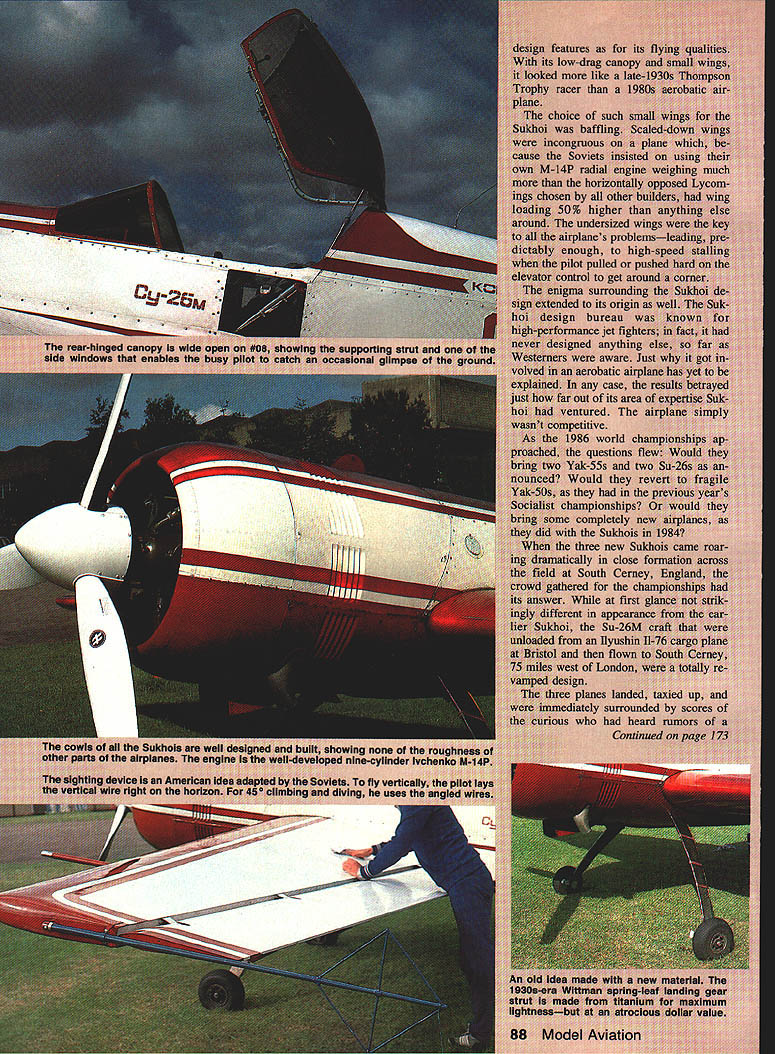
Among costly items were the landing gears. One American manufacturing authority stated that the main landing gear legs, made of titanium, had to have cost at least $10,000 each—quoted in American terms. One can only speculate what it cost the Soviets to develop and build them.
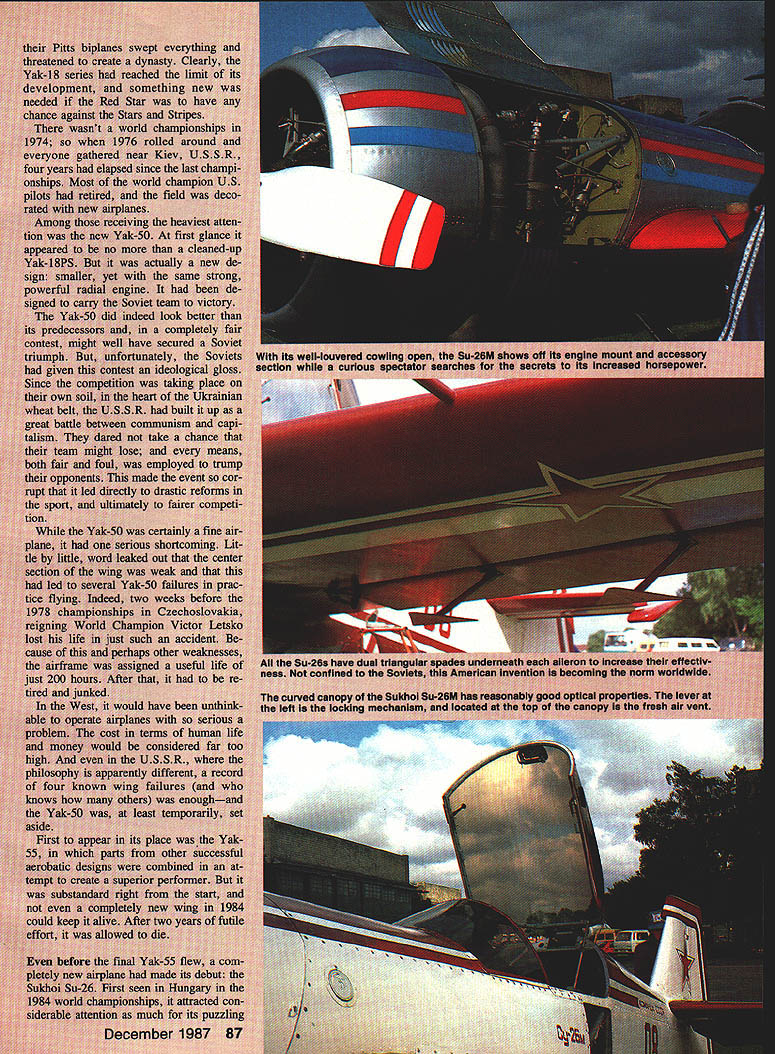
Some mysteries remain. Somehow, the Soviets designed and built the Su-26M to squeeze maximum power from their tried-and-true nine-cylinder M-14P radial engine. The actual horsepower is unknown. When the improved Sukhoi came out in 1986, the Soviets still claimed the engine produced only 360 hp. The reality, though, was that it performed better in this airplane. A three-bladed Hoffmann constant-speed propeller helped a lot; but it could not have been the only crucial change, since it had been in use in 1984 when the power output was definitely lower.
Construction of the newer Sukhoi is likewise a riddle. The Su-26M was designed to be considerably lighter than the Su-26; much of this weight reduction was probably achieved by changing the wing covering from heavy plywood to a far lighter composite. But just what that composite might be—Kevlar, carbon fiber, or something else—is unknown. (They don't talk about this sort of thing beyond the Kremlin; the rest is a military secret.) Whatever the material, it helped drop the empty weight from around 1,600 lb. for the Su-26 to about 1,300 lb. or less for the Su-26M.
Specifications (approximate)
- Wingspan: 25 ft. 7 in.
- Length: 22 ft. 4½ in.
- Wing area: ~117 sq. ft.
- Empty weight: Su-26 ~1,600 lb.; Su-26M ~1,300 lb. or less
Overall dimensions appeared little changed between versions. The only way to nail down details would be to buy one and take it apart. Though the Soviets talked about putting the Sukhoi into production for $70,000 a copy, few expected this to happen.
Implications for the Sport and the Market
Someone at a very high level in the Kremlin decided the best Soviet aerobatics team would have the best airplanes money could buy. Competing against this "blank check" system can be discouraging; in the long run it can damage the sport. American pilots—even wealthy ones—cannot justify spending huge sums on a sport that will never reach the Olympic level. Even the Czechs, whose Zlins are built in a government factory and bring international prestige, need foreign orders to keep the assembly line moving.
What will happen is unknown. Possibilities include:
- Americans setting out to develop an airplane to outfly the Sukhoi, regardless of cost.
- Stricter enforcement of FAI standards by championship juries, ensuring that awe-inspiring airplanes won't sway judgment.
- Or things continuing as they have, with money increasingly determining outcomes.
It's unlikely the Soviets would make the Su-26M commercially available, but if they did, the first American pilot to buy one might recoup a $70,000 price in a year of air show flying. The Su-26M’s amazing climbing and rolling talents would wow crowds—and the sound of that smooth radial engine is a delight.
Looking Ahead
If you'd like to see the Su-26M again, the Soviet team and its Sukhois were expected to compete in the 14th World Aerobatics Championships, scheduled for July 31–August 12, 1988 at Red Deer, Alberta, Canada (75 miles north of Calgary). Tally ho—it should be an interesting contest.
Transcribed from original scans by AI. Minor OCR errors may remain.

