
SUMMER SCHOOL MODEL AERONAUTICS
Dr. William W. Hendry
Introduction
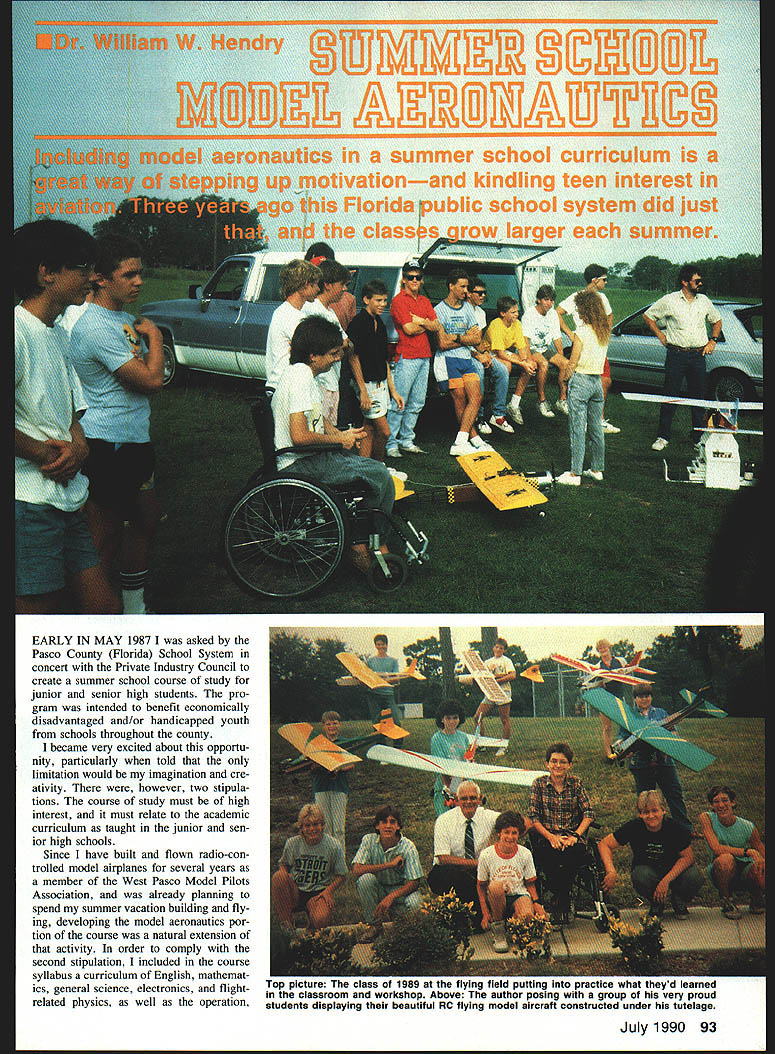
Early in May 1987 the Pasco County (Florida) School System, in concert with the Private Industry Council, asked me to create a summer school course of study for junior and senior high students. The program was intended to benefit economically disadvantaged and/or handicapped youth from schools throughout the county.
The only two stipulations were that the course be of high interest and that it relate to the academic curriculum taught in junior and senior high schools.
Course design
Because I had built and flown radio-controlled model airplanes for several years as a member of the West Pasco Model Pilots Association, developing a model aeronautics course was a natural extension of my interests. To meet the academic stipulation, the syllabus integrated:
- English
- Mathematics
- General science
- Electronics
- Flight-related physics
- Operation, care, and maintenance of small engines
- Hands-on construction and flying of radio-controlled (RC) model airplanes
A team approach was used for construction. Concern over the program’s relatively high cost prompted submission of a tentative budget to allow construction of four fully outfitted RC aircraft and solicitation of supplier assistance.
1987 program
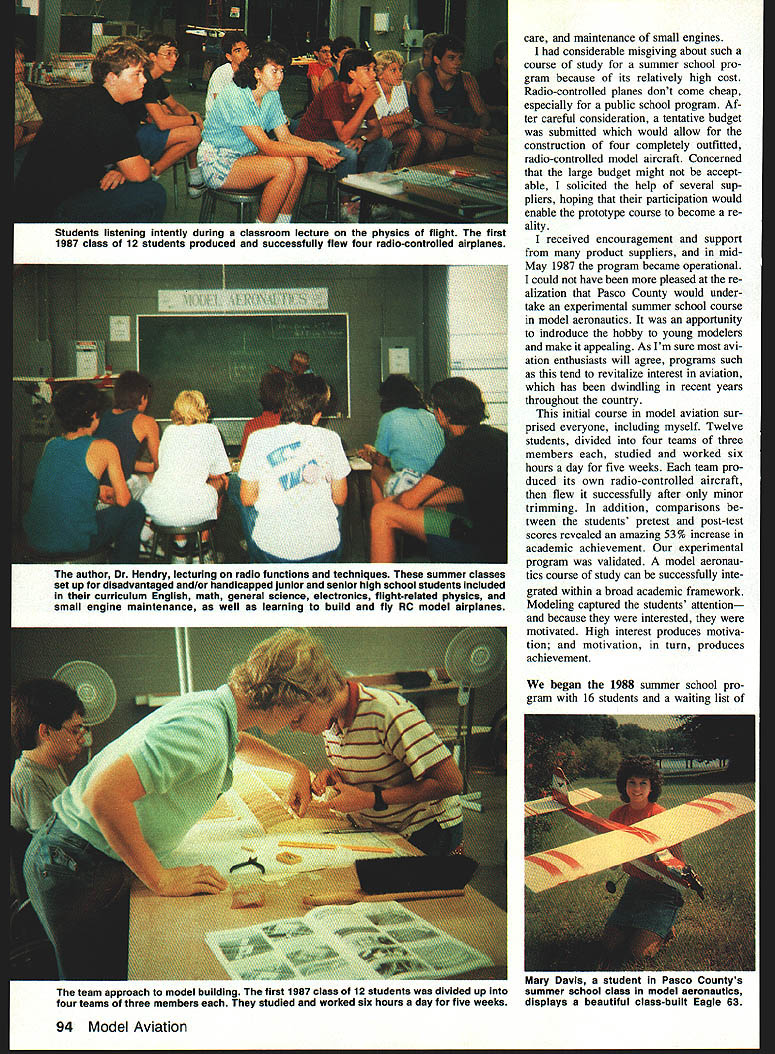
With encouragement and support from several product suppliers, the program became operational in mid-May 1987. Twelve students, divided into four teams of three, studied and worked six hours a day for five weeks. Each team produced its own RC aircraft, and each plane flew successfully after only minor trimming.
Comparisons between students’ pretest and post-test scores revealed an average 53% increase in academic achievement. The experimental program demonstrated that a model aeronautics course can be successfully integrated within a broad academic framework: high interest produced motivation, and motivation produced achievement.
1988 program
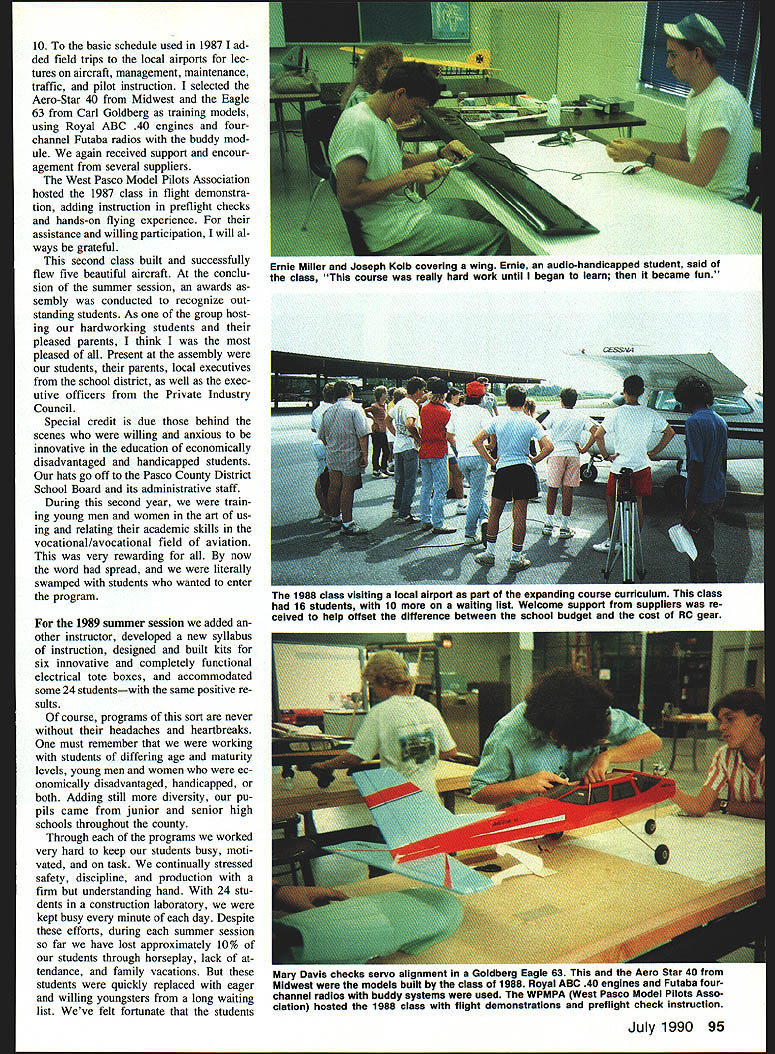
The 1988 summer school program began with 16 students and a waiting list of 10. To the 1987 schedule we added field trips to local airports and lectures on aircraft management, maintenance, air traffic, and pilot instruction.
Training models selected included the Aero-Star .40 (Midwest) and the Eagle .63 (Carl Goldberg), using Royal ABC .40 engines and four-channel Futaba radios with the buddy module. The West Pasco Model Pilots Association hosted flight demonstrations, provided instruction in preflight checks, and offered hands-on flying experience.
That second class built and successfully flew five aircraft. At the end of the session an awards assembly recognized outstanding students and was attended by students, parents, local school district executives, and officers from the Private Industry Council.
Special credit is due the Pasco County District School Board and its administrative staff for supporting an innovative program for economically disadvantaged and handicapped students.
1989 program
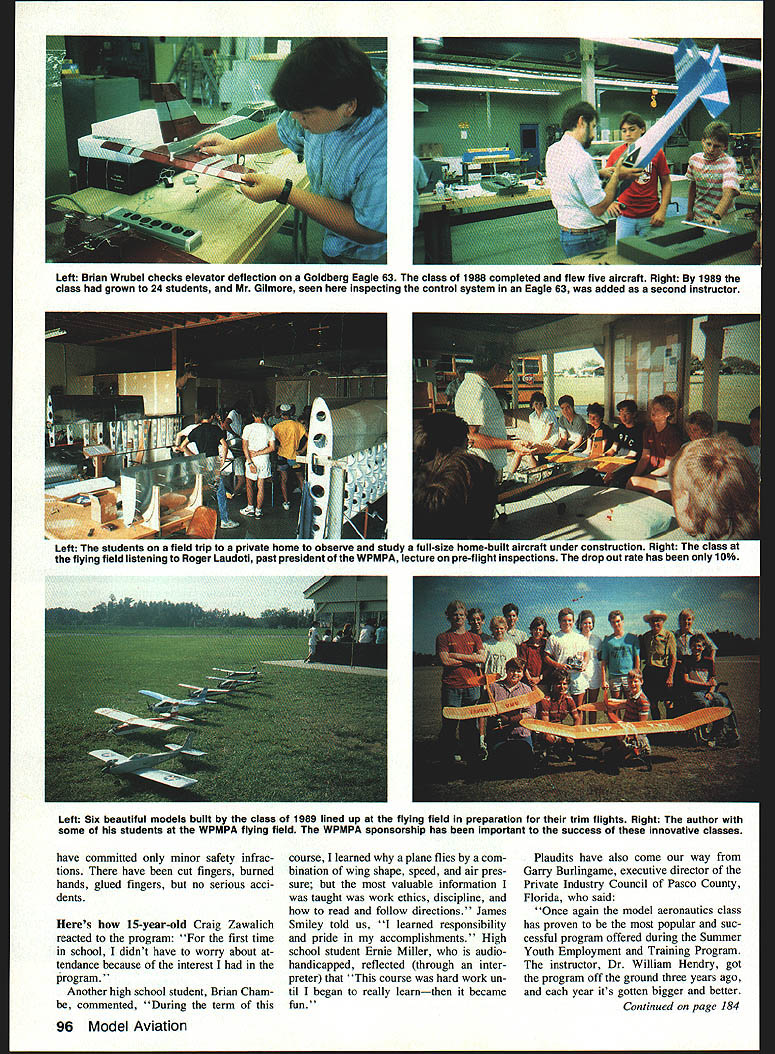
For the 1989 summer session we added another instructor, developed a new syllabus, designed and built kits for six functional electrical tote boxes, and accommodated about 24 students—with the same positive results.
Challenges and management
Programs of this sort are not without headaches. We worked with students of differing ages and maturity levels from junior and senior high schools across the county, many economically disadvantaged or handicapped. We emphasized safety, discipline, and production with a firm but understanding approach.
Typical attrition was about 10% per summer due to horseplay, lack of attendance, or family vacations; these students were quickly replaced from a waiting list. Injuries were minor (cut fingers, burned hands, glued fingers); there were no serious accidents.
Student reactions
- Craig Zawalich (age 15): "For the first time in school, I didn't have to worry about attendance because of the interest I had in the program."
- Brian Chamber: "During the term of this course, I learned why a plane flies by a combination of wing shape, speed, and air pressure; but the most valuable information I was taught was work ethics, discipline, and how to read and follow directions."
- James Smiley: "I learned responsibility and pride in my accomplishments."
- Ernie Miller (audio-handicapped, via an interpreter): "This course was hard work until I began to really learn—then it became fun."
Endorsement
Garry Burlingame, executive director of the Private Industry Council of Pasco County, said: "Once again the model aeronautics class has proven to be the most popular and successful program offered during the Summer Youth Employment and Training Program. The instructor, Dr. William Hendry, got the program off the ground three years ago, and each year it's gotten bigger and better. Not only are the kids learning academically, but they're able to see the finished product — a beautiful and fully functional model airplane."
Conclusion
Model aeronautics proved an effective way to motivate students, connect academic subjects to hands-on activities, and kindle teen interest in aviation. With growing enrollment and positive outcomes, the program looks forward to continued expansion. Why not try a summer school course in model aeronautics in your district? Happy flying!
Editor's note
Dr. Hendry is an adjunct faculty member of Pasco–Hernando Community College, an instructor at Gulf Comprehensive High School, and an active member of the West Pasco Model Pilots Association. For information about the Pasco County program, write: Dr. William W. Hendry.
Transcribed from original scans by AI. Minor OCR errors may remain.

