
Sunday Sportster
For the Sunday sport RCer. This .049 rudder-only pulse job is most inexpensive and a cinch to build.
Ken Willard
When I was asked by Model Aviation to design a rudder-only pulse job for all the modelers who are still enjoying this least costly phase of RC flying, it was suggested that I might try a low-wing design, just for something different. So I sketched out a nice looking little job, put it together, and test flew it. It confirmed an opinion that I had formed a long time ago; low-wing models and rudder-only control don't mix well. Oh yes, you can get them to fly—lots of them have flown—but for a good rudder-controlled aircraft, you just can't equal a high-wing design.
So, I discarded the low-wing idea (but the design will be used later for rudder and elevator control) and started over.
This time I went back to basics. The best design for rudder-only control is simple. Design a good, free-flight sport model—one that will fly well without radio control and, when properly adjusted, will recover from stalls, turns, or dives all by itself and resume normal flight attitude.
Back in the early days of radio control, Don Mathis got the radio enthusiasts all riled up by remarking that radio-controlled airplanes were just free-flight models whose flight path was occasionally interrupted by turning the rudder. And, at the time, he was right. Now, with all the sophisticated systems, an RC plane—particularly a competitive precision contest design—is a long way from being a good free-flight model. They go where you point them, and recover only when you command it.
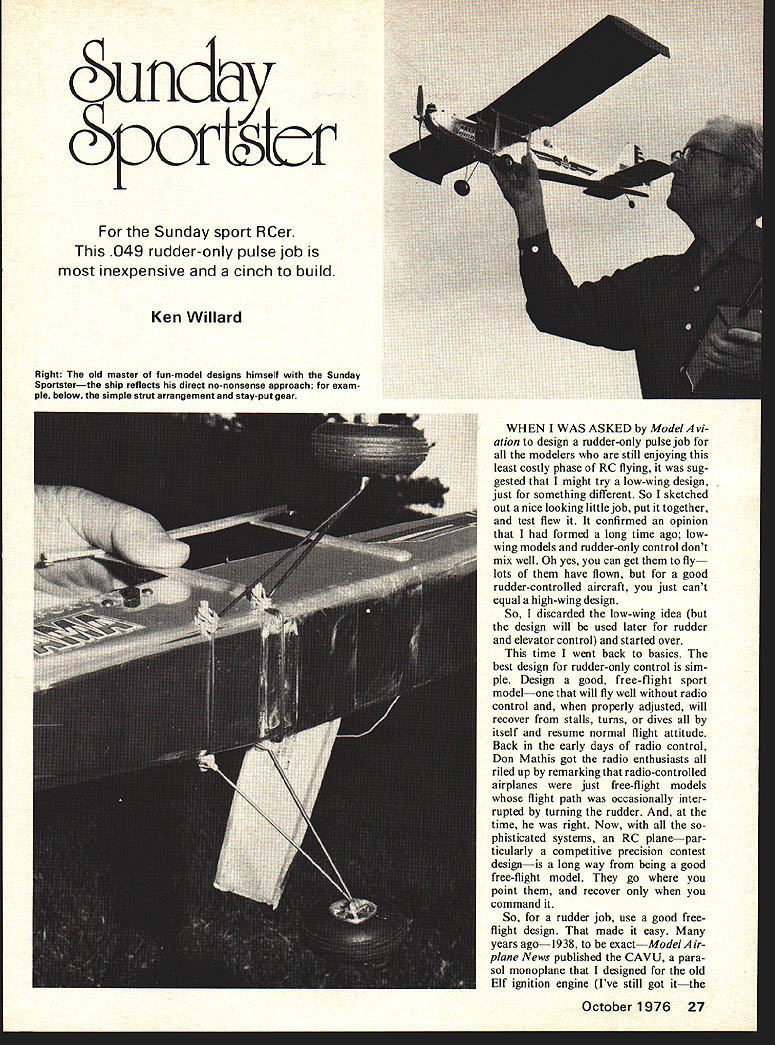
So, for a rudder job, use a good free-flight design. That made it easy. Many years ago—1938, to be exact—Model Airplane News published the CAVU parasol monoplane that I designed for the old Elf ignition engine (I've still got it—the old master of fun‑model designs himself. The Sunday Sportster — the ship reflects a direct, no‑nonsense approach. For example, the simple strut arrangement and stay‑put gear are the sort of practical details that make for a forgiving, easy‑to‑repair sport ship.
What engine? What smooth little sewing‑machine? Use the basic .049‑size setup and add some modern touches. So did I. The result was the Sunday Sportster a little smaller because I wanted to use the Cox QRC .049, the quietest‑running .049 engine you can get. Also, an Ace Stomper pulse unit is ideally suited to the 35" wingspan model — another reason. Ace "Sunday Wings" could be used, saving a lot of time building and repairing.
Yes — repair right after the first flight — not the model's fault, though. Test glides were good. I fired up the QRC and hand‑launched the model. As it turned out, I didn't have quite enough downthrust. The model promptly nosed up, and I nearly broke the control stick on the transmitter trying to push down elevator. Having forgotten that with rudder control the model noses up, turns out and climbs, it stalled and crashed and broke the prop. Pretty embarrassing; no serious damage except to the ego.
After adding a bit of downthrust and changing props, I tried again. That's what was needed. It went up in a nice left turn, just like a good sport free‑flight should. Once up it flew around; the engine ran out of gas and I let it free‑flight glide — a nice gentle right turn — and I guided it back toward the runway. Again, on approach I found myself trying to give some up‑elevator to flare for landing. Habit is hard to break.
After a few flights I began to remember the limitations of rudder control and learn to live with them. If the model starts to drift downwind and you want it to come back, it may just keep climbing. If the wind is fairly strong, you can't make headway. The procedure is: come back upwind, apply rudder to get the model into a spiral dive, then neutralize. It levels out with the nose headed into the wind; let it come up slightly, then apply rudder again. With a horizontal rudder roll into the wind the model will be going faster than usual and will penetrate. Keep rolling that way until you're upwind, then resume normal flying.
Sunday Sportster
The result is the Sunday Sportster—a little smaller because I wanted to use the Cox QRC 049, the quietest running engine you can get. Also, the Ace Stomper pulse unit is ideally suited to a 35" wingspan model. And another reason is that Ace Sunday Wings could be used, saving a lot of time in building and repairing.
Yes, I had to repair it right after the first flight—not the model's fault, though. The test glides were good, and I fired up the QRC and hand launched the model. As it turned out, I didn't have quite enough downthrust, and the model promptly nosed up. I nearly broke the control stick on the transmitter, trying to push down elevator! I had forgotten that, with rudder control only, when the model noses up, you turn it out of the climb. So, it stalled, crashed, and broke the prop. Pretty embarrassing but no serious damage, except to my ego.
After adding a bit of downthrust and changing props, I tried it again. That's all it needed; it went up in a nice left turn, just like a good sport free‑flight should. Once it got up, I flew it around, had fun, and when the engine ran out of gas, I let it free‑flight into the glide—a nice, gentle right turn. Then I guided it back to the runway—and again, as it approached the ground, I found myself trying to give it some up‑elevator to flare the landing. Habit is hard to break.
After a few flights, I began to remember the limitations of rudder control, and how to live with them—like, when the model starts to drift downwind, and you want to come back, it just keeps climbing, and if the wind is fairly strong, you can't make any headway. So, to come back upwind, apply rudder, get the model into a spiral dive, neutralize, and as it levels out and the nose is headed into the wind, let it come up slightly, then again apply rudder and do a horizontal rudder roll into the wind. The model will be going faster than usual and will penetrate. Keep rolling that way until you're upwind, then resume normal flying.
To do a loop, just get enough altitude, then give the model rudder and hold until it is spiraling down rapidly. Let up on rudder, and the excess speed will make the model nose up and over into a loop. Takes a bit of practice, but you'll enjoy it.
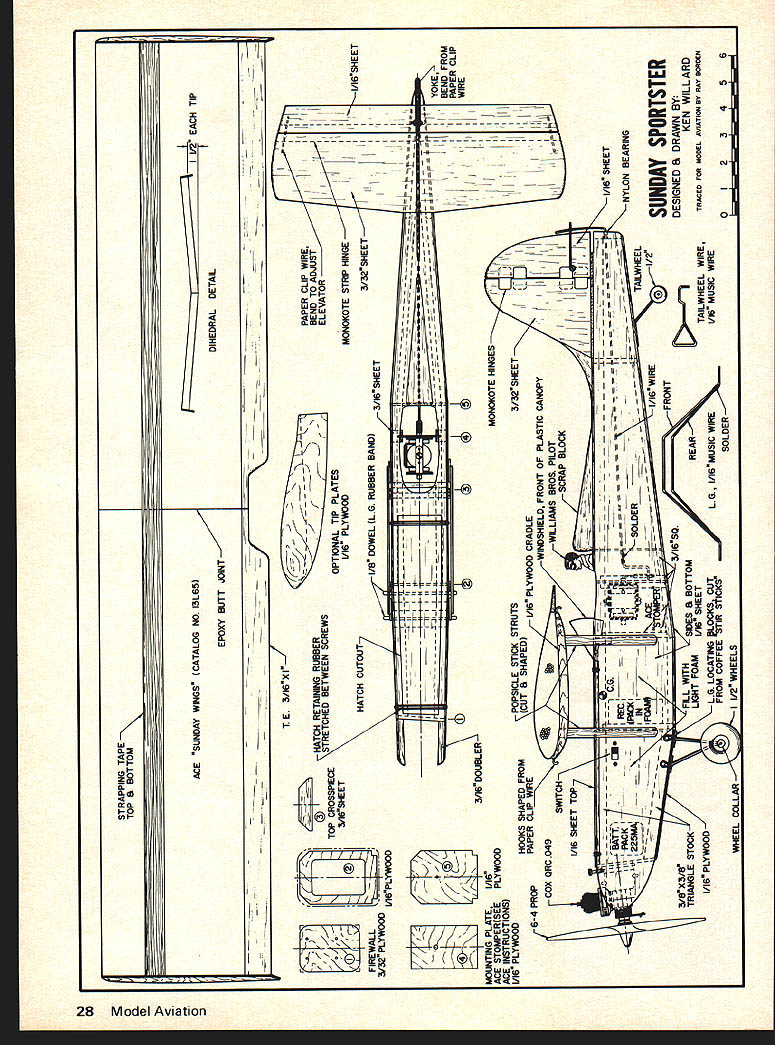
Building the Sunday Sportster is just about as simple as you can get. The fuselage is a "slabside", but with the triangular stock as a top longeron, you carve away the excess wood and round it off so the model has the appearance of a rounded hatch and turtledeck. And all the lines are straight, so you don't have to pin things together. In fact, because I was impatient (having already built one model) I put my whole fuselage together using Zap, except for epoxying the firewall in place, and it went together in a couple of hours.
The cabane structure is made with four struts carved to streamline shape, using popsicle sticks as the basic material. The wing cradle is cut from 1/16" plywood and shaped to fit the undersurface of the Sunday Wings. The whole structure is Zapped together to the fuselage sides. You have to be careful to align the two sides uniformly, so the wing rests on both and at the right incidence as shown. The little wire hooks, for the rubber bands holding the wing, should be epoxied to the wing cradle. Either that, or if you want to use Zap, add some of the microballoons alongside the wire to give a better retaining surface. Either way, make sure they are secure—you don't want them to come loose in flight, unless you want a spectacular crash. What a smooth little sewing machine the Cox QRC .049 is when used in the basic Fox set-up — add some modern touches and go. So did I. The result is the Sunday Sportster, a little smaller because I wanted to use the Cox QRC .049, the quietest running engine you can get. Also the Ace Stomper pulse unit is ideally suited to the 35" wingspan model; another reason Ace Sunday Wings could be used, saving a lot of time building and repairing. Yes — repair! Right after the first flight. Not the model's fault, though. The test glides were good. I fired up the QRC and hand-launched the model. As it turned out I didn't have quite enough downthrust; the model promptly nosed up, nearly broke the control stick on the transmitter trying to push down elevator — I'd forgotten rudder control. The model nosed up, turned out, climbed. So it stalled, crashed and broke the prop. Pretty embarrassing, no serious damage except ego. After adding a bit of downthrust and changing props I tried again. That's what was needed. It went up in a nice left turn just like a good sport free-flight should. Once it was up I flew around; the engine ran out of gas and I let it free-flight glide — a nice gentle right turn, guided back to the runway and, again approaching the ground, I found myself trying to give some up-elevator flare on landing. Habit is hard to break. After a few flights I began to remember the limitations of rudder control — live with them. If the model starts to drift downwind and you want to come back, it just keeps climbing. When the wind is fairly strong you can't make headway. So come back upwind, apply rudder to get the model into a spiral dive, neutralize and it levels out, nose headed into the wind; let it come up slightly and again apply rudder. In a horizontal rudder roll with the wind the model will be going faster than usual and will penetrate. Keep rolling away until upwind and resume normal flying.
Tail surfaces are balsa sheet. No surprises here. Maybe one. Note I have an elevator on mine; it is inoperative, but by hinging it to the stab, then zapping a couple of short lengths of wire across the hinge line, you can make small adjustments in the elevator without having to reglue the stab. Use small paper-clip wire; it's soft, yet firm enough to take the air loads.
The wing is a standard Ace Sunday Wing, Catalog No. 13L65. You get four panels, enough for two wings for the Sunday Sportster, in the kit, and the price ends at the right dihedral angle; all you do is epoxy two of the panels together at the center, and add the reinforcing strapping tape.
Are you wondering about the tip panels? Well, in a way, so am I. But, since the wing ends are both cut at the same angle, I thought it would look nice and modern to have wing-tip plates that slant out at that slight angle — a simple variation of the conical tips that some planes have. Theoretically, they should delay any tip stall, and give the same effect as a slightly longer wing. But I just thought they looked nicer. If you don't, then make standard tips — it probably won't make any noticeable difference in a model this size. Maybe you will want to experiment, since you have two sets of wings. Make one with, and the other without, the tip plates. And, if you notice any big difference, let me know. I'd be real interested.
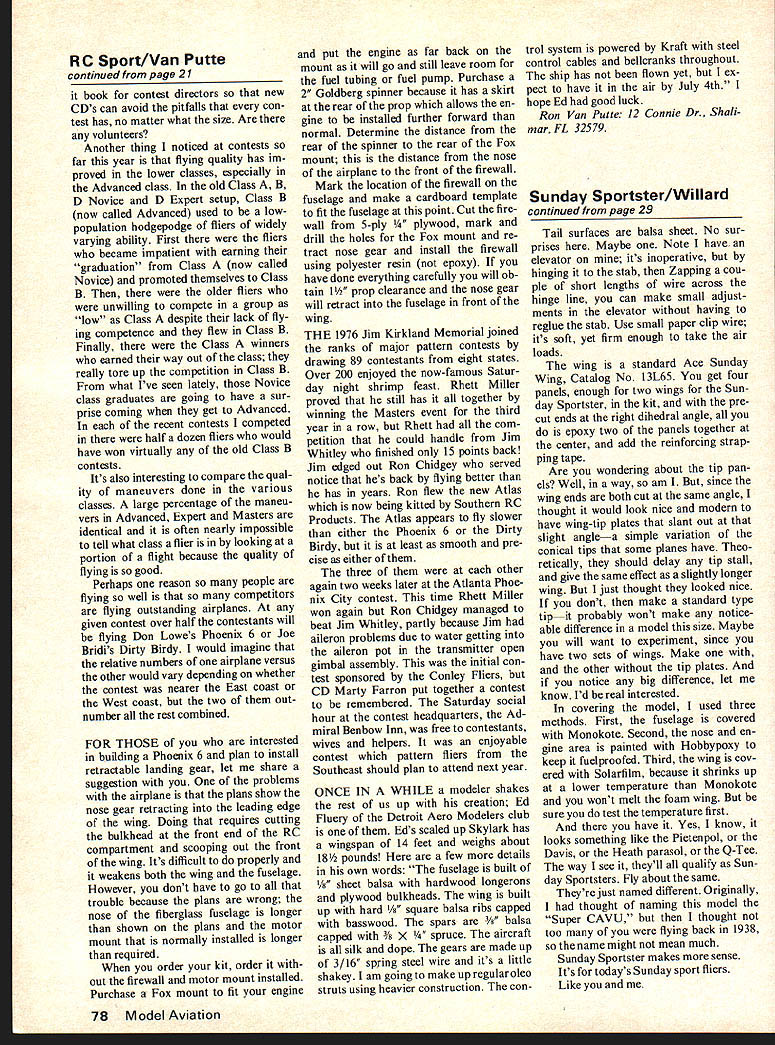
In covering the model, I used three methods. First, the fuselage is covered in Monokote. Second, the nose and center are painted with Hobbypoxy to keep it fuelproofed. Third, the wings are covered with Solarfilm, because it shrinks up at a lower temperature than Monokote and you won't melt the foam wing. But be sure you do test the temperature first.
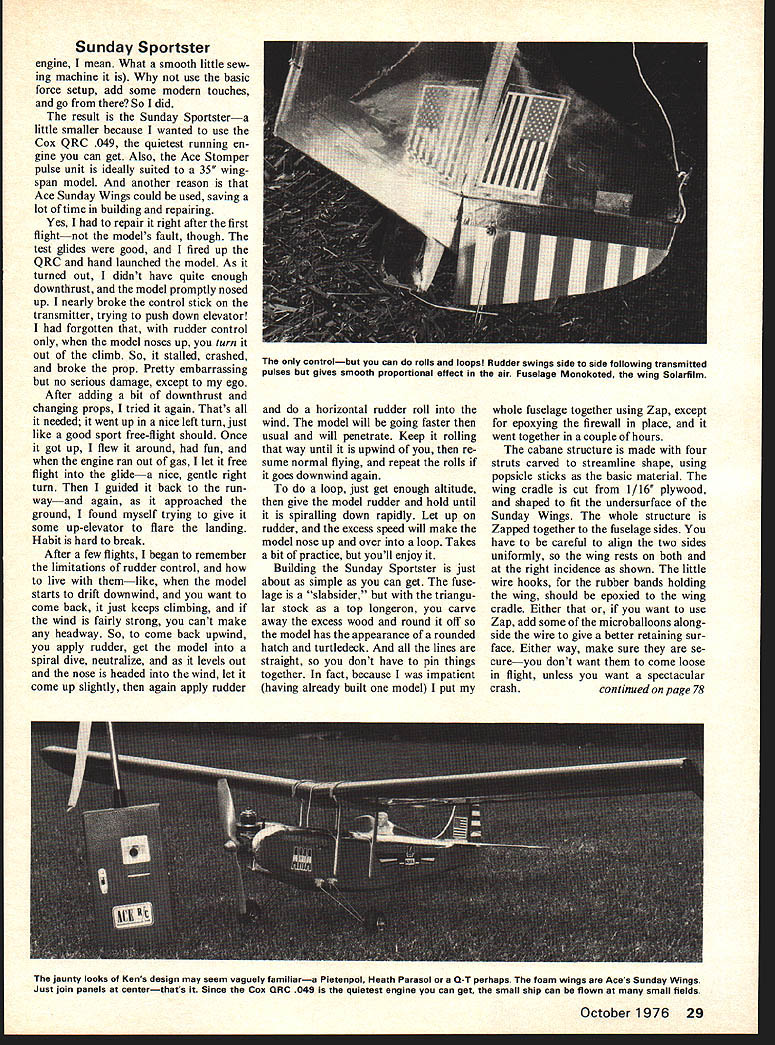
And there you have it. Yes, I know, it looks something like the Diperpol, or the Davis, or the Heath parasol, or the Q-Tee. The way I see it, they'll all qualify as Sunday Sportsters. Fly about the same.
They're just named different. Originally, I had thought of naming this model the "SUPER CAVU," but then I thought not too many of you were flying back in 1938, so the name might not mean much.
Sunday Sportster sounds more sensible.
It's for today's Sunday sport fliers.
Like you and me.
Transcribed from original scans by AI. Minor OCR errors may remain.

