
Sunspots
By Bernard L. Stuecker
"SIX METERS: Results on 50 MHz have been outstanding in Cycle 22, and amateur use of this band is growing all the time. Look for Europe and Africa, as J53US has been worked in Colorado as well as on the east coast and in VE1 Land."
The preceding message was broadcast by the American Radio Relay League (ARRL) station, call sign W1AW, in Newington, CT on December 23, 1988 as part of a daily bulletin transmitted to all radio amateurs. The bulletin gives information concerning how radio signals are being propagated on a given date and whether or not conditions for talking to distant stations are favorable. Information in this message is especially interesting to those Ham operators who enjoy talking to other amateur operators in foreign countries and who want to keep an eye on amateur band conditions, which change from day to day and from season to season.
Sunspot cycles and what a sunspot is
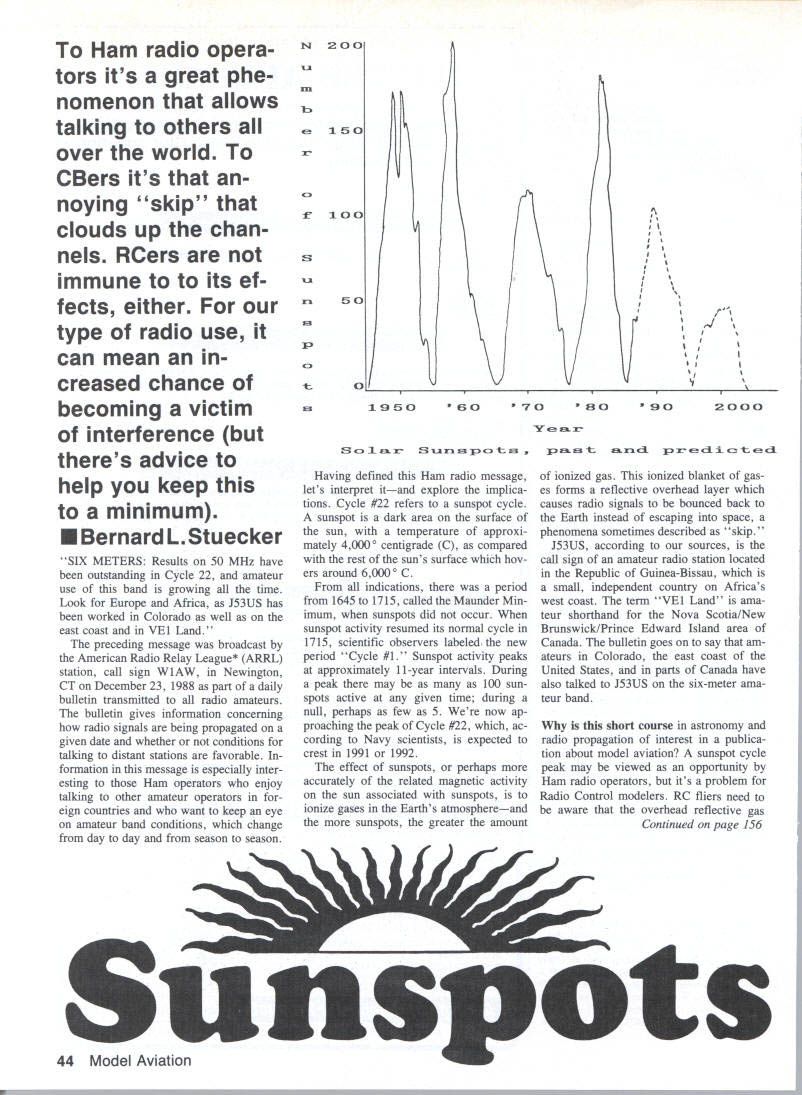
Having defined this Ham radio message, let's interpret it—and explore the implications. Cycle #22 refers to a sunspot cycle. A sunspot is a dark area on the surface of the sun, with a temperature of approximately 4,000°C, as compared with the rest of the sun's surface which hovers around 6,000°C.
From all indications, there was a period from 1645 to 1715, called the Maunder Minimum, when sunspots did not occur. When sunspot activity resumed its normal cycle in 1715, scientific observers labeled the new period "Cycle #1." Sunspot activity peaks at approximately 11-year intervals. During a peak there may be as many as 100 sunspots active at any given time; during a lull, perhaps as few as five. At the time of this writing we were approaching the peak of Cycle #22, which, according to Navy scientists, was expected to crest in 1991 or 1992.
Effects on radio propagation
The effect of sunspots, or more accurately the solar magnetic activity associated with sunspots, is to ionize gases in the Earth's upper atmosphere—and the more sunspots, the greater the amount of ionized gas. This ionized blanket of gases forms a reflective overhead layer which causes radio signals to be bounced back to the Earth instead of escaping into space, a phenomenon sometimes described as "skip."
J53US, according to our sources, is the call sign of an amateur radio station located in the Republic of Guinea-Bissau, a small independent country on Africa's west coast. The term "VE1 Land" is amateur shorthand for the Nova Scotia/New Brunswick/Prince Edward Island area of Canada. The bulletin goes on to say that amateurs in Colorado, the U.S. east coast, and parts of Canada have also talked to J53US on the six-meter amateur band.
Why model aviation readers should care
Why is this short course in astronomy and radio propagation of interest in a publication about model aviation? A sunspot cycle peak may be viewed as an opportunity by Ham radio operators, but it's a problem for radio-control (RC) modelers. RC fliers need to be aware that the overhead reflective gas layer induced by the upswing in sunspot activity is already altering radio transmissions.
The ARRL bulletin tells us that it's possible for amateur operators in the U.S. to talk to others in Africa and Europe on the six-meter (50 to 54 MHz) amateur band—the same six-meter band that some modelers use to control model aircraft. Until this peak in sunspot activity, six-meter band capacity had been limited to short-range communications (20 to 30 miles, typically), making it ideal for RC use. If it's possible for amateurs to talk to other amateurs in Africa and Europe on the six-meter band, it's also entirely possible for the African and European stations to be heard in this country. Imagine being "shot down" by someone operating a transmitter in England (or, more likely, by someone in a nearby state). As propagation conditions continue to improve, interference may be observed on higher frequencies as well; you are not immune to long-distance interference simply because you operate on 72 MHz (the four-meter band).
What you can do to minimize interference
What can be done to minimize the potential for interference? First, be sure all your RC equipment is in good repair and properly shielded. Second, use high-quality connectors and keep all wiring short and neat. Third, orient antennas to reduce pickup of unwanted signals. Fourth, if you experience interference, move to another frequency if possible. Finally, contact your local amateur radio club or the ARRL for assistance and monitoring of band conditions.
Potential for interference from distant sources
There are a number of measures you can take to reduce or eliminate skywave interference problems. Here are some suggestions:
- Use a good-quality narrow-band receiver conforming to current specifications. This is especially important if the source of interference is a transmitter operating on a frequency not absolutely identical to the frequency of your RC equipment.
- Use a PCM radio, which has an inherent ability to reject interference.
- Avoid flying very high or far away from the transmitter.
- Make sure that the radio equipment is properly tuned and adjusted.
All of these tactics will provide a measure of protection from "hits" from outside sources.
You may already have noticed interference or radio glitches on your six-meter RC equipment that had functioned reliably in the past. If so, Cycle #22 could quite possibly be the cause.
Contact the American Radio Relay League at 225 Main Street, Newington, CT 06111 for more information about when the amateur radio bulletins are broadcast and what information they contain. The ARRL is an excellent source of information about amateur radio, electronics theory, and how to obtain an amateur operator's license. They can show you how to build electronic equipment and antennas, provide help with antenna theory, and offer easily digested information concerning electrical and electronics principles. There's even a brief section in the ARRL Handbook about Radio Control equipment and principles.
Transcribed from original scans by AI. Minor OCR errors may remain.

