
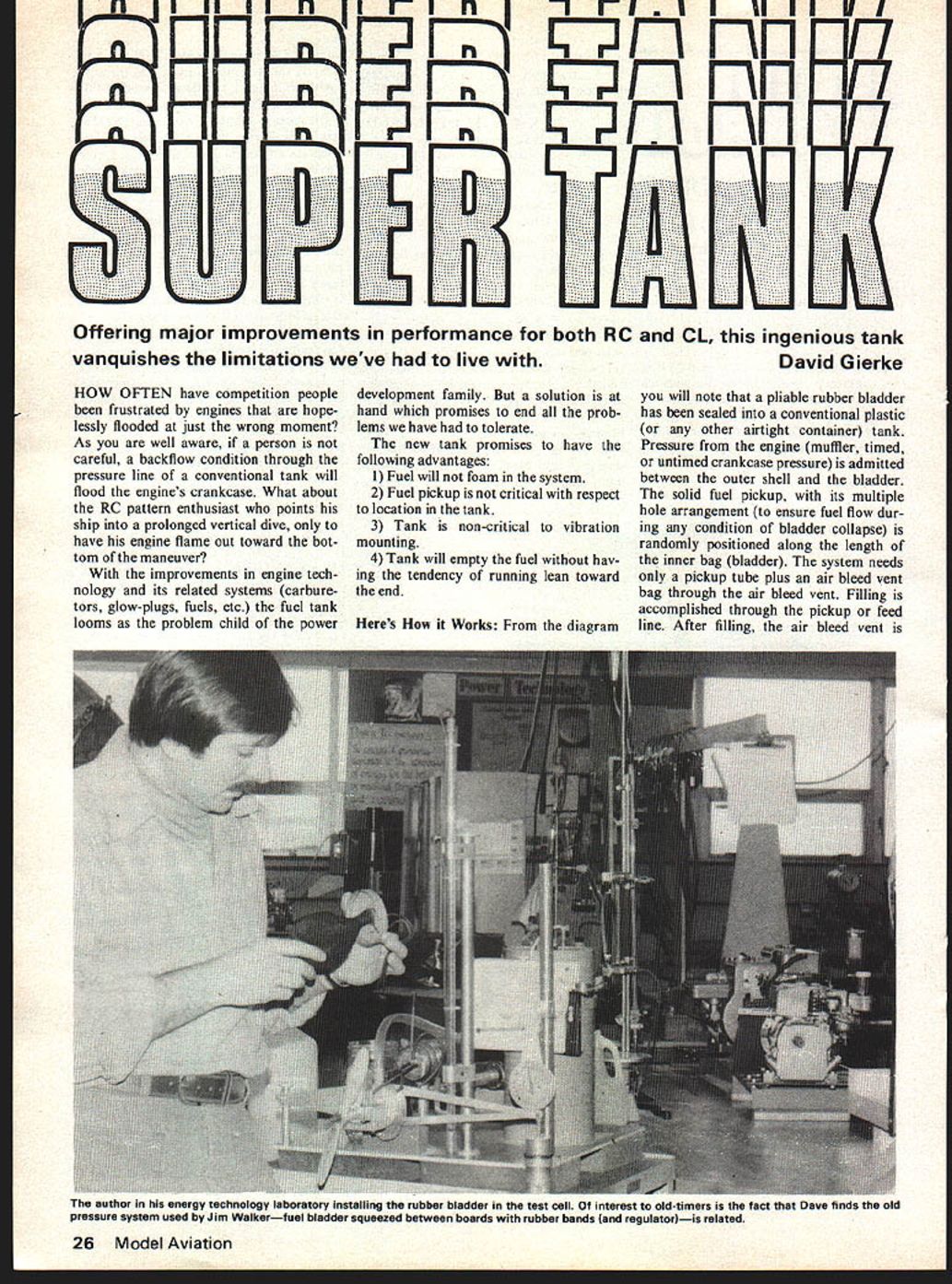
Super Tank
Offering major improvements in performance for both RC and CL, this ingenious tank vanquishes the limitations we've had to live with. David Gierke
HOW OFTEN have competition people been frustrated by engines that are hopelessly flooded at just the wrong moment? As you are well aware, if a person is not careful, a backflow condition through the pressure line of a conventional tank will flood the engine's crankcase. What about the RC pattern enthusiast who points his ship into a prolonged vertical dive, only to have his engine flame out toward the bottom of the maneuver?
With the improvements in engine technology and its related systems (carburetors, glow-plugs, fuels, etc.), the fuel tank looms as the problem child of the power development family. But a solution is at hand which promises to end all the problems we have had to tolerate.
The new tank promises to have the following advantages: 1) Fuel will not foam in the system. 2) Fuel pickup is not critical with respect to location in the tank. 3) Tank is non-critical to vibration mounting. 4) Tank will empty the fuel without having the tendency of running lean toward the end.
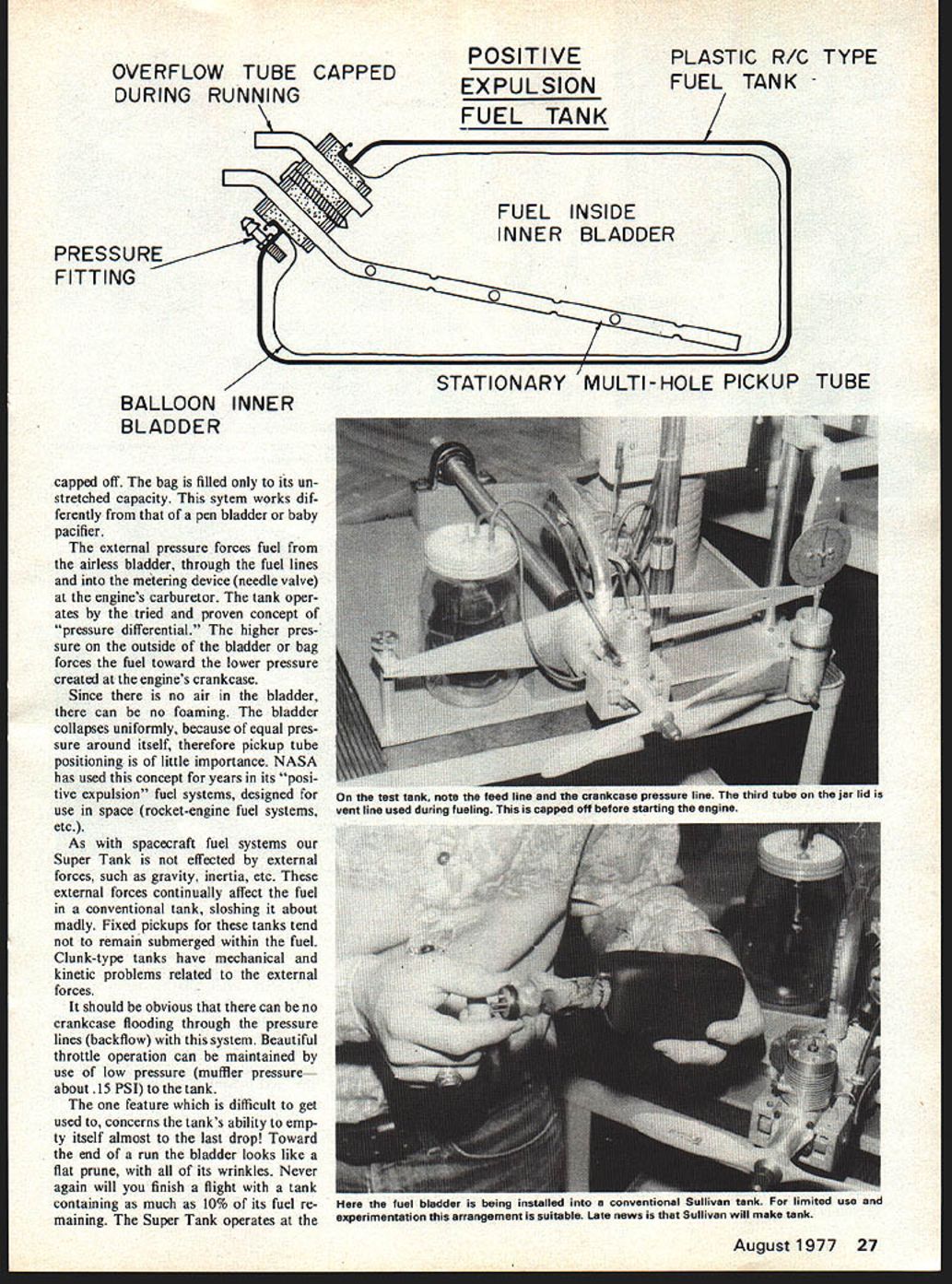
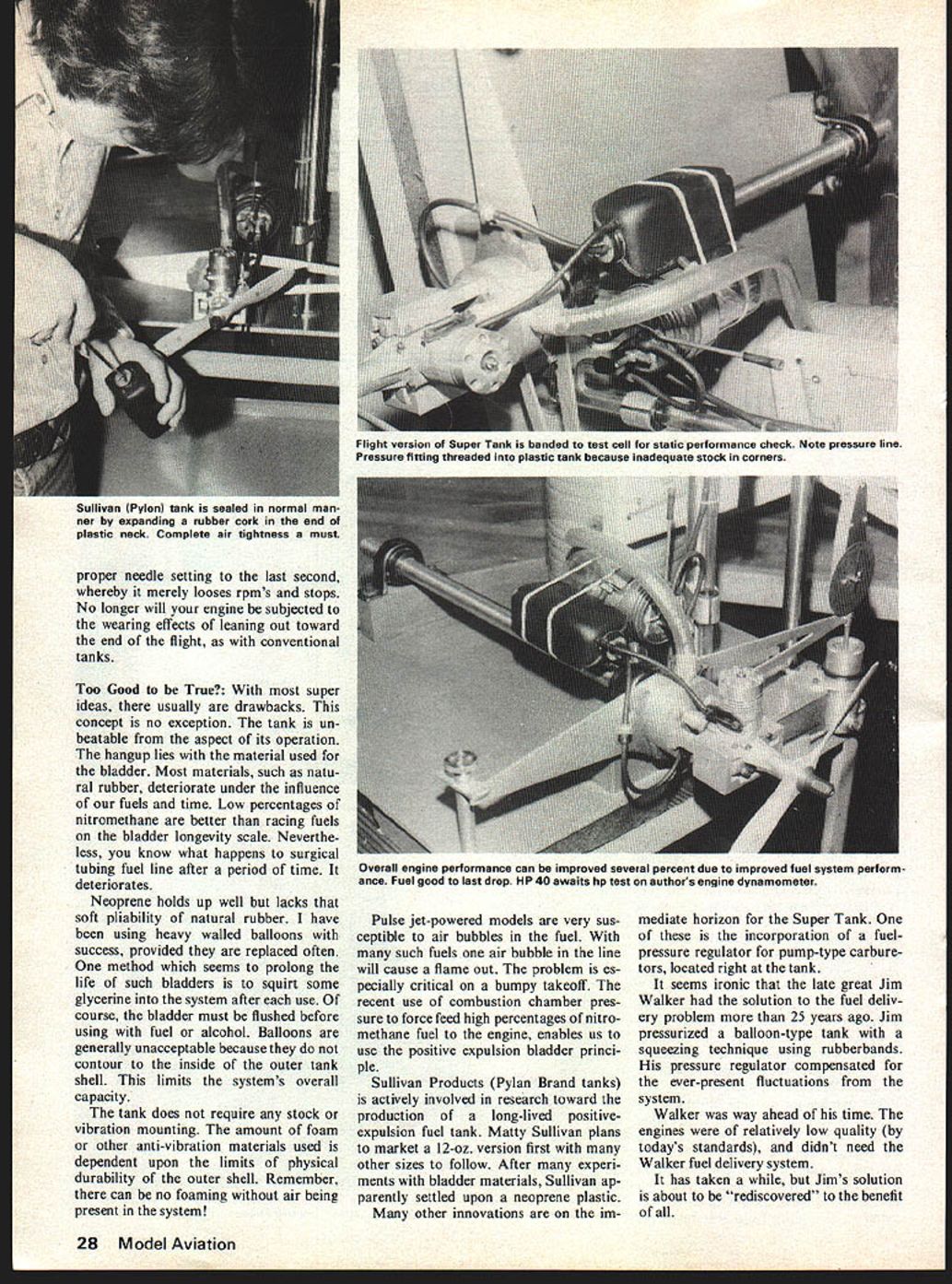
Here's How it Works: From the diagram you will note that a pliable rubber bladder has been sealed into a conventional plastic (or any other airtight container) tank. Pressure from the engine (muffler, timed, or untimed crankcase pressure) is admitted between the outer shell and the bladder. The solid fuel pickup, with its multiple-hole arrangement (to ensure fuel flow during any condition of bladder collapse) is randomly positioned along the length of the inner bag (bladder). The system needs only a pickup tube plus an air bleed vent. Filling is accomplished through the pickup or feed line. After filling, the air bleed vent is capped off. The bag is filled to its unstretched capacity.
The system works differently. Like the bladder in a baby's pacifier, external pressure forces fuel from the airless bladder through the fuel lines to the metering device (needle valve) and the engine's carburetor. The tank operates on a tried-and-proven concept — pressure differential. The higher pressure outside the bladder forces the fuel toward the lower pressure created in the engine's crankcase. Since no air is in the bladder, there can be no foaming. The bladder collapses uniformly because of equal pressure around itself; therefore pickup tube positioning is of little importance. NASA has used the concept for years in its positive-expulsion fuel systems designed for use in space and rocket-engine fuel systems.
As spacecraft fuel systems are not affected by external forces such as gravity and inertia, external forces continually affect fuel in a conventional tank, sloshing it about madly. Fixed-pickup tanks tend to remain submerged within fuel. Clunk-type tanks have mechanical/kinetic problems related to external forces. It should be obvious there can be no crankcase flooding through pressure lines or backflow with this system. Beautiful throttle operation can be maintained using low muffler pressure (about 15 psi).
A tank feature difficult to get used to is the ability of the tank to empty itself almost to the last drop. Toward the end of a run the bladder looks like a flat prune with its wrinkles. Never again will you finish a flight with the tank containing much (10%) of its fuel remaining.
Too good to be true? Super ideas usually have drawbacks — the concept is no exception. The unbeatable aspect of its operation — the hangup — lies in the material used for the bladder. Most materials, such as natural rubber, deteriorate under the influence of fuels with time. Low percentages of nitromethane or the better racing fuels accelerate bladder deterioration. Nevertheless, we know what happens to surgical tubing used as fuel line after a period of time — it deteriorates. Neoprene holds up well but lacks the soft pliability of natural rubber. capped off. The bag is filled only to its unstretched capacity. This system works differently from that of a pen bladder or baby pacifier.
The external pressure forces fuel from the airless bladder, through the fuel lines and into the metering device (needle valve) at the engine's carburetor. The tank operates by the tried and proven concept of "pressure differential." The higher pressure on the outside of the bladder or bag forces the fuel toward the lower pressure created at the engine's crankcase.
Since there is no air in the bladder, there can be no foaming. The bladder collapses uniformly, because of equal pressure around itself, therefore pickup tube positioning is of little importance. NASA has used this concept for years in its "positive expulsion" fuel systems, designed for use in space (rocket-engine fuel systems, etc.).
As with spacecraft fuel systems our Super Tank is not affected by external forces, such as gravity, inertia, etc. These external forces continually affect the fuel in a conventional tank, sloshing it about madly. Fixed pickups for these tanks tend not to remain submerged within the fuel. Clunk-type tanks have mechanical and kinetic problems related to the external forces.
It should be obvious that there can be no crankcase flooding through the pressure lines (backflow) with this system. Beautiful throttle operation can be maintained by use of low pressure (muffler pressure about 15 PSI) to the tank.
The one feature which is difficult to get used to, concerns the tank's ability to empty itself almost to the last drop! Toward the end of a run the bladder looks like a flat prune, with all of its wrinkles. Never again will you finish a flight with a tank containing as much as 10% of its fuel remaining. The Super Tank operates at the proper needle setting to the last second, whereby it merely loses rpm's and stops. No longer will your engine be subjected to the wearing effects of leaning out toward the end of the flight, as with conventional tanks.
Too Good to be True?: With most super ideas, there usually are drawbacks. This concept is no exception. The tank is unbeatable from the aspect of its operation. The hangup lies with the material used for the bladder. Most materials, such as natural rubber, deteriorate under the influence of our fuels and time. Low percentages of nitromethane are better than racing fuels on the bladder longevity scale. Nevertheless, you know what happens to surgical tubing fuel line after a period of time. It deteriorates.
Neoprene holds up well but lacks that soft pliability of natural rubber. I have been using heavy-walled balloons with success, provided they are replaced often. One method which seems to prolong the life of such bladders is to squirt some glycerine into the system after each use. Of course, the bladder must be flushed before using with fuel or alcohol. Balloons are generally unacceptable because they do not contour to the inside of the outer tank shell. This limits the system's overall capacity.
The tank does not require any shock or vibration mounting. The amount of foam or other anti-vibration materials used is dependent upon the limits of physical durability of the outer shell. Remember, there can be no foaming without air being present in the system!
Pulse jet-powered models are very susceptible to air bubbles in the fuel. With many such fuels one air bubble in the line will cause a flame out. The problem is especially critical on a bumpy takeoff. The recent use of combustion chamber pressure to force feed high percentages of nitromethane fuel to the engine, enables us to use the positive expulsion bladder principle.
Sullivan Products (Pylon Brand tanks) is actively involved in research toward the production of a long-lived positive-expulsion fuel tank. Matty Sullivan plans to market a 12-oz. version first with many other sizes to follow. After many experiments with bladder materials, Sullivan apparently settled upon a neoprene plastic.
Many other innovations are on the immediate horizon for the Super Tank. One of these is the incorporation of a fuel-pressure regulator for pump-type carburetors, located right at the tank.
It seems ironic that the late great Jim Walker had the solution to the fuel delivery problem more than 25 years ago. Jim pressurized a balloon-type tank with a squeezing technique using rubber bands. His pressure regulator compensated for the ever-present fluctuations from the system.
Walker was way ahead of his time. The engines were of relatively low quality (by today's standards), and didn't need the Walker fuel delivery system.
It has taken a while, but Jim's solution is about to be "rediscovered" to the benefit of all.
Transcribed from original scans by AI. Minor OCR errors may remain.

